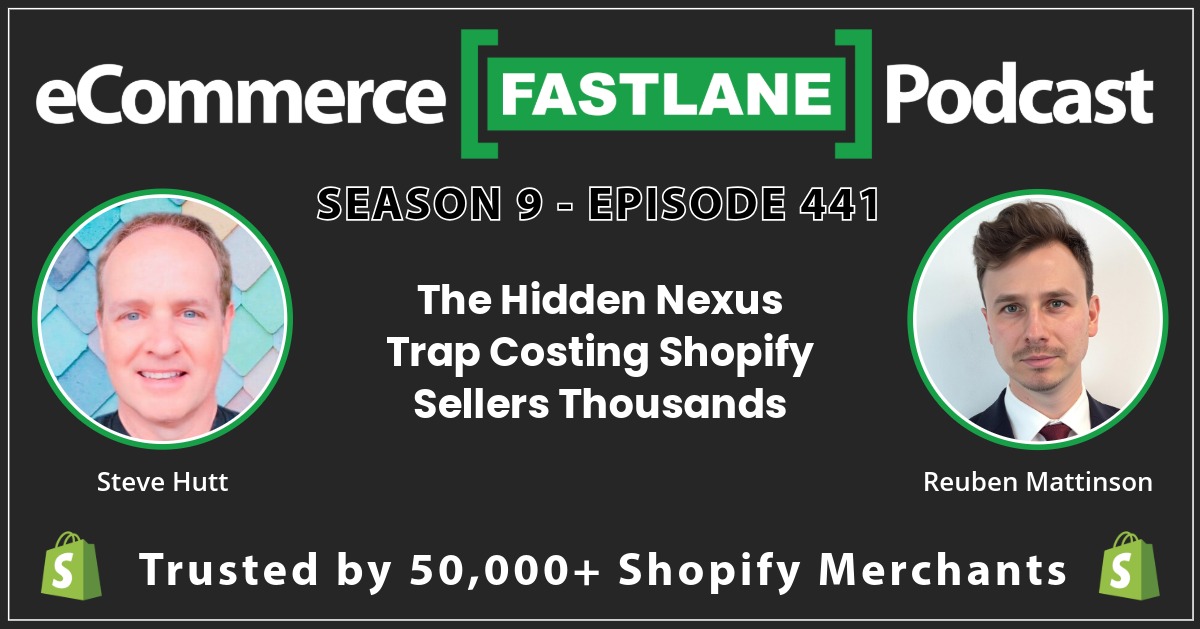
Here’s what most founders don’t realize until they’re months into scaling: the moment you cross $100K in sales across state lines or start using FBA warehouses in multiple states, you’re not just growing revenue—you’re triggering tax obligations in places you’ve never even visited. And the silence from state tax authorities? That isn’t approval. That’s them waiting.
Sales tax compliance isn’t the kind of topic that lights up LinkedIn or gets a panel at your favorite conference, but the second you cross economic nexus thresholds, store inventory in third‑party warehouses, or have affiliates driving traffic, you’re in a world that can turn into a bureaucratic nightmare fast. Some founders bury their heads in the sand. Others assume Shopify “handles it” the way Amazon does. Both are expensive mistakes.
Today’s guest has helped 4,000–5,000 ecommerce brands navigate exactly this mess. Reuben Mattinson is the CEO of RJM Tax Exemption, the number one–rated tax compliance firm on Trustpilot for online sellers. His path is unconventional—physiotherapy, high school science teacher, then ecommerce founder as a UK entrepreneur trying to crack the US market—but that frustration with overpriced, ecommerce-illiterate CPAs is exactly what led him to build the go‑to tax compliance resource in the Shopify ecosystem.
Whether you’re doing your first $100K or scaling past $5M, this episode breaks down the four types of nexus you need to track, why Amazon sellers get blindsided when they launch on Shopify, and what’s changing in 2026 that makes getting compliant right now non‑negotiable. Let’s dive in.
What You’ll Learn
✅ The four types of nexus you must track – You’ll learn why nexus is more than just hitting an economic threshold, and how physical nexus (where your inventory sits), affiliate nexus (influencers and partners driving sales), and click‑through nexus (referral sites sending traffic) can quietly trigger tax obligations in states you’re not even thinking about.
✅ Why Amazon sellers get blindsided on Shopify – You’ll see how Amazon, as a marketplace facilitator, has been handling sales tax for you in the background, and why switching to Shopify suddenly makes you responsible for tracking, collecting, and remitting tax in every state where you have nexus.
✅ The California franchise tax trap – You’ll discover how simply storing inventory in a California FBA warehouse can now trigger an $800 per year minimum franchise tax on top of sales tax registration, and why this is catching a lot of sellers off guard.
✅ Why transaction thresholds are tightening in 2026 – You’ll hear how states are starting to phase out “200 transaction” style thresholds in favor of pure revenue thresholds, making it easier to cross into nexus without realizing how fast your order volume is adding up.
✅ How voluntary disclosure can limit the damage – You’ll learn how voluntary disclosure programs can help you clean up past non‑compliance with reduced penalties and limited lookback periods—if you act before a state comes knocking.
✅ How services and digital offers now trigger tax – You’ll understand why more states are treating services and digital revenue—like subscriptions, downloads, and hybrid product–service offers—as taxable activity that can create nexus, widening the compliance net for modern ecommerce brands.
Episode Sponsor: Littledata

The Data Layer for Shopify.
Powering acquisition, retention and analytics with conversion tracking you can trust.
Littledata gives you a reliable data infrastructure that connects your Shopify store with the marketing tools you already use, including:
- Google and Meta Ads for a stronger signal and attribution
- Klaviyo and Attentive for enriched customer flows
- Google Analytics for accurate revenue and event tracking
- Recharge for complete customer lifecycle visibility
Fast to set up. Effortless to maintain. Built to scale with your brand.
Join 2,000+ Shopify brands using Littledata as their foundation for growth.
Episode Summary
Steve welcomes Reuben Mattinson, CEO of RJM Tax Exemption, for a timely deep dive into sales tax compliance that every serious Shopify brand needs to hear. Reuben’s team has supported thousands of ecommerce businesses and built a top-rated reputation, bringing the kind of clarity that can prevent painful penalties and endless admin headaches.
The conversation opens with Reuben’s unconventional path—from physiotherapist to high school science teacher to UK-based ecommerce founder trying to crack the US market. Running into confusing rules, overpriced CPAs who didn’t understand online selling, and one-size-fits-all advice is what ultimately led him to build RJM Tax Exemption to close the gap between traditional accounting and the real-world needs of multi-state ecommerce brands.
Reuben then unpacks the four types of nexus that can trigger tax obligations. Economic nexus is the one most founders know—hit certain sales or transaction thresholds in a state and you’ve got responsibilities there. But the real blind spots are physical nexus (just storing inventory in a warehouse or fulfillment center), affiliate nexus (influencers and partners promoting your products), and click-through nexus (referral sites sending customers). Each comes with its own state-specific rules, and most brands aren’t tracking them at all.
You’ll also hear why Amazon sellers often get caught out when they move to Shopify. On Amazon, the platform acts as a marketplace facilitator and handles sales tax collection and remittance because they’re treated as a co-seller. On Shopify, you’re the merchant of record, which means you’re responsible for knowing where you have nexus, registering in those states, charging the correct tax rates, and filing on time. That shift from “Amazon handles it” to “it’s all on you” is where many brands get blindsided.
The episode digs into specifics like California’s $800 minimum franchise tax for anyone storing inventory in its FBA warehouses, Illinois’ move away from transaction-count thresholds, and why voluntary disclosure programs are often the smartest path if you’ve been non-compliant and want to reset with minimal pain. Reuben explains how his team’s free 30-minute assessments help brands quickly understand where they stand, what their exposure looks like, and what it would take to get clean—without the generic, non-ecommerce advice many CPAs provide.
Ultimately, this episode isn’t about scaring founders with worst-case scenarios. It’s a practical roadmap to getting ahead of compliance before it becomes a deal-killing problem—especially important as states tighten rules, ramp up enforcement, and remove the “small seller” grace that used to exist.
Strategic Takeaways
👉 Track nexus from day one. Don’t wait until you “feel big enough” to care about compliance. Economic nexus is only one piece—physical nexus starts the moment you store inventory in a state, affiliate nexus can trigger when influencers drive sales, and click-through nexus can apply when other sites send you customers. Waiting to look at this is how small issues quietly compound into five‑figure tax problems.
👉 Treat Shopify very differently from Amazon FBA. On Amazon, the marketplace is treated as a co‑seller and handles sales tax collection and remittance in the background. On Shopify, you’re the merchant of record, which means you’re responsible for knowing where you have nexus, registering in those states, charging the correct rates, and filing on time. If you’ve only ever sold on Amazon, this shift can be a rude awakening.
👉 Use voluntary disclosure before an audit shows up. If you suspect you’ve been non‑compliant, voluntary disclosure programs can cap how far back states look and significantly reduce penalties. They only work if you step forward before a state targets you. The earlier you address your exposure, the simpler—and cheaper—it is to fix.
👉 Pay attention to changing thresholds in 2026. States are starting to phase out transaction-count thresholds and lean more heavily on revenue thresholds for economic nexus. That makes it easier for brands with low-priced, high-volume products to cross into compliance territory without realizing how quickly orders are stacking up.
👉 Bake compliance into your unit economics. Sales tax, franchise tax, registrations, and filings are not “nice-to-haves”—they’re real operating costs. Storing inventory in certain states, working with affiliates across the country, or expanding into new channels all come with compliance implications that should be modeled into your margins before you scale.
👉 Work with ecommerce-native tax experts. Traditional CPAs are often excellent at general tax, but many are not deep in the weeds on marketplace facilitator laws, state-by-state economic thresholds, or how fulfillment networks create physical nexus. Partnering with a team that lives and breathes ecommerce compliance means you’re getting guidance tailored to how Shopify and multi-channel brands actually operate.
Guest Spotlight
Reuben Mattinson
CEO, RJM Tax Exemption
Reuben Mattinson founded RJM Tax Exemption after living the headache so many international founders face: trying to sell into the US from the UK and running straight into a wall of confusing, inconsistent tax rules. His path—physiotherapy, high school science teaching, then launching his own ecommerce brand—gave him a very human, operator-first lens on what founders actually need from a tax partner, not just what the rulebook says.
The breaking point came when he spent serious money on law firms and accounting practices that didn’t really understand multi-state ecommerce. The advice was generic, the fees were steep, and no one seemed fluent in marketplace facilitator laws, FBA-driven physical nexus, or how affiliates and click-through relationships change your obligations. That pain is what drove him to build RJM Tax Exemption as a specialist firm focused exclusively on online sellers.
Today, RJM has supported thousands of ecommerce brands with sales tax compliance and built a top-rated reputation with online sellers, driven by an approach centered on clarity, transparency, and speed. Instead of slow, one-size-fits-all memos, Reuben’s team offers focused 30-minute assessments to pinpoint nexus exposure, outline what it will cost to get compliant, and sequence next steps based on risk and budget so founders can move forward with confidence.
What makes Reuben’s perspective stand out is that he doesn’t expect founders to become tax nerds overnight. He understands they want to stay compliant, protect their upside, and avoid surprise penalties—without turning compliance into a full-time job or overpaying for heavyweight advisory. His mission with RJM is to make tax compliance simple, affordable, and tailored to how modern Shopify and multi-channel brands actually operate.
Links & Resources
- RJM Tax Exemption — Sales tax compliance firm for ecommerce businesses
- RJM Tax Exemption Blog — Educational content on sales tax compliance topics with searchable database
- Free 30-Minute Compliance Audit — Available at rjmtaxexemption.com
Thanks for Supporting the Pod!
Over 9 seasons, I’ve been incredibly fortunate to chat with some of the brightest founders building amazing Shopify brands and the partners shaping the app and marketing ecosystem. Every conversation has taught me something new, and I’m grateful for the chance to learn alongside you.
What matters most is that this podcast helps you solve real challenges and unlock new growth. Your support, feedback, and stories have made this journey truly special. Thanks for tuning in, sharing your wins and losses, and being part of the eCommerce Fastlane community.
Stay Connected:
Leave an Honest Rating/Review on Apple Podcasts or Spotify.
Follow & Subscribe on YouTube for new episodes.
Get in Touch:
Like Reading? Here’s the Full Episode Transcript
Steve Hutt:
Well everyone, welcome back to eCommerce Fastlane. I’m your host, Steve Hutt. Today we’re going to dive into a topic that isn’t glamorous, but is absolutely critical if you’re serious about scaling your business on Shopify: sales tax compliance. It’s not the kind of thing that lights up LinkedIn or gets much stage time at conferences, but the moment you start shipping across state lines, hit economic nexus thresholds, or expand internationally, you step into a world of compliance requirements that can quickly turn into a bureaucratic nightmare. Some people put their heads in the sand and pretend it doesn’t exist and just keep running the business as-is, but that’s not the right way to deal with taxation. That’s one of the reasons why I’ve brought on today’s guest, Reuben Mattinson.
Steve Hutt:
He’s the CEO of a company called RJM Tax Exemption. His team has helped four to five thousand ecommerce businesses navigate the complexity of US tax compliance, and they work exclusively with online sellers. When you look at their history and reviews online, they’re clearly one of the top tax compliance pros in the Shopify ecosystem. It makes sense to have them on because they speak from a place of authority and trust, which is exactly what we want when it comes to financial topics. So, hi Reuben, welcome to eCommerce Fastlane.
Reuben Mattinson:
Steve, absolute pleasure to be here.
Steve Hutt:
Yeah, so, taxation is definitely not a sexy topic, but it’s important. I dug into your background before recording and it’s quite interesting. You started in physiotherapy, then became a high school science teacher, and now you run a top-rated tax firm on Trustpilot for ecommerce. Can you talk a bit about that journey? It sounds like a lot of random steps, but here you are—having run your own ecommerce brand at one point and now leading this company.
Reuben Mattinson:
Yeah, I think the common thread across those different roles is working with people, helping people, and trying to do that better. Those are the transferable skills. But you’re right, it’s not the obvious progression from physiotherapist to tax consultancy firm. I stumbled into it while I was still teaching and set up my own ecommerce business, as you mentioned. As you can probably tell, I’m not from these parts—I’m from the UK—so I hit a lot of hurdles and walls trying to start selling into the US.
Reuben Mattinson:
There are plenty of walls even if you’re US-based, and most of our clients now are US-based. But early on, I saw how difficult it was as an international business. We initially worked with a lot of international sellers. My frustration came from speaking to law firms and accountancy firms, paying a lot of money, and getting very little back—especially very little understanding of the complex reality of being an online seller, selling into every state with different rules and regulations. That frustration led to the idea that there was a real niche to serve people better and probably charge a lot less. I was paying a lot to CPAs who weren’t well-versed in ecommerce, particularly sales tax.
Steve Hutt:
Yeah, that’s interesting. Let’s talk a bit about the foundation—specifically nexus. It’s a topic on a lot of people’s minds. Many founders have heard the word thrown around, but don’t really understand what it means for them or when they need to start caring about it. Can you break down what nexus actually is, and more importantly, at what point in a Shopify store’s growth should someone get serious about it?
Reuben Mattinson:
Nexus comes in many different forms. I was just speaking to my COO the other day, asking whether the plural is “nexi” or “nexuses.” Either way, there are several types you need to be aware of. As for when to start paying attention, the answer is from day one. A lot of people think the only nexus that matters is economic nexus, so they just watch sales volume or the number of units they ship into a state and wait for a threshold to trigger. To answer your first question, nexus is basically a threshold being crossed where you create a sufficient connection with a state that they can require you to collect and remit sales tax.
Reuben Mattinson:
You can cross that threshold in multiple ways. A more complicated form than economic nexus is physical nexus. That’s triggered by things like where your products are stored—your warehouses and fulfillment centers—and even where your staff are based. That can get complicated when you’re selling across the entire United States. There’s also an odd one: if you do trade shows in certain states, you can trigger physical nexus there as well and need to be careful about that.
Reuben Mattinson:
Then there are two others that are even more commonly missed. Affiliate nexus applies when you have people in the US referring customers to your website and you’re paying them commission, which is common with influencers and partners driving traffic to your Shopify store. You have to be aware of where those affiliates are based and the volume they drive, because you can cross affiliate nexus thresholds in a lot of states, and those thresholds can be quite low.
Steve Hutt:
Yeah, that’s interesting. So we have physical—I wrote that down—because I didn’t know all of these. I always thought about economic nexus as just a monetary amount. I really appreciate the distinction with physical nexus and then affiliate as well. That’s quite interesting.
Reuben Mattinson:
Exactly. And even with economic nexus, many people think it’s just a dollar value per calendar year. But in a lot of states, it’s tied to the number of units sold. If you sell low-cost products, you can easily cross, say, 200 transactions in a calendar year, which is the threshold in some states. You have to watch that. The last one to mention is click-through nexus, where another website drives traffic to your site and the entity owning that site is based in a particular state. You also need to track the volume they drive, because states have thresholds there too.
Steve Hutt:
Another thing I’ve learned over the years is that a lot of sellers get tripped up because they start in the Amazon FBA world, where Amazon collects and remits all the sales tax. They assume that when they launch a Shopify store, it works the same way, but it clearly doesn’t. Can you explain why Amazon and Shopify are different here, and what that means for a seller who has been living in the Amazon bubble and now adds Shopify?
Reuben Mattinson:
If you’ve been living in the Amazon bubble, you’ve been standing behind Jeff Bezos while he takes responsibility for collecting and remitting your sales tax. Amazon lost a legal case a while back and was deemed to be a seller of the product just as much as you, which is why the responsibility landed on them. Because they sell in massive volumes, of course they have to collect sales tax on every purchase, and it’s great they do that for you.
Reuben Mattinson:
The big blind spot is when people then go to sell on Shopify. Shopify is not a marketplace facilitator like Amazon. They’re not selling your product; you are. You have to drive the traffic and build the business. Because of that, Shopify has no responsibility for your sales tax—it’s all on you. Here’s something important for listeners: if you’re selling on Amazon FBA and you also want to sell on your Shopify site, remember that you’ve already stored products across the US in Amazon FBA warehouses. Amazon has warehouses in roughly 36 states, and if you store product in a warehouse in any of those states, that state gives you physical nexus.
Reuben Mattinson:
Up until now, Amazon has been collecting and remitting sales tax for those states, so you might not have needed to register everywhere. But as soon as you start selling on Shopify, you’re not starting from zero. You’re starting from having nexus in up to 36 states and needing to be registered in those states from day one. Many people think their Shopify business is separate or that they haven’t made any sales yet, so it doesn’t matter—but that’s not how it works. A lot of people put their fingers in their ears at that point and hope it goes away, but you have to be careful. If states come after you in the future, they can legitimately say you should have been collecting sales tax because you stored products on their soil, and they can claw that money back out of your profits.
Steve Hutt:
Yeah, one thing I learned during my time at Shopify is that, from a tax perspective, Shopify has a pretty solid tax engine, especially for domestic US orders. It can take into account the origin of the goods and the destination shipping address, plus state and sometimes county-level rules and rates. Over the years, a lot of merchants connected tools like Avalara or TaxJar because they wanted extra accuracy. I believe Avalara is the only one directly integrated via API with Shopify right now, which gives very precise in-cart calculations at checkout. That matters because, for example, in Washington State, not every city and county has the same rate, and generic tax engines sometimes just assume a flat rate, which is wrong.
Reuben Mattinson:
Yeah, and Shopify’s tax engine is brilliant now. As you’ve probably noticed, they take a fee for the privilege of handling tax calculations and collection, but they do a great job with the thousands of jurisdictions out there. It has made life much easier and often cheaper than when you had to bolt on software like Avalara or TaxJar to get that level of accuracy.
Steve Hutt:
So, have you seen any mistakes over the years? I’m sure you’ve worked with Shopify brands that start growing and suddenly have all these different types of nexus—not just economic, but physical and affiliate and so on. Without throwing anyone under the bus, have you seen brands in that $1–5 million range get shocked by what can happen when they haven’t been thinking about nexus?
Reuben Mattinson:
All the time. The Amazon FBA warehouse issue we just talked about is a big one. Even if you’re not storing products in every warehouse, there are states that legally want you to be registered and file even if all your sales are through Amazon. They want gross filings and deductions that reconcile what Amazon is reporting, before you ever touch Shopify. Then when people move to Shopify, the mistakes multiply.
Reuben Mattinson:
A major one is assuming states can’t track them. In the US, people are terrified of federal tax, but treat sales tax like a harmless little teddy bear. In Europe, VAT—our equivalent of sales tax—is treated just like national tax and taken very seriously. You can get into serious trouble there, and you can absolutely get into serious trouble with sales tax in the US too. Many sellers think, “How will states find me if I never register? They don’t have the resources.” That’s a big mistake. States communicate with marketplace facilitators to check your sales volume, with fulfillment centers to see where inventory is, with payment processors like Stripe and other gateways plugged into Shopify, and even with carriers and logistics providers. When they see significant volume coming into their state, they can trace it back to you. Worst-case scenarios involve large fines, penalties, and even holds on bank accounts and assets.
Steve Hutt:
Wow, that’s wild. What about non-US sellers? A big portion of the audience is international, trying to break into the US market. That’s a different animal, with US-specific structures they’ve never had to consider before. Are there misconceptions you see from international sellers who want to start selling into the US?
Reuben Mattinson:
First, shout out to all the international sellers—we get you. We’re international as well, even though we’re US tax experts, and we love working with brands from all over the globe. As I mentioned, a lot of US-based sellers don’t treat sales tax seriously. International sellers often feel even more insulated because they’re outside the country, which adds another layer of “ignorance is bliss.” We see that a lot.
Reuben Mattinson:
From an income tax filing standpoint, we cover everything: sales tax, state tax, franchise tax, and income tax. Many internationals think, “I’m not based in the US, so I don’t need to pay US income tax.” Even if they correctly determine they don’t owe income tax because they don’t have permanent establishment, they often assume they don’t need to file anything. In reality, they often do need to file—even if no tax is due. If you don’t file when you should, the IRS can hit you with a blunt penalty—often in the tens of thousands of dollars—for non-filing, especially if you’ve been operating for a while. That’s a big one we see missed.
Steve Hutt:
Yeah, you hear terms like “mind and management” thrown around—people saying, “My corporate address is here, I’ll pay tax only where my company is domiciled.” But that concept doesn’t really protect you the way people think anymore.
Reuben Mattinson:
Exactly. It’s a strange area. When we meet a business owner who clearly takes their business seriously, the mindset is very different. But there’s a frightening number of people who think, “It’ll never come back to me, there won’t be issues.” The problem is, if you’re building an amazing Shopify business, it often becomes your most precious asset, especially if your long-term goal is a strong exit. When you go to sell, any serious buyer will audit you top to bottom. If they uncover compliance issues, you may not be able to sell at all, or you’ll have to spend a lot of money fixing things under time pressure. We’ve had to help brands in exactly that situation. If you do the work at the beginning—which isn’t that hard—you save yourself a lot of pain later.
Steve Hutt:
It’s funny—some brands in their early days are almost entirely focused on vanity metrics: top-line revenue, site traffic, maybe high-level conversion rate and AOV. Those are helpful, but you can have all the sales in the world and still be at zero or negative if acquisition costs are too high and you don’t have a retention strategy to drive second and third purchases and build loyal customers. A lot of this comes back to business acumen and financial hygiene: having a solid P&L, a cash flow statement, and doing things properly. You mentioned exits—many brands see that as a viable outcome and want a strong multiple, but when a buyer starts peeling the onion, the finances need to be in order.
Reuben Mattinson:
Yeah, and I don’t completely blame people because tax isn’t exciting. When you start a business, it’s doing really well, profits are coming in, it’s easy to get caught up in the excitement. Ecommerce is especially exciting because, unlike many other businesses, you can see almost overnight success: hitting the right product at the right time or landing on the right influencer’s TikTok can send thousands of people to your site. Before you know it, you’ve crossed multiple nexus thresholds you never expected to hit, and you weren’t paying attention because you were focused on the growth moment.
Reuben Mattinson:
That kind of sudden spike is great, but it also brings compliance into play very quickly. The key is to be aware of that and not get so swept up in the excitement that you ignore your obligations—although, of course, you should still enjoy the wins.
Steve Hutt:
Let’s talk a bit about RJM as a business. From what I understand, you don’t necessarily hire CPAs for standard compliance work. You try to keep costs down for clients. Can you explain your approach? People can get nervous when they start adding professionals into the mix—sometimes the hourly or project rates are justified, but often they’re hard to swallow. You take a different angle.
Reuben Mattinson:
That’s a big part of why we’ve been successful. As I mentioned earlier, I was frustrated with paying a lot to speak with CPAs and not getting much value, especially in sales tax. CPAs are excellent at providing legal-level advice and doing full audits for very large businesses, but in the sales tax niche, they’re often overpaid and, ironically, underqualified because it’s below the level of work they usually focus on.
Reuben Mattinson:
We realized you don’t have to pay CPA rates for most of this. You can hire highly skilled tax professionals who specialize in sales tax. That’s how we’re structured. We have excellent sales tax specialists handling the complex multi-state compliance, which allows us to offer things like a price-match guarantee against any established ecommerce tax firm. For income tax, we use US-based accountants, but again, you don’t always need CPAs doing routine work. If you need specific legal advice or you’re worried about a complex situation, by all means bring in a CPA or tax attorney. But for most ecommerce compliance, dedicated specialists are more cost-effective and very high quality. That model lets us pay our staff well, create a positive environment, and consistently deliver strong results—which is a big reason our customer ratings are so high.
Steve Hutt:
So what happens when a business is listening now and thinks, “Okay, I understand my liabilities a bit better, and I’m on the journey, but I probably need someone to look at my current setup”? How do you help a brand figure out where they stand and what their next steps should be?
Reuben Mattinson:
First step: if you go to our website, you’ll see an option to book a free consultation. We offer completely no-obligation, no-pressure calls—just a chance to talk. The goal is to give you real value: answer your questions, address your concerns, and get a general sense of your tax position right on the call. Whether you’re an international business, a US-based business, or a US entity owned by a foreign parent, we’ll give you a high-level view of where you stand on sales tax, franchise tax, income tax, and more.
Reuben Mattinson:
After that, we send you a free sales tax nexus survey. You fill that out, and from there we can give you a much clearer picture of where you have nexus, what your exposure looks like, and what it will take to fix it. And if you’re nervous about talking to me, there’s another option: our blog. We’ve built out a lot of in-depth content on sales tax, business formation, filing FAQs, and general tax compliance. There’s a search bar—type in key terms and you’ll find practical, ecommerce-specific explanations in our favorite niche: the ecommerce space.
Steve Hutt:
Yeah, I see that. I’m looking at sections on business formation, FAQs, sales tax filing, and tax compliance. There’s a ton of content there for the DIY crowd who just wants to understand more. Looking ahead to 2026, are there any major tax or compliance changes you see on the horizon that sellers should be preparing for?
Reuben Mattinson:
Surprise, surprise—laws aren’t getting simpler, and states aren’t taxing less. We’re in communication with states all the time, and what we see is more thresholds, more definitions, and more reasons to tax you. Services are increasingly being pulled into the nexus net, not just physical products. Even if you sell services or digital offerings, more states are expecting you to track nexus and potentially collect and remit.
Reuben Mattinson:
If I were giving a tax weather forecast, the outlook isn’t exactly sunny. But the good news is you’ve got people like us in your corner, working to keep things as simple and cost-effective as possible while you stay compliant.
Steve Hutt:
Yeah, I noticed something when I ran a quick check on this topic earlier. One of the trends is the elimination of transaction thresholds. For example, Illinois is removing its 200-transaction threshold for economic nexus starting January 1st, leaving only the dollar threshold. I imagine other states will follow, since many currently use a “$100,000 or 200 transactions” rule. That’s one change that’s happening right now.
Reuben Mattinson:
Exactly. Another example that comes to mind is the California franchise tax. Historically, if you were an FBA seller storing products in a California warehouse, they often left you alone on franchise tax. Now, if you store even a single product in a California warehouse, you don’t just register for sales tax—you’re also subject to an $800 per year minimum franchise tax just for the privilege of storing inventory on their soil. They’ve become quite aggressive there.
Reuben Mattinson:
It is what it is. States, for the most part, do understand the realities of running an ecommerce business and aren’t all out to ruin you. But there are definitely a few that feel like that neighbor you try to avoid because they’re always causing trouble. The key is that we can help you navigate that and stay ahead of it.
Steve Hutt:
All right, good stuff. I want to make sure everyone has the correct website. It’s rjmtaxexemption.com, and we’ll link it in the show notes for today’s episode. I see the “Book Now” option right there—a free 30-minute consultation to get an audit of where you stand from a compliance perspective across all these different types of nexus: physical, economic, affiliate, and click-through. These are all important criteria. It’s about understanding your P&L, your cash flow, and the financial health of your business, and then seeing whether your team might be a good fit to help.
Steve Hutt:
At the end of the day, this is about education. It depends where you are in your entrepreneurial journey and what size your business is, but it’s worth having pros who are deep in the trenches with Shopify brands take a look. That’s why I brought you on today—because as unsexy as this topic is, it’s incredibly important for the long-term health and value of the business. This has been a very eye-opening episode. Thanks for coming on and sharing.
Reuben Mattinson:
An absolute pleasure to be here, Steve. I really look forward to having some helpful conversations with your listeners.
Steve Hutt:
Absolutely. Have a great afternoon, and thanks again for recording.
Reuben Mattinson:
Thanks, Steve.
Steve Hutt:
All right, take care. That’s it for today’s episode. I’d like to thank you personally for being a loyal listener of eCommerce Fastlane. My hope is that this podcast gives you a ton of value through growth strategies, tactics, and insider tips on the best Shopify apps and marketing platforms—all with the goal of helping you build, manage, grow, and scale a successful, thriving company powered by Shopify. Thanks for investing some of your time today and listening to the show. I’m proud and excited that you have a growth mindset and are a constant learner. I truly appreciate you and your entrepreneurial journey. Enjoy the rest of the week, and keep thriving with Shopify.