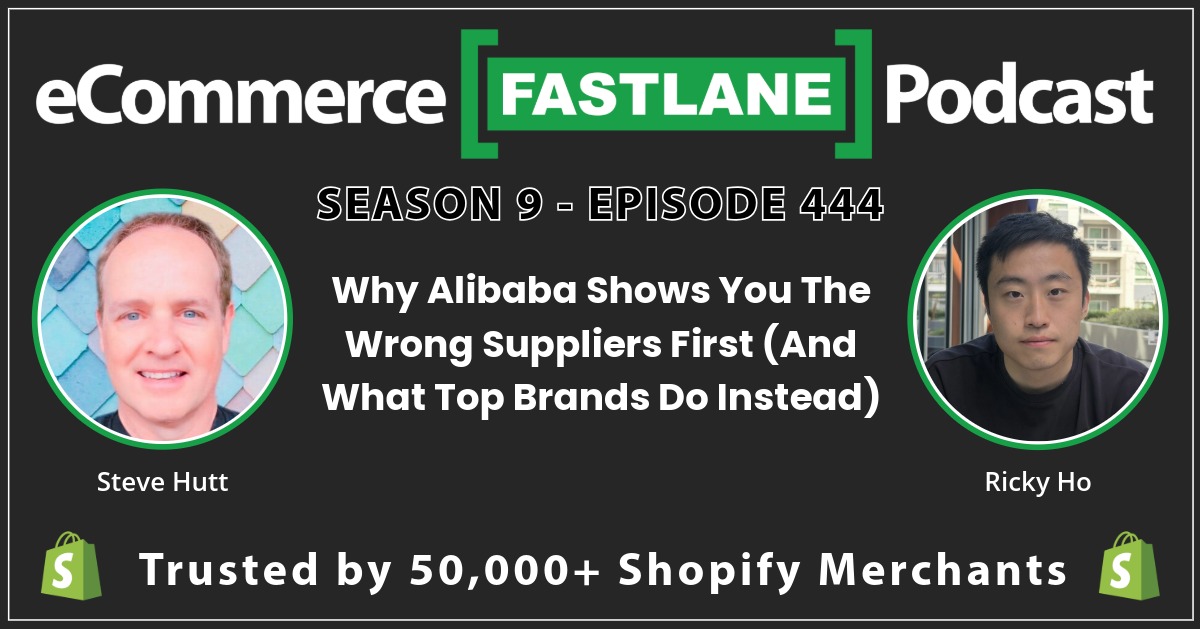
Every Shopify brand that scales beyond a single hero product eventually hits the same wall.
How do you find trustworthy manufacturers without burning weeks of time and thousands of dollars on suppliers who may not be who they say they are? The way most founders source today is fundamentally flawed—endless Alibaba scrolling, back-and-forth with middlemen who might not even represent real factories, and hoping the supplier who replies fastest is actually reliable.
What most people don’t realize until they’re months into this sourcing grind is that Alibaba makes the vast majority of its revenue from supplier advertising, not from helping you find the best manufacturers. The factories showing up first in your search results aren’t there because they deliver the highest quality; they’re there because they paid the most to rank. Meanwhile, the premium factories quietly producing for brands like Lululemon, Ralph Lauren, and Calvin Klein don’t live on Alibaba at all. If you don’t already have relationships or a trusted insider, you’re effectively locked out of the quality tier that could transform your product line.
Today’s guest has spent his entire life on the inside of this world. Ricky Ho is a third-generation manufacturing insider who built and sold a supply chain tech company in his early 20s, raised venture capital from firms like Sequoia and GGV, and landed on Forbes 30 Under 30 in Asia. Now he’s building SourceReady—a platform that rethinks supplier discovery from first principles using customs data, AI verification, and objective quality signals so you can see which factories can actually hit your standard. Whether you’re sourcing your very first SKU or expanding beyond China into Vietnam, India, or Mexico, this conversation is a playbook for getting out of the guessing game and into partnerships with manufacturers who can truly deliver. Let’s dive in.
✅ Why Alibaba’s business model quietly works against you, and how their heavy dependence on supplier advertising means top-ranked factories often pay to be there rather than being vetted for quality.
✅ The hidden proxy procurement teams at brands like Lululemon and Ralph Lauren rely on: customs and import–export data that shows which brands a factory actually serves, so you can see whether they operate at Walmart-level or true premium standards before you even request a sample.
✅ How to confirm you’re dealing with a real manufacturer instead of a trading company, using government records, trade show rosters, and facility verification so you don’t end up three layers away from the actual factory.
✅ The compliance minefield that has cost brands hundreds of thousands of dollars, including the Xinjiang Cotton Act and why U.S. Customs cares only about what’s in your shipment—not your intent—plus how modern sanctions screening can catch issues you didn’t even know were in your supply chain.
✅ Why premium factories producing for brands like Calvin Klein and Tommy Hilfiger rarely show up on directories like Alibaba, and what that means for how you search if you want to upgrade your quality tier.
✅ How AI is compressing the entire product development cycle into a single workflow—from spotting emerging trends, to generating on-brand product concepts, to matching with qualified suppliers and getting quotes in days instead of weeks or months.

78% of eCommerce stores are burning money on ads without realizing it.
Why? Because Meta and Google only see around 40% of conversions due to iOS updates, ad blockers, and cookie limits, causing brands to scale the wrong ads and kill the winners.
Wetracked.io fixes that. It’s the #1 highest-rated ad tracking software for Shopify and WooCommerce, used by 7,000+ merchants.
Our adblock-proof tracking engine pushes 100% accurate data into your ad manager, helping stores raise ROAS by up to 50% and cut wasted ad spend by 64%.
Set up in 5 minutes. No coding.
Steve chats with Ricky Ho, Founder and CEO of SourceReady, to unpack why product sourcing feels so broken for most DTC brands—and how objective, AI-powered data can finally fix it. Coming from a third-generation manufacturing family that supplies major retailers like PVH (the company behind Calvin Klein and Tommy Hilfiger), Ricky brings the kind of insider perspective most founders only encounter after very expensive sourcing mistakes.
They start with the uncomfortable truth about Alibaba: the platform is optimized for supplier advertising revenue, not for helping you find the best manufacturers. When you search for “hoodie supplier” or “yoga pants manufacturer,” the factories at the top didn’t earn those spots through verified quality—they paid for them. Meanwhile, the premium factories actually producing for brands like Lululemon or Ralph Lauren typically don’t appear on these directories at all. Ricky’s own family business, one of PVH’s largest suppliers, isn’t on Alibaba—and that’s true for most top-tier manufacturers, meaning traditional search methods literally can’t surface them if you’re on the outside looking in.
SourceReady flips this model by ignoring self-reported claims and ad spend, and instead aggregating objective data from customs agencies, government incorporation records, trade show rosters, and certifications to build quality signals you can trust. One of the strongest proxies for quality is seeing who a factory already serves. When import–export data shows that 70–80% of a supplier’s shipments go to premium brands, you suddenly have real evidence of their capability before you ever ask for a sample—the same playbook procurement teams at major retailers use, now accessible to smaller brands.
Steve and Ricky also dig into how to distinguish real manufacturers from trading companies posing as factories, the compliance landmines that have cost brands hundreds of thousands when U.S. Customs spot-checks for issues like Xinjiang cotton, and how AI-driven verification using government data can surface red flags that manual checks miss. Ricky then previews SourceReady’s product research module, which crawls e-commerce and social platforms for trending products, uses AI to generate on-brand redesigns, and automatically connects you with qualified suppliers—shrinking work that used to take weeks or months into a single workflow.
This episode isn’t about replacing human judgment in supplier relationships—it’s about giving founders the same objective data and quality signals that billion-dollar retailers rely on, so growing DTC brands can stop gambling on directory listings and start making confident, informed sourcing decisions.
👉 Demand objective proof of quality, not polished listings. The supplier with the best English, quickest responses, or most impressive website can still be a trading company several layers away from the real factory. Ask for evidence like customs data on current customers, facility verification, and incorporation records before you invest in sampling.
👉 Factory setups are built around specific quality tiers. A plant optimized for Walmart-level production runs very differently than one serving Lululemon—equipment, QC systems, and material partners all shift with the quality bar—so don’t expect a budget-focused factory to suddenly perform at premium levels just because you offer to pay more.
👉 Treat compliance screening as essential risk protection. U.S. Customs cares about what’s in your shipment, not what you intended, and regulations like the Xinjiang Cotton Act have led to seized goods and six-figure losses for brands that didn’t fully understand their upstream materials.
👉 Diversify your manufacturing footprint proactively. Building reliable capacity in regions like Vietnam, India, or Mexico takes time. Doing it before tariffs or geopolitics force your hand gives you leverage and options instead of rushed decisions and compromised quality when pressure hits.
👉 Use AI to spot trends, but validate manufacturability early. Connecting trend detection directly to qualified supplier discovery means you’re not just chasing what’s hot—you’re confirming it can be produced at your required quality and scale before you commit resources.
👉 Premium suppliers think in terms of long-term partnerships. The factories serving top brands compete on capability, consistency, and deep buyer understanding, so lead with realistic volumes, clear quality expectations, and a partnership mindset—not just a request for the lowest possible price per unit.
Ricky Ho
Founder & CEO, SourceReady
Ricky Ho brings a rare vantage point to supplier sourcing: he grew up inside a third-generation manufacturing family that serves as one of the largest suppliers for PVH, the company behind Calvin Klein and Tommy Hilfiger. That insider view of how premium factories think, vet partners, and run operations is baked into SourceReady’s DNA, giving him a nuanced understanding of both sides of the buyer–supplier relationship that most platforms simply don’t have.
Before launching SourceReady, Ricky built and exited a supply chain technology company in his early 20s, raising venture capital from firms like Sequoia and GGV and earning a spot on Forbes 30 Under 30 in Asia. Beyond the accolades, that journey gave him pattern recognition across hundreds of supplier relationships and sourcing workflows, and he repeatedly saw smaller brands struggle to reach the same quality manufacturers his family worked with daily—not because they lacked budget, but because they lacked access to the objective data and signals that professional procurement teams rely on.
What sets Ricky’s approach apart isn’t just the tech, but his conviction that supplier discovery has to be rebuilt from first principles—not just patched onto existing directories. By aggregating customs records, government incorporation data, sanctions databases, and trade show participation, SourceReady surfaces objective quality indicators that advertising-driven marketplaces tend to obscure. The result is a platform that doesn’t just help you find suppliers faster—it helps you reach manufacturers you likely couldn’t have uncovered through traditional search, narrowing the gap between emerging DTC brands and legacy players with decades of entrenched factory relationships.
Featured in This Episode:
Platform Features Discussed:
Over 9 seasons, I’ve been incredibly fortunate to chat with some of the brightest founders building amazing Shopify brands and the partners shaping the app and marketing ecosystem. Every conversation has taught me something new, and I’m grateful for the chance to learn alongside you.
What matters most is that this podcast helps you solve real challenges and unlock new growth. Your support, feedback, and stories have made this journey truly special. Thanks for tuning in, sharing your wins and losses, and being part of the eCommerce Fastlane community.
Stay Connected:
Leave an Honest Rating/Review on Apple Podcasts or Spotify.
Follow & Subscribe on YouTube for new episodes.
Get in Touch:
Steve Hutt:
Welcome back to eCommerce Fastlane. I’m your host, Steve Hutt. Today we’re going to tackle a problem that I know a lot of DTC founders feel very deeply, and that’s product sourcing. The current system is, frankly, a bit broken. Most brands get stuck endlessly scrolling Alibaba listings, talking to middlemen who may or may not represent the actual factory, and spending weeks “verifying” suppliers that often turn out to be unreliable. Layer on top of that the language barrier, time zone challenges, tariffs, and a whole lot of geopolitical instability, and you’ve got a pretty fragile setup for something as critical as your supply chain.
Steve Hutt:
Add to that the risk of depending on a single country like China for production, and you can see why more brands are starting to question how they source. That’s exactly why I invited today’s guest, Ricky Ho, onto the show. He’s the founder of a company called SourceReady. Ricky is a third-generation member of a manufacturing family, and he built his first supply chain tech company in his early 20s, raised venture capital from Sequoia and GGV, and landed on Forbes 30 Under 30 in Asia. What he’s building with SourceReady is a completely different way for brands to find and vet manufacturers—moving away from this endless “email ping pong” with factory reps and random suppliers on crowded platforms, and toward something much more data-driven and reliable.
Steve Hutt:
It can get pretty scary out there when you’re guessing which supplier to trust based on a directory listing. Ricky has built a tool that uses AI to consolidate and make sense of global manufacturing data, and it’s not just focused on China—think Vietnam, India, Mexico, and beyond. It’s fascinating what’s possible now. So, Ricky, that was a long preamble. I’m excited to unpack all of this with you. Welcome to the show.
Ricky Ho:
Thank you for inviting me, Steve. Great to be on the show.
Steve Hutt:
You grew up inside a manufacturing family, you built and sold a supply chain tech company in your early 20s, and now here you are building SourceReady. Can you talk a bit about the core patterns you keep seeing that convinced you the sourcing process needs to be rebuilt from the ground up, rather than just being “another marketplace”?
Ricky Ho:
Yeah. As you mentioned, I grew up in a manufacturing family, so I understand how factories think. One thing that really stood out to me is how hard it is for the average founder—someone who isn’t a sourcing professional—to tell which factories are truly high quality or premium and which are not. If you go to an Alibaba listing, most suppliers look the same on paper. Until you actually order samples or do a bulk production run, you don’t really know who’s good and who isn’t.
Ricky Ho:
A big part of the problem comes from the business model behind Alibaba and similar directories. Alibaba makes about 90% of its revenue from supplier advertising. That means they don’t make money from buyers like you; they make money from factories paying to appear in the listings. So when you search for “hoodie supplier” on Alibaba, the suppliers that show up on the first page are generally the ones who paid the most to rank there. A lot of buyers assume that those top-ranked suppliers must be the most reliable or highest quality, or that Alibaba has vetted them thoroughly—but that’s not the case.
Ricky Ho:
If you talk to sourcing and procurement teams at established companies like Ralph Lauren, Lululemon, or Calvin Klein, they almost never rely on Alibaba to find suppliers. Their key vendors—the ones actually producing for those brands—simply are not on Alibaba. For example, my family’s business is one of the largest suppliers for PVH, which is the parent company behind Calvin Klein and Tommy Hilfiger. You will not find our information on any directory or Alibaba site. That’s true for most major retailers and brands.
Ricky Ho:
Most of their core vendors are not on those directories, which makes life very hard for smaller startups. Let’s say your sales are growing and you want to improve product quality by working with better manufacturers. If you don’t know someone who already knows these factories, it’s very difficult to identify which suppliers are actually operating at that more premium level. Supplier discovery today is dominated by ad-driven directories, and there’s very little objective data to help you easily find quality manufacturers around the world.
Steve Hutt:
I think the other thing founders obsess over is pricing. Too many brands are optimizing strictly for price per unit. Your platform feels different because you’re aggregating a lot of data sources—customs records, certifications, trade show rosters, and more. Can you talk about those signals? These overlooked data points feel important, especially after hearing how broken the advertising model is on Alibaba.
Ricky Ho:
Yeah. We believe the best proxy for quality is understanding which customers a supplier currently works with. To do that, we lean heavily on import–export and customs data. We’ve spent a lot of time obtaining customs data from countries like Vietnam, Indonesia, Malaysia, China, the U.S., Mexico, and others. With this data, you can see where any exporter or supplier is shipping their goods and who they’re shipping to.
Ricky Ho:
That gives you a strong proxy for quality. Let’s say you want to find truly premium-quality yoga pants in Vietnam. “Premium” is subjective—if you ask a supplier on Alibaba whether they make premium quality, every single one will say, “Yes, we make the best quality.” In reality, there’s a spectrum. A supplier that primarily serves Walmart and Target is very different from a supplier that works with Alo Yoga or Lululemon.
Ricky Ho:
There’s a misconception that all suppliers are roughly similar in capability. Coming from a manufacturing family, I can tell you that’s not true. A Walmart-oriented factory is very different from a Lululemon-oriented factory, even if both “make yoga pants.” The factory design, processes, equipment, and quality control systems are completely different.
Ricky Ho:
Signals like import–export data help because our AI can look at a supplier’s shipment history and say, “Hey, 70–80% of this supplier’s customers are on the premium side of the spectrum.” That’s the best proxy we’ve found for determining what we call the supplier persona. And quality isn’t the only persona. Some brands care more about cost. In that case, seeing a supplier that mainly serves Target or Walmart might actually be a positive signal, because those retailers are extremely cost-sensitive and those factories are optimized to squeeze out every bit of cost.
Ricky Ho:
So, depending on the type of customers a supplier already serves, you can infer a lot about where they sit on the quality–cost spectrum and whether they fit your brand’s positioning.
Steve Hutt:
That’s interesting, especially when you layer in the financial side and tariffs. A lot of brands are thinking about diversification—nearshoring, moving some production to Mexico, or exploring Vietnam and India, similar to what Apple and others are doing. How should brands think about diversification based on their GMV or complexity? A brand doing $100K a month versus $2M a month clearly has different levers to pull.
Ricky Ho:
Diversification is something every brand should think about, but it can be challenging. The more regions you source from, the more complex your logistics and compliance processes become. For smaller brands, the best way to diversify is often to work with vendors who already have multiple country-of-origin options.
Ricky Ho:
A lot of Chinese vendors, for example, have factories in multiple countries. They might have a facility in Ningbo, China, another in Vietnam, and even one in Mexico. The benefit for a small company is that you can let the supplier manage the cross-country complexity. You can say, “I want part of my production in Vietnam and part in China,” and the vendor will handle differences in customs, compliance, and logistics. They also know which products make more sense in which country.
Ricky Ho:
So for smaller brands, that’s often the most realistic approach—you’re not managing six different vendors yourself. For brands that are growing and scaling volume, diversification looks different. You don’t want all your orders going to a single vendor. You want to diversify your vendor base so that if something goes wrong with one supplier, your entire supply chain doesn’t grind to a halt.
Ricky Ho:
At that stage, the biggest risk is often raw materials. For many consumer products—apparel, hats, accessories—the assembly itself is relatively low barrier and can be done in many developing countries: India, China, Vietnam, and so on. The reason China has been so dominant is because it has a vertically integrated supply chain. China doesn’t just assemble the clothing; the raw materials are there too. The fabrics, even the cotton, are often sourced locally. That makes the whole process extremely efficient and is why you can go from design to doorstep in 45 days.
Steve Hutt:
Right.
Ricky Ho:
If you move to countries like Vietnam, India, or Mexico, most of them do not have fully vertically integrated supply chains for every category. So even if you find an apparel manufacturer in Mexico, you’re likely still relying on Chinese raw material suppliers to ship fabric there. That reduces agility and increases lead times.
Ricky Ho:
You need to plan further ahead, which adds complexity to your supply chain planning. If you’re a large brand deciding to move some production to Mexico or South America, you may need to plan three to four months ahead because the raw materials themselves must be shipped there. Your product portfolio also needs to be more focused—less switching between very different materials and categories—because the local supply base isn’t as flexible.
Ricky Ho:
In China, you can decide today to make a cotton T-shirt and tomorrow decide to make a polyester jacket, and your suppliers can quickly source those materials because they have a huge network of raw material suppliers. In a country like Argentina, if you ask a supplier to make a cotton T-shirt today and a polyester jacket tomorrow, they may need weeks just to get the materials in.
Ricky Ho:
So when you diversify away from China, you need a clear roadmap: which products go where, how you’ll source raw materials, and how you’ll manage lead times. That’s why many brands adopt a “China plus one” strategy. They still use China for products where they need agility and fast reaction times, but for stable, predictable SKUs—like evergreen bestsellers with consistent materials—they shift some production to lower-cost or nearshore countries. You can front-load raw materials for those products because you know you’ll keep ordering them, and you don’t need the same level of flexibility.
Steve Hutt:
I’ve been learning a lot about this from Izzy over at Portless. It seems like there’s a potential one–two punch here. One side is solving the sourcing problem, which SourceReady addresses. The other side is rethinking fulfillment. Instead of importing everything to the U.S. and holding inventory, what if you produce in China and fulfill directly from China to the U.S., using something like Portless? That can reduce time delays and create a different financial model, where you pay for goods as they ship instead of tying up cash in inventory. How do you think about that combination—using SourceReady to find the right supplier, then fulfilling via an on-the-ground partner in China? Are brands doing this? Or is it still better for most to import into the U.S. and fulfill domestically?
Ricky Ho:
It really depends on the product category and your volumes. A good example is Shein or Temu. Most of their products ship directly from warehouses in China to the customer’s doorstep. Part of the reason they can do that is they’re leveraging things like the de minimis loophole, where shipments under a certain value threshold—traditionally under 800 dollars into the U.S.—weren’t subject to the same tariffs as bulk shipments. Shipping costs were low, and they found ways to consolidate small parcels into larger shipments while still treating them as individual packages.
Ricky Ho:
There are some challenges, though. If you want robust fulfillment on the customer side—like easy returns and strong post-purchase service—that model can get tricky. It also depends a lot on the product. If you’re selling furniture or other bulky items, air-shipping every order from China can be extremely expensive and unrealistic.
Ricky Ho:
For certain product types—especially smaller accessories or lower-volume items—shipping direct from China can be a viable strategy. But U.S. Customs is starting to crack down on abuse of the de minimis rules and loopholes around tariffs, so it’s not a no-brainer forever.
Ricky Ho:
The benefit is that you don’t have to be the importer of record. The supplier or fulfillment partner handles that role and often provides DDP (delivered duty paid) shipping directly to your customer. That can make logistics much easier for small brands. So, in short, it depends. For small brands in appropriate product categories, this approach can meaningfully reduce overhead and simplify operations.
Steve Hutt:
That makes sense. Let’s say a brand signs up for SourceReady and they’re convinced it’s time to fix their sourcing. Walk me through the first 30 to 60 days. What does implementation look like in practice? Where do most brands get stuck, and what surprises them when they first get access?
Ricky Ho:
Fundamentally, our platform works a bit like ChatGPT or Gemini in that everything starts with natural language. You describe what you’re trying to find in plain English. The difference is that we’re running that against a very specific data set of global suppliers that we’ve curated and enriched.
Ricky Ho:
On day one, the main thing we want to show is the differentiated data and insights we have on vendors. If you go to Alibaba, you scroll through pages of similar-looking suppliers, and it’s hard to tell what separates A from B from C. With SourceReady, you tell us exactly what you’re looking for: for example, “I want premium quality, an MOQ under 500 units, specific capabilities, and a particular certification.”
Ricky Ho:
Our AI ranks suppliers against those requirements and shows you why each one is a good fit. It might say, “This supplier is a major vendor for Alo Yoga,” which tells you they likely operate at a higher quality standard. You don’t have to manually piece together the reasoning—the AI surfaces it for you, so you can see why a supplier is recommended.
Ricky Ho:
By day two or three, we focus on automating outreach and communication. Anyone who has sourced products knows the pain of staying up at 2:00 a.m. emailing suppliers in China, answering the same questions repeatedly. One of our core value propositions is letting AI handle that outreach and follow-up. Instead of personally emailing ten suppliers, you can have AI reach out to twenty, thirty, or forty on your behalf.
Ricky Ho:
You wake up the next morning with multiple quotes, and the AI can help you analyze which ones are most competitive and aligned with your criteria. That ability to scale outreach is a big shift. Most small brands simply don’t have the time to contact 50 or 100 suppliers. AI lets you expand your funnel without expanding your workload.
Steve Hutt:
I got a taste of this before we recorded. I created an account, landed on your main chat-style interface, and typed in “MagSafe phone holder.” I wanted to see what’s out there. After a couple of quick follow-up questions, within about ten seconds it came back with 90 suppliers. There were filters, it asked for some basic contact details, and what I saw looked pretty well-ordered—lots of “100% match” indicators, OEM and ODM tags, and verified badges. For people listening who can’t see my screen, walk us through what’s happening behind the scenes and what they should do once they see those 90 results.
Ricky Ho:
Sure. On that results page, you’re seeing two key things. First, the match percentage—like “100% match”—is our AI’s assessment of how closely a supplier aligns with the requirements you provided. If you click that match label, the AI will explain why it considers the supplier a strong fit.
Ricky Ho:
Second, if you click into a supplier profile, you’ll see much more detail: a description of the company, the products they offer, and their current customer base. From there, you can shortlist suppliers. For example, you can select the ones that look promising and save them into a list called “MagSafe suppliers.”
Ricky Ho:
Once you have that list, you can use the “Invite to quote” function. You can bulk-invite all the suppliers that fit your criteria, and the AI will handle the outreach. If you want, you can have it contact all 90. The next morning, you’ll likely see a set of quotes come back, and then you can move into comparing pricing, MOQs, and other details.
Ricky Ho:
So that initial search is about narrowing down to the best-fit suppliers. The second step is automating quote collection and communication, which historically has been a big time sink for founders.
Steve Hutt:
What I loved digging into the profiles was the level of detail—things you’d almost never get access to otherwise. I saw actual factory images, which really helps you gauge the environment: how clean it is, what the workflow looks like, how people are working. Is that content captured by your team on the ground, or provided through the network? Either way, it’s impressive to see it aggregated into a single, coherent company record.
Ricky Ho:
Exactly. We pull that data from multiple sources and, in many cases, work with on-the-ground teams or partners to verify and enrich what we have. The goal is to give you a much clearer, more trustworthy picture than a typical directory listing or a few polished product photos.
Steve Hutt:
Very cool. So a brand signs up, does their searches, gets quotes, and starts working with suppliers. How do you make money? What does the revenue model look like for using the platform? Is this a “use it once to find a product” kind of thing, or are most teams staying on as ongoing customers to keep iterating and expanding their product lines?
Ricky Ho:
Good question. Unlike Alibaba, we don’t make money from supplier ads. The lists you see are not biased by which supplier is paying us. That’s a fundamental difference.
Ricky Ho:
For most small businesses, the platform is effectively free at the start. We give 30 free credits per day, and each search or action uses a few credits. If you’re not sourcing constantly, that’s often enough.
Ricky Ho:
If you have more volume, or you’re doing more intensive sourcing and outreach, you can upgrade into paid tiers that give you more credits. Our entry tier is around the low-twenties per month, and for teams with serious procurement needs, the Pro tier is around 299 a month.
Ricky Ho:
The ROI is usually very obvious. If you’re ordering, say, 20,000 dollars worth of product and we help you identify a supplier that’s 10% cheaper without sacrificing quality, that’s 2,000 dollars saved on one order. That alone pays for the software many times over. So for brands that use it properly, the economics generally make a lot of sense.
Steve Hutt:
My last question before we wrap is about risk and regulation. There’s a lot going on right now—tariffs, geopolitical tensions, evolving trade rules. You’re close to this, and your team is effectively “boots on the ground.” How do you see supply chain risk management evolving, especially this year? And how should brands think about where to produce—China versus Mexico, Vietnam, or elsewhere—based on their complexity and maturity?
Ricky Ho:
There are two main angles. First, the reason so many people like working with Chinese suppliers and why China has been so dominant is that Chinese vendors are generally more experienced—not just in manufacturing, but across product development.
Ricky Ho:
If you compare China to, say, Mexico, you’ll often find that Mexican suppliers have weaker English and less experience translating product concepts into physical goods. I’ve talked to brands that have worked in both places. In China, you can send a supplier a reference image and some specs and they’ll figure out the rest—they’ve done it thousands of times. In some newer manufacturing hubs, you have to be much more detailed and hands-on.
Ricky Ho:
So your diversification strategy should match your internal capabilities. If you have a strong design, product development, and sourcing team that understands the nuances of different regions and can “train” suppliers, then diversifying away from China is something you should actively pursue.
Ricky Ho:
If you’re a small or medium-sized brand just getting started, without a deep operations bench, it’s usually easier to work with Chinese, Taiwanese, or Korean vendors—or with foreign-invested factories in other regions. For example, if you partner with a Taiwanese factory that has a facility in Mexico, you’re not dealing directly with a local Mexican operator. You’re talking to a team in Taiwan that understands advanced product development and can decide which factory (China, Mexico, etc.) should produce which items.
Ricky Ho:
In that setup, you get the benefits of geographic diversification without the full burden of managing inexperienced local vendors. You send them a product image and requirements, and they handle design translation and logistics behind the scenes.
Ricky Ho:
The second angle is compliance and regulation. A lot of suppliers are, frankly, a bit “scammy” in how they present themselves on platforms like Alibaba. They may claim to be manufacturers when they’re really trading companies. Because Alibaba’s business model is ad-driven, there isn’t a strong incentive to rigorously verify every claim—especially from suppliers spending heavily on ads.
Ricky Ho:
We focus heavily on verification using objective data sources. We pull data directly from customs agencies, check government incorporation records to confirm legal status, and integrate sanctions data so you can run checks on suppliers. That includes screening for whether a company itself is sanctioned and whether it may be using materials from sanctioned regions.
Ricky Ho:
Some founders think, “That’s an edge case. It won’t happen to me.” But the 2021 Xinjiang Cotton Act proved otherwise. The U.S. government found evidence of forced labor in Xinjiang, and even brands that never intended to source from there were impacted because some of their upstream suppliers were using Xinjiang cotton.
Ricky Ho:
U.S. Customs started doing random spot checks, including DNA testing of cotton products. If they detected Xinjiang-origin cotton, shipments were held and brands faced significant fines. Explaining that you “didn’t know” doesn’t help. Customs doesn’t judge your intent; they judge the outcome.
Ricky Ho:
That’s why I believe compliance screening will become non-negotiable. Without it, you can be down hundreds of thousands of dollars because of a hidden risk in your supply chain. AI can help here by continuously checking suppliers against sanctions lists, customs data, and other signals far more efficiently than manual processes.
Steve Hutt:
One last topic before we close—your design and research module. I know it’s in early access for some users. It’s interesting because it moves SourceReady beyond vendor discovery into product ideation. Can you walk through what it does and how AI is generating product concepts and renderings? I’m asking because by the time people hear this, it may already be available to them.
Ricky Ho:
Absolutely. For any eCommerce business, spotting trends and understanding what kinds of products will sell is crucial. AI is a great fit for this because it can analyze huge volumes of data quickly.
Ricky Ho:
Our product research function crawls eCommerce sites and social platforms to detect emerging trends. You can tell the AI, “Find trending products in this category,” and it will analyze social signals and product data from different retailers and competitors. If it sees, for example, that a particular Ralph Lauren jacket is performing extremely well, you can then ask the AI to redesign that concept into something that fits your brand.
Ricky Ho:
You might keep the core silhouette but remove the Ralph Lauren logo and tweak certain design details so the product aligns with your brand identity. In a few steps, you have your own product that’s aligned with a proven trend.
Ricky Ho:
From there, you can feed that new design into the rest of the SourceReady workflow—have AI find suitable suppliers, request quotes, and kick off sampling. So in a single workflow, you can go from trend research to product ideation, product generation, supplier discovery, and quote automation.
Steve Hutt:
It’s a great time to be an eCommerce brand when you can consolidate all of that into one platform. Huge kudos to you and your team for what you’re building with SourceReady. I’ll include all the details in the show notes—SourceReady.com, plus direct links for anyone who wants a demo or a deeper look at the platform.
Steve Hutt:
Ricky, this has been awesome. Thanks so much for taking the time to record today. I feel really grateful that I get to interview founders like you, learn about what you’re building, and see how you’re solving real problems for brands. You’re creating something genuinely impactful. Thanks again for being here.
Ricky Ho:
Awesome. Thank you so much, Steve.
Steve Hutt:
All right, have yourself a great day.
Ricky Ho:
Bye-bye.
Steve Hutt:
Well, that’s it for today’s episode. I’d like to thank you personally for being a loyal listener of eCommerce Fastlane. My hope is that this podcast gives you a ton of value through growth strategies, tactics, and insider tips on the best Shopify apps and marketing platforms—all with the goal of helping you build, manage, grow, and scale a successful, thriving company powered by Shopify.
Steve Hutt:
Thanks for investing some time today and listening to the show. I’m so proud and excited that you have a growth mindset and are a constant learner. I truly appreciate you and your entrepreneurial journey. Enjoy the rest of the week, and keep thriving with Shopify.