Here’s something most Shopify founders don’t realize until it’s almost too late: you can be running an 8x return on ad spend, staring at a wall of green in your marketing dashboards, and still be losing $100,000 a month.
That’s not a hypothetical. That was Pentane’s very first client—a scaling DTC brand whose marketing team was celebrating while the rest of the company had four months of runway left. If you’re doing $1M–$20M in revenue and your ad platforms look incredible but your bank account tells a different story, this episode is for you.
Adam Callinan isn’t just another SaaS founder who spotted a gap and built a tool. He built and scaled Bottlekeeper—an insulated beer bottle holder that went from $150,000 in year one to $1.8M, then $8M, then past $60M in annual revenue—with a team of four and zero outside investors. He walked onto Shark Tank Season 10 with $10M+ in trailing revenue, asked for $1M at 5%, and walked the judges through numbers that made their jaws drop. When he exited, he turned his focus to the internal system that made all of it possible: a financial operating system he and his co-founder had been running in a sprawling spreadsheet for eight years.
That system became Pentane. In this conversation, Adam breaks down the profit-clarity framework that connects your QuickBooks financials directly to your ad platforms—Meta, TikTok, Google, Shopify, Amazon—and tells you what ROAS you actually need to hit, how much you should actually be spending on ads, and which levers to pull when tariffs, discounts, or hiring decisions threaten your margin. Whether you’re a $2M founder staring at a confusing P&L or a $15M operator whose marketing and finance teams are speaking different languages, this is your playbook for reconnecting growth with profit.
Let’s dive in.
✅ Why a “killer” ROAS can quietly destroy your business—and how one brand was running 8x ROAS while losing $100,000 a month, until they fixed their spend levels and accepted a lower return.
✅ The Profit Pyramid framework that shows why obsessing over impressions and click-through rates on a shaky foundation is a recipe for disaster—and what you must fix first before any of that work really matters.
✅ How to calculate your true profit guardrail—the minimum ROAS your business needs to survive and grow based on your actual fixed and variable expenses, not what your ad platforms say looks good.
✅ The hidden costs quietly eroding your margin that never show up in Shopify—from operating expenses and fulfillment fees to the damage done by BFCM discounting and coupon tools like Honey and Capital One Shopping.
✅ Why marketing and finance rarely speak the same language—and how building one unified view of your numbers turns scattered conversations into a single, directive operating system.
✅ What to focus on if you’re early-stage—the pricing and margin fundamentals from Adam’s free Profit Masterclass that you need in place before you step on the paid acquisition gas.
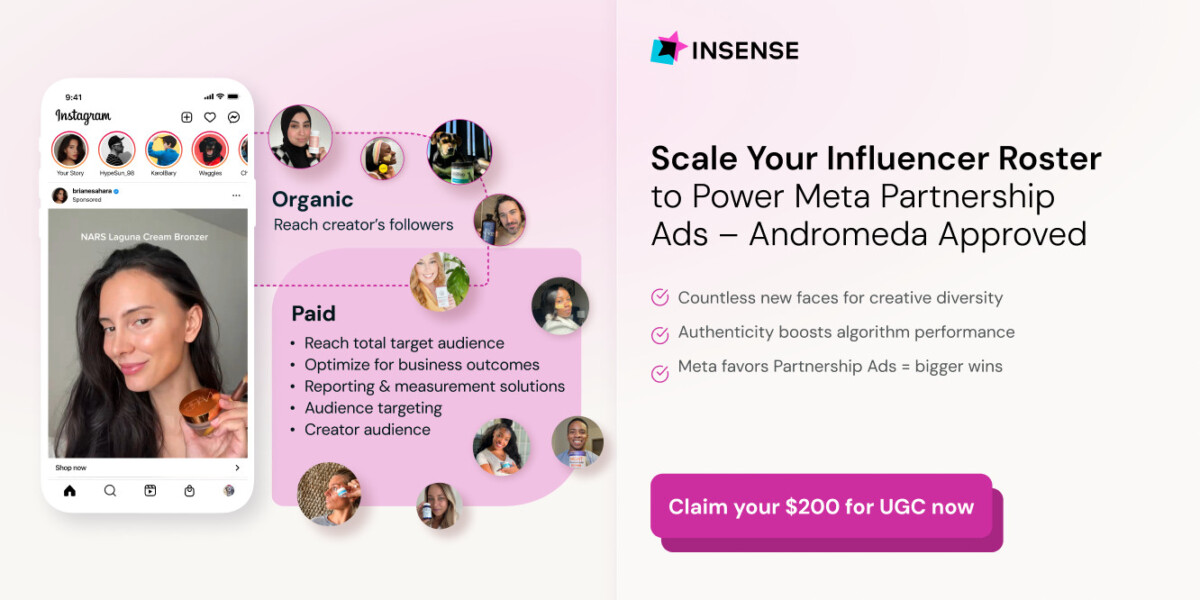
More than 3,500 ecommerce brands use Insense to source UGC, run influencer campaigns, and launch creator-led ads from one platform. With access to 80,000+ vetted creators across 35+ countries and a native Shopify integration for product seeding, Insense helps brands move faster without adding more manual work to the team.
Most brands start receiving creator applications within 48 hours, making it easier to find creators who actually fit the brief and turn ideas into live campaigns quickly. Brands use Insense to manage sourcing, outreach, deliverables, contracts, payments, and activation for formats like Meta Partnership Ads and TikTok Spark Ads in one place.
Results include Bones Coffee generating $25,000+ in revenue with a 2.16 ROAS from 54 UGC ads in 3 months, Quip reaching 85% influencer activation, and Easy A Media sourcing 100+ UGC assets in 45 days through product seeding alone.
Book a demo and get $200 off your first campaign through March 27.
The dashboard problem is real and it’s getting worse. As Shopify brands scale, they stack up platforms like Meta, TikTok, Google, Amazon, and Shopify, each showing “great” numbers in isolation while saying nothing about whether the business is actually making money. Adam Callinan calls this the “context problem.” Every metric becomes a vanity metric when it isn’t grounded in your financials. You can be sitting on an 8x ROAS and still have only four months of runway left. That’s exactly what happened with Pentane’s first client.
The root cause is structural. Marketing and finance don’t speak the same language—even when they get along. Marketing wants to spend more because more spend drives more revenue. Finance wants to spend less to protect cash. Neither side has a shared, real-time view of what “good” actually looks like: what ad budget is appropriate, what ROAS is realistic, what contribution margin is required, and what profit guardrail the business simply cannot go below. All of that guidance lives in your financials, and almost nobody is connecting those numbers directly to their marketing.
Pentane does exactly that. It pulls data from your accounting tools (QuickBooks, Xero, Finloop) and your revenue and ad platforms at the same time, then uses straightforward math—not AI—to build a live model of how your business spends and makes money. From there, it can tell you what has to be true for the business to be profitable. A built-in guidance system lets you set your target net profit margin, plug in your ad budget, and instantly see the minimum ROAS required to hit that outcome. If your trailing 30-day ROAS is 5.2 and the model says you need 11.7, Pentane flags that as unrealistic and shows you the alternative levers: raise prices 10%, factor in a 15% tariff, or model a new hire and see what revenue growth that decision demands.
The early client stories are where it really clicks. One $2M e-commerce brand—with a great product, a passionate founder, and strong marketing—was consistently losing money and couldn’t pinpoint why. Pentane surfaced two issues: fixed expenses were too high for their revenue, and they were dramatically underspending on ads while chasing a sky-high ROAS. The prescription was counterintuitive: cut fixed expenses by 25%, triple the ad budget, and let ROAS drop from 8 down to 2.5. Month one: a $102K loss. Month two: a $12K loss. Month three: $44K in net profit. Two years later, the brand is at $7M a year and still runs on Pentane as its financial operating system.
Adam’s Profit Pyramid framework ties the whole philosophy together. The foundation is your P&L—the financial reality of your business. Above that are your core KPIs: AOV, conversion rate, contribution margin. At the very top is where most founders spend their time: click-through rates, impressions, virality. The problem is simple: you can become world-class at the top of the pyramid and it still won’t matter if the foundation is broken. If your variable margin is 85% before ad spend, there is no ROAS that can save you. Fix the foundation first and everything above it gets easier. It’s the same system Adam used to take Bottlekeeper from $150K to $60M with four people and no outside capital.
👉 High ROAS is not the goal—profitable revenue is. An 8x ROAS sounds incredible until you realize your fixed expenses only require a 2.5x to break even. The brands that win aren’t chasing the highest ROAS; they’re staying above their profit guardrail and scaling spend hard within it. Know your floor, then build above it.
👉 Your ad budget is fuel, not a fixed expense—if you know how much fuel the engine actually needs. Most founders underspend on ads because a high ROAS feels safe. The counterintuitive reality: spending more at a lower ROAS can generate significantly more net profit, as long as you stay above your minimum contribution margin. One Pentane client tripled their ad budget, watched ROAS drop from 8 to 2.5, and went from losing six figures a month to positive $50K in 90 days.
👉 Marketing and finance need a shared language before they can make good decisions together. If your agency or internal team is judged on ROAS alone, they’re set up to fail—that metric ignores cost of goods, shipping, fulfillment, and fixed expenses. Give them a MER (Media Efficiency Ratio) target that’s derived from your actual P&L and you’ll see completely different campaign decisions.
👉 BFCM discounts might be the most expensive thing you do all year. Adam has watched brands post record-breaking Q4 revenue, then open their January P&L to find they lost money. More revenue, less profit. Discounts crush already-thin margins while variable costs scale with every order. Before you lock your promo calendar, run the discount impact through your margin model.
👉 Fix your pricing before you scale your ads. For brands under $1M, pricing is the highest-leverage, least-used lever. Raising prices even 10% can materially lower your required ROAS and create margin space to acquire customers at higher CPAs. As Adam puts it, when you create more margin space, performance can come down and you can still make more money. Test prices up—the conversion hit is often smaller than you fear.
👉 In finance, context engineering beats prompt engineering. Pentane’s AI layer (internally, “Charlie”) doesn’t do math—the math is programmatically locked. The AI interprets already-calculated results and explains them in plain language. That matters because large language models make basic math mistakes at a surprisingly high rate when they construct equations themselves. The future of AI in financial ops isn’t replacing the engine—it’s translating the engine’s output into clear, actionable decisions.
Adam Callinan
Founder/ CEO, Pentane
Adam Callinan co-founded Bottlekeeper—the stainless steel insulated beer bottle holder—and scaled it from $150,000 in year one to over $60 million in annual revenue with a team of just four people and no outside investors. At peak, Bottlekeeper was generating more than $1 million in a single week. His Shark Tank Season 10 appearance became memorable not just for the offer, but because the sharks couldn’t believe a self-funded four-person operation was doing $10M+ annually. After exiting through acquisition, Adam began advising portfolio companies and quickly realized the real edge at Bottlekeeper wasn’t just product or marketing—it was the internal financial operating system he’d built: an eight-year-old spreadsheet that tied P&L data directly to ad performance.
That system became Pentane, a financial intelligence platform built specifically for Shopify and DTC brands in the $1M–$20M range. Adam holds 42 patents from his Bottlekeeper days and brings a mix of deep ecommerce operator experience and hard-science thinking to a problem most founders find overwhelming. He still personally leads every demo and onboarding call because he wants founders to understand what the numbers actually mean, not just what a dashboard shows. His free Profit Masterclass at theprofitmasterclass.com distills the financial fundamentals every brand needs in place before they’re truly ready to scale paid media.
Featured in This Episode:
Over 9 seasons, I’ve been incredibly fortunate to chat with some of the brightest founders building amazing Shopify brands and the partners shaping the app and marketing ecosystem. Every conversation has taught me something new, and I’m grateful for the chance to learn alongside you.
What matters most is that this podcast helps you solve real challenges and unlock new growth. Your support, feedback, and stories have made this journey truly special. Thanks for tuning in, sharing your wins and losses, and being part of the eCommerce Fastlane community.
Stay Connected:
Leave an Honest Rating/Review on Apple Podcasts or Spotify.
Follow & Subscribe on YouTube for new episodes.
Get in Touch:
Steve Hutt:
So you can check out Incense at incense.pro, incense.pro, or you can hit the link in the show notes and that’ll redirect you over. I would honestly go and book a free demo, just take a look and see what their platform is. I know it’ll help your brand.
Now, let’s jump into today’s episode.
Welcome back to eCommerce Fastlane. I am your host, Steve Hutt. There are a lot of brands right now where revenue is climbing and their ad spend looks very efficient.
Steve Hutt:
For all intents and purposes, their dashboards all look green. But when many founders actually look in their bank accounts, they find there’s not as much money there as they anticipated, even though the ad accounts suggest there should be. There’s this interesting disconnect happening between what the marketing reports are saying and what your bank balance actually shows.
I think that’s a pretty dangerous spot to be in with e-commerce, and it only gets worse as the business starts to scale. That’s one of the reasons why I have my guest on today. It’s Adam Callinan, and he’s the CEO and founder of a company called Pentane.
Now Adam’s not just building software to solve this problem. He’s actually lived this firsthand. He was the co-founder of a company called Bottlekeeper, which I want to talk about. He was on Shark Tank, really interesting business, and I think he grew that business—we’ll hear more from him—but I believe he grew it to upwards of $60 million with only four employees. It’s a really interesting story and I want to unpack it.
Steve Hutt:
What’s interesting about Pentane, from what I see, is that they connect a lot of the financial data to the marketing data, all from within one platform. Now you can actually see what you’re really making. What Facebook, Instagram, Google—whatever the platform—are showing you is very different from the true profitability in your bank account.
So Adam, welcome to eCommerce Fastlane.
Adam Callinan:
Thanks for having me, Steve. I’m excited to be here. It’s great.
Steve Hutt:
My pleasure. So you scaled this Bottlekeeper company, and from what I understand—maybe there’s some insider information I don’t know about—but publicly it’s reported that it grew past $60 million in revenue with four people, and then you finally exited.
Can you talk a bit about that story? I think there are other stories leading up to it, and then I want to talk about the pivot over to a SaaS company.
Adam Callinan:
Bottlekeeper is the typical consumer brand startup story. My cousin is drinking a beer on the beach out of a red Solo cup at a party. He’s a bit of a brilliant maniac—he wants to drink a Corona at a specific temperature, in a bottle. That’s just what he likes.
So he has a problem. He scratches his own itch, so to speak. He sees people drinking out of a water bottle and has the idea of cutting one in half and insulating it so he can put a beer bottle in it to keep it cold and make sure glass isn’t such a disaster on the beach.
Steve Hutt:
Yeah.
Adam Callinan:
So he does that. He literally hacksaws a bottle in half. On video you’ll see this—I have one on my desk. A prototype, hacksawed-in-half bottle, stuffed with neoprene koozie material, and his beer bottle fit in it and it solved his problem.
This is the classic consumer brand startup story: you have a problem, you create a solution to your own problem, it turns out other people have the same problem, and they’ll pay for your solution. That’s how most companies get started.
Steve Hutt:
Yep.
Adam Callinan:
That’s what happened. I had just sold my position at a medical tech company and was looking for the next thing. We came together on this, but that previous decade was really heavy and difficult. It was a medical device company, and there was so much going on that it was impossible to get away from.
Coming into Bottlekeeper, I was adamant that we build the company in a way that required no employees. I was done managing people. I wanted to build it with zero employees. That was a really critical guardrail.
That was a constraint—important word, “constraint”—that I put on the company early on. It forced me to solve problems in completely unique and different ways, which was a really important thing at the beginning.
As it started working—and there’s luck in a lot of these things; generally, it’s timing-related—as it did start to work, I was doing everything. I was running all the paid media, building the website, writing the copy, doing the emails, customer service—anything a customer saw was my responsibility.
Matt was handling manufacturing, managing the manufacturing, shipping, fulfillment, our finance stuff, all of that. As it started working, it really worked. At the time we were on WordPress with WooCommerce.
This was kind of the early Shopify days. We did eventually move to Shopify, which was a game-changing experience. It scaled at a lucky moment when Facebook launched video ads. They were really inexpensive and we had a very visual product.
I made one video of my hands coming in on the beach—Bottlekeeper in action—and we exploded. I could not spend ad dollars fast enough.
We went from our first functional year in 2014, where we did around $150,000 in sales, which was incredible for a year—
Steve Hutt:
Yeah, profitably. Yeah, for sure.
Adam Callinan:
Year two, we did around $1.8 million in sales. Year three, we did over $8 million in sales.
Steve Hutt:
Right.
Adam Callinan:
And we had no employees, no investors. We started paying ourselves in the third year.
Steve Hutt:
Oh my.
Adam Callinan:
But it got too big to not have employees, so we eventually built a small team. It was just a rocket ship.
Steve Hutt:
Yeah. So how does Shark Tank fit into all this? I know leading up to that there’s a lot of pre-shows you have to go on, pre-pitching, and you’re not sure if you’re going to be on the live show, or if it’s just going to be web-only, or not at all.
You obviously got approved and went on the live show. Can you give us a quick synopsis of what happened getting on the live show, what happened during, and then post-show?
Adam Callinan:
Yeah, the shortest possible version is that we had a casting producer from Shark Tank reach out to us in 2015.
Steve Hutt:
Okay.
Adam Callinan:
That was around the $1.8 million year, at the beginning of the year. Most of our revenue—and this was a really difficult part of the business—we did half of our revenue in the last six weeks of the year.
So we had to hit a grand slam every year or the year was a disaster. And we had one of those not-good years later on in the company.
Steve Hutt:
Okay.
Adam Callinan:
By the time we ended up on the show, it was three years later. There were a lot of reasons. You’re dealing with Sony, ABC, all these huge production companies.
Steve Hutt:
Yeah.
Adam Callinan:
We were in Season 10, so they knew what they were doing. From the first season they wanted us, I was out of the country.
The whole deal with Bottlekeeper was that I wanted to build a scalable business my wife and I could operate from anywhere in the world with an internet connection.
Steve Hutt:
Right.
Adam Callinan:
So we did that. We didn’t have kids yet. We traveled and were gone four to six months of the year—Asia, Africa, Europe, all over the place.
Steve Hutt:
Yeah.
Adam Callinan:
I was in Iceland when they told us the dates they wanted us back for. They freaked out because they didn’t realize I was out of the country, and basically said, “Nope, you’re going to the next season.” Had I known that, I obviously wouldn’t have told them.
Steve Hutt:
Yeah. Oh my.
Adam Callinan:
They pushed us to the next season. That season they had too many beer companies, so we were pushed again.
By the time we finally aired, our trailing 12 months were over $10 million in revenue, profitably, with a lean team and no investors.
The fun part of the show—if you see it, it’s Season 10, I think Episode 6—was another lucky timing thing. They filmed the week before Father’s Day, which is our second biggest holiday next to Christmas.
You get to build your pitch; it’s your pitch—they’re not telling you what to do.
They’ll tell you what you can’t do. For example, I wanted to get the judges out of their seats, have them take their shoes off, and come into a beach scene with sand. They said that was too complicated for camera angles, so we couldn’t do that. Otherwise, you get to do what you want.
I opened the studio with an insane ask: $1 million for 5%, which is the upper end of what you can do on Shark Tank. The immediate response is, “Oh, you better have sales.”
Steve Hutt:
Surprisingly, I do.
Adam Callinan:
Yeah. I was able to say, “We’ve done over $1 million in the last week and over $10 million in the last 12 months.” These were crazy numbers.
Steve Hutt:
I know, and you see their faces, they’re like, “Oh, that’s a whole different situation.”
Adam Callinan:
It’s either, “You’re the worst business people in the world,” or, “You don’t need us,” which is what one of them said.
Steve Hutt:
I was like, oh man, this is great.
Adam Callinan:
It was super fun.
Steve Hutt:
That’s lovely. Thanks for sharing that story—that’s really cool.
My other question is around profitability. That’s the crux of why I wanted to chat with you today. Brands continue to grow, but a lot of times they don’t really understand what’s happening with true profitability.
There’s a big disconnect, as I said at the top of the show, between what the ad platforms are saying, what the ROAS is, and the reality of what’s actually going on.
Can you talk about that problem where things don’t match up or they’re not profitable? Where’s all the money going? Why does the founder or marketer feel they’re profitable until they look at their bank account and realize, “This is not as profitable as I thought”?
I’d like to frame that first before we get into the solution itself.
Adam Callinan:
In our dashboards—no matter what you’re looking at, whether it’s Shopify, and I hesitate to even bring up Google Analytics because it’s such a disaster, or your Amazon dashboard, Meta, TikTok—there are so many dashboards. We don’t need more dashboards.
Steve Hutt:
Yeah, yeah, yeah.
Adam Callinan:
All the metrics in those dashboards can be misleading. Every single one becomes a vanity metric if you don’t have context. Context is critically important, and that context lives in your financials. It lives in your QuickBooks account.
Steve Hutt:
Yep.
Adam Callinan:
The challenge is that we don’t start companies because we want to become experts at QuickBooks or finance. We’re not all heavy finance people who understand the deep nuance of a P&L and how different types of expenses impact the company.
You can be running an 8x return on ad spend. Your dashboards are green, you’re “crushing it,” you couldn’t be doing anything better—and still be losing $100,000 a month. That has happened. Our very first Pentane client was that client.
Steve Hutt:
Wow.
Adam Callinan:
It’s all about context. A million dollars in net profit is incredible unless you’re doing a billion in revenue—then it’s terrible. Context is critically important, and it all lives in how the business spends money.
Steve Hutt:
I see. Are there hidden costs that are eating into margin that founders don’t realize? Beyond what dashboards show—a great 8x ROAS—but if it’s not hitting the bank account, there have to be hidden costs chewing away at it.
Adam Callinan:
All the costs are hidden. The only cost that isn’t hidden is ad budget, because the platform literally tells you, “You spent $27,000 and earned an 8x ROAS—hooray.”
Steve Hutt:
Yeah.
Adam Callinan:
The way costs work is that different types of expenses impact the company differently.
We have operating or fixed expenses—things like payroll, office rent, health insurance, benefits—things we pay regardless of whether we make money. If we make more money, they don’t automatically go up. If we make less money, they don’t automatically go down. They’re not tied to sales.
Then we have variable or sales-related expenses: cost of goods, shipping and fulfillment to the customer, credit card fees, Shopify fees, and technically paid advertising—Meta, TikTok, all those things.
Let’s set paid ads aside for a moment. Those variable expenses increase as we make more money. If your revenue goes from $1,000 to $2,000, you’ve spent more on inventory, shipping, and fulfillment.
Then we have paid ads, which we separate into another bucket. The hidden expenses are buried in those first two buckets. It’s the lack of understanding around how much revenue the company needs to make to cover fixed expenses, taking into account all those sales-related expenses.
It becomes a big math equation. If you’re good at math and understand the system, you can figure it out.
But most of us don’t start a consumer brand because we want to be mathematicians. We do it because we want to be creative, sell a thing, and serve customers. That’s where we want to spend our time.
Steve Hutt:
Yeah, that’s really interesting. I’m going to put that in the show notes because I think it’s important to understand those hidden costs.
You’re right: you look at the top line, and then you net it all out and there’s… nothing. That happens a lot around BFCM. I’ve seen it big time.
Brands run killer sales, and I know Q4 was massively important for your business. A lot of brands go out, push hard, and offer discounts. They think they have to offer discounts, and then they end up losing money or, best case, breaking even and worrying about the second and third sale.
That gets into retention and loyalty. It’s, “How do I get them to the second and third sale?” But they just don’t have…
And that’s another problem I see as businesses grow, especially inside Shopify: the marketer’s doing their thing, but the marketer and finance people often aren’t really talking. They roll up to the CEO to see where things are at, but they don’t talk to each other about campaigns and true profitability.
A lot of times they only look at this after campaigns are done, instead of live. I think that’s where Pentane fits: there’s a live view of what’s happening from a paid ads and sales perspective, and then all the other variable and fixed costs, so you can see true net profit—what should be hitting the bank account.
Can you walk us through that scenario? Because I don’t think anyone really has that. As you said, no one’s a QuickBooks expert with it open off to the side while a marketer is running campaigns.
Steve Hutt:
All they see is the ROAS number. They’re not seeing true profitability that includes fixed and variable costs. So let’s talk about your platform a bit.
Adam Callinan:
Yeah, you set that up perfectly. It’s something I talk about all the time: marketing people and finance people do not speak the same language.
Steve Hutt:
They do not.
Adam Callinan:
Even if they like each other, they don’t speak the same language. They have different needs and desires based on the information they have and what they know about the business.
Finance wants to spend less and earn more revenue.
Steve Hutt:
Yeah.
Adam Callinan:
Marketing wants to spend more because they know more spend equals more revenue. There’s this wild disconnect.
The way we build an ad budget and how that ad budget needs to perform to achieve breakeven or, say, a 10% net profit—whatever “good” looks like for you—those answers live in finance. We have to connect them. They have to be connected.
That’s something we did really well at Bottlekeeper. We built a system internally because, as the CEO spending millions a year on paid ads, I had to know what “good” looked like—what a good ROAS was, what a realistic ad budget was.
Steve Hutt:
Right.
Adam Callinan:
A couple of minutes ago I mentioned that one of the first companies into Pentane was an e-commerce brand losing $100,000 a month with an 8x ROAS.
Their marketing team was like, “Party time, hooray!” and everyone else in the company was saying, “We have four months of life left.”
Steve Hutt:
Yeah.
Adam Callinan:
The problem was that they were dramatically underspending on advertising. Their fixed expenses were a bit heavy for their revenue, but we could grow into that.
The real issue was they needed to spend three times more on advertising, and their ROAS needed to come down from 8 to 2.5. We executed that, and in three months they were profitable—making $50,000 a month three months later.
So their marketing wasn’t broken. Their business wasn’t broken. The connection between those two things didn’t exist. That’s what Pentane does: it creates that connection.
Steve Hutt:
Right. So is this happening live then? When someone runs campaigns, I’m assuming you sync your platform to all the ad platforms.
So the marketers are still doing their job, but on the financial side, are you connecting bank accounts? Are there journal entries? How are fixed and variable costs pulled in so there’s a proper, maybe not hour-by-hour, but day-by-day or week-by-week picture?
Can we make adjustments to fixed and variable costs? Does this open up conversations where someone can say, “Great campaign on paper, ROAS looks good, but we now have extra tariff costs on imports,” or “Shipping costs are up 5%,” or “Our returns are high,” or “We’re taking a hit on Amazon right now”?
I haven’t logged into the platform to see it in real time. Can you walk us through what people see when they connect all their sources?
Adam Callinan:
Yeah, it connects to their accounting platform—QuickBooks, Finloop, Xero, whatever they’re using—and it connects to all their revenue and ad platforms: Shopify, Amazon, Meta, TikTok, Google, Pinterest, Bing, anywhere they’re spending and making money.
From the financial platform, it ingests information and uses math—not AI, which is really important—math, algebra, and a little calculus to create an understanding of how the business spends money. Once we know how it spends money, we can understand what needs to happen for it to make money.
Steve Hutt:
Right.
Adam Callinan:
Then we overlay revenue and ad data on top of that, and we can get very directive. In Pentane’s guidance system, they can say, “Based on our finances, we want a 10% net profit margin, and finance says we have $40,000 to spend in ad budget.”
They move the slider to $40,000, and it says, “Great, you need an 11.7x ROAS for that to happen.” Is that realistic or not? Probably not.
There’s historical context: in the last 30 days, maybe they’re at a 5.2x ROAS. That 11.7 is not likely. So what other levers can we pull?
Steve Hutt:
Right.
Adam Callinan:
If you increase prices 10%, that required ROAS comes down. It shows you the guardrail—that’s the critically important rate. It gives you the lower limit. Anything above that is gravy.
Steve Hutt:
Right.
Adam Callinan:
As long as you stay above that number, you’re good. If you increase prices 10%, your conversion rate can go from 1.25% to 0.95% and anything above that still adds contribution profit to the business. That’s the name of the game.
Steve Hutt:
I see.
Adam Callinan:
It gives you all these levers you can pull. Tariffs are one of them. We built that in because tariffs are a real thing right now.
Steve Hutt:
Yeah.
Adam Callinan:
You can say, “What happens if we get a 15% tariff? What needs to change? Do we need to increase prices? Cut fixed expenses? Increase ad budget? Adjust our goal?”
You can see all those things before you make decisions. Then, within the system, you can see it visually on a graph with a trend line: as you make decisions, are they adding to the business or taking away?
Because that’s the key. You can’t find out from your P&L next month that it didn’t work. That’s a disaster. We’ve all felt that.
Steve Hutt:
I know, it’s not a great way to operate. It really sucks because it goes back to those two silos—marketers and finance not talking in real time.
With your platform in the middle pulling data from both sides, almost in real time, people can start having real conversations: “We need to work on this, we need to work on that,” and everyone’s working together toward the common goal of profitability.
Adam Callinan:
It unifies the conversation. It helps finance—
Steve Hutt:
I love that.
Adam Callinan:
If you have one finance person—or in a lot of cases at $3 million in revenue, you don’t have a finance team—you have a CEO/operator struggling with, “Do I spend more or less? What happens if I do? How do I manage cash flow if this goes up or down?”
It unifies the information so we can get really clear. If you’re going to give your marketing agency $10,000 in ad budget, how do we define “good”?
Steve Hutt:
Right.
Adam Callinan:
We need to be able to say, “We need a minimum 3.2 MER to get to breakeven.” Now they can build their systems around that.
Steve Hutt:
Right.
Adam Callinan:
You also want to know if, at that $10,000 budget, you really need a 9.2 MER, because that’s probably not going to happen. Wouldn’t you rather know that before you commit capital?
In that case, you’re just setting the campaign up for failure. There’s no way they’re going to hit that, and it’s not their fault. It was set up incorrectly.
Steve Hutt:
So this whole framework was originally part of Bottlekeeper, but internally. You later pivoted to SaaS. Were these initially manual systems you created? Did you hire an engineer to join things together?
A lot of times these platforms are purpose-built for internal use, and then founders realize there’s a wider use case for others with the same problem. Eat your own dog food, then flip it to SaaS.
Was the Pentane platform, in its entirety, kind of pre-built behind the curtain and used by your team, or was it more theories and concepts that you later turned into full-blown SaaS?
I’m curious how it worked.
Adam Callinan:
Yeah, great question. It was purpose-built by my cousin Matt and me in what started as a small spreadsheet and, eight years later, became a massive, behemoth, horrifically awesome, ugly-beautiful spreadsheet.
Steve Hutt:
Yeah.
Adam Callinan:
It was manual. We tried to automate pieces. We tried to build it in NetSuite—that was a disaster. We tried Datorama—that was a disaster. We always went back to the spreadsheet.
That’s what we ran the company on, but it was error-prone. If we manually input a wrong number, it could wreck the month, and we learned that lesson a few times.
Steve Hutt:
Yeah.
Adam Callinan:
I built it for me. We were both good at math, both with heavy science backgrounds. Structured process and problem-solving with math was something we were comfortable with.
After the acquisition, I took time off and did nothing—woodworking, like this Montana sign behind me I built for my family. I just did stuff around the house. It was awesome.
Then I woke up one day and realized the hardest decision I had to make was what to have for breakfast. That was bad. My brain was melting.
Steve Hutt:
Yeah, I know.
Adam Callinan:
So I went to two companies my wife and I had invested in, just to get busy doing something. I had no idea what the next chapter was; it was just, “Can I help?”
I looked under the hood and realized they were good businesses, they just didn’t understand how to pull levers to make more money—to change their destiny.
So I took the systems we used at Bottlekeeper and rebuilt them in a cleaner, leaner, sexier way.
Steve Hutt:
Right.
Adam Callinan:
It totally changed how they operated.
Steve Hutt:
Right.
Adam Callinan:
Then I did it again for a company that paid me a lot to come in as an advisor and help turn things around. Same thing, rebuilt the system, and it completely changed their company—it saved their business.
At that point, I still didn’t set out thinking, “I’m going to build a SaaS company.” I didn’t know what it would become.
I had a performance coach and we called this “soft offense”—just gently pushing on things and seeing what happens. That was the point.
It became clear that this needed to be more than a complex set of spreadsheets. The natural progression was software.
Steve Hutt:
Amazing. I know you pushed back a bit on AI. I’d like to understand your mindset around whether a large language model can assist in any capacity.
Is there an AI component in your platform that gives recommendations, looks at ad performance and financial data, and suggests next steps or offers some handholding?
AI is powerful in analyzing a lot of data points. You mentioned your math and finance background and that’s baked into the system, but many people are adding AI to their tools.
How can large language models help a SaaS tool like yours? Is AI currently being used? And what’s the future there?
Adam Callinan:
I am extremely pro-AI. It’s a huge part of my life, a huge part of what I build, and a huge part of how we function as a company.
Steve Hutt:
Okay.
Adam Callinan:
We have no AI in our production environment—in what you see when you log into a Pentane account today. There’s a specific reason for that.
AI is great for big-data analysis. As we pull in data from Meta and want to connect guidance around campaigns, budgets, and reallocations with the business’s underlying finances—which is magic—that’s an amazing place for AI.
We have that in beta and are testing it with existing clients, seven of them at this point.
Where AI struggles is inherent to how LLMs are structured. They think logically really well, but the underlying math I use for building and scaling profitably—and using ad budget as fuel instead of treating it like an expense—is not logical math in the way an LLM approaches it.
Steve Hutt:
Yeah.
Adam Callinan:
AI can do math. If you give it an equation and ask for an output, it will give you the right output. But if you just give it numbers and say, “Calculate my gross margin,” about 25% of the time it inverts the numerator and denominator.
So it does the math correctly but builds the wrong equation. We cannot let it build the equations.
Pentane has all the equations and math logic programmed. They can’t be wrong. Then we feed that information to an LLM.
We have a system now I call “Charlie,” where companies test a web app that uses their data pulled via API. The LLM just gets already calculated numbers.
It then gives information, guidance, and feedback based on my underlying framework. It tells them what I would tell them—but it doesn’t do any math.
It might say, “You need to cut this, increase that, test prices up, your conversion rate can come down,” and give very directive guidance without doing the calculations itself.
Steve Hutt:
I see. So it sounds like you’re considering an option where, through an API connection to a large language model, data is pulled out and contextualized.
There can be hallucinations, but it’s not just prompt engineering. There are other layers: intent, context—the word you used. Context engineering is another idea: does the system fully understand the contextual side of the business?
Maybe that’s where you’re working now: you have the intent, and you’re moving from prompt engineering to context engineering.
Adam Callinan:
Yeah, we’re spending an incredible amount of time in that space.
As I said at the beginning, we don’t need more dashboards. A year from now you’ll be able to spin up your own bespoke dashboard based on data.
But do you want to put your P&L into an LLM? Do you want to connect your bank account to OpenAI?
Steve Hutt:
Not right now. Nope.
Adam Callinan:
Exactly. I see the future as an underlying financial framework where that sensitive stuff is safe. There’s an infrastructure guiding AI so you can trust the data.
The worst thing we could do is have AI do some math and give someone the wrong information, they act on it, and it creates a bad outcome. That’s worst-case scenario. We’re incredibly cognizant of that.
Steve Hutt:
Yeah. What about case studies? I was on the website this morning before recording and saw a lot of great case studies. There’s one brand whose revenue went up 234% and they boosted profitability.
Is there a specific brand you can call out publicly and share their story? Their life pre-Pentane, where they are now, and how things changed?
I get warm and fuzzy hearing those stories, and this gives you a chance to throw them a bone and tell their story.
Adam Callinan:
Yeah, there are two different types of companies. The one you’re referring to is a good example.
That business was in bad shape coming into Pentane. They were an early customer. When we implemented the system, it told them they needed to reduce their fixed expenses significantly.
They were a $2 million-a-year, heavy e-com-only business with a brilliant founder and incredible product—everything else lined up. They just didn’t understand the finance piece, so they couldn’t connect the dots.
They needed to cut fixed expenses by 25%, which is hard. Those are tough decisions—they had to fire people. That sucks. But the reality was they were too heavy for the size of the business and needed to dramatically increase their ad budget.
This is a recurring theme: they were chasing the wrong metric. They were chasing a high ROAS without understanding how detrimental that was to the business.
Steve Hutt:
Right.
Adam Callinan:
Pentane told them exactly where to put their ad budget and what ROAS they should expect at that spend level. It feels uncomfortable, but when you know where the guardrails are, ad budget can increase, ROAS can come down, and net profit can go up.
It kind of blows your mind: “Wait, I can get less efficient and make more money?” The answer is yes. In the Profit Masterclass, I explain exactly why that is.
The key is you have to know where the guardrails are.
In that case, that business is now a $7 million-a-year company two years later, still operating on Pentane. It’s their financial operating system. It’s how they do marketing and how they make hiring decisions.
If they’re considering hiring someone, they put that into the system and it tells them what needs to change. Can they afford it? If not, what else needs to change so they can? What levers can they pull?
Steve Hutt:
I see. Yeah, I see in the case study: month one they had a $102,000 loss—I don’t know the exact revenue that month. Month two they were at $2 million in revenue.
Adam Callinan:
It’s huge.
Steve Hutt:
Then a $12K loss in month two, but month three they were at $44K in net profit.
Adam Callinan:
And the reason it took that long is you can’t triple your ad budget in a week. That’s such a risky move; you should never do that.
Steve Hutt:
Yeah.
Adam Callinan:
When you increase ad budget that fast, it freaks out the algorithm. There’s a process to increase that aggressively, and it takes time.
They also didn’t see the report and fire three people the same day. It takes time to figure out how to do that.
Steve Hutt:
Yeah.
Adam Callinan:
So—
Steve Hutt:
What about early-stage people? We chatted before recording about the fact that you have a sweet spot of customer: certain ad spend levels, enough data to make intelligent profitability decisions.
Let’s talk about that sweet spot of customer and why, and then talk about early-stage people listening who wonder, “What should I do if Pentane isn’t ready for me yet?”
I know you allow some pre-revenue customers who want to get ahead of the curve, but there are lots of people doing $100K annually, $10K a month, trying to get product-market fit.
Are they profitable? Maybe. But they’re small startups. Let’s talk about your sweet spot of customer and then what you recommend early-stage folks do before they’re ready for Pentane.
Adam Callinan:
The sweet spot for us is generally about $1 million in revenue up to $20 million.
Steve Hutt:
Okay.
Adam Callinan:
Most of our customers are in the middle of that, in the $5–$15 million range.
Steve Hutt:
Okay.
Adam Callinan:
We do, as you mentioned, have a handful—probably five—who are pre-revenue. That’s not a lot relative to our overall base, but the fact that they’re this proactive is really cool and compelling. They want the framework in place before they grow.
Whether they come into Pentane or not, Pentane is priced at $199 a month, intentionally low so it works for smaller businesses.
For those early-stage companies, many of the important considerations are different from a $15 million brand. They just have different problems.
For them, the key things—which I cover in the free Profit Masterclass on pentane.com—are pricing, margins, and the impact of discounts.
People don’t realize how detrimental discounts are. You mentioned Black Friday/Cyber Monday. We had a massive influx of companies come in January because Q4 didn’t work the way they thought.
They didn’t realize it until they got their P&L on January 5th and said, “How did we make 30% more revenue and lose money? How does that happen?”
So for early-stage brands, pricing is important. Margins are the name of the game. Keep your fixed expenses as low as humanly possible for as long as humanly possible.
If what you make and ship the product for plus related fees is 50% of every dollar you make, and then you add $11,000 a month in fixed expenses, you’re losing money at a 4x ROAS.
Steve Hutt:
Yeah.
Adam Callinan:
Let’s understand those things so we can make adjustments. Testing prices is something every company should be doing constantly—testing them up to create more margin space. As we create more margin space, performance can come down and we can still make more money.
When we’re making more money, we can buy more inventory and pay more to acquire a customer to grow the business. Those implications affect a brand-new company just like a $15 million one, the numbers just look different.
Steve Hutt:
Yeah. I’m also thinking about margin loss from coupon codes shared on places like Capital One Shopping and Honey. Brands are throwing away 5–10% margin when they don’t have to.
There are apps now that block these coupon-sharing sites. The coupon extension still “runs” and says, “You have the best price,” but under the hood, there’s tech preventing margin leakage.
I had someone on the show about that, but there are a lot of sneaky areas where margin gets given away—UGC, influencers, where you’re paying influencers based on coupon codes that might have been shared widely.
Did that influencer truly impact the business, or did the code just get picked up elsewhere and spread? The bucket leaks margin in so many weird ways.
Adam Callinan:
Yeah, that’s something we dealt with at Bottlekeeper in the late 2010s—2018, 2019—as Honey and those tools came out. We had to get extremely aggressive with expiration dates.
We were always cautious with discounts. We’d largely only offer discounts for things that were valuable to us, like buying more product.
So you’d get a slight discount on a 2-pack and a bigger discount on a 3-pack—things that drove AOV and contribution profit. We were careful about discounts for anything else.
Steve Hutt:
Yeah.
Adam Callinan:
On the onboarding side, right now, you do it with me. That won’t be the case forever. In probably six months, the tech will be at a point where you’ll be able to click and onboard yourself.
For now, we talk through your situation and understand your problems, challenges, and whether this is a fit. If it’s not, we stop wasting each other’s time and move on. Most of the time it is a fit, because these are early-stage companies with challenges.
Onboarding is extremely quick—10 or 15 minutes. Again, you do that with me. That’s intentional.
We’re essentially connecting APIs and clicking buttons; you don’t really need me for that, but we do make sure the financial data is pulled and assigned correctly because, as you said earlier, garbage in, garbage out.
Then I walk you through your system and tell you exactly what I see: this is good, this is a red flag, this is a “pay attention” area. We do that together, so right now it’s a very personal experience.
Steve Hutt:
I love it. I love the white-glove service. So $199, there’s a 30-day guarantee if you’re unhappy with the platform.
It seems like a no-brainer for $200. If you’re already bleeding money, it’s going to be a net positive pretty quickly.
You also have the Mastery Plan, where you allow up to five brands per quarter. What happens with the Mastery Plan? Is it even more handholding?
Adam Callinan:
Yeah, that was built from customer demand—people wanting more of my time. I can only do a couple of them a quarter because they take a lot of bandwidth.
We meet together—either you and I or your team and I—for an hour a week to talk about whatever you want.
If you want to go through patent strategy—I had 42 patents when we got acquired—we spent incredible amounts of time and money on that. If you want to talk distribution or marketing, I ran all those at scale.
A lot of it revolves around Pentane—the information that lives in your Pentane account. We spend time together figuring out how to improve and change outcomes in a more white-glove, handholding way.
Steve Hutt:
I see.
Adam Callinan:
That’s around $3,000 a month. But $199 is a really good starting point. Get a demo, get on the platform, check it out. You don’t know what you don’t know. It’s a small amount of money, and you can kick the tires for 30 days.
Steve Hutt:
Yeah, this is great.
I always joke on the show—it’s hard because I usually hide behind the mic—but I talk about how many pages of notes I take, and I’ve taken a lot of notes today.
I think life is about learning; every day there’s something new. I just want to thank you for your time.
You’re really giving back to the Shopify ecosystem. It’s nice that someone has walked the walk and talked the talk—you’ve actually done it.
You’re paying it forward now with a platform that can honestly help people grow and profitably scale, truly understanding the financial impact of their business from ad accounts through to the financial side.
I think it’s really cool what you’re building. Kudos to you and the team, and thank you for coming on the show today.
Adam Callinan:
I very much appreciate you saying that. My next chapter in life is built around being as helpful as I possibly can. That’s great feedback. I appreciate it.
Steve Hutt:
All right, Adam, thanks so much for recording today.
Adam Callinan:
Thanks, Steve.
Steve Hutt:
Well, that’s it for today’s episode. I’d like to thank you personally for being a loyal listener of eCommerce Fastlane.
It’s my hope that this podcast is giving you a ton of value through growth strategies, tactics, and exclusive insider tips on the best Shopify apps and marketing platforms—all with my personal goal to help you build, manage, grow, and scale a successful and thriving company powered by Shopify.
Thanks for investing some time today and listening to the show. I’m so proud and excited that you have a growth mindset and are a constant learner. I truly appreciate you and your entrepreneurial journey.
Enjoy the rest of the week and keep thriving with Shopify.