




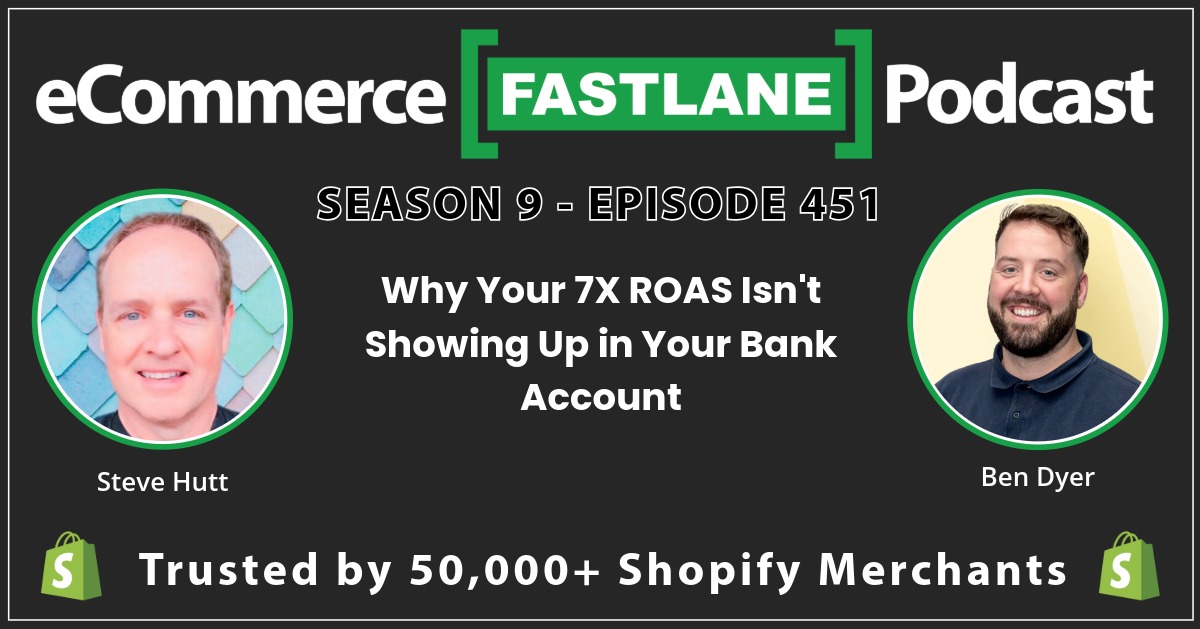
Too many Shopify founders discover this six months too late: a climbing top line and a shrinking bottom line can absolutely co-exist.
You can scale to $5M, $10M, even $20M in revenue—while your contribution margin quietly erodes, eaten alive by rising CAC, inflated COGS, and paid media that props up growth instead of powering profit.
If you’re in that $5M–$30M range and your ROAS dashboard looks great but your bank account tells another story, this episode is your wake-up call.
My guest today is Ben Dyer, Head of Growth at Webtopia—a profit-led growth partner for mid-market DTC brands. As an official Meta partner managing over $100 million in ad spend and having driven more than $400 million in client revenue, Ben’s seen inside enough brand P&Ls to know exactly where margin goes to die—and how to stop it. He’s worked with brands scaling from $5M to $70M+, navigating everything from Meta’s Andromeda shift to tariff volatility and rising customer acquisition costs.
In this conversation, Ben breaks down Webtopia’s profit-first framework—how to spot hidden margin leaks before they become fatal and what to do to reverse them. Whether you’re crossing seven figures or optimizing a $20M+ operation, this is your playbook for turning growth into real profitability.
Let’s dive in.
What You’ll Learn
✅ Why ROAS can be a vanity metric and the profit-focused metrics that actually tell you whether your paid media is making you money or just keeping you busy.
✅ How a haircare brand shifted 83% of its Google budget from branded to non-branded search, freed up spend to reach new customers, and grew revenue by 74%.
✅ What the Meta Andromeda shift really means and how Meta moved from demographic targeting to content engagement, plus how to craft creatives that win when your pixel can’t do the heavy lifting anymore.
✅ The subscription brand push-pull cycle Webtopia uses: run hard on acquisition for three months, then pause to harvest recurring revenue, scaling the top line without burning margin.
✅ The key mindset shift for early-stage brands and why ads should amplify what already works, not fix what doesn’t. This perspective separates profitable brands from those accidentally subsidizing growth.
✅ How to apply the RFM model to Shopify by mapping which customers who buy Product A also buy B, C, and D (and which never return) so you can allocate ad spend with precision.
More than 3,500 ecommerce brands use Insense to source UGC, run influencer campaigns, and launch creator-led ads from one platform. With access to 80,000+ vetted creators across 35+ countries and a native Shopify integration for product seeding, Insense helps brands move faster without adding more manual work to the team.
Most brands start receiving creator applications within 48 hours, making it easier to find creators who actually fit the brief and turn ideas into live campaigns quickly. Brands use Insense to manage sourcing, outreach, deliverables, contracts, payments, and activation for formats like Meta Partnership Ads and TikTok Spark Ads in one place.
Results include Bones Coffee generating $25,000+ in revenue with a 2.16 ROAS from 54 UGC ads in 3 months, Quip reaching 85% influencer activation, and Easy A Media sourcing 100+ UGC assets in 45 days through product seeding alone.
Book a demo and get $200 off your first campaign through March 27.
Episode Summary
The most common issue Ben Dyer sees in $5M–$30M DTC brands isn’t a lack of growth, it’s mistaking revenue for health. A 7x ROAS might look great, but when you dig into contribution margin, a different story often emerges. Rising shipping costs, labor, tariffs, and a constantly climbing CAC can quietly erode profitability even as the top line grows. There’s often a real gap between where founders think they are and where the P&L says they actually are.
That profit-first mindset is what’s shaped Webtopia’s evolution from an ad agency into a profit-led growth partner. Instead of managing Meta and Google channels in isolation, Webtopia looks at the entire commercial model: COGS, acquisition costs, LTV by product, and retention all together. One standout example is a haircare brand they’ve supported for nearly six years, scaling from zero to over $60M during COVID. When analysis revealed they were wasting 83% of their Google budget on branded search, essentially paying for customers already intent on buying, Webtopia redirected that spend to non-branded campaigns targeting new audiences. The result? 74% revenue growth.
Ben also unpacks Meta’s Andromeda shift, the move from demographic and interest-based targeting to creative-led discovery. While many saw the change as a challenge, Ben sees it as a return to fundamentals: good creative now wins. If your content misses the mark, Meta marks you irrelevant, CPMs rise, and returns crash. Webtopia’s response has been to build audience personas from real engagement data instead of assumptions, letting customer behavior define the ICP rather than founder intuition.
Behind it all is a data-driven approach to product journey modeling. When you know that buyers of Product A repurchase six times while buyers of Product B rarely return, you can redirect ad spend with surgical precision. This RFM thinking (recency, frequency, and monetization) is what separates brands that scale profitably from those that grow into a cash flow crunch.
For earlier-stage brands, Ben’s message is simple: build equity before you buy growth. Focus on organic reach and your email list first. Paid media amplifies what’s already working, but if your fundamentals are weak, ads will only expose the cracks faster and more expensively.
This episode isn’t just about ad tactics. It’s a masterclass in profit-led growth, showing what happens when you measure success not by spend or scale, but by sustainable, margin-first performance.
Strategic Takeaways
👉 ROAS is a starting point, not the scoreboard. A 7x or 8x return on ad spend only matters if it translates into profit. Real success comes from understanding contribution margin, CAC payback, and whether the customers you’re acquiring are actually profitable to serve. Webtopia’s approach looks beyond ad dashboards to account for every cost (COGS, shipping, labor, and LTV) so you know what’s really left over.
👉 Branded search can secretly drain your budget. If you’re spending heavily on branded Google campaigns, you might be paying for customers who were already going to buy. Webtopia’s haircare case study proved the point: shifting 83% of branded spend toward non-branded campaigns drove 74% revenue growth by reallocating budget toward genuinely new customers.
👉 Creative quality is the new targeting. After Meta’s Andromeda update, demographic targeting took a back seat to engagement signals. The algorithm now rewards content that captures attention, specifically who watches, clicks, and interacts. Weak creative drives irrelevance, higher CPMs, and collapsing returns. The winning move is to build audience personas from actual engagement data, not assumptions about who should buy.
👉 Map the product journey before scaling ads. When you know which products drive repeat purchases and which don’t, you can target acquisition with precision. Webtopia tracks how customers move across product lines, identifying entry products with strong LTV versus those that stall after one purchase. This clarity tells you which customers to acquire, not just how many.
👉 Subscription brands win with push-pull cycles. Instead of chasing steady ROAS, Webtopia runs three months of aggressive acquisition followed by three months of harvesting recurring revenue. Each cycle steps up the top line while protecting margin. The key is patience and trusting the model rather than forcing constant acquisition pressure.
👉 Build organic equity before buying growth. Paid ads amplify what’s already working, and they won’t fix weak fundamentals. For early-stage brands, the play is simple: earn organic traffic first, build an email list, and use that data to train your ad pixels with high-quality signals. Then, when you turn on paid, you’re pouring fuel on a fire that’s already burning.
Guest Spotlight
Ben Dyer Head of Growth, Webtopia
Ben Dyer is the Head of Growth at Webtopia, a profit-led growth partner for mid-market DTC brands in the $5M–$30M+ range. As an official Meta partner managing over $100 million in ad spend across social, search, and content, Webtopia has helped generate more than $400 million in client revenue for brands operating on marketplaces, TikTok, YouTube, and beyond. Their average client relationship lasts three to six years, a rare feat in the agency world and a reflection of how deeply the team embeds within each brand’s commercial operations.
What sets Ben apart from the typical media buyer is his financial discipline. Before entering marketing, he built his career in accounting, a foundation that now shapes how he diagnoses margin erosion, analyzes LTV by product line, and accounts for macro factors like tariffs and COGS volatility. That financial lens is exactly why Webtopia operates as a commercial partner, not just a channel operator.
Ben also leads the alignment between Webtopia and its sister company, Oak Email Studio, which manages retention through email and SMS. Together, they create a seamless acquisition-to-retention system that drives profitability from both sides of the funnel.
If your Shopify brand is in that $5M–$30M range, has clear product‑market fit, and is ready to trade vanity metrics for sustainable profit growth, Webtopia is built for exactly where you are.
Links & Resources
Thanks for Supporting the Pod!
Over 9 seasons, I’ve been incredibly fortunate to chat with some of the brightest founders building amazing Shopify brands and the partners shaping the app and marketing ecosystem. Every conversation has taught me something new, and I’m grateful for the chance to learn alongside you.
What matters most is that this podcast helps you solve real challenges and discover new ways to grow. Your support, feedback, and stories have made this journey truly special. Thanks for tuning in, sharing your wins and losses, and being part of the eCommerce Fastlane community.
Stay Connected: Leave an Honest Rating/Review on Apple Podcasts or Spotify. Follow & Subscribe on YouTube for new episodes.
Like Reading? Here’s the Full Episode Transcript 👇
Steve Hutt:
Welcome back to eCommerce Fastlane. I’m your host, Steve Hutt. Today’s conversation is really interesting because I think a lot of Shopify brands don’t realize what we’re going to talk about until it’s too late. They think they have a growth problem, but a lot of the time, they actually have a profitability problem that’s disguised as growth. It’s the old saying about ROAS.
Steve Hutt:
Sometimes I think ROAS is a bit of a vanity metric. You say, “Hey, I’m doing a 5x or an 8x ROAS,” and you assume there’s a lot of money going into your bank account. The reality is, that’s often not true. Revenue can be climbing, but contribution margin can be shrinking while your CAC, your acquisition costs, keep rising. Paid media is carrying a lot of businesses right now, and the harder you push for acquisition, the less you might actually get to keep. That leads into the retention conversation that we’re going to dig into today.
Steve Hutt:
My guest today is perfect for this topic. His name is Ben Dyer. Ben is the Head of Growth at a company called Webtopia. They’re a profit-led growth partner for mid-market D2C brands. Their sweet spot is brands with at least around $5 million in revenue, up into the tens of millions, where there’s clearly product–market fit but not always true profitability yet.
Steve Hutt:
I think that’s a great revenue range. If that’s you, this is a good episode to pay attention to. They’re an official Meta partner, they manage over $100 million in ad spend, and they’ve helped generate over $400 million in client revenue across channels like marketplaces, TikTok, YouTube, and more. Webtopia is really a business partner. They work alongside a sister company—which is another podcast I’m recording later today—called Oak Email Studio. Together, they align acquisition and retention under one commercial model. It’s a very interesting setup.
Steve Hutt:
In today’s episode, I want to unpack what profitability‑first growth actually looks like. That’s the most important thing. Then we’ll dig into where most brands are leaking margin without realizing it. I have a bit of experience here, but I know Ben has a ton. So, Ben, welcome to eCommerce Fastlane.
Ben Dyer:
Steve, thanks so much for having me. It’s a pleasure to be here—and what an intro.
Steve Hutt:
Thank you so much, and thanks for the hustle. Our time zones are significantly different—I can tell by the accent—so I appreciate you making the effort. I know you often have to work on Eastern time, but I really value you being here because profitability is incredibly important. We’re past Q4 of last year, we’re rolling into Q1, and Q2 is literally around the corner. A lot of people are looking at their numbers and they’re not overly excited. They’re asking, “Am I maximizing the profitability of my business?”
Steve Hutt:
From your perspective, what are these brands dealing with? You’ve used this language before—profitability disguised by growth: revenue going up, margin going down. When a brand comes to you and you open up the books, what does it actually look like?
Ben Dyer:
Yeah, 100%. As you said, Q4 is a hectic time, and even January is hectic. People are rebounding off the back of it. “New year, new me” is a big movement in January. By February, a lot of people sit down and realize, “Top line was really good, bottom line, not so hot.”
Ben Dyer:
When we look at what we do as a partner, we’re mostly focused on social, search, and then content creation. As you said earlier, if we jump on a call with a brand and they tell us they have a 7x ROAS, it can be a vanity metric. There’s so much behind that—different attribution windows, for example. It looks fantastic and gives you a bit of an ego boost when you see it, but it doesn’t always tell the full story.
Ben Dyer:
So, when we talk to businesses at a profitability level, we dig into CAC. How much are you acquiring a customer for? Is that breakeven for you? If not, what’s your retention strategy? Some businesses are one‑and‑done, so they have to be super profitable on the first purchase. Others know their LTV over 3, 6, or 12 months is really strong, customers come back five or six times, and they can afford to lose a bit on the first sale.
Ben Dyer:
As you grow, those lines get blurred for some brands, and it becomes even more important to be super clear on the numbers. You also can’t just look at your own eCom/D2C world; you have to factor in macroeconomic trends that affect COGS—shipping costs going up, labor costs going up, and so on. If you’re not adjusting your plans and financial projections with these in mind, you can hit your revenue goals and still make less money than you expected because the cost to make your product has gone up by 15–20%.
Ben Dyer:
Take tariffs as an example. We work mostly with American brands, so tariffs matter. Recently India dropped its tariffs to around 18%. Before that, they were climbing and became very hard to predict. So you want to err on the side of caution in volatile environments like that. With tariffs moving, and other global factors at play, you have to wear multiple hats—not just your “eCom” hat. You need to stay current with the news and understand your numbers deeply. Every business is different—different costs, different goals. Some brands are fine not making money for a year. For some subscription brands we work with, we’ll push really hard for acquisition over three months, be less profitable than we could be, then pull back for three months while subscriptions roll in and that’s where they make their cash. Over time, you see the top line get bigger and bigger as you cycle through those phases.
Steve Hutt:
This is amazing. It sounds like Webtopia has almost made a bit of a pivot—from being primarily a channel operator in the past, very surgical and specific, to now being more of a profit‑led growth partner. That’s how you position yourselves on the website, and it makes total sense.
Steve Hutt:
I was trying to understand your unique value proposition and moat for D2C brands. Clearly, you’re not just a marketing agency pulling a bunch of disconnected tactics. You’re looking at the full scope of the business through a profitability lens. You understand fixed and variable costs, and you’re not obsessed with the vanity side of total revenue. You care about what goes into the bank account after all those fixed and variable costs. That’s where the profitability‑led marketing comes in and how Webtopia is positioned. Am I right in assuming that’s how you help people today?
Ben Dyer:
Absolutely. If we look at what media buying has become, I’d be naive to think media buying in its current form will be the same 12 months from now. Meta recently acquired Manus, which is already being baked into Meta ad accounts so you can create digital agents to do tasks for you.
Ben Dyer:
With partners, we plug into their team. It’s not, “You own that, we’ll talk to you in three weeks.” It’s a tight, ongoing collaboration, because the landscape changes so fast. Webtopia plugs into that environment. Yes, we still do the foundational stuff like building ads, which I assume will be heavily AI‑automated in 12 months, but we’re also operating at a higher level—understanding where new customers are coming from, where retention is coming from, and leaning into those insights.
Ben Dyer:
One of the biggest Meta changes in the last 12 months is Andromeda, which deprioritizes demographic targeting and prioritizes content. I’m actually delighted about this. Some people saw it coming and felt like it was iOS 14 all over again, but when you strip it back, it takes marketing back to the fun stages.
Ben Dyer:
Before Andromeda, you could “school” a pixel with pure data and make it perform. It was all data, data, data. It still is data‑driven, but now data is led by content, which is what marketing should be—understanding who’s consuming your content, who’s watching and clicking, and then building personas around that. That’s where we’ve been evolving over the last 12 months at Webtopia. “Content is king or queen,” depending on who you ask, but it really is true. You can run all the demographic or interest targeting you like in Meta, but if your content isn’t on point, people won’t engage.
Ben Dyer:
The less they engage, the higher your costs. Meta will see your ads as irrelevant to the audience, your CPM spikes, your CPC goes up, and suddenly you’re seeing red across Meta or Google. So, short answer: Webtopia plugs in as an overall business strategy partner for D2C brands, understanding from bottom to top what’s needed to be profitable.
Steve Hutt:
That’s interesting. I was looking at some of your case studies, and there was a perfect example with a haircare brand on your site—and I think I saw it on LinkedIn too. They were spending about 80% of their Google budget on branded search. You came in and flipped that to about 83% non‑brand, and according to the case study, saw 74% revenue growth.
Steve Hutt:
Can you walk me through that? A lot of brands are unfortunately paying for customers who were already going to buy anyway, and that really eats into margin. Talk us through that case study at a high level.
Ben Dyer:
Absolutely. These guys are super fun to work with. They set up at the start of COVID as a bit of an experiment and suddenly became a 50, 60, 70‑million‑dollar brand in a short period, which has been amazing. We’ve been on that journey with them.
Ben Dyer:
One thing we do at Webtopia is work very closely with founders. Being able to sit down with founders weekly or even daily is super important. You’re talking directly to decision‑makers and bouncing ideas around. No one knows the brand better than the founder. We do work with marketing managers too, but we try to keep a line open to the founders as well because that collaboration is powerful.
Ben Dyer:
Going back to ROAS: a few years ago, you were judged almost entirely on ROAS. If you were at 5–7x, you were seen as doing a good job; if it dropped to 3–4x, you were seen as doing a bad job. Some people still think that way, but now you have to zoom out, especially as you grow. The more you grow, the more people are searching for you and discovering you.
Ben Dyer:
When this haircare brand came to us, they’d gone from nothing to 60–70 million in 5–6 years, so there was a lot of awareness. They were very specific to a particular hair type, so people knew the brand and were Googling it. It’s easy to run a brand campaign and capture everyone already looking for you, then claim a 10x ROAS—but the truth is, those people were going to buy anyway. In this case, they were spending a large amount on that brand traffic.
Ben Dyer:
That money is better spent going after people who don’t know you yet. Our job on the social and search side, especially when a brand is growing, is to get as many new customers as possible. That’s where you should be spending your money, and that’s what we did here—shifting spend from branded to non‑branded to drive incremental growth.
Steve Hutt:
That makes sense. When I think about campaign optimization, one lever is feed optimization or campaign structure changes, plus creative updates. Sometimes you get what I’ll call “creative fatigue”—you’ve got a couple of videos running on paid social, they’ve had their run, and then you find yourself scrambling for new creative, which isn’t ideal.
Steve Hutt:
We’re talking about the paid ad side of the business, which is part of the ROAS story, but what you feed the system matters: creative, feed structure, and campaign setup. There are levers you can pull and sequence properly that make an account more profitable. I think that’s where you fit in. Can you talk about that?
Ben Dyer:
Absolutely. There are a lot of “dark arts,” so to speak—a few different moving parts. Feed optimization is massively important. When people are on Google Shopping, scrolling across the top of their phone—and I’ll say phone a lot because most consumers are on mobile—you need to stand out on that small screen.
Ben Dyer:
Personally, I can’t remember the last time I completed a purchase on desktop; if I did, it was for research, not buying. People buy on their commute, at lunch, on the sofa. When they’re scrolling through shopping ads on a small screen, most images have a plain background. You’re paying to be there, so you want to stand out. You won’t get everyone to click, but you can make your listings more compelling.
Ben Dyer:
Small feed optimizations can be really powerful. There are tools you can plug in between Google and Shopify so you don’t have to change your Shopify catalog; you adjust in the tool and Google shows it differently. You can do similar things for Meta and other social platforms. Feed optimization often gets neglected—people say, “We’ll just run dynamic ads with the catalog and they’ll be fine,” but it’s probably the most powerful asset you have.
Ben Dyer:
If we’re talking Meta or Google, those platforms will dynamically show what they think is the best product for each consumer. They know that I buy golf gear, for example, so they build a persona and show me what I’m most likely to buy. Having a catalog that stands out is important, because you’re paying for those impressions. You’re not trying to jump from a 3% conversion rate to 10% overnight; you’re trying to go from 3 to 3.2 to 3.4 to 3.8. Those 1% gains, depending on your scale, can add a lot of zeros to your bottom line.
Steve Hutt:
Exactly. We mentioned AI earlier, and I want to bring it back up because it’s on everyone’s mind. A lot of ad platforms are commoditizing tactical ad execution with AI baked into the interface—autonomous optimization, ad managers, and so on. If the platforms are automating media buying, what’s left for the brand to do?
Steve Hutt:
This is where your work comes in. We’ve talked about creative and feed optimization. Outside of what’s pre‑baked into the ad networks from an AI perspective, what else can a brand—or you—do to enhance performance?
Ben Dyer:
Media buying is becoming more and more automated. There’s still a bit of manual work, but nowhere near as much as before. So we look at the other 1% gains. CRO is a big one: is the website optimized, is it slow, do we need to test landing pages or customized funnels?
Ben Dyer:
This is where you move up the value chain. That’s what we’ve started offering: customized funnels, building demographics and personas around customers buying specific products, then nurturing them through a funnel. A couple of years ago, you could put out a pretty boring image ad and it would still sell. Now there are multiple touchpoints before someone buys. They might Google you, visit your site a few times, see you on social.
Ben Dyer:
The way I frame it is: social is your demand creation platform. People don’t open Instagram looking for your brand—they’re looking at cars, homes, babies, holidays. You appear in between those moments, creating demand. Search then captures that demand. People see a golf club on Instagram, decide they want a golf club, then Google “golf club”—that’s where you capture them on Google.
Ben Dyer:
Understanding that journey is critical. We build personas and then use the higher‑level tools—landing pages, custom funnels, profitability analysis, LTV, and so on—to add real value. For many of our brands, we don’t just look at top‑line revenue and its growth; we dig into product‑level patterns. If someone buys Product A, how often do they come back and buy B, C, D, or E? If they buy Product B, do they ever come back?
Ben Dyer:
You might be losing money on the first purchase of Product A, but they come back six times. Product B, meanwhile, looks great because you’re 3x profitable on the first purchase, but they never return. Really understanding that is extremely valuable.
Steve Hutt:
That’s the RFM modeling—recency, frequency, monetization. Back when I was at Shopify, we had point solutions that ingested your data and figured out, say, if someone bought Product A (like a pair of shoes), the next likely purchase was Product B, and they could identify the typical time window between those purchases.
Steve Hutt:
If you have the right tools—and I know you’re doing this now, and some of it is baked into Klaviyo—you can say, “You bought A, and most people buy B within 30–45 days, so we need a plan.” That plan might be SMS (if they’ve opted in) or, at minimum, email. The idea is to nudge people based on actual behavior and timing.
Steve Hutt:
That leads into segmentation: loyal customers, at‑risk customers who haven’t bought B yet, and churned customers who bought once and never returned. There’s a strategy for how you deal with each segment—active, at‑risk, churned. I see that as where your other agency fits in holistically from an email and SMS perspective. Am I right? I read that you have a 5‑stage creative performance system. Is that part of the overall framework for understanding the customer journey—from pre‑purchase through post‑purchase follow‑ups?
Ben Dyer:
Is that all part of your framework? Absolutely. Just going back to your model, myself and my brother—who runs the email side—we often debate how long someone is “churned” before they should be treated as a new customer again. Is it two years, three years?
Ben Dyer:
On the social/search side, we focus heavily on exclusions to make sure we’re targeting as many net‑new people as possible. But we’re constantly debating: should we exclude all‑time customers? If a brand is 10 years old and someone hasn’t bought in 8 years, if we reactivate them via paid social, are they effectively a new customer?
Ben Dyer:
People have different opinions on that, which is fine. Then, on the content creation side, it’s about guiding people through that journey. This is a broad statement, but in general, people aren’t just buying products anymore; they’re buying brands. They’re buying into stories, reasons, and communities—especially at $200, $300, $400 AOV.
Ben Dyer:
So the content side is about that journey: behind‑the‑scenes, founder stories, making, unboxing, and so on. You’re showing people what their full experience with the brand will look like before they ever purchase.
Steve Hutt:
I have another question, slightly off to the side. Let’s say there’s a merchant listening who’s earlier‑stage. You have a very specific sweet spot of customer where there’s enough data for you to really move the needle. For early‑stage brands, there are fundamental things they need to do—build business acumen, get product–market fit, get initial traction—before they’re ready for a partner like you.
Steve Hutt:
You must take a lot of calls with prospects who aren’t quite a fit yet for Webtopia. What do you say to them? Especially today, in the age of AI, what are a couple of takeaways they can use right now so that maybe in the future they are a fit for Webtopia?
Ben Dyer:
I like to give stage‑aware strategies or tactics. We’ve all been there. A lot of the people I work with have run their own brands or still do. We actually encourage our team at Webtopia to start and run brands because it helps them understand how brand owners feel.
Ben Dyer:
Personally, I feel organic is incredibly important. You can turn on ads and make things work for a while, but I see ads as a magnifier. If things are going well organically, ads can 10x that. If things aren’t going well, ads will magnify that too—your site doesn’t convert, your product doesn’t fit the customer, and so on. It’s super important to get organic to a good standard and prove that people will come to your site and buy for who you are before you start paying to send them there.
Ben Dyer:
The second big thing is your email list. We’re in an era where advertising on the big platforms is expensive and getting more so. Meta and Google costs are rising and the environment is volatile. So owned media—your email list and similar channels—is critical. A 10,000‑person email list can be incredibly powerful. You can sell to them directly, and you can also use that list to train pixels on the ad platforms, showing them what your ideal customer looks like.
Steve Hutt:
I totally agree on organic. Even during my six years at Shopify, I was a huge proponent of organic traffic. It often has the highest ROI because it’s natural placement in Google.
Steve Hutt:
There is a bit of a pivot happening with large language models, AI Overviews, and zero‑click searches. I’ve done a lot of research there for my own media company. My traffic hasn’t gone down because I’ve expanded internationally into multiple languages, creating new markets with either localized versions of existing content or new content. Brands can learn from that—localization of both payment methods and language, particularly leveraging default languages in browsers like Chrome.
Steve Hutt:
Shopify Magic and Shopify Sidekick are interesting here. There’s a lot pre‑built that early‑stage companies can use to build out strong product descriptions and metadata. I wrote an article about Shopify Magic vs. Sidekick, because they’re similar but different—they both support Shopify’s push to become an AI‑first company and drive what I’d call agentic commerce with Google and other platforms.
Steve Hutt:
If organic is so important, is there anything Webtopia can assist with there? Do you help with strategy and execution for on‑page work, product catalog structure, maybe blogging? At the end of the day, you want to show up in AI citations, Gemini, AI Overviews. A lot of that is still classic SEO—Google scraping, indexing, and surfacing—but we’re also hearing about GEO (generative engine optimization). Some tools scrape the web differently and build their own content graphs. Do you have experience with organic placement and what it means in an AI world?
Ben Dyer:
It’s a tough one. Some people say AI is going to take over the world; others say they don’t use AI at all. I use AI to supplement what I do, and I encourage its use—there are so many great tools. Going back to SEO and GEO, for one brand we work with in jewelry, an influential TV personality bought from them organically.
Ben Dyer:
We then noticed a lot of search volume around that person’s name plus the type of jewelry. So we worked with the brand to build blog content around that combination for SEO. As a result, we started seeing relevant search terms pop up and drive traffic and sales. It’s really important to understand what people are looking for. You can use AI for that or do it manually, but either way, you need to listen to the data and adapt.
Ben Dyer:
Sometimes early‑stage brand owners come to us and say, “My ideal audience is a 25‑year‑old woman in Glasgow,” and then we discover it’s actually a 45‑year‑old man in a different region. You have to be willing to accept what the data is telling you and adjust. In the jewelry example, blogs were critical for SEO. Some people say SEO is dying. I don’t think SEO is dying; like AI, it’s evolving. You can’t do it the way you did 10 years ago, but that doesn’t mean it’s dead; it means you have to adapt.
Steve Hutt:
A lot of people are now dabbling with AI tools for prompts. Instead of classic keyword tracking, we’re looking at “prompt tracking,” because people interact with chatbots—ChatGPT, Claude, Gemini, Perplexity—using natural language. They’re speaking into their phones more than typing keywords. Google is getting very good at understanding these query patterns.
Steve Hutt:
Tools are adapting. People ask, “What are the best running shoes for men over 50?” That’s exactly the kind of question a large language model gets. The question becomes: how do you get cited in that answer? That’s where agentic commerce comes in. It’s early—less than 1% of total GMV—but the future is clear: larger brands are already laying groundwork, ensuring their schema and product catalogs are strong, doing everything they can from an SEO/GEO perspective, and also thinking about answer engine optimization.
Steve Hutt:
They’re producing a lot of content—on‑page and off‑page—on Reddit, YouTube, blogs, etc. These models scrape all that and capture brand mentions. We haven’t talked much about brand mentions, but they’re key. You had a case study where you reduced brand campaign spend because customers were already going to buy. You don’t necessarily want to pay for every brand click. But from an AI perspective, you actually want a lot of unpaid brand mentions out there.
Steve Hutt:
These LLMs see those mentions, corroborate the story about the brand, and that helps drive citations in the models when people ask for product recommendations.
Ben Dyer:
It’s super exciting. Before marketing, I worked in accounting. One thing I love about marketing is how fast it moves—it’s exciting. Answering people’s questions proactively is part of what we do at Webtopia—review mining, data mining, and understanding what people are already saying about your product, as well as anticipating the questions and objections they might have.
Ben Dyer:
We then build content to answer those questions—what sets you apart, why someone should choose you, what their experience will be like. That’s a big part of our role. It’ll be fascinating to see where this all goes. We also have the cookieless future coming, eCPA in California, and so on. It’s getting harder, but there are tools that help you model data in compliant ways and still understand performance.
Ben Dyer:
So, as you said, it’s important to answer questions almost before they’re asked.
Steve Hutt:
If someone’s listening and this conversation resonates—growth through a profitability lens being the core theme—what should they do next to learn about Webtopia?
Steve Hutt:
Let’s say they’re growing, they’re in the sweet spot for Webtopia, but they can’t see the forest for the trees. They don’t have a proper framework for understanding profitability beyond ROAS. They can check their bank account, but finance and marketing don’t always talk, and the CEO is stuck in the middle. There are silos. I think you help fix that disconnect between the financial and marketing sides of the business. What should someone do next? Is there an audit, an initial conversation, a fit assessment based on GMV and complexity? How does that work if someone listening is your ideal customer?
Ben Dyer:
The long answer starts back in COVID. Everything moved online, and unfortunately, a lot of people suddenly presented themselves as marketing experts. I’m not claiming to be an expert, but I’ve learned a lot. Many brands got burned. It took time for the industry to heal and rebuild trust.
Ben Dyer:
Audits are important, but you can almost audit a Meta or Google account with a script now—you don’t always need to dig through every setting manually. The more important piece is a business‑level audit. At Webtopia, we refer to “partners” rather than “clients” because we see it as a collaboration. Many of our partners have been with us for 3, 4, 5, even 6 years, which is not typical in agency land where some shops have a “4 in, 4 out” model every month.
Ben Dyer:
For us, it’s massively important that we vibe together. It’s a very millennial word, but it matters. Before we talk business, we want to know that we enjoy talking to each other, that we can bounce ideas around, and that we share a similar vision. Someone can come in with a totally different vision from ours, and that’s okay, but if we don’t align, we might not be the best partner for them and we’ll say so.
Ben Dyer:
Once we feel that fit, then we get into the accounts, use scripts where needed, and also look at the broader business picture—profitability, COGS, what’s driving revenue growth, and why profit isn’t matching. We dig into all of that. So the short answer is: book a call on our website. The long answer is everything I just described.
Steve Hutt:
I love that. “Business partner” is the right language. It’s more than transactional. The vibe matters because you’re all on the same trajectory. Often the cost of an agency partner should be the smallest part of the equation; the upside of profitability should more than justify a strategic partner.
Steve Hutt:
That’s why I wanted you on the show. There’s a real need in the market. There are partners out there, but there’s also a revolving door in the agency world, especially in done‑for‑you marketing. You’re looking beyond channel marketing to a more holistic view, which is why you’ve acquired Oak and brought them under the Webtopia umbrella. I’ll be interviewing them in a couple of minutes.
Steve Hutt:
This has been great, Ben. I’ve been scribbling a lot of notes. I think it’s been an impactful episode. We’ve all learned a lot about where we are as an industry and the incredible amount of opportunity that’s still out there.
Steve Hutt:
For me, the big takeaway is really understanding the financial side of your business. Looking through that profitability lens rather than just the vanity of ROAS is key. That really hit home for me as we talked. I just want to thank you for coming on the show. Any parting words before we wrap up?
Ben Dyer:
Growth comes in many forms. It’s not just top‑line revenue; it’s efficiency and small wins. It’s easy to sit down at the end of the year and say, “We wanted to hit $10 million and only hit $9 million—we missed our growth target.” But maybe your efficiency improved by 20%. That’s growth too.
Ben Dyer:
It’s important to recognize that growth doesn’t always happen exactly the way you planned. You need to be agile, adapt, and understand what’s happening along the way. Running and growing a brand is super exciting. There will be people listening with $100‑million brands and others with $10,000 brands, but everyone started somewhere.
Ben Dyer:
I wish everyone the best of luck with what they’re building.
Steve Hutt:
That’s lovely. Thanks, Ben.
Ben Dyer:
Thank you so much, and have an awesome day.
Steve Hutt:
Thanks so much, Steve.
Ben Dyer:
Dave.
Steve Hutt:
All right, take care.
Steve Hutt:
Well, that’s it for today’s episode. I’d like to thank you personally for being a loyal listener of eCommerce Fastlane. It’s my hope that this podcast gives you a ton of value through growth strategies, tactics, and exclusive insider tips on the best Shopify apps and marketing platforms—with my goal always being to help you build, manage, grow, and scale a successful, thriving company powered by Shopify.
Steve Hutt:
Thanks for investing some time today and listening to the show. I’m proud and excited that you have a growth mindset and that you’re a constant learner. I truly appreciate you and your entrepreneurial journey. Enjoy the rest of your week and keep thriving with Shopify.
