





Quick Decision Framework
- Who This Is For: Growth and established Shopify brands ($50K to $2M+ monthly) who are flying blind on customer LTV, churn risk, and ad attribution and want one platform to fix all three.
- Skip If: You are pre-revenue or under $50K monthly and have not yet established repeat purchase patterns worth analyzing; the platform’s depth will exceed your current data volume.
- Key Benefit: RetentionX unifies customer intelligence, identity resolution, marketing attribution, and automation in one platform, replacing the fragmented stack of Klaviyo analytics, GA4, and a separate CDP that most mid-market brands are currently duct-taping together.
- What You’ll Need: A Shopify store with at least 6 to 12 months of order history for cohort analysis to be meaningful; Klaviyo, Meta, or Google Ads connected for full attribution value; 2 to 4 hours for initial setup; ongoing weekly review by a marketer or founder.
- Time to Complete: 15 minutes to read this review; 1 to 2 hours to connect to Shopify; 1 to 3 days for full historical data sync and segment population.
If you are evaluating RetentionX, you are almost certainly also looking at Klaviyo’s analytics layer and Triple Whale. These three tools dominate the customer data conversation for Shopify merchants, and they each solve the core problem differently. RetentionX takes the approach of a unified Growth OS: it wants to be the intelligence layer that connects customer behavior, ad attribution, and automated action in one place. Klaviyo is built around email and SMS execution with analytics as a supporting feature, not the core product. Triple Whale focuses on paid media attribution and profit analytics with less emphasis on customer segmentation depth. By the end of this review, you will know exactly which one fits where you are today.
Is RetentionX Actually Worth It for Your Shopify Store?
Here is the truth most analytics reviews will not tell you: the problem is not that Shopify brands lack data. The problem is that their data is fragmented across Shopify, Klaviyo, Google Analytics, and their ad platforms, and nobody on the team has the bandwidth to reconcile it. RetentionX bets that the answer is consolidation into one intelligent platform rather than adding another point solution. Based on what I have seen across 440 plus podcast episodes and thousands of merchant conversations, that bet is directionally correct for brands at the growth stage and above.
I have been tracking the customer intelligence space for Shopify brands since the early days of DTC, and I have watched the category evolve from basic cohort reports into what RetentionX represents today: a platform that combines the LTV analytics of a traditional CDP, the attribution capabilities of a paid media tool, and the automation layer of a retention platform. The brands I have seen get the most from it are the ones who already know they have a retention problem but have not had the data infrastructure to act on it with precision.
This review is based on direct analysis of RetentionX’s current feature set as of March 2026, evaluation of published case studies across fashion, home, and DTC brands, review of 124 Shopify App Store ratings, comparison against Klaviyo’s analytics capabilities and Triple Whale across the specific use cases that matter most to Shopify merchants, and conversations with brands operating across the $50K to $2M+ monthly revenue range.
Who Is RetentionX Actually For?
Emerging Stage ($0 to $50K Monthly)
The Promise: Access to LTV tracking, cohort analysis, and customer segmentation from day one, with a $49/month entry point that makes professional analytics accessible without enterprise pricing.
The Reality: The platform’s depth is its strength and its limitation at this stage. With fewer than 500 to 1,000 customers, cohort analysis and RFM segmentation do not have enough data to produce statistically meaningful signals. You will be looking at a powerful engine running at 10% capacity.
The Trigger: When you have 6 to 12 months of order history, a repeat purchase rate worth optimizing, and you find yourself making marketing decisions based on gut feel rather than customer behavior data.
Skip If: You are still focused on getting your first 100 customers. Spend that $49/month on acquisition, not analytics, until you have a customer base worth segmenting.
Growth Stage ($50K to $500K Monthly)
The Promise: This is where RetentionX starts to compound. The platform gives growth brands the ability to identify which customers are worth acquiring more of, which customers are about to churn, and which ad campaigns are actually driving high-LTV customers versus low-quality one-time buyers.
The Reality: You will need to invest 2 to 4 weeks to set up your core segments, connect your ad platforms, and build your first automated audiences before you see the full picture. The platform rewards teams who engage with the data rather than just install and check occasionally.
The Trigger: When your repeat purchase rate matters more than your new customer acquisition cost, and when you suspect your best customers look very different from your average customers but you cannot prove it yet.
Skip If: Your entire marketing operation is one person running ads with no bandwidth to act on segmentation insights. The platform generates intelligence; you still need the capacity to act on it.
Established Stage ($500K to $2M+ Monthly)
The Promise: At this stage, RetentionX functions as the intelligence layer that ties your entire customer strategy together: predictive churn modeling, AI-powered product recommendations, multi-touch attribution, and automated merchandising that sorts your collections based on real conversion data rather than manual judgment.
The Reality: Brands at this stage often already have fragmented point solutions doing parts of what RetentionX does. The consolidation case is compelling but requires an honest audit of what you are currently paying for and what you are willing to migrate.
The Trigger: When you are paying for a separate CDP, a separate attribution tool, and a separate merchandising solution and none of them talk to each other cleanly.
Skip If: You are on Shopify Plus with a fully built out data warehouse, a dedicated data team, and custom integrations that RetentionX cannot replicate. At that scale, you may have outgrown the platform’s current ceiling.
Stage Recommendation at a Glance
What RetentionX Actually Does Well
Capability 1: Customer Intelligence and LTV Analytics
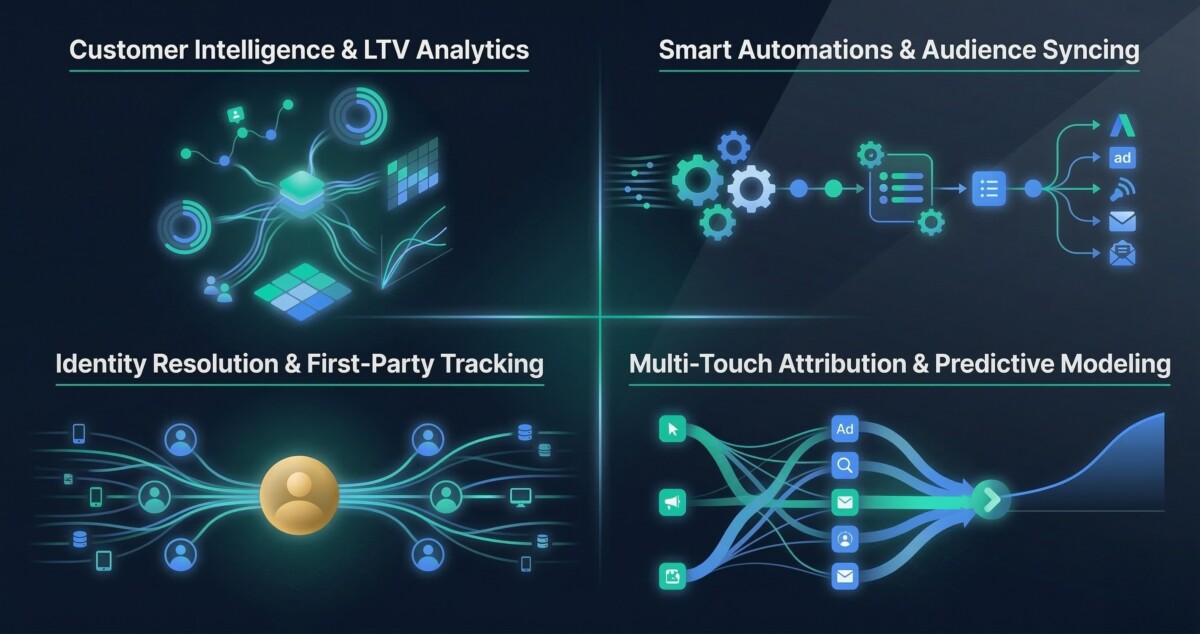
RetentionX’s core is a suite of 100 plus analytics tools built around one central question: which customers are actually valuable, and what does it take to get more of them? The platform gives you RFM analysis (Recency, Frequency, Monetary value), cohort viewers that show how customer groups behave over time, LTV analyzers that project future revenue from existing segments, and product analytics that reveal which items drive repeat purchase versus one-and-done buyers. What separates this from Shopify’s native analytics or even Klaviyo’s reporting is the depth of the behavioral layer. You are not just seeing what customers bought; you are seeing when they are likely to buy again, which products act as gateway purchases to higher LTV, and which segments are quietly eroding your revenue base.
The Stat That Matters
RetentionX’s own platform data across 1,500 plus brands shows an average 36% LTV improvement and 21% repeat purchase rate increase after 12 months of use. For NICKIS, the world’s leading luxury children’s fashion retailer, identifying the critical 90-day window between first and second purchase led to a 7 percentage point increase in repeat purchase rate and $1.25M in additional annual revenue. (Source: RetentionX Case Studies, March 2026)
Emerging ($0 to $50K): You will have access to all the dashboards from day one, but meaningful cohort data requires at least 6 months of order history. The realistic outcome at this stage is establishing your baseline metrics so that when you hit growth stage, you have historical data to compare against.
Growth ($50K to $500K): This is where the LTV analytics start generating real decisions. You will identify which acquisition channels are bringing in high-LTV customers versus low-quality buyers, which product categories anchor repeat purchase behavior, and which segments are worth investing in versus cutting. The ROI on that intelligence at this stage is significant.
Established ($500K to $2M+): At this stage, the AI predictive modeling (Growth plan) adds churn risk scoring and revenue forecasting that allows your team to operate proactively rather than reactively. You are not just understanding what happened; you are anticipating what will happen and acting before the revenue leaves.
vs. Klaviyo and Triple Whale: Klaviyo’s analytics are designed to serve email and SMS campaign decisions, not broad customer intelligence. Triple Whale excels at paid media attribution and profit analytics but does not offer the depth of RFM segmentation, cohort analysis, or LTV modeling that RetentionX provides. For brands that need to understand customer behavior across the full lifecycle, RetentionX is meaningfully deeper than either alternative.
Capability 2: Identity Resolution and First-Party Tracking
This is the capability that most reviews understate, and it is increasingly the most important one in a post-cookie world. RetentionX’s RX Identity layer combines a first-party pixel, server-side tracking, and cross-device identity resolution to build a complete picture of each customer across every touchpoint. When a customer browses on mobile, clicks an email on desktop, and purchases through a retargeting ad, RetentionX stitches those sessions together into a single customer profile. This matters enormously for attribution accuracy and for the quality of the audience segments you push to Meta, Google, and TikTok. Audiences built on resolved identities outperform audiences built on fragmented cookie data, which is why ARCHIVIST saw a 417% ROAS improvement using RetentionX’s lookalike audiences built from their top 10% LTV customers.
The Stat That Matters
ARCHIVIST, a digital luxury archive on Shopify, used RetentionX’s identity-resolved lookalike audiences to generate 753 new high-value customers and $251,000 in additional annual revenue, with a 417% ROAS improvement over standard audience targeting. The critical differentiator was that the audiences were continuously updated automatically, not static exports. (Source: RetentionX Case Studies, March 2026)
Emerging ($0 to $50K): Identity resolution is available on the Core plan ($149/month) and above. At this stage, the primary value is establishing clean first-party data from the beginning rather than trying to reconstruct it later.
Growth ($50K to $500K): This is where identity resolution starts to pay for itself in ad spend efficiency. If you are spending $10K to $50K per month on paid media, the improvement in audience quality from resolved identities versus raw Shopify customer lists can meaningfully improve your ROAS within the first 60 to 90 days.
Established ($500K to $2M+): At this scale, the server-side Conversion API becomes critical for maintaining attribution accuracy as browser-level tracking continues to degrade. The brands I have spoken with who have migrated to server-side tracking consistently report 15 to 25% improvement in attributed conversions.
vs. Klaviyo and Triple Whale: Klaviyo does not offer identity resolution or server-side tracking. Triple Whale has its own pixel and attribution layer (Triplewhale Pixel) but focuses primarily on paid media attribution rather than full cross-device identity resolution for segmentation purposes. For brands who need both attribution accuracy and audience quality, RetentionX’s identity layer is the more complete solution.
Capability 3: Smart Automations and Audience Syncing
RetentionX closes the loop between intelligence and action through three automation pillars: audience syncing to ad platforms, email and SMS flow triggers via Klaviyo and Attentive, and merchandising automation that sorts your Shopify collections based on real conversion data. The audience sync is particularly powerful because it is not a one-time export. RetentionX continuously updates your audience segments in Meta, Google, and TikTok as customers move between segments based on their behavior. A customer who enters your high-churn-risk segment automatically gets added to your winback retargeting audience. A customer who crosses the LTV threshold into your top 10% automatically gets added to your lookalike seed audience. This is the difference between a static snapshot and a living intelligence system.
The Stat That Matters
Plank+Beam, a solid wood furniture brand on Shopify, used RetentionX’s churn risk predictions integrated with Klaviyo to run a tiered winback campaign. The result was an 82% higher order rate versus the control group, recovering 1.17% of at-risk customers in just ten days and delivering a 14x ROI on RetentionX’s monthly subscription cost. Industry benchmarks for furniture winback campaigns typically sit at 0.1% to 0.3% placed order rates. (Source: RetentionX Case Studies, March 2026)
Emerging ($0 to $50K): The Audience Builder is available on the Starter plan, meaning you can start syncing segments to ad platforms from day one. At this stage, the practical value is ensuring your ad platforms are not wasting budget on existing customers or on low-LTV lookalike profiles.
Growth ($50K to $500K): The Core plan adds the Conversion API and Email and SMS Flows, which is where the automation layer becomes a genuine revenue driver. Brands at this stage typically see the most immediate ROI from churn prevention flows and first-to-second-purchase sequences triggered by behavioral signals rather than time-based delays.
Established ($500K to $2M+): The merchandising automation is particularly valuable at this stage. Automatically sorting your collection pages based on which products actually convert for which customer segments removes a significant manual workload and can meaningfully improve on-site conversion rates without any additional ad spend.
vs. Klaviyo and Triple Whale: Klaviyo’s automation is deeper on the email and SMS execution side but relies on you building the segments and triggers manually. RetentionX generates the intelligence that makes those Klaviyo flows smarter. Triple Whale does not offer merchandising automation or behavioral audience syncing at this depth. The most powerful setup I have seen is RetentionX feeding enriched segments into Klaviyo rather than choosing between them.
Capability 4: Marketing Intelligence and Attribution
RetentionX’s Marketing Intelligence module (Core plan and above) provides multi-touch attribution models, a KPI Hub, and advanced reporting that connects ad spend to actual customer LTV rather than just last-click revenue. This is the capability that answers the question most Shopify brands are getting wrong: not “which campaign drove the most revenue this week” but “which campaign acquired customers who are still buying six months later.” The platform’s attribution models account for the full customer journey, including the email, the retargeting ad, and the organic search visit that preceded the purchase, giving you a more accurate picture of which channels are actually building your business versus which ones are capturing demand that would have converted anyway.
The Stat That Matters
MAAP, a premium cycling apparel brand, reported that RetentionX gave their marketing team visibility they had never had before, allowing them to adjust course rather than chasing flat ROAS numbers from agency reporting. The shift from last-click attribution to LTV-weighted attribution fundamentally changed how they allocated budget across channels. (Source: RetentionX Customer Testimonials, March 2026)
Emerging ($0 to $50K): Basic reporting is available on the Starter plan. At this stage, the attribution value is limited because you need volume across multiple channels to see meaningful patterns. Focus on the customer analytics first.
Growth ($50K to $500K): This is where multi-touch attribution starts to change real budget decisions. If you are running Meta, Google, and email simultaneously, understanding which combination of touchpoints produces your highest-LTV customers is worth significantly more than the $149/month Core plan cost.
Established ($500K to $2M+): The custom attribution models available at this stage allow you to weight channels based on your specific business model and customer journey. For brands with long consideration cycles or high AOV, this level of attribution customization is essential for accurate media mix modeling.
vs. Klaviyo and Triple Whale: Triple Whale is the strongest competitor on paid media attribution specifically, with a more mature pixel and more granular creative-level reporting. Klaviyo’s attribution is email-centric and does not provide cross-channel modeling. RetentionX’s advantage is connecting attribution to LTV rather than just revenue, which changes the strategic conclusions you draw from the data.
Shopify Integration: What Actually Syncs
What Syncs Natively: Full order history (including historical data from before install), customer profiles, product catalog, collection structure, refund and return data, Shopify customer tags, subscription data via Recharge integration, review data via Yotpo integration, support tickets via Gorgias and Zendesk, ad platform data via Google Ads, Meta, TikTok, and Pinterest.
What Requires Configuration: First-party pixel installation for behavioral tracking; Conversion API setup for server-side event passing; custom attribution model setup; Klaviyo and Attentive integration for flow triggering.
What Doesn’t Sync Automatically: Offline sales data (requires manual import or custom integration); marketplace sales from Amazon or other channels; custom ERP or inventory management data outside the Shopify ecosystem.
Integration Depth in Context
Beis Travel reported that rollout was seamless and within a few days they were able to consolidate their stores and accounts and have full data on all Shopify customers historically. This historical data import is a meaningful differentiator: most analytics tools only start tracking from the install date, leaving years of customer behavior invisible. (Source: RetentionX Customer Testimonials, March 2026)
Emerging: The historical data import means you are not starting from zero even if you install today. Your existing customer base, purchase patterns, and cohort data are available immediately after the sync completes.
Growth: Connecting Klaviyo and your ad platforms within the first week of installation is where the integration depth pays off. The enriched profiles that flow into Klaviyo from RetentionX transform your email segmentation from list-based to behavior-based.
Established: The multi-store management capability (Core plan and above) is critical for brands operating multiple Shopify stores or regional storefronts. Seeing consolidated customer intelligence across stores is something Shopify’s native analytics cannot provide.
Pricing vs. ROI: The Honest Calculation
Important pricing note: the prices above are for stores under $250K in annual sales. RetentionX pricing scales with your annual revenue across tiers from under $250K up to $30M plus. At $1M to $2.5M in annual revenue, for example, the Growth plan is priced higher than the base $249/month. Check retentionx.com/pricing for your specific tier. This is standard for analytics platforms at this depth and reflects the value scaling appropriately with your business size.
You are likely already spending on fragmented tools that RetentionX can partially or fully replace. Here is the consolidation case for a typical growth-stage brand:
- Separate CDP or customer analytics tool: $100 to $300/month
- Attribution tool (basic tier): $100 to $200/month
- Merchandising automation: $50 to $150/month
- Total fragmented stack: $250 to $650/month
- RetentionX Core or Growth equivalent: $149 to $249/month
- Monthly savings: $100 to $400/month | Annual savings: $1,200 to $4,800/year
The ROI Math at the Growth Stage
- Platform cost: $149 to $249/month (Core to Growth plan at sub-$250K annual revenue tier)
- Plank+Beam achieved 14x ROI on monthly subscription cost from a single winback campaign in 10 days (Source: RetentionX Case Studies, March 2026)
- On $200K monthly revenue with email driving 25% of sales: current email revenue = $50,000/month
- A 7 percentage point lift in repeat purchase rate (NICKIS benchmark) = $3,500 to $7,000/month in incremental revenue from the email channel alone
- Platform cost: $149 to $249/month
- Net ROI: 14x to 47x on platform cost at growth stage, based on published case study results
- The constraint is never the platform cost. It is whether you have the strategy and bandwidth to act on what the data tells you.
Emerging Stage ROI: At sub-$50K monthly, the ROI case is real but slower to materialize. The primary value is building clean data infrastructure from the beginning. Think of the $49/month Starter plan as insurance against the data debt that kills analytics projects at the growth stage.
Growth Stage ROI: This is where the math gets compelling fast. A single well-executed churn prevention campaign or first-to-second-purchase sequence, informed by RetentionX’s behavioral data, can generate 10x to 20x the monthly platform cost. The brands in the case studies are not outliers; they are the expected outcome for teams who engage with the platform seriously.
Established Stage ROI: At $500K plus monthly, the ROI is less about individual campaigns and more about the compound effect of making every marketing decision with better data. A 5% improvement in LTV across your customer base at $1M monthly revenue is $50,000/month in incremental revenue. The platform cost becomes a rounding error.
User Experience and Team Adoption
Who Manages This Day to Day:
- Emerging: Founder or solo marketer; 1 to 2 hours per week reviewing dashboards and adjusting segments
- Growth: Marketing manager or retention specialist; 3 to 5 hours per week actively building segments, reviewing attribution, and triggering audience syncs
- Established: Dedicated retention or analytics role; 5 to 10 hours per week across strategy, reporting, and automation management
The Honest Reality from Long Term Users
A small Netherlands-based store noted: “It does take some time to find the right settings and determine which data is most relevant to use, but our Strategist Kori is highly knowledgeable and guides us well through the process.” This is the honest tradeoff: RetentionX is not a plug-and-play dashboard. It rewards teams who invest in understanding what the data means and act on it consistently. (Source: Shopify App Store Reviews, January 2026)
Pros and Cons: The Honest Assessment
Strategic Advantages
Advantage 1: The Most Complete Retention Intelligence Stack in One Platform
(Source: Feature Analysis, March 2026)
No other Shopify app at this price point combines LTV analytics, identity resolution, churn prediction, merchandising automation, and multi-touch attribution in a single interface. For growth-stage brands who have been duct-taping five tools together to approximate this capability, RetentionX is a consolidation that reduces cost and eliminates the data reconciliation problem entirely.
Advantage 2: Human Support That Actually Knows Ecommerce
(Source: Shopify App Store Reviews, March 2026)
Across 124 reviews averaging 5.0 stars, the support team is mentioned in nearly every positive review. Multiple reviewers specifically name their strategists by first name, which tells you something about the quality of the relationship. At the Growth plan level, a dedicated CSM and quarterly strategy review are included, which is unusually generous for a $249/month platform.
Advantage 3: Continuous Audience Syncing Rather Than Static Exports
(Source: Feature Analysis and ARCHIVIST Case Study, March 2026)
The difference between a static audience export and a continuously updated segment that reflects real-time customer behavior is the difference between targeting who your customers were last month and who they are right now. This is the capability that produced ARCHIVIST’s 417% ROAS improvement, and it is the capability that most brands do not realize they are missing until they see it working.
Advantage 4: Historical Data Import from Day One
(Source: Brands Reported This, March 2026)
Most analytics tools start tracking from the install date, leaving years of customer history invisible. RetentionX imports your full Shopify order history on connection, meaning your cohort analysis and LTV models are immediately meaningful rather than requiring months of data accumulation before they produce actionable signals.
Honest Limitations
Three Things Most RetentionX Reviews Won’t Tell You
- Pricing Scales with Revenue. The base prices ($49, $149, $249/month) apply only to stores under $250K in annual sales. As your revenue grows, so does the platform cost. This is appropriate and transparent, but brands should model their expected pricing at their current and projected revenue tiers before committing. Check retentionx.com/pricing for your specific tier. (Source: Feature Analysis, March 2026)
- Full Value Requires Active Engagement. RetentionX is not a set-and-forget dashboard. The brands who see 14x to 300x ROI are the ones who actively build segments, act on churn signals, and iterate on their audience strategies. If your team does not have the bandwidth to engage with the data weekly, you will underutilize the platform significantly. (Source: Shopify App Store Reviews, March 2026)
- Identity Resolution and Attribution Are Core Plan Features. The Starter plan at $49/month provides excellent analytics and segmentation, but the features that differentiate RetentionX most sharply from competitors (server-side tracking, Conversion API, multi-touch attribution) require the Core plan at $149/month minimum. Factor this into your evaluation if those capabilities are central to your use case. (Source: Feature Analysis, March 2026)
RetentionX vs. Klaviyo vs. Triple Whale: The Deciding Factor
Reading the comparison: The “Tie” on paid media attribution reflects genuinely different strengths rather than equal capability. RetentionX’s advantage is connecting attribution to LTV so you can see which campaigns acquire your best customers over time. Triple Whale’s advantage is creative-level granularity and real-time profit tracking for teams running active paid media at scale. The most sophisticated Shopify brands I know use RetentionX for customer intelligence and Triple Whale for paid media creative decisions, rather than choosing one. Klaviyo’s attribution is intentionally email-centric and should not be your primary attribution source for cross-channel decisions.
Real Results: How Shopify Brands Are Using RetentionX
Case Study 1: NICKIS, Established Luxury Children’s Fashion Brand
The Problem: NICKIS was excelling at converting second-time buyers into loyal customers but was falling 7 percentage points below industry benchmarks on converting first-time buyers to second-time buyers. They could not identify the optimal timing or the right product recommendations to trigger that second purchase.
What Changed: RetentionX’s Follow-up Purchase analysis identified the critical 90-day window for second purchase conversion. The team built a multi-channel engagement strategy including personalized product recommendation emails at day 85, retargeting ads at day 70, outbound customer service calls for high-potential segments, and exclusive offers at day 105 for customers who had not yet converted.
The Outcome: 7 percentage point increase in repeat purchase rate (placing NICKIS in the top 25% of their industry), resulting in $1.25M in additional annual revenue.
Verification: Results verified through RetentionX published case study with named founder attribution. Last verified March 2026.
Case Study 2: Plank+Beam, Growth Stage Solid Wood Furniture Brand
The Problem: Plank+Beam knew customers were churning but their existing winback campaigns were generating no measurable lift. Generic discount emails were not moving the needle, and they had no way to identify which customers were most at risk or what incentive level would actually convert.
What Changed: RetentionX’s churn risk predictions were integrated with Klaviyo to create two tiered winback audiences: customers at 90 to 95% churn risk received a 15% off incentive; customers at 95% plus churn risk received a 20% off incentive. The precision targeting ensured discounts went only to customers who genuinely needed the nudge.
The Outcome: 82% higher order rate versus the control group, 1.17% customer recovery rate in 10 days (versus a 0.1% to 0.3% industry benchmark for furniture), and a 14x ROI on RetentionX’s monthly subscription cost.
Verification: Results verified through RetentionX published case study with named team member attribution. Last verified March 2026.
Case Study 3: ARCHIVIST, Growth Stage Digital Luxury Fashion Archive
The Problem: ARCHIVIST wanted to maximize ROAS on paid social but their audience targeting was built on standard Shopify customer lists rather than LTV-weighted segments. They could not identify which customers represented the highest lifetime value potential for lookalike modeling.
What Changed: RetentionX revealed that the top 10% of ARCHIVIST customers by LTV contributed nearly 40% of total revenue. The team used RetentionX’s segment builder to identify this cohort’s characteristics, then synced the segment to Meta, TikTok, and Pinterest as a continuously updated 1% lookalike seed audience with full behavioral enrichment.
The Outcome: 417% ROAS improvement, 753 new high-LTV customers acquired, and $251,000 in additional annual revenue projected from the first year of the campaign.
Verification: Results verified through RetentionX published case study with named founder attribution. Last verified March 2026.
My Verdict by Stage
Emerging Stage ($0 to $50K Monthly): Conditional Yes
If you are between $20K and $50K monthly and you have at least 6 months of order history, the Starter plan at $49/month is worth it to start building clean data infrastructure now. The LTV and cohort analytics will not be statistically powerful yet, but you will have historical context when you hit growth stage that brands who waited will not have. If you are under $20K monthly, focus your $49 on customer acquisition first.
The trigger: When you have 300 plus customers and you find yourself wondering which ones are actually worth spending money to retain.
The risk of waiting: You will have a data gap in your cohort analysis that cannot be reconstructed retroactively.
Growth Stage ($50K to $500K Monthly): Strong Yes
This is the stage where RetentionX pays for itself most clearly and most quickly. The combination of LTV analytics, behavioral audience syncing, and churn prediction gives you a competitive intelligence advantage over brands that are still making retention decisions based on gut feel or basic Klaviyo segments. The Core plan at $149/month is the right entry point; add the Conversion API and attribution layer from day one.
The trigger: When you are spending $10K plus monthly on paid media and you cannot confidently answer which channels are acquiring your highest-LTV customers.
The risk of waiting: Every month you run paid media without LTV-weighted attribution, you are likely misallocating budget toward channels that acquire low-quality customers at low cost rather than high-quality customers at justified cost.
Established Stage ($500K to $2M+ Monthly): Strong Yes
At this stage, RetentionX is not a nice-to-have; it is the intelligence infrastructure that makes every other marketing investment more efficient. The Growth plan’s AI predictive modeling, dedicated CSM, and quarterly strategy reviews are genuinely valuable at this scale. The consolidation case is also compelling: if you are paying separately for a CDP, an attribution tool, and a merchandising solution, RetentionX likely costs less and integrates better.
The trigger: When your marketing team is making decisions from four different dashboards that tell four different stories about the same customers.
The risk of waiting: Fragmented data infrastructure compounds over time. The longer you wait to consolidate, the more historical data lives in disconnected systems that cannot be reconciled.
The Question Worth Sitting With
If you could see exactly which 10% of your current customers will generate 40% of your revenue over the next 12 months, and you could build your entire acquisition, retention, and ad strategy around finding and keeping more of them, what would that be worth to your business? That is the question RetentionX is built to answer. The more interesting question is: what decisions are you making right now without that information?
Frequently Asked Questions About RetentionX for Shopify
What does RetentionX actually do for a Shopify store?
RetentionX is a customer intelligence and growth platform that connects to your Shopify store and analyzes your customer data to reveal LTV patterns, churn risk, repeat purchase behavior, and attribution across channels. It then helps you act on those insights through automated audience syncing to ad platforms, behavioral triggers for email and SMS flows, and merchandising automation that sorts your collections based on real conversion data.
How does RetentionX compare to Klaviyo and Triple Whale for Shopify analytics?
RetentionX is the strongest option for customer lifecycle intelligence (LTV, RFM, cohort analysis, churn prediction). Klaviyo is the strongest option for email and SMS execution and flow building. Triple Whale is the strongest option for paid media creative-level attribution and profit analytics. The most sophisticated brands use RetentionX and Klaviyo together, with RetentionX enriching Klaviyo segments with behavioral data. Choosing between RetentionX and Triple Whale depends on whether your primary gap is customer intelligence or paid media attribution.
How much does RetentionX cost for a Shopify store?
RetentionX starts at $49/month for the Starter plan for stores under $250K in annual sales, with Core at $149/month and Growth at $249/month at the same revenue tier. Pricing scales with annual revenue across tiers up to $30M plus per year. All plans include a 30-day free trial. Check retentionx.com/pricing for your specific revenue tier pricing.
How long does RetentionX take to set up on Shopify?
The initial Shopify connection takes 1 to 2 hours and imports your full order history automatically. Connecting your ad platforms (Meta, Google, TikTok) and email tool (Klaviyo, Attentive) adds another 1 to 2 hours. Most brands are seeing their first meaningful insights within 1 to 3 days of installation. Full value from the identity resolution and attribution features requires the first-party pixel to be installed and collecting data, which takes 2 to 4 weeks to build a meaningful behavioral dataset.
Does RetentionX integrate with Klaviyo?
Yes, and this is one of the most valuable use cases for the platform. RetentionX enriches Klaviyo contact profiles with behavioral data including LTV scores, churn risk scores, RFM segments, and predicted next purchase dates. This transforms Klaviyo segmentation from list-based to behavior-based and allows you to trigger flows based on signals like churn risk reaching a threshold or a customer entering the high-LTV segment for the first time.
What are the best alternatives to RetentionX for Shopify customer analytics?
The main alternatives are Klaviyo (stronger on email execution, weaker on customer intelligence depth), Triple Whale (stronger on paid media attribution, weaker on LTV and retention analytics), Lifetimely (focused specifically on LTV and cohort analysis, less automation capability), and native Shopify Analytics (free but significantly limited in segmentation depth and behavioral analysis). For brands who need the full stack of intelligence plus automation, RetentionX has the most complete offering in a single platform.
Who should NOT use RetentionX?
RetentionX is not the right fit if you are pre-revenue or under $20K monthly (insufficient data volume for the analytics to be meaningful), if you need only a simple reporting dashboard and have no intention of acting on segmentation insights, if your entire tech stack is built around a non-Shopify platform, or if you are on Shopify Plus with a fully custom data warehouse and dedicated engineering team that has already built the intelligence layer internally.
Review Information: Published March 2026 | Last Verified: March 2026 | Next Scheduled Review: June 2026 | Reviewer: Steve Hutt, eCommerce Fastlane | Pricing verified directly from retentionx.com/pricing and apps.shopify.com/retentionx-com (March 2026) | App Store rating verified March 2026 (5.0/5.0, 124 reviews)
