






Quick Decision Framework
- Who This Is For: Ecommerce founders, operators, and tech stack decision makers who sell physical or digital products and need to understand how the global memory chip shortage is reshaping the technology landscape their business depends on.
- Skip If: You have no interest in how hardware constraints, AI chip competition, or game industry economics connect to the broader technology supply chain that affects ecommerce infrastructure costs and platform development timelines.
- Key Benefit: A clear, grounded picture of how memory shortages are forcing structural changes across the technology industry, and what those changes signal for ecommerce operators planning technology investments over the next 24 months.
- What You’ll Need: No tools required. This is an industry briefing. Read it, note the patterns, and apply the lens to your own technology planning conversations.
- Time to Complete: 10 to 12 minutes to read. Ongoing relevance as memory supply conditions evolve through 2027.
The gaming industry is not a niche corner of the tech world. It is one of the most hardware-intensive, budget-sensitive, and structurally complex segments of the global technology economy. When it adapts under pressure, the rest of the industry pays attention.
What You’ll Learn
- Why the global memory chip shortage is already delaying next-generation console releases and pushing hardware prices toward levels that will shrink the addressable market.
- How major players including Valve, Nvidia, AMD, Microsoft, and Sony are responding to component constraints in ways that signal broader technology industry shifts.
- What the gaming industry’s accelerating adoption of generative AI tools means for development costs, team structures, and the economics of large-scale software production.
- Why the outsourcing and collaborative development model is becoming the dominant structure for AAA game production, and what that pattern tells us about how technology companies manage cost under pressure.
- How the structural adaptation happening in gaming connects to the technology decisions ecommerce operators are facing right now around infrastructure, AI tools, and platform investment.
The global shortage of memory chips and their growing cost are increasingly impacting the video game industry, extending well beyond the PC and smartphone markets. At the last Game Developers Conference 2026, developers stated that memory-supply problems are already changing the industry structure, from the release dates of new consoles to the economic model of game development.
According to market participants, the memory deficit may persist for about two more years, which can significantly slow down the update of the gaming hardware. This is especially noticeable in the console segment. If the next PlayStation 6 system is expected only by 2029, then Microsoft’s new Xbox Project Helix console may appear to developers as an early version as early as 2027. However, a price of at least $1,000 is being discussed on the sidelines of the industry, which will inevitably lead to a decrease in the user base and, as a result, potential game sales.
The industry used to aim for maximum entertainment, but these days, a lot of studios rely on optimization. As the cost of components rises, developers are increasingly reviewing hardware resource requirements, as seen in the updated specs for Lego Batman: Legacy of the Dark Knight, where the recommended amount of RAM has been reduced from 32 to 16 GB. This approach can expand the project’s audience and lower the barrier to entry for players, especially on more accessible platforms like Nintendo consoles.
Moreover, the same graphics cards from AMD or Nvidia are getting harder to find at the same cost. The latter also delayed the release of a new gaming chip, prioritizing production for the AI sector. At the GTC 2026 conference, the company unveiled a new chip for orbital AI data centers, highlighting its primary focus and temporarily lifting the Nvidia stock.
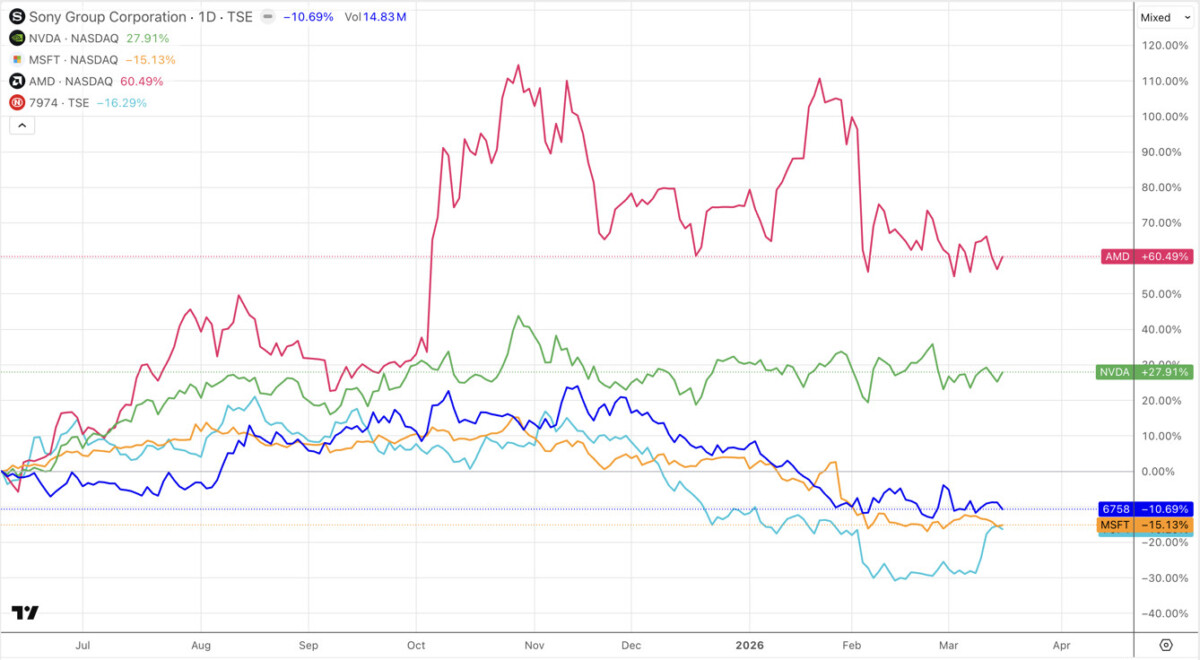
Challenges with the component supply impact even large market participants. At the same Game Developers Conference, Valve Corporation sought partners’ support in securing memory, as the ongoing shortage is already impacting device availability. Limited supplies are making it difficult to release products, including portable Steam Deck systems, and are delaying the launch of new projects in the Steam ecosystem, such as virtual reality devices and next-generation gaming platforms. Since 2022, Steam Deck sales have not exceeded approximately 5 million units, and for a company of this scale, securing priority memory supplies during a shortage is a significant challenge.
In addition to the problems with the components, the industry is also facing internal structural changes. Over the past three years, the gaming industry has lost tens of thousands of jobs. Oversupply during the pandemic, rising project budgets, and market instability led to large-scale cuts. The conference highlighted a difficult phase for the labor market. CV preparation seminars were crowded, with experienced professionals competing for the same roles as students and newcomers. A similar pattern can be seen across the broader market — even tech giants with high positions on the stock screener have faced major layoffs in recent years, with companies like Amazon still cutting jobs.
Another element in the transformation is the spread of generative artificial intelligence. Many studios are already using AI tools for ancillary tasks, from automating meeting notes to sorting internal documentation. Although some developers are cautious about this technology, most recognize that AI is gradually becoming part of the production process and can reduce development costs.
Economic pressure is also forcing studios to change their development structure. As budgets for large projects approach $300-400 million, companies are increasingly turning to outsourcing and collaborative development models. Under this scheme, specialized studios are brought in temporarily to develop individual elements of the game, from animation to network infrastructure. This reduces permanent staff and keeps costs under control.
Taken together, these trends show that the gaming industry is entering a phase of structural adaptation. Memory shortages, rising equipment costs, and increased project budgets are forcing companies to rethink development approaches, optimize technologies, and look for new collaboration models. For the market, this means moving from an era of unlimited cost growth to a more cautious and pragmatic strategy, where development efficiency and cost control become key factors of competitiveness.
Frequently Asked Questions
How long will the memory chip shortage affect the gaming industry?
Market participants at GDC 2026 projected the memory deficit will persist for approximately two more years, placing the earliest meaningful supply normalization around 2028. That timeline has direct consequences for hardware release schedules, with the PlayStation 6 not expected until 2029 and next-generation GPU availability for gaming remaining constrained while AI infrastructure competes for the same production capacity. The shortage is not a temporary allocation problem. It reflects a structural imbalance between memory production capacity and a demand environment that has been transformed by AI infrastructure investment. Studios and hardware manufacturers are making multi-year decisions based on the assumption that constrained supply is the operating reality for the foreseeable future, not an anomaly that will resolve on its own.
Why is Nvidia prioritizing AI chips over gaming GPUs?
Nvidia is prioritizing AI chip production because the margin profile and demand certainty of AI infrastructure customers significantly exceeds that of the gaming market. AI data center operators are purchasing chips in large volumes at premium prices with long-term supply agreements, while gaming GPU demand is more fragmented, more price-sensitive, and more cyclical. At GTC 2026, Nvidia unveiled a chip specifically designed for orbital AI data centers, a product category that did not exist three years ago and that now represents one of the company’s highest-growth revenue lines. The decision to delay gaming chip releases in favor of AI infrastructure production is a rational response to where the highest-value demand is concentrated. For gaming consumers and developers, it means continued GPU scarcity and elevated prices for the foreseeable future.
What is happening to jobs in the gaming industry right now?
The gaming industry has lost tens of thousands of jobs over the past three years, the result of a combination of pandemic-era overhiring, escalating project budgets, and a market normalization that exposed the gap between staffing levels and sustainable revenue. The correction has been large-scale and continues in 2026. At GDC 2026, the labor market distress was visible in crowded CV preparation seminars and in the competitive dynamics of job seeking, where experienced professionals with significant credits were competing directly with recent graduates for the same roles. The simultaneous adoption of AI tools that automate portions of the production pipeline is adding a structural dimension to what might otherwise be a cyclical correction, suggesting that some of the roles lost in the past three years will not return even when market conditions improve.
How are game studios using AI to reduce development costs?
Game studios are currently using generative AI primarily for ancillary production tasks: automating meeting notes, organizing internal documentation, generating first drafts of asset descriptions, and handling repetitive content that previously required dedicated human time. These applications produce real productivity gains that compound across production cycles spanning three to five years. The next wave of AI adoption is expected to reach asset generation, localization, and testing workflows, with further progression into creative production areas over the following two to three years. The pace is being set by economic pressure rather than technological readiness, which means adoption is moving faster than most developers anticipated. Studios that integrate AI tools into their workflows are reporting meaningful reductions in administrative overhead and are using those savings to offset rising costs in other areas of production.
Why are game development budgets approaching $300 to $400 million and what is studios doing about it?
Game development budgets have escalated to $300 million to $400 million for major releases due to a combination of factors: larger open worlds requiring more content, higher graphical fidelity requiring more art assets, longer development cycles, expanded voice acting and motion capture, and global marketing campaigns that now rival the production budgets themselves. The primary structural response has been a shift toward collaborative, outsourced production models where specialized studios are contracted to develop specific components rather than maintaining large permanent teams in-house. This reduces fixed overhead, allows workforce scaling to match production phases, and provides access to specialized expertise without the cost of permanent employment. Studios that have adopted this model report better cost control and more flexibility to respond to production challenges than the traditional single-studio approach provides.
