





If you run a Shopify store, you already pay a quiet tax: the hours you spend trying to read state websites, decode sales tax rules, and guess which forms actually apply to you.
Income tax, sales tax, exemption certificates, foreign ownership, LLCs, C-corps, marketplace rules. It stacks up fast.
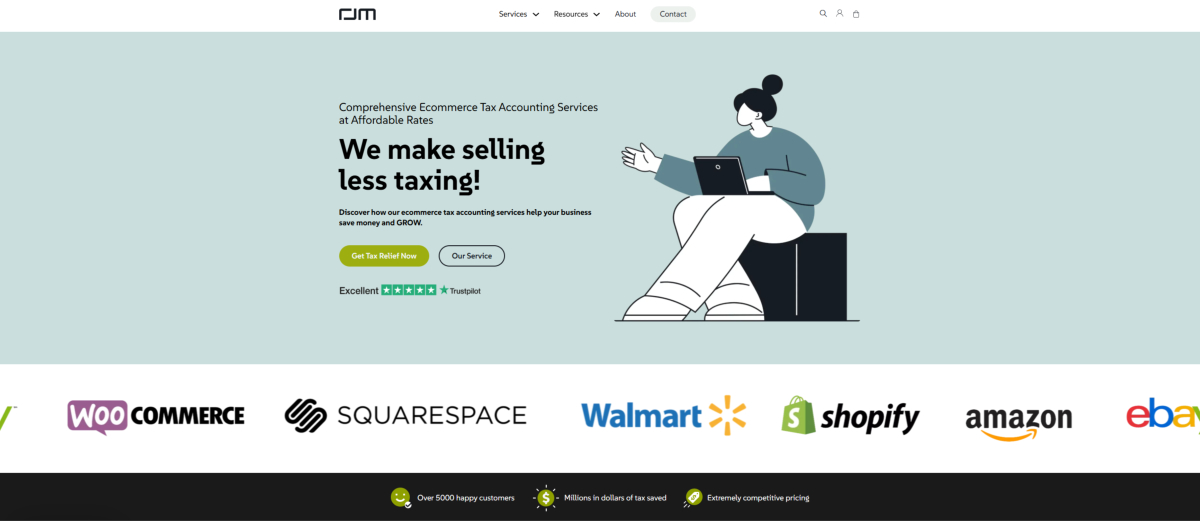
RJM Tax Exemption steps in as a human tax and compliance partner for ecommerce brands. Since 2019 they have helped more than 5,000 online businesses set up US entities, register in the right states, secure tax exemptions, and keep both sales tax and income tax filings on track.
This review is not about features on a pricing page. It is about whether RJM really earns a spot as your behind-the-scenes tax team if you sell on Shopify, Amazon, Walmart, or across all of them.
Across the reviews and client stories, a clear theme appears: founders who work with RJM spend less time inside state portals, avoid painful surprise tax bills, and often reclaim thousands in overpaid tax through proper exemption and filing. The benefit shows up as quieter Slack channels and cleaner P&Ls, not flashy dashboards.
Quick Verdict: RJM Tax Exemption Review, Rating, And Who It Is Best For
RJM earns a 4.8 / 5 from an ecommerce operator lens, with a public Trustpilot rating around 4.9 out of 5 based on hundreds of reviews. Think of it as a solid ⭐⭐⭐⭐ experience with results that punch above the price for most serious brands.
They are best for three groups:
- New Shopify brands that want to start with the right entity, EIN, bankable structure, and sales tax registrations instead of patching problems a year later.
- Growing multi-state sellers who crossed economic thresholds or use 3PLs and now have nexus in more states than they realized.
- International founders who want a US entity and clean tax compliance without learning the whole US code.
If you are a low-volume, single-state hobby seller doing a handful of orders per month, you probably do not need RJM yet. Shopify Tax and a basic local accountant will carry you for a while.
For real ecommerce operators though, especially those pushing into multiple states or marketplaces, RJM’s focus on online sellers matters. Their team lives inside Shopify, Amazon FBA, Walmart, and multi-channel workflows all day, so the guidance aligns with how you actually sell.
The pattern I keep seeing is simple: once brands move past a single-state side hustle, done-for-you tax support starts to pay for itself. Between nexus mistakes, missed filings, and lost exemptions, the cost of guessing can easily hit five figures over a few years. RJM’s value is in stopping that leak early.
What RJM Tax Exemption Actually Does For Ecommerce Businesses
RJM is not a software app. It is a specialist tax and compliance service that plugs into your ecommerce business.
At a high level they do five things:
- Business formation: Forming US LLCs and corporations, securing EINs, and handling registered agent services.
- Sales tax registration: Registering your business in the states where you have nexus, based on your products, sales channels, and 3PL footprint.
- Sales tax filing: Preparing and filing monthly or quarterly sales tax returns across many states.
- Sales tax exemption: Securing and managing reseller and exemption certificates so you do not pay sales tax on inventory you plan to resell.
- Income tax filing: Handling federal and state income tax returns for US-owned and foreign-owned entities, including foreign-owned single-member LLCs.
They work daily with Shopify, Amazon, Walmart, and eBay sellers, plus brands using a mix of these. That matters, because ecommerce tax pain does not live inside a generic chart of accounts. It lives where Amazon collects some tax, Shopify collects in other states, and your 3PL quietly creates nexus in three more.
With RJM, you are not buying a dashboard. You are buying a human team that knows which states to register in, which forms you must file even at zero sales, and how to protect margins with the right exemptions.
At-A-Glance Rating: 4.8 / 5 For Ease, Expertise, And ROI
Here is how that 4.8 / 5 breaks down.
- Expertise with ecommerce tax rules: 5 / 5. They live and breathe ecommerce, including marketplace facilitator rules, foreign ownership quirks, and multi-channel setups.
- Speed of turnaround: 4.5 / 5. Onboarding typically starts within about 24 working hours, with filings and registrations handled as soon as data is ready.
- Customer support quality: 5 / 5. Reviews often mention named team members who answer quickly, explain in plain English, and follow through.
- Pricing value: 4.5 / 5. RJM is not the rock-bottom option, but package pricing is clear and they offer a price match guarantee against recognized competitors for key services.
When you look across 490+ public reviews, a useful data point pops out: founders rarely talk about “cool features.” They talk about missed deadlines fixed, messy prior setups cleaned, and ongoing reminders that keep them compliant. That is the soft ROI you feel when tax problems quietly stop showing up.
The net result is strong: real compliance, fewer scary letters, and extra savings from correct exemptions and deductions. On the softer side, you gain fewer late-night Google searches and more headspace for growth work.
Formation, Sales Tax, Exemption, And Income Tax
Let’s walk this the way a brand grows, not the way a tax textbook is written.
Business Formation Services: Getting Your US LLC Or Corporation Set Up Right
For many founders, the relationship with RJM starts at formation.
RJM offers formation packages for both US and non-US owners. Example numbers from their offers:
- EIN formation for US citizens starting around $97, usually bundled with an operating agreement and a year of registered agent service.
- LLC or corporation formation packages with EIN starting near $297, plus state filing fees.
State fees are always separate, since Delaware is not Nevada, and Texas is not Wyoming. RJM makes that clear up front.
Why this matters for ecommerce:
- It protects your personal assets once money and inventory grow.
- It unlocks US bank accounts and payment processors.
- It gives you the structure you need for tax exemption and state registrations.
- It looks real to suppliers, 3PLs, and marketplaces.
Non-US founders hit extra friction with EINs, US addresses, and IRS forms. RJM handles that admin, explains what information they need, and usually gets onboarding going within about 24 working hours so you are not stuck for weeks.
Across foreign-owned LLCs, I keep seeing the same mistake: founders think “no profit, no filing.” In reality, the IRS often expects a return, even at zero profit, and the penalties for ignoring that are painful. Formation without a filing path is half a job. RJM connects those pieces.
Sales Tax Registration: Where RJM Really Saves Time And Pain
Sales tax is where most growing brands start to sweat.
RJM’s sales tax registration packages are built around how many states you need:
- Roughly $200 for a single state registration.
- Around $397 for two states.
- Discounted bundles that scale up through 5, 10, 20, and even 30 states.
Before anyone hits a submit button, they run a nexus review. In plain English, nexus is your tax footprint. It can be triggered by:
- Your inventory sitting in a warehouse in a state.
- Crossing a sales threshold in a state, often $100K or 200 orders.
- Using marketplaces or 3PLs that create a presence for you.
Shopify, Amazon FBA, Walmart, and 3PLs all affect this.
RJM maps where you actually have nexus, then handles registrations in those states. That helps you avoid two big traps: registering where you are not required, or failing to register where you should have months ago.
For a Shopify brand that has added Amazon and a 3PL, this is where DIY usually breaks. Every state portal looks different, asks odd questions, and has its own list of documents. RJM deals with those differences every day so you do not have to.
From a numbers angle, cleaning up nexus early can save real money. Late registrations often come with back filings and penalties, even in states with friendly rules. Brands that sort this out within the first year of multi-state sales tend to avoid four and five figure surprise bills that can wipe a month of profit.
Sales Tax Filing & Exemption: Protecting Your Margins Month After Month
Once you are registered, you have to file, even at zero sales.
RJM offers ongoing sales tax filing as a service. They prepare and submit returns to each state on the correct schedule, handle zero returns when needed, and can help close accounts if you stop selling into a state.
Marketplace facilitators like Amazon or Etsy collect tax for many orders, but not every state, and not always for your own direct site. Returns still have to go in. This is where many brands miss deadlines, pay late fees, or realize they registered on auto-pilot in states they never file.
The second piece is sales tax exemption for resellers.
If you buy inventory that you plan to resell, you usually should not pay sales tax on that purchase. You use a reseller or exemption certificate instead. RJM helps secure and maintain these certificates so suppliers accept them with no drama.
Without exemption, high-volume resellers can bleed cash:
- You pay sales tax when you buy inventory.
- Customers pay sales tax again when they purchase from you.
- Your margin gets squeezed from both sides.
For brands doing consistent wholesale or dropshipping volume, proper exemption changes the math. It reduces cost of goods, gives you more room for discounts without killing margin, and still keeps you inside the rules. It is not a loophole, it is the way tax is supposed to work for resellers, but many founders never get it set up correctly.
Income Tax Filing For US And Non-US Owners: Staying On The Right Side Of The IRS
Many ecommerce founders assume income tax is optional if they are overseas, not yet profitable, or selling only online. That belief gets expensive.
RJM handles income tax filing for US-owned and foreign-owned entities. Typical pricing ranges are:
- Around $997 for foreign-owned LLCs, multi-member LLCs, and non-US entities.
- Around $1,297 for corporations with more complex filings.
These are ballpark numbers, but they reflect real-world offers.
What you get here:
- Federal and state returns prepared and filed on time.
- Help understanding treaty questions if you are outside the US.
- Guidance on deductions that are normal for ecommerce, like advertising, software, 3PL fees, and samples.
- A clear calendar of deadlines so nothing slips through.
Across the board, the highest stress stories come from founders who ignored income tax filings for two or three years, then tried to raise money or sell. Banks, investors, and buyers do not like missing returns. RJM’s value is as much about future due diligence as it is about this year’s tax bill.
RJM Tax Exemption Pricing, Support, And Real-World ROI
RJM uses package pricing for formation, state registrations, exemption support, and income tax filings. They position themselves as one of the best value options in this niche, and back that with a price match guarantee for comparable services from recognized competitors.
Here is how that plays out against real ROI: time saved, penalties avoided, and tax saved through exemptions and accurate filings.
Across more than 5,000 businesses served, RJM reports clients saving thousands to tens of thousands of dollars in overpaid or misapplied tax once exemptions, nexus, and filings are cleaned up. That does not even count the soft savings on founder time and stress, which often shift from hours per week to a few quick email approvals per month.
How RJM’s Simple Packages And Price Match Guarantee Work
The buying experience is closer to hiring a specialist agency than signing up for an app.
You:
- Pick a package based on what you need, such as US LLC formation, 3-state sales tax registration, or income tax filing for a foreign-owned LLC.
- Pay securely online.
- Get contacted by a specialist, usually within about 24 working hours, to start onboarding.
Packages start near $97 for simple EIN work, climb to the $200 per state range for registrations, and reach the $997 to $1,297 range for complex annual income tax filings.
The price match guarantee gives founders a simple filter. If you find a recognized competitor offering a clearly similar formation or registration package cheaper, RJM will match that price. That removes a lot of shopping friction and lets you pick based on expertise and service quality instead of chasing a few dollars.
Customer Support, Onboarding Process, And Service Experience
Most reviews talk about people, not forms.
The usual flow looks like this:
- Pick package or book a free consult from the RJM site.
- Complete payment, then fill out a short intake form.
- Onboarding call or email sequence where an RJM specialist clarifies questions, collects documents, and outlines the timeline.
Each service has a simple three-step rhythm: you pick, they onboard, they execute and send updates.
Founders highlight three things:
- Plain English explanations of complex rules. No tax jargon unless you ask for it.
- Ecommerce-specific guidance, for example, how Amazon FBA warehouses affect nexus or how Shopify reports interact with state filings.
- Secure handling of data, with only the required details requested.
Customer feedback across sites tells a consistent story: RJM’s team is responsive and patient. Names like Reuben, Jared, Brandon, and Jayne appear again and again in positive reviews, which is usually a good sign that the service is built around accountable humans, not just ticket numbers.
Real ROI: How RJM Helps Different Stages Of Ecommerce Businesses
RJM’s value shifts as you grow.
- Beginners avoid early structural mistakes. You form the right entity, pick a sensible state, and get your first sales tax registrations right. That alone can prevent scary letters or corrections down the road.
- Growth-stage brands finally get out from under the monthly filing grind. RJM handles multi-state registrations, filings, and exemption certificates, which protects thin margins and gives your team hours back every month.
- International or seven-figure brands reduce risk and increase credibility. Clean, consistent filings and a clear compliance trail make due diligence smoother when raising, exiting, or working with larger partners.
Founders often underestimate the cost of messy tax history. When you try to sell or raise, buyers will ask for tax clearance and past filings. Brands that invest in a service like RJM early tend to move faster through due diligence, which can mean better terms, smoother closes, and fewer last-minute surprises.
RJM Tax Exemption Pros, Cons, And Alternatives
Biggest Advantages Of RJM Tax Exemption
A few real advantages stand out.
First, deep ecommerce focus. RJM is built for online sellers using Shopify, Amazon, Walmart, and similar platforms. You are not educating a generic accountant on what “FBA” or “Shopify payouts” mean.
Second, they cover the full lifecycle. Formation, sales tax registration, exemption, sales tax filing, and income tax filing are all under one roof. That means fewer gaps where something gets “lost” between providers.
Third, support and turnaround are strong. Onboarding within roughly a day, real humans answering questions, and clear expectations on timelines create a smoother experience than cold state portals.
Fourth, pricing is competitive, especially with bundled state registrations, and the price match option reduces shopping time.
Finally, they have a proven track record; over 5,000 ecommerce businesses served and millions of dollars in tax saved through proper compliance.
Limitations, Tradeoffs, And When RJM Might Not Be The Best Fit
There are tradeoffs.
RJM is a premium service, not a free tool. For very early, hobby-level stores doing a few hundred dollars per month, the cost can feel heavy.
There is also no single flat subscription that covers absolutely everything year round. You pick and pay for what you need: formation, certain state registrations, ongoing filings, income tax. That is fair, but you must budget it.
Simple, single-state Shopify shops may be fine using Shopify Tax plus a local CPA, especially if they have no 3PLs, no Amazon inventory, and no foreign ownership.
RJM also does not replace a full-time CFO or very advanced tax planning around complex holding companies, stock option plans, or multi-country corporate structures. They are specialists in ecommerce compliance, not a Wall Street tax law firm.
How RJM Compares To DIY And Other Tax Solutions
Most Shopify founders pick one of three paths.
- DIY with state sites plus Shopify Tax. Cheapest on paper, most expensive in time and mistakes. Works for very simple, single-state setups, breaks as soon as you hit real scale or multiple channels.
- Software-led tools like Avalara or TaxJar. Great for automation and calculations at scale, but you still need someone who understands ecommerce tax rules to configure them and handle exceptions.
- Traditional local accountants. Helpful for local business owners, but many are not comfortable with multi-state nexus, FBA, or foreign-owned US entities.
RJM sits in the middle. They blend human specialists with tight internal processes built around ecommerce. They can work alongside your general accountant as the sales tax and compliance specialist, or handle most of the workload for lean founder-only teams.
For many brands, the winning formula looks like this: a local or virtual accountant for day-to-day bookkeeping and broad strategy, RJM for formation and multi-state tax compliance, and Shopify/Amazon reports as the shared source of truth. That combo covers most real-world needs without turning you into a part-time tax clerk.
Final Take: Should You Use RJM Tax Exemption For Your Ecommerce Brand?
Stage By Stage Recommendation For Shopify And Multi-Channel Sellers
Here is the straight answer by stage.
- Curious or early founders under ~$50K annual revenue: RJM is a “plan for soon” unless you are foreign-owned or know you will scale quickly. Use them for formation and basic registrations if you have the budget, since that sets you up cleanly.
- Growth-stage brands in the mid six to low seven figures: RJM is close to a must-have. This is where multi-state nexus, 3PLs, and multiple channels create real risk. Bring them in for nexus review, state registrations, exemption, and monthly filings.
- Established or international brands selling in many states: RJM is best used as a cleanup and stability partner. Have them review your entire tax footprint, fix past gaps, lock in income tax filings, and help you get “due diligence ready” before a fundraise or exit.
Example path:
- Use RJM at launch for formation and an initial 1-3 state registrations.
- Add exemption and filing once you cross into multi-state sales or introduce FBA and 3PLs.
- Use RJM to rebuild messy historical filings before serious investor conversations or potential acquisition talks.
Brands that take this staged approach usually spend less overall. They address the highest risk areas at each stage instead of over-buying early or paying double later to fix rushed DIY work.
How To Get Started With RJM Tax Exemption The Smart Way
Before you contact anyone, do a quick self-audit.
- List where you sell and ship today, including marketplaces and 3PL locations.
- Check your order volume by state. You may already have nexus in more places than you realized.
- Review whether you are paying sales tax on inventory you resell, and whether you have proper exemption certificates.
- Check if you have missed income tax filings, especially for foreign-owned US entities.
Then book a free assessment or consultation on rjmtaxexemption.com. Bring basic numbers: trailing 12-month revenue, sales by state, sales channels, and your current entity structure.
Start with your two highest risk areas. For most brands, that is sales tax registration and filing, plus income tax filing. Once those are under control, add exemption optimization and any extra state cleanups.
Getting compliant early is cheaper and much less stressful than receiving a letter from a state you forgot about.
Conclusion
RJM Tax Exemption is a strong 4.8 / 5 choice for ecommerce brands that want a long-term partner for US tax and compliance instead of juggling state portals alone. The mix of ecommerce focus, full-service coverage across formation, sales tax, exemption, and income tax, and strong 4.9-star public reviews creates real trust.
You are not buying fancy software; you are buying fewer penalties, better margins, and more time to grow your brand. For most serious Shopify and multi-channel sellers, treating tax compliance as a growth tool, not just a cost, is one of the smartest shifts you can make.
If that is the stage you are in, it is worth having RJM in your corner.
