






Quick Decision Framework
- Who this is for: Shopify founders and marketers processing 50+ orders/day who feel operational strain
- Skip if: You’re still validating product-market fit or processing fewer than 20 orders per day
- Key benefit: Scale operations without proportionally increasing headcount using proven systems from Dubai’s PropTech sector
- What you’ll need: Basic analytics infrastructure, willingness to automate manual processes, budget for operational tools
- Time to complete: 2-3 months to implement core systems, 6-12 months to see full operational transformation
Property management and eCommerce seem worlds apart. But dig into how Dubai’s leading property companies scaled from manual operations to tech-driven platforms, and you’ll find a blueprint that applies directly to scaling a Shopify business.
What You’ll Learn
- How Dubai’s PropTech evolution mirrors eCommerce scaling challenges and why the operational lessons translate directly
- Technology adoption strategies that reduce headcount requirements while increasing operational capacity
- Retention tactics that cost 5-7x less than acquisition and drive long-term profitability
- Data-driven decision frameworks used by companies managing thousands of properties at scale
- A 4-phase action plan to implement these operational systems in your Shopify business
Dubai’s real estate sector has undergone massive digital transformation over the past few years. Companies managing thousands of properties have had to solve problems eerily similar to what eCommerce operators face: tenant retention (customer retention), operational efficiency at scale, data-driven pricing, regulatory compliance, and creating seamless digital experiences.
Let’s break down the operational lessons from Dubai’s PropTech evolution and translate them into actionable strategies for Shopify founders and marketers.
Why Property Management Operations Mirror eCommerce Challenges
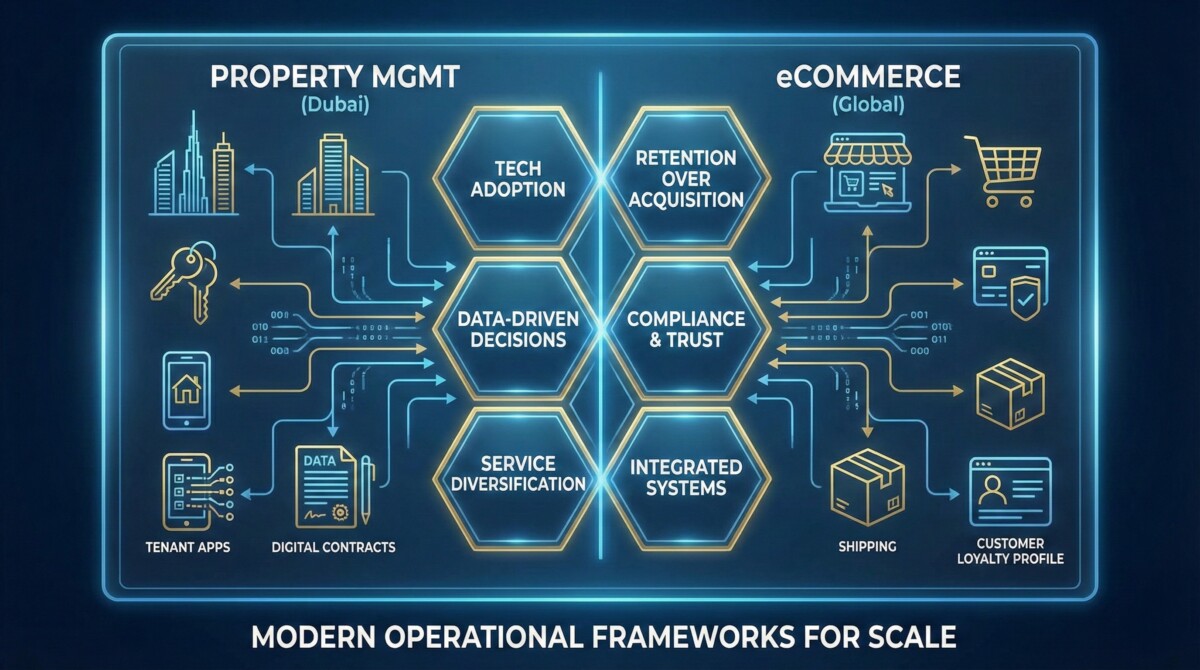
At first glance, managing rental properties and running a Shopify store have little in common. But the operational frameworks are strikingly similar:
- Customer/Tenant Acquisition: Both require marketing, lead qualification, and conversion optimization
- Retention Strategy: Long-term tenants = long-term customers. Both drive profitability through repeat engagement
- Service Delivery: Maintenance requests = customer support tickets. Speed and quality determine satisfaction
- Data-Driven Pricing: Dynamic rental rates = dynamic product pricing based on demand
- Operational Scale: Managing 1 property vs. 1,000 = managing 10 orders/day vs. 1,000 orders/day
Companies like property management companies in Dubai have built sophisticated systems to handle these challenges at scale. Here’s what they’re doing right and how you can apply it.
Lesson 1: Technology Adoption is Non-Negotiable
Dubai’s property management sector went all-in on PropTech between 2020-2025. Smart property apps, AI-driven analytics, and blockchain-based contracts became standard, not optional.
What They Implemented:
- Tenant portals for rent payments, maintenance requests, and building updates
- AI-driven pricing tools that analyze market demand and optimize rental rates
- Predictive maintenance systems that flag issues before they become expensive problems
- Blockchain contracts for transparent, secure transactions
Your eCommerce Translation:
- Customer portals: Implement subscription management dashboards (Recharge, Skio) so customers control their orders
- Dynamic pricing: Use demand-based pricing tools (Prisync, Omnia) to optimize margins without losing competitiveness
- Predictive inventory: Adopt forecasting tools (Inventory Planner, Cogsy) to prevent stockouts and overstock
- Transparent operations: Use order tracking apps (Malomo, Rush) that build trust through visibility
Technology isn’t about being cutting-edge. It’s about removing friction from operations so you can scale without proportionally scaling headcount.
Lesson 2: Retention Beats Acquisition (And It’s Cheaper)
In Dubai’s competitive rental market, keeping a tenant for 3+ years is far more profitable than constantly finding new ones. Property managers realized this and shifted focus from pure acquisition to retention optimization.
What They Implemented:
- Flexible payment options: Monthly credit card payments instead of annual checks
- Tenant loyalty programs: Rewards for lease renewals and referrals
- Proactive maintenance: Regular inspections prevent major issues and show tenants they’re valued
- Dedicated communication channels: Direct access to property managers through apps
Your eCommerce Translation:
- Flexible payment: Offer Shop Pay, Klarna, Afterpay to reduce cart abandonment
- Loyalty programs: Use Smile.io, LoyaltyLion, or Yotpo to reward repeat purchases
- Proactive support: Implement post-purchase email flows (Klaviyo) that check in before problems arise
- VIP communication: Create SMS or Slack channels for top customers to get priority support
Acquiring a new customer costs 5-7x more than retaining an existing one. Dubai property managers know this. Do you?
Lesson 3: Data-Driven Decision Making Eliminates Guesswork
Dubai’s top property management firms stopped relying on gut feeling and started using data to drive every major decision.
What They Track:
- Occupancy rates by location and property type
- Average tenant lifetime value
- Maintenance cost per property
- Time-to-fill for vacant units
- Tenant satisfaction scores (NPS)
Your eCommerce Translation:
- Conversion rates by traffic source (Google Analytics, Shopify Analytics)
- Customer lifetime value (CLV) by cohort
- Cost per acquisition (CPA) by channel
- Average order value (AOV) and upsell effectiveness
- Net Promoter Score (NPS) to measure brand loyalty
Move from “I think this is working” to “The data shows this is working.” Use tools like Littledata, Northbeam, or Triple Whale to connect your data and make informed decisions.
Lesson 4: Compliance and Trust Are Competitive Advantages
Dubai’s real estate market is heavily regulated. Companies that master compliance don’t just avoid penalties – they use it as a trust signal to attract premium clients.
What They Do:
- Ensure all contracts comply with Dubai Land Department regulations
- Provide transparent rental increase calculations using official tools
- Handle disputes through proper legal channels
- Educate landlords on their legal responsibilities
Your eCommerce Translation:
- Privacy compliance: Proper GDPR/CCPA implementation isn’t just legal – it builds trust
- Transparent pricing: Show all costs upfront (shipping, taxes, fees) before checkout
- Clear return policies: Make returns easy and clearly communicated
- Accessibility compliance: ADA-compliant sites show you care about all customers
In competitive markets, trust is a differentiator. Companies that operate transparently win premium customers.
Lesson 5: Service Diversification Creates Revenue Resilience
When long-term rentals slowed during certain periods, Dubai property managers pivoted to short-term vacation rentals. This diversification protected revenue during market shifts.
What They Implemented:
- Added Airbnb/holiday rental management services
- Offered furnished vs. unfurnished options
- Created corporate housing packages
- Bundled maintenance and cleaning services
Your eCommerce Translation:
- Product line expansion: Don’t rely on one hero product – build a catalog
- Subscription models: Add recurring revenue through subscriptions (Recharge, Skio)
- B2B wholesale: Sell to retailers alongside D2C (Faire, Bulletin)
- Service add-ons: Offer installation, customization, or premium support
Revenue diversification protects you from algorithm changes, market shifts, and seasonal fluctuations.
Lesson 6: Integrated Systems Beat Point Solutions
Early on, property managers used separate tools for rent collection, maintenance, tenant communication, and reporting. The winners consolidated into integrated platforms that connected everything.
What They Built:
- All-in-one platforms connecting payments, maintenance, communication, and analytics
- Automated workflows that triggered based on tenant actions
- Centralized dashboards showing real-time performance across all properties
Your eCommerce Translation:
- Unified customer data: Use Klaviyo or Omnisend to connect email, SMS, and customer behavior
- Automated workflows: Build flows that trigger based on customer actions (abandoned cart, post-purchase, win-back)
- Centralized analytics: Use tools like Shopify Analytics, Triple Whale, or Northbeam to see everything in one place
Integrated systems reduce manual work, eliminate data silos, and let you scale without hiring proportionally.
Real-World Implementation: How One Company Scaled
Take a company like property management companies in Dubai as an example. They manage thousands of properties across Dubai by implementing exactly these systems:
- Tenant portals that handle 80% of routine requests automatically
- AI-driven pricing that adjusts rental rates based on real-time market data
- Predictive maintenance that reduces emergency repair costs by 40%
- Integrated platforms that give landlords full visibility into their investments
The result? They scaled from managing dozens of properties to thousands without proportionally increasing staff. That’s the power of operational excellence.
Applying This to Your Shopify Store
Here’s your action plan based on these lessons:
Phase 1: Audit Your Current Operations (Week 1)
- Map every manual process in your business
- Identify bottlenecks that prevent scaling
- Calculate your customer retention rate and CLV
- Review your tech stack for redundancies and gaps
Phase 2: Implement Quick Wins (Weeks 2-4)
- Set up post-purchase email flows (Klaviyo)
- Add flexible payment options (Shop Pay, Afterpay)
- Implement a basic loyalty program (Smile.io)
- Create a customer portal for subscription management
Phase 3: Build Systems for Scale (Months 2-3)
- Integrate your data sources into one analytics platform
- Automate repetitive customer service tasks (Gorgias, Gladly)
- Implement dynamic pricing based on inventory and demand
- Build predictive models for inventory forecasting
Phase 4: Optimize and Iterate (Ongoing)
- Review retention metrics monthly
- A/B test loyalty program incentives
- Refine your automation workflows based on performance
- Explore revenue diversification opportunities
The Bottom Line
Dubai’s property management sector didn’t become tech-forward overnight. It happened through systematic adoption of tools, processes, and strategies that prioritized efficiency, retention, and data-driven decision making.
Your Shopify store faces the same scaling challenges. The operational lessons are the same. The tools are available. The question is: will you implement them?
Start with retention. Add flexible payment options this week. Set up post-purchase flows next week. Build from there. Small operational improvements compound into massive competitive advantages.
The brands that win in 2026 won’t just have great products. They’ll have great operations.
Frequently Asked Questions
What operational lessons from property management apply to eCommerce?
Key lessons include prioritizing retention over acquisition, implementing technology to scale without proportional headcount increases, using data to drive decisions, building integrated systems instead of point solutions, and diversifying revenue streams to protect against market shifts. Dubai’s property management sector faced similar challenges to eCommerce: managing customer relationships at scale, optimizing pricing dynamically, ensuring regulatory compliance, and creating seamless digital experiences.
How can Shopify stores improve customer retention?
Implement flexible payment options like Shop Pay and Afterpay to reduce cart abandonment, create loyalty programs that reward repeat purchases using tools like Smile.io or LoyaltyLion, set up proactive post-purchase email flows through Klaviyo that check in before problems arise, offer VIP communication channels for top customers, and make subscription management easy through customer portals. Retaining existing customers costs 5-7x less than acquiring new ones.
What tech stack should eCommerce brands prioritize for scaling operations?
Focus on integrated platforms that connect customer data (Klaviyo, Omnisend for email and SMS), centralized analytics (Triple Whale, Northbeam for unified reporting), inventory forecasting (Inventory Planner, Cogsy to prevent stockouts), customer support automation (Gorgias, Gladly for ticket management), and subscription management (Recharge, Skio for recurring revenue). Integrated systems eliminate data silos and reduce manual work as you scale.
Why is data-driven decision making important for eCommerce operations?
Data eliminates guesswork and helps you optimize based on actual performance rather than assumptions. Track metrics like customer lifetime value (CLV) to understand long-term profitability, cost per acquisition (CPA) by channel to optimize marketing spend, conversion rates by traffic source to identify your best channels, and Net Promoter Score (NPS) to measure brand loyalty. This shift from “I think this is working” to “the data shows this is working” is how Dubai property managers scaled efficiently.
How can eCommerce brands diversify revenue like property management companies?
Expand your product line beyond hero products to protect against single-product dependency, add subscription models for recurring revenue using platforms like Recharge or Skio, explore B2B wholesale channels alongside D2C through marketplaces like Faire or Bulletin, and offer service add-ons such as installation, customization, or premium support packages. Revenue diversification protects you from algorithm changes, market shifts, and seasonal fluctuations just like Dubai property managers who pivoted between long-term and short-term rentals.
