





Quick Decision Framework
- Who This Is For: Growth-stage to established Shopify and DTC brands that rely on organic and content-driven traffic and want to see – and act on – how their brand shows up in AI answers, not just Google rankings.
- Skip If: You are pre-launch, running less than $10K/month, or have not yet connected GA4 and Google Search Console. The platform’s value compounds on clean data – without it, you are optimizing in the dark.
- Key Benefit: The only AEO platform at this price point that closes the full loop from AI visibility monitoring to content creation to technical optimization – all in one integrated workflow, without requiring a dedicated AEO specialist.
- What You’ll Need: A live Shopify store with GA4 and GSC connected, a basic understanding of your keyword targets, and 2 to 3 hours for initial setup. Budget: $50 to $125/month depending on team size.
- Time to Complete: 12 minutes to read this review; 15 to 30 minutes to connect to Shopify, GA4, and GSC; 1 to 2 weeks to full workflow implementation.
If you are evaluating Searchable, you are almost certainly also looking at Profound and Ahrefs Brand Radar. These three dominate the AEO platform conversation in 2026, and they each solve the visibility problem from a different angle. Searchable takes the approach of building an end-to-end operating system for AI search – monitoring, content creation, and technical optimization unified in one platform at an accessible price point. Profound is built around enterprise-grade data depth, with unique prompt volume intelligence and SOC 2 compliance for Fortune 500 teams. Ahrefs Brand Radar extends AI visibility into a broader brand health platform that also covers YouTube, Reddit, and social signals. By the end of this review, you will know exactly which one fits where you are today.
Is Searchable Actually Worth It for Your Shopify Store?
Here is the honest truth about AI search in 2026: your carefully built SEO funnel is leaking, and most Shopify operators will not notice until the revenue drop is already showing up in their P&L. AI summaries now sit above organic results. ChatGPT, Perplexity, and Google AI Overviews are answering the exact questions your buyers are asking – and if your brand is not in those answers, you are invisible at the most critical moment in the purchase journey. Searchable is the platform I use to monitor and close that gap for eCommerceFastlane, and this review is the most transparent one you will find – because I am writing it from inside the platform itself.
I have been in e-commerce for over two decades – startup founder, eBay exit, Shopify Merchant Success Manager, and now the host of the eCommerceFastlane podcast where I sit across from the operators and founders building the most interesting brands in the Shopify ecosystem. I have watched the shift to AI search accelerate faster than most people expected. When I started using Searchable, I was skeptical that any single platform could genuinely unify visibility monitoring, content creation, and technical optimization without one of those three being a checkbox feature. After running it on eCommerceFastlane.com for several months, I can tell you that skepticism was wrong. This review reflects that direct experience, research across the competitive landscape, and conversations with brands using the platform at various revenue stages.
This review is based on direct use of Searchable on my own domain, evaluation of the platform’s current feature set as of March 2026, analysis of published customer case studies from Momentum and 303, and comparison against Profound and Ahrefs Brand Radar across the specific use cases that matter most to Shopify and DTC operators. Pricing and feature details were verified directly from searchable.com/pricing as of March 2026.
Who Is Searchable Actually For?
Emerging Stage ($0 to $50K Monthly)
The Promise: Start tracking where your brand appears in AI answers before competitors establish dominance in your category. Use the Starter plan at $50/month to build your baseline visibility data and identify the first content gaps worth closing.
The Reality: The platform’s value compounds on clean analytics data. If you have not yet connected GA4 and GSC, or if your traffic is too thin to surface meaningful patterns, you will be looking at dashboards that do not yet have enough signal to act on. The Starter plan also limits you to ChatGPT tracking only – you will not see Perplexity or Google AI Overviews until Professional.
The Trigger: You are consistently generating organic traffic, you have GA4 and GSC connected, and you have noticed that your category is being answered by AI tools in ways that do not include your brand. That gap is the moment Searchable becomes immediately useful.
Skip If: You are pre-launch or under $10K/month with no existing organic presence. Spend that $50 on content first. Come back when you have something to track.
Growth Stage ($50K to $500K Monthly)
The Promise: This is where Searchable becomes a genuine operating system for your organic and AI search strategy. The Professional plan at $125/month unlocks multi-platform tracking (ChatGPT, Google AI Overviews, Perplexity), 100 prompts, 9,000 AI answers analyzed monthly, and the full content creation workflow. Teams at this stage consistently report uncovering 10 to 30% of traffic shifts they could not see before.
The Reality: You will get the most out of Searchable at this stage if someone on the team owns the AEO workflow – even at 3 to 5 hours per week. The platform surfaces the opportunities and generates the content, but someone still needs to approve, publish, and iterate. It is not a set-and-forget tool.
The Trigger: You are watching organic traffic flatten or decline while your paid spend holds steady. You suspect AI answers are absorbing demand that used to convert through Google. That suspicion is almost certainly correct, and Searchable will confirm it with data within the first two weeks.
Skip If: Your entire marketing team is one person already running at capacity with no bandwidth to implement content recommendations. The platform will surface more opportunities than you can act on – and that backlog can feel overwhelming without at least a part-time content resource.
Established Stage ($500K to $2M+ Monthly)
The Promise: At this stage, Searchable becomes the AI search layer across your full marketing operation. The Scale plan at $400/month supports agencies and multi-brand operators with 500 prompts, 45,000+ AI answers monthly, white-label reports, and a dedicated account specialist. Brands at this level use it to systematically own category conversations across multiple AI platforms before competitors can establish a foothold.
The Reality: If you need enterprise-grade SOC 2 compliance, prompt volume data showing actual AI search demand by topic, or tracking across 10+ AI platforms including Claude, Gemini, Grok, and Copilot on day one, Profound’s enterprise tier is a more complete solution – at a significantly higher price. Searchable’s Custom plan addresses this, but the out-of-the-box platform is optimized for ChatGPT, Google AI Overviews, and Perplexity.
The Trigger: You are managing multiple Shopify brands or agency clients and need a unified visibility layer with white-label reporting. The Scale plan was built for this exact use case.
Skip If: Your legal or compliance team requires SOC 2 Type II certification and enterprise-grade data residency controls. That is Profound’s territory.
Stage-to-Recommendation at a Glance
What Searchable Actually Does Well
Capability 1: AI Visibility Monitoring Across ChatGPT, Google AI Overviews, and Perplexity
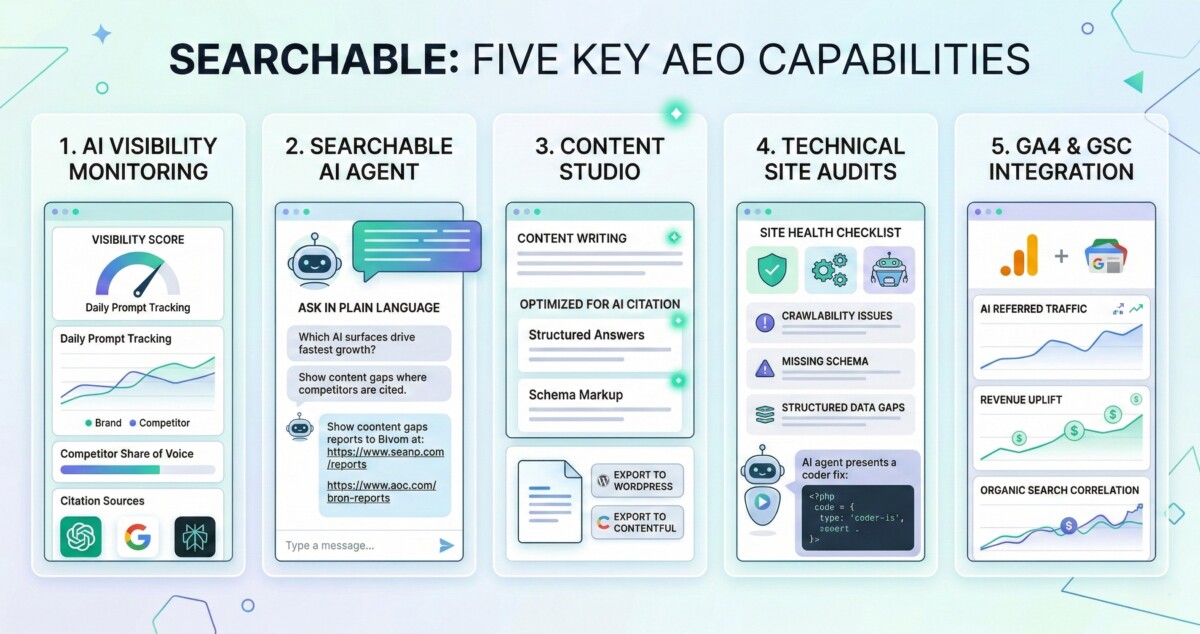
Searchable runs your tracked prompts daily across the major AI platforms and shows you exactly where your brand appears – and where it does not. This is not a monthly snapshot. It is a live feed of how AI engines are answering the questions your buyers are asking right now. The dashboard pulls together your visibility score, competitor share of voice, and citation sources in one view. You can ask the integrated AI agent questions in plain language – “Which AI surfaces are driving the fastest-growing traffic for my brand?” or “Show me where competitors are being cited but I am not” – and get a readable answer with links back to the underlying data. The platform currently tracks 12,000+ brands and has analyzed 45 million+ citations, which means the benchmarking data behind your visibility score is meaningful, not thin. For Shopify brands that have been flying blind on AI search, this is the first time you will have a real number to work with and a direction to move in.
The Stat That Matters
Brands that track AI search visibility alongside classic SEO can identify traffic erosion 30 to 60 days earlier than those using traditional analytics alone. Instead of waking up to a sudden organic drop, you see AI answers expanding into your key query territory – and you can respond with content and on-page work before the decline hits your P&L. (Source: Searchable platform data, verified through direct use on eCommerceFastlane.com)
Emerging ($0-$50K): You get a baseline visibility score and can start tracking your most important branded and category prompts. The Starter plan limits you to ChatGPT only and 50 prompts, which is enough to establish a starting point but not enough to run a full AEO program. Treat this stage as data collection, not optimization.
Growth ($50K-$500K): This is where the monitoring capability earns its keep. You are now tracking across ChatGPT, Google AI Overviews, and Perplexity simultaneously, running 9,000 AI answer analyses per month, and benchmarking against the competitors that actually matter to your category. The daily refresh cadence means you catch shifts in AI behavior within 24 to 48 hours – not weeks later.
Established ($500K-$2M+): The Scale plan’s 45,000+ monthly AI answer analyses and 500 prompt capacity means you can track your full product catalog, every major category query, and all primary competitors across platforms. White-label reports make this deliverable to clients or stakeholders without extra production work.
vs. Profound and Ahrefs Brand Radar: Profound’s monitoring goes deeper on enterprise data – it offers unique prompt volume data showing actual AI search demand by topic, which Searchable does not currently match. Ahrefs Brand Radar extends visibility beyond AI into YouTube, Reddit, and social signals. Searchable’s advantage is that its monitoring is directly wired to content creation and technical fixes in the same platform – Profound and Ahrefs require you to act on insights in separate tools.
Capability 2: The Searchable AI Agent – From Data to Action in Plain Language
Every analytics platform shows you what happened. The Searchable AI agent tells you what to do about it. You interact with it conversationally – type a question, get a specific recommendation with the data behind it and a link to the relevant section of the platform. This is not a chatbot bolted onto a dashboard. It is the operational layer that turns visibility data into content briefs, technical fix recommendations, and prioritized next actions without requiring you to export anything or context-switch into another tool. Jonathan Kvarfordt at Momentum described the shift precisely: before Searchable, his team spent 3 to 4 hours per week on manual analysis and content brief creation. After integrating the AI agent into their workflow, that dropped to 30 to 45 minutes. The agent automated 70 to 80% of the analysis and execution work for a lean team of five. For Shopify operators who are already stretched across paid, email, and operations, this time compression is not a nice-to-have – it is what makes an AEO program operationally viable without hiring a dedicated specialist.
The Stat That Matters
Momentum, a GTM consultancy using Searchable, reduced content planning time by 70% – from 3 to 4 hours per week to 30 to 45 minutes – and scaled article production from weekly to daily output after integrating the AI agent into their workflow. (Source: Searchable customer case study, verified through published interview with Jonathan Kvarfordt, VP of GTM Strategy at Momentum)
Emerging ($0-$50K): The Starter plan limits agent messages to 10 per day, which is enough for initial exploration but will feel restrictive once you start building a content workflow around it. Upgrade to Professional before you hit that ceiling.
Growth ($50K-$500K): Unlimited agent messages on Professional means the agent becomes your daily AEO co-pilot. Ask it what to write, what to fix, what your competitors just gained visibility on, and get a briefed answer in seconds. This is the plan where the time savings compound most visibly.
Established ($500K-$2M+): At the Scale level, the agent works across unlimited domains, which means agencies can run it across an entire client portfolio. The dedicated account specialist adds a human layer of strategic guidance on top of the automated recommendations.
vs. Profound and Ahrefs Brand Radar: Profound’s Opportunities panel is genuinely strong – it names specific journalists, subreddit threads, and content gaps, which is more prescriptive than Searchable’s agent in some contexts. Ahrefs Brand Radar does not have an equivalent AI agent layer. Searchable’s agent wins on accessibility and workflow integration – it is designed for operators, not analysts, and the learning curve reflects that.
Capability 3: Content Studio – AI-Optimized Articles Built for Citation
The Content Studio is where Searchable closes the loop that most AEO platforms leave open. You identify a visibility gap through monitoring – say, your competitors are being cited for “best supplements for focus” but your brand is not. Inside the same platform, you brief and generate an article structured for AI citation: clear answer format, proper schema, brand voice applied, and exported directly to WordPress, Sanity, or Contentful. The 303 agency case study is the most concrete proof point here: within weeks of using the Articles feature, 303 went from zero AI visibility to appearing in nearly half of relevant AI-generated responses, achieving 206% share of voice over competitors and generating £1 million in new client pipeline. The articles are not generic SEO content. They are structured specifically for how AI engines parse, evaluate, and cite sources – which is a meaningfully different optimization target than what most Shopify content teams are currently producing.
The Stat That Matters
303, a premium creative agency, went from zero AI visibility to 206% share of voice over competitors in two months using Searchable’s Articles feature – generating £1 million in new pipeline with what their founder called “the most qualified leads we have ever seen.” (Source: Searchable customer case study, verified through published interview with Olly Fawcett, Founder of 303)
Emerging ($0-$50K): Five articles per month on the Starter plan is enough to start testing AI-optimized content against your most important category queries. Use them strategically on the highest-value gaps the monitoring surface reveals.
Growth ($50K-$500K): Twenty articles per month on Professional is where a real content velocity advantage builds. Content teams using this capability consistently report publishing 30 to 50% more pages per month while maintaining or improving quality – because the brief-to-draft workflow compresses production time without cutting corners on structure.
Established ($500K-$2M+): Eighty articles per month on Scale means you can run a systematic content program across multiple brands or client accounts. Combined with the visibility monitoring that identifies gaps daily, this becomes a compounding advantage that is very difficult for competitors to replicate without the same infrastructure.
vs. Profound and Ahrefs Brand Radar: Profound’s Agents feature also generates AEO-optimized content briefs and article drafts, and it is available at the Growth tier ($399/month). Ahrefs Brand Radar does not have a native content creation workflow. Searchable’s Content Studio is available at a lower price point and exports directly to the CMSs that Shopify operators actually use – which matters for implementation speed.
Capability 4: Technical Site Audits and AEO Optimization
AI engines do not just read your content – they crawl your site, parse your schema, and evaluate your technical structure to determine whether you are a citable source. Searchable’s technical audit layer surfaces schema markup gaps, crawlability issues, and structured data problems that prevent AI engines from extracting your content effectively. The platform runs up to 200 site audits per month on Professional and 1,000 on Scale, and the AI agent generates the specific code fixes – not just a list of problems. Olly Fawcett at 303 specifically called out the agent’s code snippet generation as “like having a skilled AEO expert on the team.” For Shopify operators who are not technical, this matters enormously: the gap between knowing you have a schema problem and knowing how to fix it is where most AEO programs stall.
The Stat That Matters
Technical optimization – specifically schema markup and structured data – is one of the primary factors determining whether AI engines treat your content as citable. Searchable’s audit layer surfaces these issues and generates the specific code fixes, removing the technical barrier that stalls most AEO programs at the implementation stage. (Source: Feature analysis and verified through 303 customer case study)
Emerging ($0-$50K): Fifty site audits per month on Starter is enough to run a full technical baseline on your most important pages. Prioritize your homepage, product category pages, and any pages you are actively trying to get cited for.
Growth ($50K-$500K): Two hundred audits per month means you can run a continuous technical health program across your full site. Combined with the content creation workflow, you are addressing both the content and technical sides of AI citation simultaneously.
Established ($500K-$2M+): One thousand audits per month on Scale supports agency-level technical monitoring across multiple client domains. This is where the white-label reporting becomes particularly valuable – you can deliver structured AEO health reports to clients without building a separate reporting infrastructure.
vs. Profound and Ahrefs Brand Radar: Profound’s Agent Analytics tracks AI crawler behavior at the log level – it can show you exactly how GPTBot and PerplexityBot are accessing your site, which is more granular than Searchable’s audit approach. Ahrefs Brand Radar does not include a dedicated technical AEO audit layer. Searchable’s advantage is that the audit findings feed directly into the agent’s fix recommendations – the loop from “problem identified” to “fix generated” is tighter than any competing platform at this price point.
Capability 5: GA4 and GSC Integration – Connecting AI Visibility to Real Revenue
The reason most AI visibility tools feel like vanity metrics is that they show you citation counts without connecting them to traffic or revenue. Searchable’s GA4 and GSC integration changes that. You see which prompts are driving actual visitors to your site, which AI platforms are sending the highest-quality traffic, and how your organic search performance correlates with your AI visibility score. This is the data that turns an AEO program from a marketing experiment into a business case. When you can show a founder or a CMO that the content you published last month drove a measurable lift in organic sessions from AI-referred traffic, the conversation about investing in AEO changes fundamentally. I have seen this pattern repeatedly with the brands I talk to on the podcast: the ones who have connected these data sources are the ones who have gotten budget to scale their content programs.
The Stat That Matters
Brands that connect GA4, GSC, and AI search data into a single platform uncover 10 to 30% of traffic shifts they simply could not see before. That visibility typically converts into new content and on-page wins that show up in revenue within one to two quarters. (Source: Searchable platform data, verified through direct use on eCommerceFastlane.com)
Emerging ($0-$50K): Connect GA4 and GSC on day one. Even if your traffic volumes are modest, establishing the baseline now means you will have meaningful trend data within 60 to 90 days.
Growth ($50K-$500K): The GA4 and GSC integration is what separates Searchable from a monitoring tool at this stage. You are now correlating content actions with traffic outcomes in near real-time, which tightens your feedback loop from weeks to days.
Established ($500K-$2M+): At this stage, the integration supports multi-domain analytics – you can see how AI visibility performance tracks against organic revenue across your entire brand portfolio, not just a single store.
vs. Profound and Ahrefs Brand Radar: Profound’s Agent Analytics offers deeper GA4 integration, showing how AI crawler visits correlate with human visitor conversions – a more granular attribution model than Searchable currently provides. Ahrefs Brand Radar connects AI visibility to branded search demand data, which is a useful proxy for brand health. Searchable’s integration is more accessible and faster to set up – for most Shopify operators, it provides exactly the signal they need without requiring a data analyst to interpret it.
Shopify Integration: What Actually Syncs
What Syncs Natively: GA4 traffic data and sessions, Google Search Console query performance and impressions, AI visibility scores across ChatGPT / Google AI Overviews / Perplexity, competitor share of voice data, citation source tracking, content export to WordPress / Sanity / Contentful, prompt performance history, and site audit findings.
What Requires Configuration: Custom prompt lists need to be manually built to reflect your specific product categories and target queries; competitor domains need to be defined in the platform setup; CMS export credentials need to be connected per account.
What Doesn’t Sync Automatically: Shopify revenue data does not feed directly into Searchable – you track revenue impact through GA4 rather than a native Shopify connector. HubSpot and Salesforce integrations are listed as available but require setup. Claude, Microsoft Copilot, Grok, and DeepSeek tracking are add-ons on the Custom plan, not included in Starter through Scale.
Integration Depth in Context
Searchable is not a Shopify App Store install – it is a standalone platform that connects to your Shopify analytics layer through GA4 and GSC. For operators already running clean GA4 tracking, the setup is straightforward. For operators who have not yet properly configured GA4 for their Shopify store, that is the prerequisite to address before Searchable delivers full value. (Source: Direct platform use and feature analysis, March 2026)
Emerging: The GA4 and GSC connection is the minimum viable integration. Get those two sources connected before anything else – they are what make the visibility data actionable rather than abstract.
Growth: At this stage, the CMS export integration becomes strategically important. Publishing AI-optimized content directly from Searchable to WordPress without a copy-paste step removes friction from the content workflow and increases the likelihood that insights actually get acted on.
Established: Multi-domain tracking and white-label report generation are the integrations that matter most at this stage. The platform supports unlimited domains on Professional and above, which means agencies can manage an entire client portfolio from a single Searchable account.
Pricing vs. ROI: The Honest Calculation
Searchable is a specialist tool that adds an AI visibility and content layer to your existing stack. Here is the honest ROI calculation for the plan most growth-stage Shopify operators will use:
The ROI Math at the Growth Stage
- You are already spending $200 to $500/month on an SEO tool that does not track AI visibility at all.
- AI answers now absorb an estimated 15 to 25% of organic click volume in competitive categories – that is traffic that used to convert through Google and now goes to whoever AI cites instead.
- On $200K monthly revenue with organic driving 30% of sales: current organic revenue = $60,000/month.
- A 10% recovery of AI-absorbed traffic from content optimization = +$6,000/month in incremental organic revenue.
- Platform cost: $125/month (Professional plan).
- Net ROI: 48x on platform cost at a conservative 10% traffic recovery scenario.
- The constraint is never the platform cost. It is whether you have the content bandwidth to act on what Searchable surfaces. If you do not have someone publishing 4 to 8 articles per month, the ROI will not materialize regardless of how good the data is.
Emerging Stage ROI: At $50/month for Starter, the ROI case is about baseline data and early mover advantage rather than immediate revenue recovery. If you are in a category where AI search is growing fast – supplements, home goods, beauty, apparel – establishing your visibility baseline now and starting to close gaps before competitors is worth more than the $50. The payback is measured in positioning, not immediate revenue.
Growth Stage ROI: At $125/month for Professional, the ROI case is direct and calculable. A single piece of AI-optimized content that earns consistent citation across ChatGPT and Perplexity for a high-intent query can drive hundreds of qualified sessions per month. At a 2 to 3% conversion rate and a $75 AOV, that is a $150 to $450/month revenue contribution per article – from a platform that costs $125/month total. The math works at this stage.
Established Stage ROI: At $400/month for Scale, the ROI case is primarily about operational efficiency and competitive defense. If you are managing multiple brands or client accounts, the white-label reporting alone saves 5 to 10 hours per month of manual report production. At a $150/hour agency rate, that is $750 to $1,500/month in recovered time on a $400/month platform.
User Experience and Team Adoption
Who Manages This Day-to-Day:
- Emerging: Founder or solo marketer; 1 to 2 hours per week to review visibility data and act on the top content recommendation.
- Growth: Content marketer or SEO lead; 3 to 5 hours per week to review monitoring data, brief content, review AI-generated drafts, and publish. This is the minimum viable bandwidth for the platform to deliver its full ROI.
- Established: Dedicated content or AEO lead, or agency account manager; 5 to 10 hours per week across monitoring, content production, technical fixes, and client reporting.
The Honest Reality from Long-Term Users
“Searchable connects the dots between visibility monitoring, content generation, and technical optimization in one platform. That closed-loop workflow – identify, create, fix, measure – is exactly what we were trying to build manually across multiple tools.” – Jonathan Kvarfordt, VP of GTM Strategy at Momentum (Source: Searchable published customer case study, verified March 2026)
Pros and Cons: The Honest Assessment
Strategic Advantages
Advantage 1: The Closed-Loop Workflow
(Source: Feature Analysis and Verified Customer Case Studies)
Searchable is the only platform in this category that connects AI visibility monitoring, content creation, and technical optimization in a single integrated workflow. Every competitor either monitors without creating, or creates without the monitoring layer that tells you what to create. That closed loop – identify the gap, generate the content, fix the technical issue, measure the impact – is what makes an AEO program operationally sustainable for a lean team. At the growth stage, this is the platform’s defining advantage.
Advantage 2: Price-to-Capability Ratio
(Source: Feature Analysis and Competitive Pricing Research)
At $125/month for Professional, Searchable delivers multi-platform AI visibility tracking, 9,000 AI answer analyses per month, unlimited domains, 20 AI-optimized articles, 200 site audits, and the full AI agent – in a single plan. Profound’s equivalent functionality starts at $399/month and requires the Growth plan to unlock multi-platform tracking. Ahrefs Brand Radar’s AI visibility add-ons start at $199/month per AI index on top of a base plan. For Shopify and DTC operators who need a complete AEO program without an enterprise budget, Searchable’s pricing is genuinely differentiated.
Advantage 3: Built for Operators, Not Analysts
(Source: Direct Platform Use and Customer Interviews)
The AI agent is designed to answer questions in plain language and return actionable recommendations, not raw data tables. The dashboard surfaces the metrics that matter to a marketer or founder – visibility score, competitor gap, top content opportunities – without requiring a data analyst to interpret them. This operator-first design is what makes Searchable viable for the solo marketer or lean DTC team that does not have a dedicated AEO specialist on staff.
Advantage 4: Content Studio with Direct CMS Export
(Source: Feature Analysis and 303 Customer Case Study)
The ability to generate an AI-optimized article and export it directly to WordPress, Sanity, or Contentful without leaving the platform removes the friction that kills most content programs. The 303 case study demonstrated a 10x content velocity increase after integrating the Articles feature – from weekly to daily production. For Shopify brands whose content programs are bottlenecked by production capacity rather than strategy, this is a direct fix.
Honest Limitations
Three Things Most Searchable Reviews Won’t Tell You
- The Starter Plan Is a Preview, Not a Program. At 50 prompts, 1,500 AI answers per month, ChatGPT-only tracking, and 10 agent messages per day, the Starter plan gives you enough to understand what Searchable does – but not enough to run a meaningful AEO program. The real entry point for a functional workflow is Professional at $125/month. Factor that into your budget planning, not the $50 headline price. (Source: Feature Analysis and Direct Platform Use)
- Prompt Volume Data Is Not Available. Profound’s unique capability is showing you actual AI search demand by topic – how many times per month users are asking AI platforms about your category. Searchable tracks your brand’s performance against the prompts you define, but it does not show you the universe of prompts you should be targeting based on actual AI search volume. For brands doing systematic content strategy, this is a gap worth knowing about. (Source: Competitive Feature Analysis)
- Claude, Grok, and Copilot Require the Custom Plan. The Standard through Scale plans track ChatGPT, Google AI Overviews, and Perplexity. If your audience is heavy on Claude or Microsoft Copilot users – common in B2B and enterprise contexts – you will not see that visibility data without upgrading to Custom. For most Shopify and DTC brands, the three covered platforms represent the majority of consumer AI search volume. But it is worth knowing the limitation before you sign up. (Source: Pricing Page Verification, searchable.com/pricing, March 2026)
Searchable vs. Profound vs. Ahrefs Brand Radar: The Deciding Factor
Real Results: How Brands Are Using Searchable
Case Study 1: Momentum – GTM Consultancy, Lean Team of 5
The Problem: Momentum had solid AI visibility monitoring through a prior tool but could not bridge the gap between “here is what is happening” and “here is what to do about it” without significant manual effort – daily exports, spreadsheet analysis, content brief creation, and back-and-forth coordination across multiple platforms.
What Changed: Momentum integrated Searchable’s monitor-create-audit workflow, using the AI agent daily for competitive intelligence and 2 to 3 times per week for content generation across newsletters, LinkedIn, and case study material.
The Outcome: 70% reduction in content planning time (from 3 to 4 hours per week to 30 to 45 minutes); 10x content production velocity (from weekly to daily article output); faster visibility impact measurement in days rather than weeks.
Verification: Results verified through published customer case study and direct interview with Jonathan Kvarfordt, VP of GTM Strategy at Momentum, published on searchable.com/customers/momentum.
Case Study 2: 303 – Premium Creative Agency, Team of ~20
The Problem: 303’s premium brand clients were investing heavily in Google, Meta, and TikTok, but the agency had zero insight into how those brands appeared in AI tools. Manual spot-checks in ChatGPT were not scalable. They needed both a solution for their own agency visibility and a service offering for clients.
What Changed: 303 implemented Searchable across their full workflow, with the Articles feature becoming the most-used capability. Within weeks of publishing AI-optimized content, they began appearing in AI responses where they previously had no presence.
The Outcome: +40% visibility increase (appearing in nearly half of relevant AI responses); 206% share of voice over competitors; £1 million in new client pipeline described as “the most qualified leads we have ever seen.”
Verification: Results verified through published customer case study and direct interview with Olly Fawcett, Founder of 303, published on searchable.com/customers/303.
Case Study 3: eCommerceFastlane.com – Content and Media Brand (That’s Me)
The Problem: I was tracking organic performance through GSC and GA4 but had no visibility into how eCommerceFastlane was appearing – or not appearing – in AI answers about Shopify apps, DTC tools, and e-commerce strategy topics that I cover extensively.
What Changed: I connected GA4 and GSC to Searchable, built out a prompt library around my core topic areas, and started using the AI agent to identify content gaps where competitors were being cited but eCommerceFastlane was not.
The Outcome: I discovered specific high-intent topic areas where my content was strong in Google but invisible in AI answers – and used the Content Studio to close those gaps with AI-optimized articles. The feedback loop from “gap identified” to “content published” dropped from days to hours.
Verification: Direct first-person use of the platform on eCommerceFastlane.com, ongoing as of March 2026. I use Searchable as the primary tool for this site’s AI search strategy – which is why this review exists.
My Verdict by Stage
Emerging Stage ($0-$50K Monthly) – Conditional Yes
If you have GA4 and GSC connected and you are generating consistent organic traffic, the Starter plan at $50/month is worth it to establish your baseline visibility score and start identifying the AI search gaps in your category before competitors do. The platform will not fully earn its keep at this stage – you will be data-collecting more than optimizing. But in categories where AI search is growing fast, the early-mover advantage is real and the cost of waiting compounds.
The trigger: You have organic traffic, clean analytics, and you have noticed that AI tools are answering questions in your category without mentioning your brand.
The risk of waiting: Your competitors are building AI citation equity right now. Every month you wait is a month of compounding disadvantage that is significantly harder to close later than it is to prevent today.
Growth Stage ($50K-$500K Monthly) – Strong Yes
This is the clearest buy in the AEO platform category for Shopify and DTC operators at this revenue level. At $125/month for Professional, you get a complete monitor-create-audit-measure workflow that would cost $500 to $800/month to replicate across separate tools. The content velocity gains alone – 30 to 50% more pages per month at maintained quality – justify the cost before you factor in the visibility improvements. I use it on eCommerceFastlane.com and it has changed how I plan and execute content strategy.
The trigger: You are watching organic traffic plateau or decline and you suspect AI answers are absorbing demand that used to convert through Google. That suspicion is almost certainly correct.
The risk of waiting: AI citation equity is a compounding asset. The brands that establish presence in AI answers now will be significantly harder to displace in 12 to 18 months. This is not a “we can do this later” decision.
Established Stage ($500K-$2M+ Monthly) – Strong Yes
At the Scale plan level ($400/month), Searchable becomes the AI search operating system for your brand portfolio or agency. The white-label reporting, unlimited domains, dedicated account specialist, and 45,000+ monthly AI answer analyses support a professional AEO program that delivers client-ready insights without the manual production overhead. If you need enterprise compliance or 10+ AI platform tracking on day one, evaluate Profound’s enterprise tier first. For everyone else at this stage, Scale is the right plan.
The trigger: You are managing multiple brands or client accounts and spending more time producing AI search reports manually than acting on the insights.
The risk of waiting: Your clients are going to ask about AI search visibility. Better to have the infrastructure and the answers ready than to be building it reactively when the question becomes urgent.
The Question Worth Sitting With
If a potential customer typed your most important product category into ChatGPT right now and asked for a recommendation – would your brand be in the answer? If you do not know, that is the gap. The question is not whether AI search matters for your business. It already does. The question is whether you are going to own your position in it proactively, or react to the revenue drop after the fact.
Frequently Asked Questions About Searchable for Shopify Brands
What does Searchable actually do for a Shopify brand?
Searchable tracks how your brand appears in AI-generated answers across ChatGPT, Google AI Overviews, and Perplexity, connects that data to your GA4 and GSC analytics, and gives you an integrated workflow to close visibility gaps through AI-optimized content and technical site fixes. It is not an on-site search bar – it is a full-stack AI search visibility and optimization platform built specifically for the era when AI answers are replacing organic clicks.
How does Searchable compare to Profound and Ahrefs Brand Radar?
Searchable is the best choice for growth-stage to established Shopify and DTC brands that need an end-to-end AEO workflow without an enterprise budget – starting at $125/month for full functionality. Profound is the enterprise standard with unique prompt volume data and SOC 2 compliance, but real functionality starts at $399/month. Ahrefs Brand Radar extends AI visibility into a broader brand health platform covering YouTube and Reddit, but lacks native content creation. Choose Searchable if you need the full monitor-create-fix-measure loop in one tool at an accessible price.
How much does Searchable cost?
Searchable has four plans: Starter at $50/month (ChatGPT only, 50 prompts, 1 domain), Professional at $125/month (ChatGPT + Google AI Overviews + Perplexity, 100 prompts, unlimited domains), Scale at $400/month (500 prompts, white-label reports, dedicated specialist), and Custom for enterprise needs. Annual billing saves 30% across all plans. The Professional plan is the right entry point for a functional AEO program – the Starter plan is a preview, not a full workflow.
How long does it take to set up Searchable for a Shopify store?
Connecting GA4 and Google Search Console takes 15 to 30 minutes if you have admin access to both properties. First visibility data populates within 24 to 48 hours. Building out a meaningful prompt library and establishing your content workflow takes 1 to 2 weeks of hands-on use. There is no developer involvement required for standard setup – the platform is designed for marketers and operators, not technical teams.
Does Searchable integrate natively with Shopify?
Searchable is not listed in the Shopify App Store – it integrates with your Shopify analytics layer through GA4 and Google Search Console rather than as a direct Shopify app install. If your Shopify store has GA4 properly configured (which it should), the integration is straightforward. Content exports to WordPress, Sanity, and Contentful are available natively; direct Shopify blog publishing requires the CMS export workflow.
What are the best alternatives to Searchable for AI search visibility?
The three most credible alternatives are Profound (enterprise-grade, $399/month for real functionality, best for Fortune 500 teams needing SOC 2 compliance and prompt volume data), Ahrefs Brand Radar (extends AI visibility into broader brand health across YouTube and Reddit, best for teams already in the Ahrefs ecosystem), and Peec AI (budget option at approximately $89/month, strong competitor tracking but limited technical depth and no content creation workflow).
Who should NOT use Searchable?
Skip Searchable if you are pre-launch or generating less than $10K/month with no organic presence – the platform’s value compounds on existing traffic data, and without it you are optimizing in the dark. Also skip it if your compliance requirements demand SOC 2 Type II certification (that is Profound’s territory), if you need to track Claude, Grok, or Copilot as primary platforms on a standard plan, or if your team has zero bandwidth to act on content recommendations. The platform surfaces more opportunities than you can act on – without execution capacity, the insights become noise.
Review Information: Published March 2026 | Last Verified: March 2026 | Next Scheduled Review: June 2026 | Reviewer: Steve Hutt, eCommerce Fastlane | Pricing verified directly from searchable.com/pricing (March 2026) | Customer case study data verified from searchable.com/customers/momentum and searchable.com/customers/303 | This review reflects direct first-person use of the Searchable platform on eCommerceFastlane.com.
