





Quick Decision Framework
- Who This Is For: Shopify merchants doing $200K to $10M in annual revenue who rank well organically but have never tested whether their brand appears in ChatGPT, Claude, or Perplexity recommendations.
- Skip If: You are pre-revenue or still validating product market fit. Come back to this when you are processing at least 50 orders a month and have a brand identity beyond your founder.
- Key Benefit: Test your AI visibility in 15 minutes and identify the specific gap preventing your brand from being recommended by AI assistants, even when you rank number one on Google.
- What You’ll Need: Access to ChatGPT, Claude, and Perplexity (free accounts work). A spreadsheet. 30 minutes to implement the three moves that actually move the needle.
- Time to Complete: 15 minutes to test and diagnose. 2 to 4 weeks to see your first AI mentions if you implement the tactical moves in this piece.
Your brand can own the first page of Google and still be completely invisible to AI. That gap is costing you discovery conversations you do not even know are happening.
What You’ll Learn
- Why your Google ranking does not automatically translate to AI recommendations, even for branded searches
- How to test your AI visibility right now in three AI platforms and what the results actually mean
- What third party citation means and why it is the single biggest factor AI models weight when deciding whether to recommend your brand
- The four types of editorial placements that signal to AI models that your brand is worth recommending
- The exact three moves that move the visibility needle fastest for Shopify brands in the $200K to $10M range
The Gap Between Google Visibility and AI Visibility
You rank number one on Google for your brand name. When someone searches “Vuori” or “Ritual” or “Allbirds,” your store appears at the top. That is Google visibility, and you have earned it.
But here is what most Shopify operators do not realize: Google visibility and AI visibility are two completely different things.
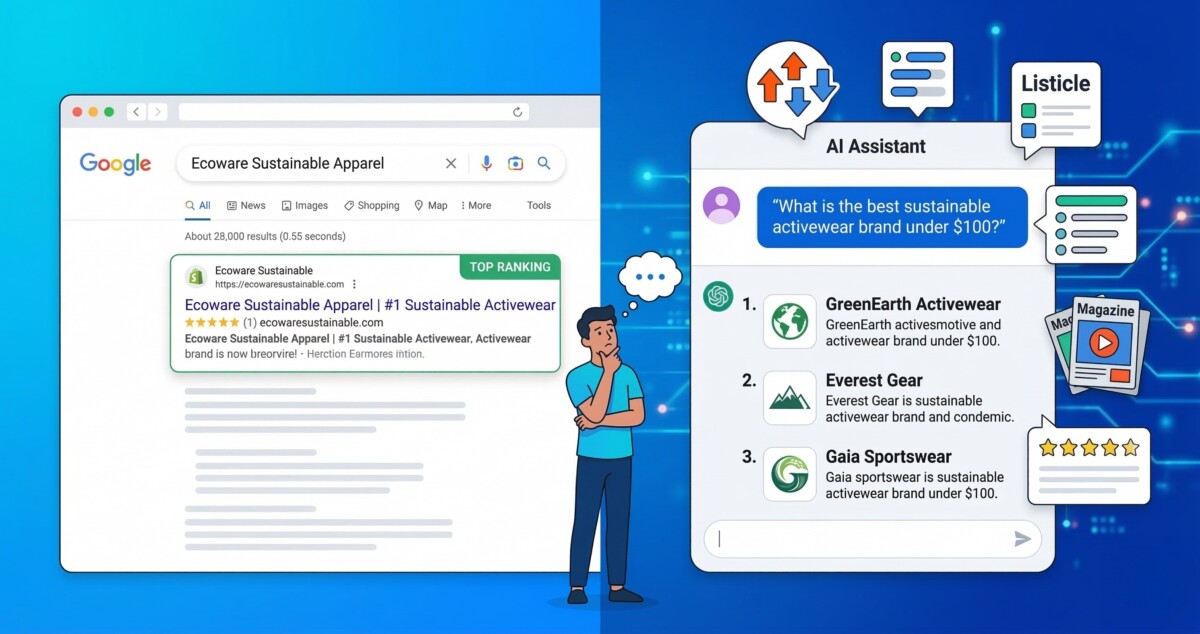
When a potential customer opens ChatGPT and asks “recommend a sustainable activewear brand under $100,” your brand does not appear in the response. Not because you do not rank well. Not because your product is not good. But because AI models have no signal that your brand is worth recommending to someone who does not already know about you.
This is the discovery layer gap. Google works when people search for what they know. AI works when people ask for what they need. Your brand may own the first category. You are probably losing the second.
Here is the pattern I have seen across 450 plus conversations with Shopify operators: brands doing $200K to $2M in revenue almost always have strong organic presence but almost zero AI visibility. The brands that have cracked AI visibility typically did not do it by accident. They built it deliberately.
The good news: you can test this in 15 minutes. The better news: once you know where the gap is, closing it follows a predictable playbook.
Test Yourself Right Now: The Three Platform Check
Before we talk about how to fix this, you need to know whether you actually have an AI visibility problem.
Go to ChatGPT, Claude, and Perplexity. In each one, ask the same question you would expect a potential customer to ask. Do not search for your brand name. Search for the problem your product solves.
If you sell sustainable activewear, ask: “What are the best sustainable activewear brands under $100?” If you sell personalized skincare, ask: “Recommend a personalized skincare brand that uses AI.” If you sell subscription coffee, ask: “What are the best specialty coffee subscription services?”
Open a spreadsheet and track three things: Does your brand appear in the top three recommendations? Does your brand appear anywhere in the response? Does the AI mention a competitor instead?
Run this test across all three platforms. Most Shopify brands will find they appear in zero to one of the three. Some will find they do not appear at all.
This is not a failure of your product. This is a failure of signal. AI models are trained on text data, and they make recommendations based on the patterns they see in that data. If your brand is mentioned frequently in editorial content, reviews, Reddit threads, and listicles, the model learns to recommend you. If your brand is mostly mentioned on your own website, the model has no third party signal to work with.
Why Google Ranking Does Not Automatically Mean AI Visibility
Google ranks pages based on links, content quality, and user behavior signals. If you have a strong product and a decent content strategy, you can rank well for your own brand name.
AI models rank recommendations based on citation frequency and source credibility. If your brand is cited frequently across independent sources, you get recommended. If your brand is mostly cited by yourself, you do not.
This distinction matters because it changes where you need to focus your effort. On Google, you can rank well by optimizing your own website. On AI, you cannot. You have to get other people to talk about you.
The brands that have figured this out are the ones that appear in “best of” lists, review roundups, Reddit discussions, and press mentions. They are not necessarily bigger than their competitors. They are just more visible in the places AI models learn from.
Understanding Third Party Citations: The Real Currency of AI Visibility
A third party citation is any mention of your brand that appears outside your own website. It could be a review site mentioning your product. It could be a Reddit thread where someone recommends your brand. It could be a listicle on a media site that includes you. It could be a press mention in a trade publication.
AI models are trained on billions of pieces of text. When they see your brand mentioned frequently across independent sources, they learn that your brand is worth recommending. When they see your brand mentioned only on your own website, they learn nothing.
This is why a brand like Ritual (the vitamin company) appears in AI recommendations for “best supplement brands” even though they are not the biggest player in the space. They have been mentioned in dozens of editorial pieces, reviews, and articles. The AI model sees that signal and learns to recommend them.
This is also why many excellent Shopify brands remain invisible to AI. They have strong products and strong Google rankings, but they have not built a citation footprint outside their own website. The good news: building that citation footprint is not complicated. It is just different from what you have been doing to rank on Google.
The Four Types of Editorial Placements That Signal to AI
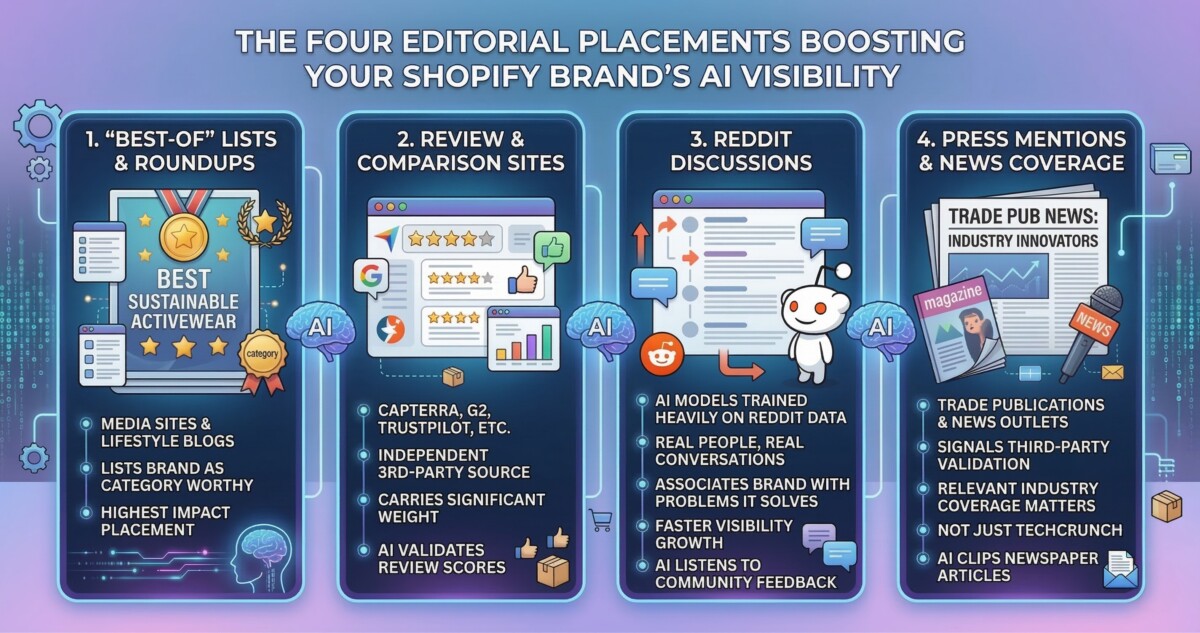
Not all third party mentions are equal. AI models weight some sources more heavily than others. Here are the four types of editorial placements that actually move the needle for Shopify brands.
Best of lists and roundups. These are the “best sustainable activewear brands” or “top 10 subscription services” articles that appear on media sites, lifestyle blogs, and industry publications. When your brand is included in one of these lists, the AI model learns that your brand is worth recommending in that category. This is the highest impact placement type for AI visibility.
Review and comparison sites. Sites like Capterra, G2, Trustpilot, and niche review sites carry significant weight with AI models because they are independent, third party sources. A single mention on a credible review site can move your AI visibility more than five mentions on smaller blogs.
Reddit discussions. AI models are trained heavily on Reddit data because Reddit is where real people have real conversations. When your brand is mentioned positively in relevant subreddits, the model learns to associate your brand with the problem you solve. This is why brands that have active Reddit communities see faster AI visibility growth.
Press mentions and news coverage. A mention in a trade publication, industry newsletter, or news outlet carries weight because it signals third party validation. You do not need TechCrunch. A mention in a relevant industry publication or newsletter is enough.
These four types are not equally easy to get. Best of lists require outreach and often a relationship with the publication. Review sites require customers to actually leave reviews. Reddit requires an active community or at least people willing to mention you. Press mentions require a story worth telling.
But here is what matters: if you are getting zero of these four types of mentions, your AI visibility will remain zero. If you are getting even two to three of these types of mentions consistently, your AI visibility will start to move.
Move One: Get Into the Editorial Ecosystem
The fastest way to build AI visibility is to get your brand mentioned in places where AI models learn from.
Start by identifying the “best of” lists and roundups that exist in your category. If you sell activewear, search “best sustainable activewear brands” and look at the articles that rank. If you sell skincare, search “best personalized skincare brands.” If you sell coffee, search “best specialty coffee subscriptions.”
Read the top five to ten articles. Note which ones include brands similar to yours. Note the author and publication. This is your target list.
Now reach out. Not with a sales pitch. With a genuine note that says: “I read your article on best sustainable activewear brands. We launched [your brand] last year and we fit the criteria you outlined. If you are updating this list, we would love to be considered.”
Most of these outreach attempts will go nowhere. But some will result in your brand being added to the list. Each addition is a citation signal to AI models.
Do this 20 times. Aim for five to ten successful placements in the first 90 days. Each placement is a signal. Ten placements across different publications is enough to start moving your AI visibility.
This is not a one time effort. It is an ongoing program. Every quarter, identify new lists and roundups and run the outreach again.
Move Two: Build Your Reddit Presence and Community Mentions
Reddit is where AI models learn what real people think about real brands. If your brand is being discussed positively on Reddit, AI models learn to recommend you.
This does not mean you need to build a massive subreddit. It means you need to be present in the communities where your customers already are.
If you sell activewear, you should be active in subreddits like r/fitness, r/running, r/yoga, and r/sustainable. If you sell skincare, you should be in r/skincare, r/beauty, and r/SkincareAddiction. If you sell coffee, you should be in r/coffee and r/espresso.
Do not spam. Do not sell. Just answer questions, share genuine insights, and when it is relevant, mention your brand. Over time, your brand becomes part of the conversation in these communities.
The second part of this is making sure your customers are talking about you on Reddit. This happens naturally if you have a good product and you encourage customers to share their experience. Some brands do this by including a note in the packaging: “Love us? Tell the world on Reddit at r/[your category].”
After 60 to 90 days of consistent community presence and customer mentions, you will start to see your brand appearing in AI recommendations for category searches.
Move Three: Optimize Your Owned Content for Answer Format
The third move is making sure that when your brand is mentioned in editorial content, the context makes it easy for AI models to understand why your brand is worth recommending.
This means optimizing your website for answer format. Instead of writing product pages that are optimized for Google, write pages that are optimized for AI.
An AI optimized page answers a specific question directly in the first paragraph. It provides context about why your brand is the answer. It includes specific details about what makes you different. It uses the language that AI models have learned to associate with recommendations.
For example, instead of a product page that says “Our activewear is made from sustainable materials,” write a page that says: “We make sustainable activewear for runners who care about environmental impact. Our fabrics are made from recycled ocean plastic and our manufacturing process uses 90 percent less water than conventional activewear. We price our products at $60 to $120 per piece, making sustainable activewear accessible to people who cannot afford premium brands like Patagonia or Allbirds.”
That second version gives AI models the information they need to recommend you when someone asks for “sustainable activewear under $100.”
This is not about gaming the algorithm. This is about making it easy for AI models to understand what you do and who you serve.
Audit your top 10 to 15 pages. Rewrite the introductions to answer the question directly. Add specific details about your price point, your materials, your process, and what makes you different. This takes two to four hours per page.
After you have optimized your owned content, you have created the foundation for the other two moves to work. When your brand gets mentioned in editorial content, the AI model can click through to your site and understand exactly why you are worth recommending.
The Timeline: What to Expect
If you implement all three moves, here is what the timeline typically looks like.
This is not guaranteed. It depends on your category, your product quality, and how aggressively you execute. But this is the pattern I have seen work most consistently for Shopify brands in the $200K to $10M range.
Tools for Monitoring Your AI Visibility
Once you start building your AI visibility, you need to monitor it. There are now several affordable tools that track brand mentions across AI platforms.
Searchable tracks your brand mentions across ChatGPT, Claude, Gemini, and Perplexity. Brand24 monitors mentions across the web and social media. Mention tracks brand mentions across news and web. These tools range from $50 to $500 per month depending on the features you need.
For most Shopify brands starting out, Searchable is the best option because it focuses specifically on AI platform visibility, which is what you are trying to move. You can see exactly which prompts are mentioning your brand, which platforms are citing you, and how your visibility is trending over time.
The key is to pick one tool and use it consistently. Do not try to monitor across multiple tools. Pick one, set it up, and check it weekly. After 90 days, you will have a clear picture of whether your three moves are working.
The Difference Between Being Visible and Being Recommended
There is one more distinction that matters. Being visible in AI is different from being recommended.
You might appear in an AI response because the AI is answering a question about your brand directly. That is visibility. But you might not appear when someone asks for a recommendation in your category. That is recommendation visibility, and it is what actually drives discovery traffic.
This piece has focused on recommendation visibility because that is where the real opportunity is for most Shopify brands. You probably already have visibility for your own brand name. What you are missing is visibility for the problem you solve.
If you implement the three moves in this piece, you will move from zero recommendation visibility to meaningful recommendation visibility within 90 days. That is when you will start to see AI traffic in your analytics and when you will know that the work is paying off.
Frequently Asked Questions
How do I know if my brand has an AI visibility problem?
Open ChatGPT, Claude, and Perplexity. Ask for a recommendation in your category without mentioning your brand name. If your brand does not appear in the top three results in at least two of the three platforms, you have an AI visibility problem. Most Shopify brands doing under $10M will find they appear in zero to one of the three platforms. This is normal and fixable with the right strategy.
Does AI visibility matter if I already rank well on Google?
Yes, because they serve different discovery moments. Google captures people who already know what they are looking for. AI captures people who are asking for help. A customer asking for a recommendation on ChatGPT is in a different mindset than someone searching your brand name on Google. Both are valuable, and they require different visibility strategies. You need both to capture the full range of discovery moments.
How long does it take to see results from editorial outreach?
Most publications will respond to your outreach within two to four weeks. Some will add you immediately. Others will wait until they are updating the list. Expect that about 20 percent of your outreach attempts will result in a placement. So if you reach out to 20 publications, you should expect four to five placements within 90 days. Each placement is a citation signal to AI models that strengthens your recommendation visibility.
Can I pay for AI visibility or do I need to earn it organically?
You cannot pay for AI visibility directly. You can pay for tools to monitor it, and you can pay for services that help you get editorial placements, but the visibility itself has to be earned through third party mentions. This is actually good news because it means your competitors cannot buy their way past you. If you build the citation footprint, you own that visibility long term.
What is the difference between AI visibility and AI traffic?
AI visibility means your brand is being mentioned in AI responses. AI traffic means people are actually clicking through from those responses to your website. You need visibility first, but visibility does not automatically create traffic. Traffic comes when your brand is recommended in a response that includes a link to your website. Some AI platforms include links in recommendations and others do not. Focus on building visibility first, and traffic will follow.
