






Quick Decision Framework
- Who This Is For: Shopify merchants doing $50K to $5M+ per year who want to understand why MCP matters to their business right now, before their competitors figure it out. No coding background required.
- Skip If: You are pre-launch or still building your first product. Come back when you have a live Shopify store and at least 30 days of order history. MCP optimization requires a real catalog to work with.
- Key Benefit: Understand exactly how MCP makes your store discoverable and purchasable inside AI assistants like ChatGPT, Google Gemini, and Microsoft Copilot, and know the three things to do this week to get ready.
- What You’ll Need: An active Shopify store (any plan), access to your Shopify Admin, and about 30 minutes to audit your product data quality. No developer required for the merchant-facing steps.
- Time To Complete: 12-minute read. Initial merchant-side setup takes 1 to 2 hours. Ongoing catalog hygiene is a weekly 30-minute habit.
The primary user of your Shopify storefront is no longer a human with a browser. In 2026, it is an AI agent with a purchase mandate. MCP is the protocol that decides whether that agent can find you, understand you, and buy from you.
What You’ll Learn
- What MCP actually is in plain English, and why Anthropic building it changed the trajectory of ecommerce faster than any platform update in the last decade.
- How Shopify embedded MCP directly into every store by default, and what that means for merchants who have never touched a line of code.
- Why product data quality is now your most important growth lever, and what “inference-ready” means for your catalog in practical terms.
- How the new Universal Commerce Protocol co-built by Shopify and Google connects MCP to real-time purchasing inside Google AI Mode, Gemini, ChatGPT, and Microsoft Copilot.
- What three actions to take this week to make your store more visible and purchasable through AI agents before your competitors realize this window exists.
In late 2024, Anthropic open-sourced a technical specification called the Model Context Protocol. Most merchants did not notice. The developer community did. Within six months, Google, Microsoft, OpenAI, Visa, and Mastercard had all committed to the standard. Shopify rolled native MCP support into every store on the platform. And on March 3, 2026, Shopify and Google jointly announced the Universal Commerce Protocol, a new open standard built on MCP that lets AI agents complete real purchases inside Google Search, the Gemini app, and Microsoft Copilot.
That announcement was not a preview. It was a live rollout. If you run a Shopify store, you are already inside this system whether you know it or not. The question is whether your store is set up to win inside it or get skipped by it. After tracking this shift through 400+ conversations with Shopify operators and ecosystem builders, the pattern I keep seeing is this: the merchants who treat MCP as a developer problem lose ground fast. The ones who treat it as a data and positioning problem are picking up incremental revenue right now with no custom development at all.
This is what MCP means for your business, in plain language, with the specific steps that matter at every stage of growth. If you want the broader strategic context first, start with what AI agents in ecommerce actually do before coming back here for the protocol layer.
What MCP Actually Is, And Why It Changes Everything
Before MCP, every AI assistant that wanted to interact with an online store had to build a custom integration. A developer at OpenAI had to write specific code to talk to Shopify’s API. A developer at Google had to write different code for a different store. Every retailer was a walled garden, and every AI platform had to build its own key for every lock. This is why AI shopping felt like a novelty for years. The plumbing was not there to make it real at scale.
MCP solves this with a single standardized language. Think of it as USB-C for AI. Before USB-C, every device had a different charger. After USB-C, one cable works everywhere. MCP does the same thing for AI agents and commerce platforms. An agent that speaks MCP can walk into any MCP-enabled store, read the product catalog, understand the policies, build a cart, and trigger checkout without a single custom integration on either end.
The protocol follows a client-server architecture. The MCP server lives on the merchant side, exposing structured data about products, inventory, pricing, policies, and checkout flows. The MCP client lives inside the AI assistant, reading that data and acting on it in real time. When a shopper tells ChatGPT “find me a waterproof hiking boot under $180 with wide sizing,” the AI client queries MCP servers across eligible merchants, compares results against the shopper’s constraints, and surfaces the best matches with an embedded checkout option, all inside the conversation.
Shopify moved fast here. As part of the Summer 2025 Edition, Shopify activated a default MCP endpoint at /api/mcp on every store on the platform. No setup required. No developer needed. Every Shopify merchant became MCP-accessible overnight. The practical implication is significant: your store is already reachable by any AI assistant that speaks the protocol. The variable is not whether agents can find you. It is whether what they find is good enough to recommend you.
Shopify Has Embedded MCP Into Your Store
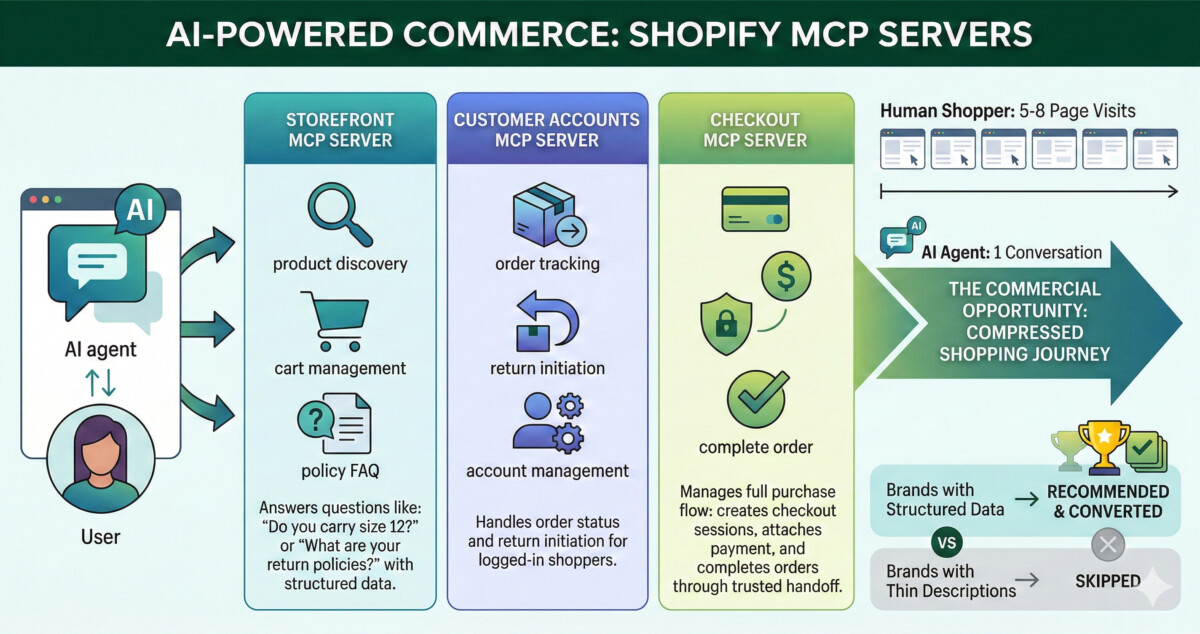
Most merchants running Shopify today have never heard of MCP. That is fine. Shopify made a deliberate decision to handle the protocol layer invisibly so merchants could benefit without needing to understand the technical implementation. But understanding what is running under the hood changes how you think about your store setup, and that shift in thinking is worth the 10 minutes it takes.
Shopify built three MCP server types that are now active across the platform. The Storefront MCP server handles product discovery, cart management, store policy questions, and FAQ responses. When an AI agent asks your store “what are your return policies?” or “do you carry this item in a size 12?” the Storefront MCP server answers in real time with structured data the agent can use immediately. The Customer Accounts MCP server handles order tracking, return initiation, and account management for logged-in shoppers. The Checkout MCP server manages the full purchase flow: creating checkout sessions, collecting buyer information, attaching payment data, and completing orders through a trusted handoff.
Together, these three servers give an AI agent the ability to do in one conversation what a human shopper used to do across five to eight page visits. That compression of the shopping journey is the commercial opportunity. Brands that have clean, complete, structured product data get recommended more often and convert more of those recommendations into completed orders. Brands with thin descriptions, missing attributes, and outdated policies get skipped.
Shopify’s Winter 2026 Edition delivered over 150 updates, with Agentic Storefronts as one of the headline features. Through Agentic Storefronts in your Admin, you can manage your presence across ChatGPT, Microsoft Copilot, Google AI Mode, and Gemini from a single interface. The setup that used to require months of custom development per platform now takes a few clicks. For context on why this infrastructure advantage matters at scale, the analysis of why Shopify is outpacing custom platforms in the agentic era covers the compounding effect in detail.
The Universal Commerce Protocol: What Changed On March 3, 2026
MCP solved the communication problem between AI agents and commerce platforms. But a new problem emerged: completing a purchase across different AI surfaces, payment processors, and merchant systems required each combination to negotiate its own checkout flow. A shopper buying through ChatGPT had a different experience than a shopper buying through Google Gemini. Merchants had to manage inconsistencies across platforms. Payment processors were not integrated into the agent layer in a standardized way.
The Universal Commerce Protocol, announced by Shopify and Google on March 3, 2026 and already endorsed by 20+ retailers and platforms, solves this. Shopify’s announcement of the Universal Commerce Protocol describes it as an open standard for AI agents to connect and transact with any merchant, built on top of MCP and designed to handle the full complexity of real commerce: discount codes, loyalty credentials, subscription billing cadences, final sale terms, pre-order timing, and every other variable that makes checkout more than just a payment form.
For Shopify merchants, the practical outcome is significant. Your products are now eligible to appear and sell natively inside Google AI Mode in Google Search and the Gemini app. Microsoft Copilot Checkout is live, allowing shoppers to complete purchases inside Copilot without leaving the conversation. Shopify also opened the Agentic Plan, which lets brands on any platform, not just Shopify storefronts, use Shopify’s commerce infrastructure to sell through AI channels. The catalog syndication that used to require a custom Shopify store is now available to any brand that wants to reach AI-driven buyers.
Visa and Mastercard are already inside this ecosystem. Visa’s Trusted Agent Protocol and Mastercard’s Agent Pay, both built on a cryptographic authentication layer called Web Bot Auth, let merchants verify that an incoming purchase request comes from a legitimate AI agent acting on behalf of a real cardholder, not a bot or a fraud attempt. This is the payment security layer that makes autonomous agent-led purchasing commercially viable at scale. Merchants who understand this layer stop worrying about whether agentic commerce is real and start asking what they need to do to capture their share of it.
Why Your Product Data Is Now Your Most Important Asset
Here is the thing that most MCP explainers miss. The protocol is live. The infrastructure is in place. Shopify has done the technical work on your behalf. The variable that separates merchants who win in this environment from merchants who get passed over is not their tech stack. It is the quality of their product data.
AI agents do not browse product pages the way humans do. They do not respond to lifestyle photography or clever taglines. They read structured attributes and make matching decisions based on how precisely your product data answers a shopper’s stated constraints. When someone tells an AI agent “I need a moisturizer for oily skin, fragrance-free, under $40, ships in two days,” the agent queries your MCP server and evaluates whether your product data contains clear answers to every one of those constraints. If your description says “great for all skin types,” the agent cannot confirm the match and moves to the next result. If your attributes include “skin type: oily, combination,” “fragrance: none,” and your inventory shows two-day shipping availability, you win the recommendation.
Shopify Catalog is the infrastructure layer that makes this work at scale. It standardizes product information so agents can compare across merchants consistently. The merchants who are winning early in this environment share a common pattern: they treat their catalog as a communication layer with AI agents, not just a display layer for human browsers. That means writing product titles that include the key use-case constraint, not just the product name. It means filling in every attribute field Shopify surfaces, even the ones that feel redundant. It means keeping your policies current and complete because agents query return windows, shipping timelines, and warranty terms as part of purchase decisions.
Whether you are doing $10K months or $1M months, this work is the same. The scale of the catalog is different, but the discipline is identical. Merchants at $10K who get this right now will have a compounding advantage in 18 months that larger competitors will find expensive to close. The complete guide to agentic commerce for Shopify merchants covers the 30 to 90 day catalog optimization rollout in detail if you want a structured execution plan.
What Merchants Should Actually Do This Week
Most of what needs to happen on the merchant side requires no developer, no app, and no budget. It requires attention and the willingness to treat your catalog as infrastructure rather than marketing collateral. Here is what matters right now, in order of impact.
First, audit your top 20 products for attribute completeness. Pull your best-selling SKUs and ask: if an AI agent were matching this product against a shopper’s specific constraints, what attributes would it need to confirm a match? Size, material, use case, compatibility, dietary information, skin type, age range, shipping speed, return window. Fill in every field. Write product descriptions that lead with the use case and the constraint it solves, not the brand story. “Waterproof trail running shoe with wide toe box, rated to 15 degrees Celsius, ships same day from Vancouver” is more useful to an agent than “our most popular outdoor shoe, loved by adventurers everywhere.”
Second, verify your store policies are current and complete. Agents query return policies, shipping timelines, and FAQ content as part of purchase decisions. If your return policy page is outdated, vague, or missing, agents will either skip your store or surface inaccurate information to shoppers, which creates returns and erodes your quality signals over time. Spend 30 minutes reading your own policy pages as if you were an AI agent trying to answer a shopper’s question. Fix every gap you find.
Third, activate Agentic Storefronts in your Shopify Admin if you have not already. This is the single-click connection that syndicates your catalog to ChatGPT, Google AI Mode, Gemini, and Microsoft Copilot. It is not a complex setup. It is a switch in your Admin that connects your existing catalog to Shopify’s agentic infrastructure. Once it is on, your products are eligible to appear in AI-driven shopping results across all four major platforms simultaneously. The brands that turned this on in Q4 2025 are already seeing incremental revenue from AI-referred orders. The brands turning it on now are still early. The ones waiting until this becomes mainstream news will be playing catch-up.
For operators who want to understand the full payment layer and how ChatGPT’s own checkout protocol fits into this picture, the breakdown of how ChatGPT Instant Checkout works for Shopify brands covers the Stripe-powered Agentic Commerce Protocol and what it means for your revenue attribution.
The Honest Trade-Offs Merchants Need To Understand
MCP and agentic commerce are genuinely good for Shopify merchants at most stages. But there are trade-offs worth naming directly, because understanding them lets you make better decisions about where to invest your time.
The first trade-off is visibility into the shopper journey. When a purchase completes through an AI agent, you often lose the mid-funnel data you are used to seeing. The shopper did not visit your product page. They did not scroll your images. They did not read your reviews in the traditional sense. The agent read structured data, made a match, and completed the transaction. Your analytics will show an order, but the attribution path looks different. This is not a reason to avoid agentic commerce. It is a reason to invest in the post-purchase relationship more deliberately, because the pre-purchase touchpoints you used to rely on for brand-building are compressed or absent.
The second trade-off is that returns may increase in the early months. When a shopper buys based on an AI agent’s interpretation of your product data, and your data is not perfectly precise, expectation gaps emerge. A shopper who asked for “warm-weather hiking pants” and received something that runs small because your sizing notes were incomplete will return the item and leave a signal that reduces your recommendation frequency over time. The solution is tighter data, not less agentic commerce. But expect a short adjustment period while you close the gaps between what your data says and what your products deliver.
The third trade-off is that quality signals compound in both directions. Merchants with clean data, accurate descriptions, fast shipping, and low refund rates get recommended more often as agents learn from transaction outcomes. Merchants with inconsistent data, slow fulfillment, or high return rates get recommended less often, and that signal is difficult to reverse quickly. This is the same dynamic as early SEO, where the brands that invested in content quality early built advantages that took competitors years to close. The window for getting ahead of this curve is open right now. It will not stay open indefinitely.
Frequently Asked Questions
What Is MCP And Why Does It Matter For My Shopify Store?
MCP stands for Model Context Protocol, an open standard originally developed by Anthropic in late 2024 and now adopted by Google, Microsoft, OpenAI, and Shopify. It creates a standardized way for AI assistants to read your store’s product data, policies, and inventory in real time, and to complete purchases on behalf of shoppers without requiring custom integrations. Shopify activated a default MCP endpoint on every store as part of the Summer 2025 Edition, which means your store is already reachable by AI agents. The variable is whether your product data is complete and structured enough for agents to confidently recommend and sell your products.
Do I Need A Developer To Set Up MCP On My Shopify Store?
No. Shopify handles the MCP protocol layer automatically for all merchants. You do not need to write code, install a custom app, or hire a developer to make your store MCP-accessible. The work that matters on the merchant side is catalog hygiene: filling in product attributes completely, keeping policies current, and activating Agentic Storefronts in your Shopify Admin to connect your catalog to ChatGPT, Google AI Mode, Gemini, and Microsoft Copilot. All of this is done through your existing Admin interface. Developers become relevant only if you want to build a custom AI shopping assistant or extend the protocol for specialized use cases.
How Does The Universal Commerce Protocol Differ From MCP?
MCP is the communication layer. It standardizes how AI agents read store data and trigger actions. The Universal Commerce Protocol (UCP), announced by Shopify and Google on March 3, 2026, is the transaction layer built on top of MCP. UCP defines how agents, merchants, payment processors, and credential providers communicate through the full purchase lifecycle, from product discovery through checkout completion. It handles the complexity of real commerce: discount codes, loyalty programs, subscription billing, final sale terms, and payment security. Think of MCP as the language agents use to read your store, and UCP as the protocol they use to actually buy from it. Both are now live and built into Shopify’s infrastructure.
Will AI Agents Replace My Existing Sales Channels?
No. Agentic commerce is an additional sales surface, not a replacement for your existing channels. Shoppers who prefer to browse your website will continue to do so. Email, paid ads, and social commerce remain relevant. What agentic commerce adds is a new entry point: shoppers who start their purchase journey inside an AI assistant can now complete it there without visiting your storefront. The brands that win treat this as incremental revenue from a new surface, not a migration away from existing channels. The practical implication is that your product data now needs to serve two audiences simultaneously: human browsers who respond to storytelling and imagery, and AI agents who respond to structured attributes and policy clarity.
How Do I Know If AI Agents Are Already Sending Traffic To My Store?
Start by checking your Shopify Analytics for referral traffic from ChatGPT, Perplexity, Google Gemini, and Microsoft Copilot. These sources may show up under direct or referral traffic depending on how the agent handles attribution. For more precise tracking, create a UTM-tagged URL for each AI platform and monitor order tags from agentic sources separately. Shopify’s Agentic Storefronts dashboard, accessible through your Admin, will show impression and click data from connected AI platforms once you have activated the feature. Merchants who activated Agentic Storefronts in late 2025 are already seeing 5 to 15% of new customer orders attributed to AI-referred sources in high-intent categories like health, outdoor gear, and specialty food.
