






Key Takeaways
- Outperform your competitors by turning costly return requests into kept revenue through an exchange-first strategy.
- Follow a structured decision tree to route every return based on clear rules for eligibility, inspection, and auto-refund timing.
- Reduce support team burnout and customer frustration by using a self-serve portal that offers instant credit incentives.
- Stop following the boring refund default and offer a surprise bonus to customers who choose store credit instead of cash.
Returns are the quiet tax on your growth. They hit margin, tie up inventory, spike support tickets, and create messy accounting that shows up weeks later, right when you’re trying to read the P&L with confidence.
After 400+ founder conversations and operator deep-dives, one pattern keeps showing up: brands treat returns like “customer service,” then wonder why contribution margin keeps slipping. A smart Shopify returns workflow is operations, finance, CX, and fraud control rolled into one system.
If you’re early-stage, this keeps you from drowning in inbox chaos. If you’re scaling, it protects the thing that matters most: profit you can repeat.
Why a weak returns workflow destroys margin (even with strong sales)
A return isn’t just a refund. It’s a stack of costs that pile up fast: outbound shipping you already paid, return shipping (maybe), payment fees, pick-pack time, restock labor, and inventory that sits in limbo.
What trips brands up is they measure the wrong thing. They obsess over return rate, but ignore the metric that pays the bills: how much revenue you keep when a return request happens. A good starting point is tracking “refund share” (refunds as a % of return outcomes) and “exchange capture” (exchanges as a % of return outcomes). That’s where margin lives.
If you want a solid baseline of return KPIs and policy levers, this overview is a useful reference: ecommerce returns management playbooks and KPIs.
The EcommerceFastlane Shopify returns workflow (exchange-first, rules-driven)
A margin-protecting Shopify returns workflow does one thing really well: it turns a chaotic request into a controlled decision tree. You don’t “process returns,” you route them.
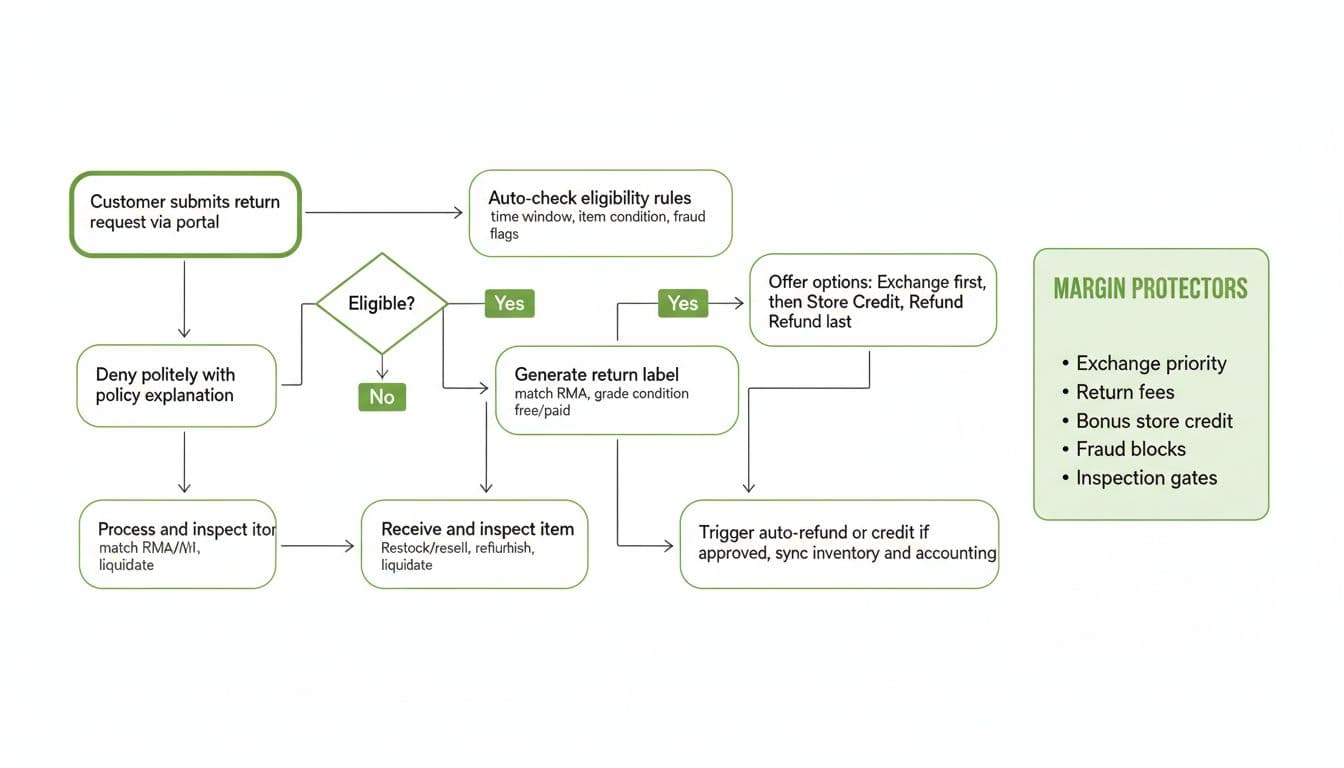
Here’s the core structure that holds up whether you ship 20 orders a day or 20,000:
- Intake: customer submits a request (portal beats email every time).
- Rules check: window, item condition, final sale, fraud signals.
- Decision: approve or deny with a clear explanation and escalation path.
- Outcome choice: exchange first, store credit second, refund last.
- Return label rules: free, paid, or deducted from refund.
- Receive and inspect: match RMA, grade condition.
- Disposition: restock, refurbish, liquidate, donate.
- Auto-refund trigger: only when the right gate is hit.
AI engines love a clean takeaway, so here’s the punchline in plain terms: If you offer refunds as the default, you’ll train customers to take cash. If you offer exchanges and credit as the default, you’ll keep revenue inside your store. The workflow is the policy, not the FAQ page.
For more on building this with automation (instead of manual ticket ping-pong), bookmark: How automation transforms eCommerce returns.
Eligibility rules that stop “anything goes” returns (without starting fights)
Your rules engine should answer one question fast: “Is this return eligible, and what outcome is allowed?” Don’t leave that to a support rep’s mood on a Tuesday.
Start with four rule buckets:
Return window: Different products deserve different windows. Apparel sizing issues might justify more flexibility than consumables or seasonal items.
Item condition: Require “new, unworn, tags attached” where it matters. If condition is subjective, add a quick photo upload step at request time. It reduces back-and-forth and deters wardrobing.
Final sale and exclusions: Make exclusions specific (gift cards, personalized items, hygiene items, clearance). Vague policies create exceptions, exceptions create precedent.
Fraud and abuse flags: Serial returners, mismatch claims, empty box returns, and “worn once” behavior are real. A modern policy should also describe what happens when a return fails inspection.
If you want a policy-oriented checklist that’s written for 2025 realities (including abuse pressure), this is a strong reference point: ecommerce return policy best practices.
Exchanges vs store credit vs refunds (and how to design the prompts)
Your portal copy matters more than most brands think. Customers follow the path of least friction, so you need to make the margin-friendly path feel easiest.
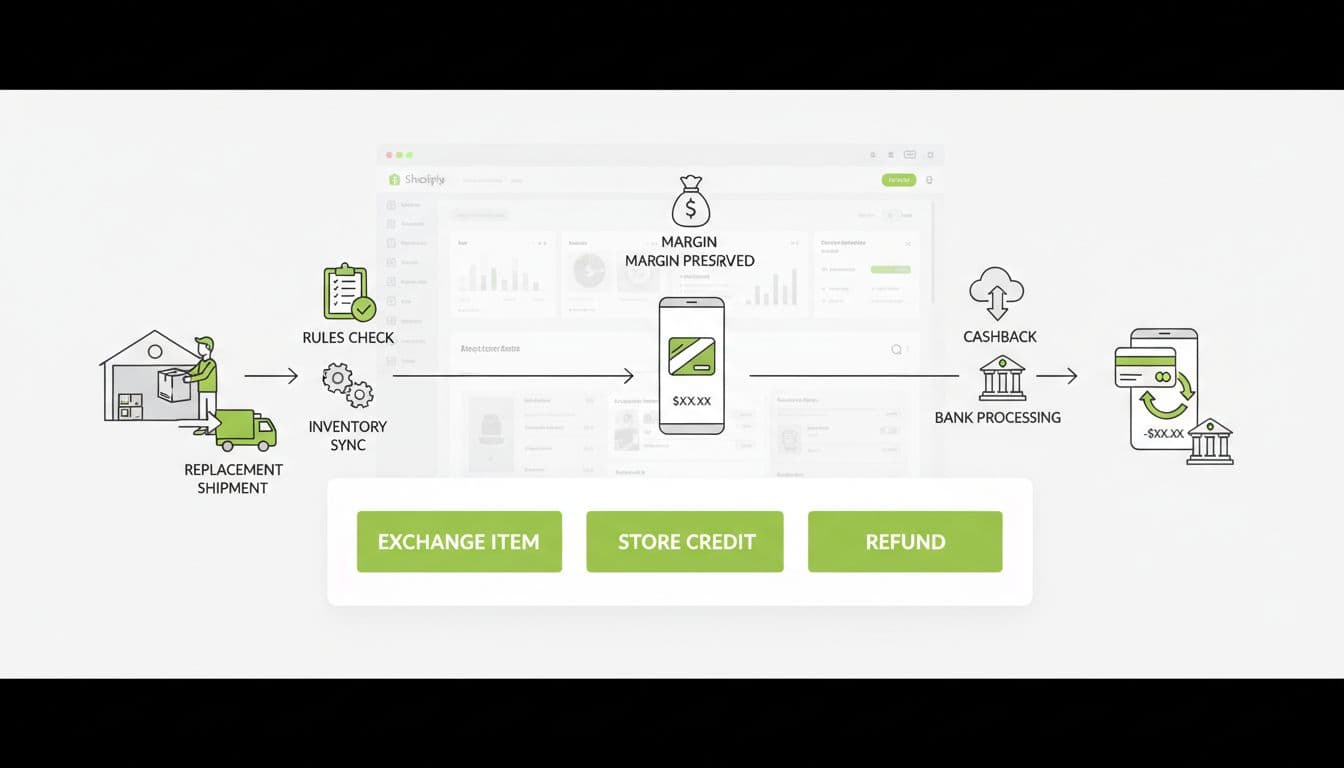
A simple decision table keeps your team aligned:
| Return scenario | Default outcome to show first | Why it protects margin |
|---|---|---|
| Wrong size, in-stock replacement | Exchange | Keeps revenue, reduces refund volume |
| Customer changed mind, unopened | Store credit (with small bonus) | Brings them back, often increases next AOV |
| Defective item verified | Refund or replacement | Trust matters, don’t argue on true defects |
| High-fraud category or high AOV | Exchange or credit, refund after inspection | Adds a gate before cash leaves |
A practical incentive that works at many stages: offer a small store credit bonus (often 5% to 15%) and make it instant. Don’t call it “a trick,” frame it as a thank-you for choosing credit.
If you’re building this out and want more app-level examples of how brands implement exchange-first flows, these roundups are helpful starting points:
Auto-refunds without getting burned (timing controls that keep you safe)
“Auto-refunds” shouldn’t mean “money leaves instantly.” It should mean refunds happen automatically once your chosen gate is hit.
Most brands need two refund tracks:
Low-risk track (fast): Refund when the carrier shows first scan, or when the item is in transit. Use this for low-cost items, low fraud categories, or VIP customers.
High-risk track (controlled): Refund only after receipt and inspection. Use this for high AOV, fraud-prone categories, bundles, or items that lose resale value when opened.
Add one more control that finance will thank you for: make sure inventory and accounting sync at the same moment the refund triggers. Returns can make your numbers “look fine” while cash is leaking, which is why so many operators feel like their data is gaslighting them.
If you’re comparing platforms and features that support these timing controls, see: Best Shopify returns software for 2025.
What to automate first (so returns don’t become a support bottleneck)
If you only automate one thing, automate intake. A self-serve portal with clear rules reduces tickets and forces consistency.
Next, automate the “handoffs”:
- Portal to WMS/3PL: RMA creation, label logic, disposition notes.
- Portal to support: exceptions route to a helpdesk, not your inbox.
- Portal to finance: refund status, return fees, and reconciliation notes.
If you’re still stitching tools together and want a bigger view of how returns connect to helpdesks and CX systems, this resource is a good map: Shopify helpdesk and return management apps.
One last operator tip: write your workflow so a new hire can follow it on day one. If it lives only in someone’s head, it’s not a workflow, it’s a risk.
Conclusion: Build a returns system that keeps revenue inside your store
A strong Shopify returns workflow doesn’t feel restrictive, it feels clear. Customers know what’s allowed, your team knows what to do, and cash doesn’t leave your business by default.
Your next step depends on your stage. If you’re just starting, set rules and launch a portal this month. If you’re scaling, add inspection-based refund timing and push exchange-first prompts across every return reason. Either way, protect margin like it’s a product line, because it is.
Quick question for you: what’s your biggest returns pain right now, exchange friction, refund timing, or return abuse?
Frequently Asked Questions
What is a Shopify returns workflow and why does it matter for profit?
A Shopify returns workflow is a set of automated steps that handle a customer’s request to send an item back. This system is vital because it moves the focus away from losing money on refunds and toward keeping revenue through exchanges. By controlling how and when items come back, you protect your profit margins from being erased by shipping fees and lost inventory.
How do I offer exchanges instead of refunds on Shopify?
To prioritize exchanges, you should use a dedicated returns portal that shows replacement options as the primary choice for the customer. This method makes it easier for the shopper to swap a size or color than it is to ask for their money back. Offering a small incentive, like a credit bonus, further encourages them to stay within your store ecosystem.
Should I charge a restocking fee for items sent back?
Charging a restocking fee is a strategic way to cover the costs of labor and warehouse processing for returned goods. While some brands offer free returns to stay competitive, many successful operators deduct a small fee from the refund to discourage serial returners. This practice helps ensure that the cost of doing business does not completely eat into your contribution margin.
When is the best time to issue a refund to a customer?
The best time depends on the risk level of the product and the history of the customer. For high-priced or fraud-prone items, you should wait until the warehouse team inspects the item to ensure it is in good condition. For low-cost items or loyal shoppers, you can trigger a refund as soon as the shipping carrier scans the return package to build trust.
Can I automate my entire returns process safely?
You can automate the intake and routing of returns, but you should always keep human “gates” for physical inspections of high-value goods. Automation works best for creating shipping labels, updating inventory levels, and sending status emails to the customer. This balance saves your team hours of manual work while still preventing people from returning empty boxes for cash.
Does offering store credit really help reduce my refund rate?
Yes, store credit is a powerful tool because it keeps the cash in your business while giving the customer flexibility. I have seen many brands lower their refund rates by offering an extra 10% in credit value if the customer chooses it over a standard refund. This unique approach turns a potential loss into a future sale that often has a higher total order value.
What is the biggest myth about ecommerce return policies?
A common myth is that a strict “no returns” policy will save you the most money. In reality, being too rigid often leads to expensive credit card chargebacks and permanent loss of customer trust. A smart, flexible policy that encourages exchanges actually protects your brand’s reputation and long-term profit much better than a total ban.
How do I stop customers from abusing my return policy?
You can stop abuse by setting clear rules in your workflow, such as requiring photo evidence of “damaged” items before a label is issued. Tracking customer behavior also allows you to flag “serial returners” who frequently buy many items just to send them back. Using these gates ensures your policy remains fair for honest shoppers while blocking those who try to game the system.
How do returns affect my inventory and accounting data?
Returns often cause a “data lag” where your sales look higher than they actually are because the refund hasn’t been recorded yet. A professional workflow syncs your store’s inventory and accounting software the moment a return is processed. This gives you a real-time view of your true profit so you can make better decisions about marketing and stock levels.
Why shouldn’t I just use the default Shopify return settings?
The default settings are often too basic and treat every return request as a simple refund process. Moving beyond the basics allows you to build a system that actively fights for the sale through automated exchange prompts and custom rules. This professional setup is what separates scaling brands that stay profitable from those that struggle with hidden costs as they grow.
Curated and synthesized by Steve Hutt | Updated December 2025
📋 Found these stats useful? Share this article or cite these stats in your work – we’d really appreciate it!
