




Key Takeaways
- Outperform competitors by replacing standard tracking alerts with a Decision Layer that cuts support tickets by up to 90 percent.
- Implement a logic-based filter to suppress irrelevant carrier updates and ensure customers only receive notifications that provide true delivery clarity.
- Protect your team from burnout and reduce customer anxiety by providing proactive updates that solve problems before a person feels the need to call.
- Stop treating every shipping update as equal and realize that showing less data can actually create a better shopping experience.
For growing Shopify brands, success is often measured in rising conversion rates and record-breaking product drops.
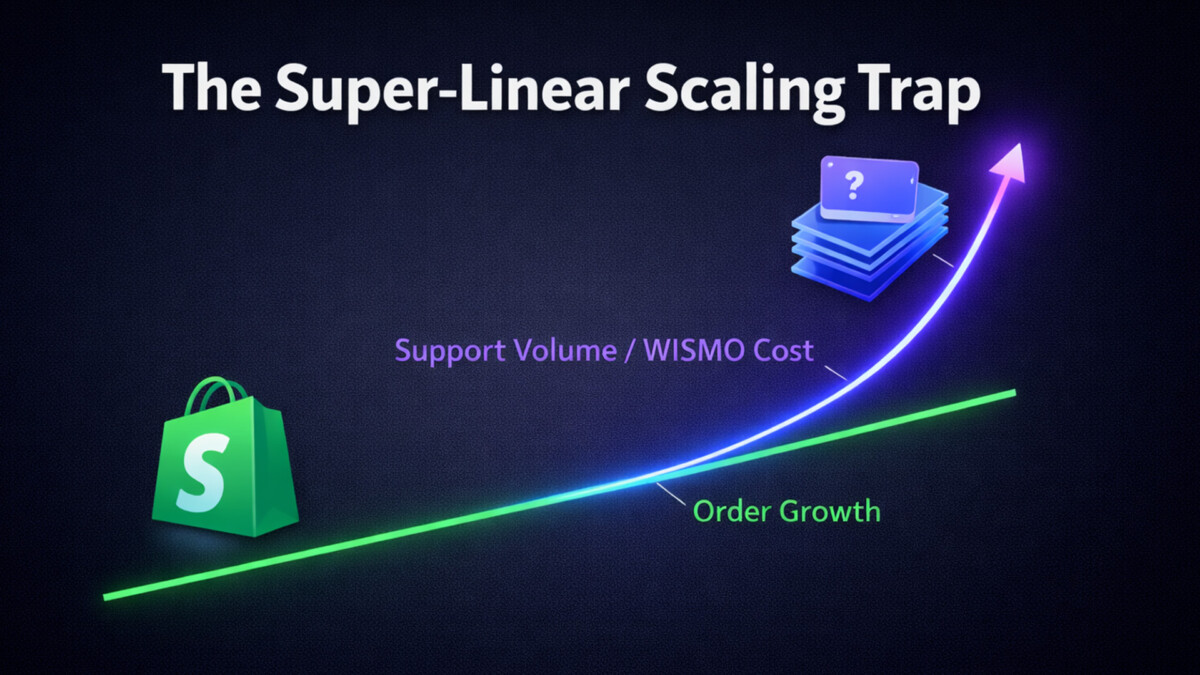
But beneath the surface of a successful Shopify Admin, a quieter, more persistent trend often takes hold. As order volume scales, the operational burden of “Where Is My Order?” (WISMO) inquiries doesn’t just grow – it accelerates super-linearly (source: WISMOlabs).
WISMO isn’t a one-time crisis; it is a chronic support challenge that slowly erodes operations, eats away at profitability, and quietly degrades customer satisfaction. To scale a brand profitably, retailers must move beyond the “band-aid” of basic tracking automation and address the systemic logic failures that keep the WISMO tickets coming, phone ringing and customer leaving negative reviews.
The Super-Linear Support Challenge
In a perfect operational world, doubling your orders would simply double your support needs. However, ecommerce logistics rarely follow a linear path. As you grow, you introduce more carriers, more international shipping lanes, and more third-party logistics (3PL) nodes. This complexity creates a “Super-Linear” scaling trap: your support burden grows faster than your revenue.
At the center of this trap is WISMO. While many brands attempt to solve this with standard shipment tracking apps, they often find that these tools act as reactive relays rather than proactive solutions. They automate the delivery of information, but they lack the order and customer context required to provide true clarity.
For example, many automated systems will blindly push a notification if a carrier flags a shipment “Exception,” even if that exception has no impact on the final delivery date. In this scenario, the automation hasn’t solved a problem—it has created one by triggering unnecessary anxiety. To prevent sending messages that raise more questions than they answer, retailers need a system that filters raw carrier signals and enriches them with relevant data. By using order, customer, and shipment context together, a brand can ensure that every notification provides a meaningful answer rather than a reason to contact support. This shift from raw data to contextual clarity is what stops a simple shipment from turning into a high-cost operational drain.
Why Standard Shipping Notifications Fail to Stop the Erosion
Most Shopify brands rely on a standard set of shipping notifications. These are the traditional post-purchase emails or SMS updates triggered directly by raw carrier data. On paper, this is “automation.” In practice, it is often a direct pipe that lacks the intelligence to interpret the data it is sending.
The fundamental flaw in standard shipping notifications is that they are blind to order and customer context. Because shipment tracking systems only see the carrier’s tracking number, they treat every scan as equally important. For example, they don’t know if a “Label Created” status for 48 hours is a genuine delay or simply the standard pickup cadence for a specific warehouse. They don’t know if the customer is a first-time buyer who needs extra reassurance or a loyalty member who understands your fulfillment process.
Without such context, standard shipping notifications struggle to provide clarity – a problem that compounds during shipping exceptions when accurate information is most critical. In these moments, they can only offer raw data, which to the customer often looks like a ‘black hole’ in the fulfillment or shipment process. When they see a status that hasn’t moved for three days or a vague exception notification with no updated expectations, they often assume their order has been lost or forgotten.
When shipping notifications create noise instead of reassurance, they trigger the very customer anxiety they were meant to prevent. The customer doesn’t care that you have a “branded” tracking page; they care that their $200 order appears to be in limbo. Because standard notifications lack the logic to interpret the shipment’s progress, they fail to provide the necessary clarity, leading the customer to pick up the phone. This is how the “never-ending challenge” begins to eat away at your bottom line: one frustrated customer and one manual support interaction at a time.
The Decision Layer: Moving from Noise to Clarity
To break the cycle of operational erosion, Shopify brands need a Post-Purchase Decision Layer. Pioneered by WISMOlabs, this framework moves beyond standard shipment notifications by evaluating the entire context. Unlike standard shipment notifications that simply relay data, a decision layer evaluates the entire context of an order before deciding whether or not to contact the customer.
This works by assessing every update through a logic-based filter:
- Intelligent Suppression: The system identifies and suppresses irrelevant carrier updates—like back-end “exceptions” that don’t affect the delivery experience. This prevents the “noise” that often triggers unnecessary support tickets.
- Unified Context: By combining customer history, order details, and carrier events into a single data layer, the system understands the true status of a delivery. It knows if a delay is a genuine problem or just a standard part of a warehouse’s schedule or delivery logistics.
- Customizable Logic: Using dynamic templates, retailers can tailor messages to their specific goals. Instead of a generic one-size-fits all updates, the system provides a clear, contextual message that either reassures the customer during a delay or encourages a repeat purchase when a shipment is on track.
The difference in outcomes between these two approaches is quantifiable. While standard shipment tracking apps typically reduce inquiries by an average of 40%, they eventually hit a ceiling because they cannot solve for anxiety-inducing exceptions. In contrast, by implementing a Decision Layer with programmable templates, WISMOlabs has seen an average reduction in WISMO calls of 70% to 90%. This is achieved by using the programmable logic to provide the specific context required to resolve a customer’s question before they feel the need to reach out.
By shifting from reactive tracking to this context-aware approach, brands can finally reduce WISMO calls and protect their operational efficiency. When you provide clarity by design—and withhold information that causes confusion – you eliminate the primary reasons customers reach out.
The Profit Leak: The Hidden Cost of WISMO
The true cost of WISMO is rarely found on a single line item in a P&L statement. Instead, it is a gradual erosion of margins and brand equity that happens across three key areas.
First, there is the inefficiency of standard defenses. Most retailers do not deal with WISMO manually as a first line of defense; they employ AI chatbots and automated help desks. However, if these tools are powered by the same noisy carrier data found in standard shipping notifications, they simply recycle the confusion. When an AI bot provides a vague or inaccurate update because it lacks order context, the customer eventually bypasses the automation to reach a human agent. This results in a high-cost manual interaction that the retailer had already paid for automation to prevent.
Second, there is the reputational damage. A poor post-purchase experience often translates into negative reviews that have nothing to do with the actual product. A customer may love the item they purchased, but if the delivery process was defined by uncertainty and “black hole” periods, they are likely to leave a one-star review citing “poor service” or “shipping issues.” These reviews live on social media and Shopify store pages, increasing customer acquisition costs by discouraging new shoppers who cannot distinguish between a carrier delay and a brand’s operational failure.
Finally, there is the erosion of Customer Lifetime Value (LTV). The post-purchase period is the highest point of customer engagement. If that experience is defined by anxiety and a lack of clarity, the likelihood of a repeat purchase decreases significantly. It costs far more to acquire a new customer than to retain an existing one; allowing preventable WISMO inquiries to degrade your retention rate is a direct hit to long-term profitability.
Transforming the Shopify Post-Purchase Journey
The goal of a modern Shopify operation is not simply to manage the volume of WISMO inquiries, but to implement a system that provides enough clarity to prevent them. By focusing on operational intelligence rather than just reactive automation, brands can scale their order volume without a corresponding spike in support costs.
Integrating a decision-driven post-purchase platform into the Shopify ecosystem ensures a consistent flow of information across the organization. When support agents do need to assist a customer, they are looking at the same enriched context-customer history, order details, and warehouse logic-that the customer sees on their tracking page. This creates a single source of truth that aligns the brand’s promises with the actual fulfillment experience, eliminating the discrepancy between carrier data and customer expectations.
Finally, removing the noise from the post-purchase journey allows brands to shift from a defensive posture to a proactive one. When a customer is well-informed and confident in their delivery, they are much more receptive to post-purchase engagement, such as loyalty program invitations or personalized product recommendations. By prioritizing clarity first, retailers earn the trust necessary to drive repeat revenue and increase long-term loyalty.
Conclusion: Growth Without the Drain
Scaling a Shopify brand is an exercise in managing complexity. While the chronic challenge of WISMO will always exist as long as goods are being shipped, it does not have to be a primary drain on your profitability or your brand’s reputation.
By recognizing that standard shipping notifications are no longer sufficient for the needs of high-volume retailers, brands can take a meaningful step toward true operational efficiency. The transition from a reactive tracking page to a robust Post-Purchase Decision Layer is the difference between an operation that is constantly on the defensive and one that maintains ownership of the customer journey from the checkout to the doorstep.
Growth should be rewarded with higher margins and more satisfied customers, not penalized by a super-linear rise in support tickets, phone calls, and negative reviews. By prioritizing clarity and logic over raw data and noise, retailers can ensure that the post-purchase experience becomes a foundation for loyalty rather than a source of operational frustration. The shift toward a proactive, context-aware strategy is a fundamental key to scaling a sustainable and profitable ecommerce business.
Frequently Asked Questions
What does WISMO mean in ecommerce and why does it matter?
WISMO stands for Where Is My Order and represents the most common customer support inquiry for online brands. While it seems like a simple question, high volumes of these tickets can eat away at your profits and overwhelm your support team. Solving this issue is essential for any brand that wants to scale without losing money on manual labor.
Why do support tickets grow faster than sales for growing Shopify brands?
This happens because shipping logistics become more complex as you add new carriers, warehouses, and international shipping routes. This complexity creates a super-linear growth pattern where your support burden increases much faster than your actual revenue. Without a smart system to manage this noise, your brand will spend more on fixing problems than making sales.
Why are standard shipping notifications often ineffective?
Basic notifications simply relay raw data from carriers, which often lacks the context of the actual order or customer history. These automated messages can trigger unnecessary anxiety by notifying customers of back-end shipping exceptions that do not actually delay the delivery. True clarity comes from interpreting the data rather than just passing along every technical update from the shipping company.
How does a Post-Purchase Decision Layer differ from a standard tracking app?
A standard tracking app acts as a reactive relay that shows the same raw information to every user. In contrast, a Decision Layer uses logic to evaluate the entire context of an order before sending an update to the customer. This system filters out confusing noise and only shares information that helps the customer understand exactly when their package will arrive.
Can automated shipping updates actually increase customer anxiety?
Yes, sending too much raw data often backfires by highlighting minor technical errors that the customer does not need to know about. When a buyer receives a vague exception notice without a clear explanation, they often assume their order is lost or stuck in a black hole. Modern shipping strategy focuses on withholding confusing data to maintain a sense of calm and trust.
What is the most effective way to reduce WISMO calls immediately?
The best move is to implement programmable templates that provide specific instructions or reassurance during common shipping milestones. By using logic to explain why a package might sit at a warehouse for forty-eight hours, you answer the customer’s question before they feel the need to call. Providing this specific context can reduce your support volume by up to ninety percent.
How do shipping delays impact a brand’s long-term reputation?
Negative reviews often stem from a lack of communication during the shipping process rather than the delay itself. Customers are generally patient if they feel informed, but silence or vague updates lead to one-star reviews about poor service. These reviews increase your cost to find new customers and can permanently damage your brand equity on social media.
Does using an AI chatbot solve the problem of high support volume?
Automation alone is not enough if the chatbot is fed the same confusing carrier data that the customer already sees. If your bot lacks the order context to explain a delay, the customer will simply ask to speak with a human agent anyway. To be effective, your AI tools must have access to a single source of truth that combines carrier updates with warehouse logic.
How does the post-purchase experience affect Customer Lifetime Value?
The period between clicking buy and receiving the package is the time of highest engagement and highest emotional stakes for a customer. If this journey is filled with uncertainty, the shopper is much less likely to return for a second purchase. A clear and professional delivery experience builds the trust necessary to turn a one-time buyer into a loyal fan.
What should I look for in a modern shipping tracking platform?
Look for a platform that emphasizes programmable logic and “intelligent suppression” rather than just a branded tracking page. You want a tool that can hide irrelevant carrier data and allow you to customize messages based on specific customer segments. This shift from raw information to meaningful communication is what separates successful brands from those struggling with support costs.
