





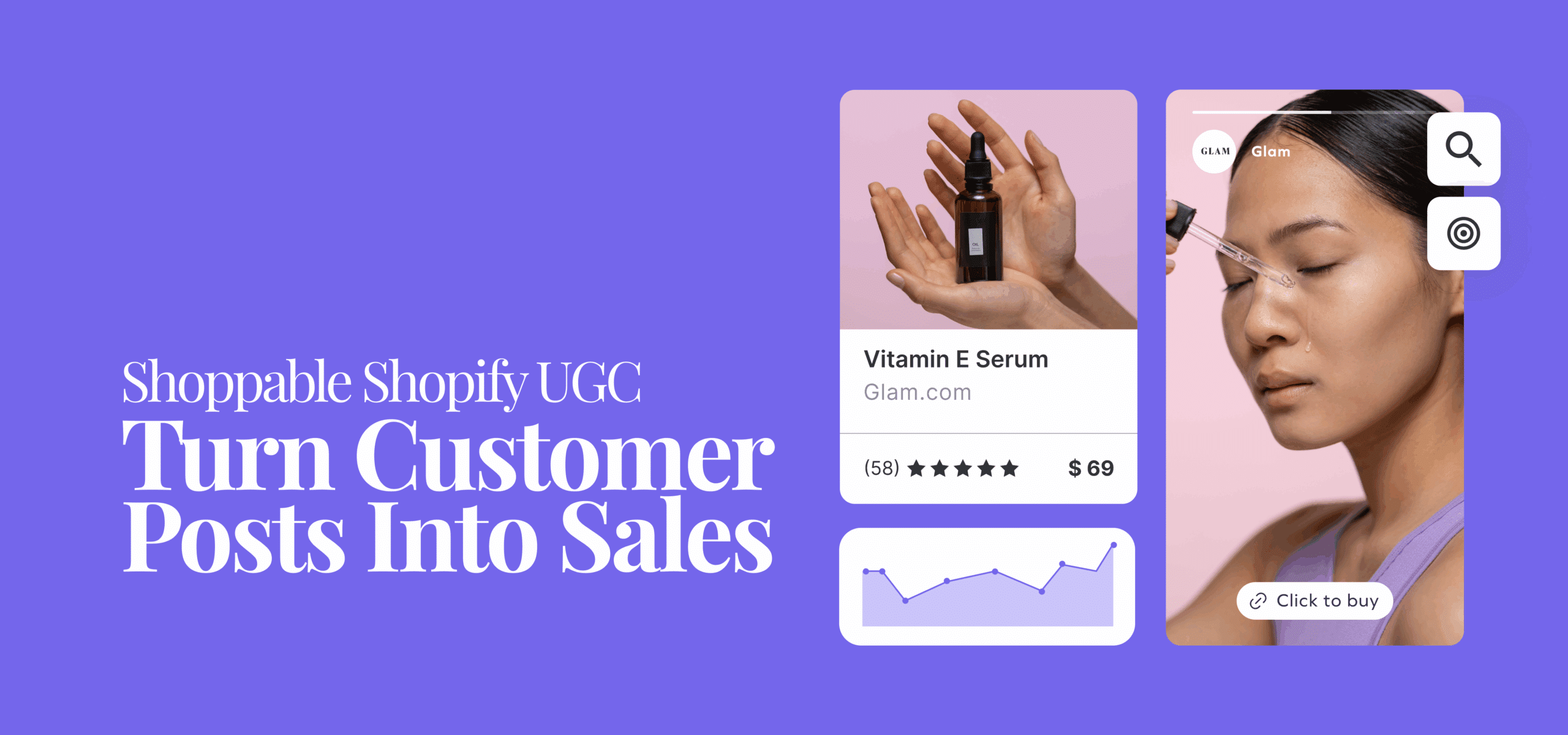
Look at any successful Shopify store, and you’ll find a common thread: trust. Shoppers today are discerning; they can spot an impersonal marketing campaign instantly. What they trust are real people: your customers. The content they create—photos, videos, and reviews—is your single most powerful marketing asset. This is user-generated content (UGC). However, simply having UGC is often not enough. Making it shoppable bridges the gap between inspiration and purchase. This guide will show you how to build a complete strategy to collect, manage, and monetize your Shopify UGC.
Key Takeaways: Best Strategies for Shoppable Shopify UGC
- UGC Drives Conversion: Shoppers who interact with user-generated content convert at a 161% higher rate than those who don’t.
- “Shoppable” Reduces Friction: Tagging products directly in customer photos allows shoppers to move from discovery to checkout in a single click.
- Visuals are Critical: Customer photos increase purchase likelihood by 137%, offering authentic social proof that branded photos cannot match.
- Start with the PDP: The Product Detail Page is your highest-leverage placement. Even a small number of reviews (10) can drive a 53% uplift in conversion.
- Automate Collection: Relying on organic posts isn’t enough. Use post-purchase requests (via email or SMS integrations) to build a consistent content engine.
What is User-Generated Content (UGC) and Why Does Your Shopify Store Need It?
First, let’s establish a clear definition. User-Generated Content is any form of content—text, photos, videos, social media posts, Q&A—that is created by your customers rather than your brand. It’s the digital equivalent of “word-of-mouth,” and it is incredibly powerful.
Defining UGC (Beyond Just Reviews)
When most merchants hear “UGC,” they think of text-based product reviews. Those are a vital part, but modern UGC is much more. For your Shopify store, UGC includes:
- Visual Reviews: Customers uploading photos or videos of themselves using your product. This is the gold standard of authentic content.
- Social Media Posts: Shoppers posting on Instagram or TikTok and tagging your brand or using your brand’s hashtag.
- Community Q&A: Customers answering each other’s questions on your product pages. This builds a helpful community and surfaces key information.
- Text Reviews: The classic star ratings and written feedback that build your store’s foundation of trust.
The “Why”: Trust is the Currency of E-commerce
Why does UGC work so well? Because it offers the one thing money can’t buy: authenticity. As e-commerce expert Ben Salomon often notes, in an era of infinite choice, trust is the primary currency. Customers don’t just want to know what a brand says about itself; they want to know what people like them say about it.
Consider your own habits. A studio-shot photo is beautiful, but a customer photo answers the real questions: “How does it fit?” “Is the color accurate?” UGC validates the purchase decision, overcoming skepticism at the critical moment.
The Tangible Benefits for Shopify Merchants
A strong UGC strategy delivers measurable ROI:
- Higher Conversion Rates: The data is clear—shoppers who interact with UGC are 161% more likely to convert.
- Increased Purchase Confidence: Visual social proof, like customer photos, lifts purchase likelihood by 137%.
- SEO & “GEO” Readiness: Search engines today, including new “AI Overviews” and other LLMs, prioritize fresh, helpful content. A steady stream of reviews provides unique, keyword-rich text that signals relevance to Google’s algorithms.
The “Shoppable” Component: Bridging the Gap
So, you have a growing collection of great customer photos. That’s fantastic. But if your gallery is just a “wall of fame,” you are creating a dead end. A shopper sees a photo they love, gets inspired, and then has to hunt for the product. That is friction, and friction hampers conversion.
Shoppable UGC connects inspiration directly to the point of purchase. It allows a shopper to:
- Click a customer photo in your gallery.
- See the exact products tagged in that photo.
- Add the item to their cart immediately.
This turns passive browsing into active shopping, capturing impulse buys when intent is highest.
Step 1: Building Your Shopify UGC Collection Strategy
A shoppable content strategy begins with a robust collection plan. Relying on organic posts is unpredictable. A proactive “flywheel” ensures new customers buy, submit UGC, and that UGC helps convert the next wave of shoppers.
Method 1: Smart Post-Purchase Requests
This is your most reliable method. You are catching the customer when the experience is fresh.
- Optimize the Channel: While email is standard, consider using integrations for SMS requests. Data shows that SMS review requests convert 66% higher than email.
- Use Smart Prompts: Don’t just ask “How was it?” Use AI-driven prompts to ask specific questions about fit, quality, or usage. This makes customers 4x more likely to mention high-value topics.
- Reduce Friction: Ensure customers can submit their review and upload a photo directly within the email or SMS flow (in-mail forms).
Method 2: Hashtag Campaigns & Social Monitoring
Encourage customers to tag you on Instagram or TikTok with a branded hashtag (e.g., #MyBrandStyle). Use a UGC tool to monitor these tags and pull the content into a central dashboard for curation.
Legal Checkpoint: Rights Management
This is a critical step. Obtaining explicit permission is essential before making a customer’s social media photo “shoppable” on your site.
- For Reviews: Your terms of service in the request flow should cover usage rights.
- For Social: Automate the rights request process. Comment on the post asking for permission (e.g., “Reply with #YesBrand to let us feature this!”). Never use content without this confirmation.
Step 2: Choosing the Right Tools
Managing UGC manually—saving photos to a desktop folder and hard-coding galleries—is not scalable. A dedicated Shopify app handles collection, rights management, and display efficiently.
Look for a solution that offers:
- Deep Shopify Integration: It must sync with your catalog to allow easy product tagging.
- Visual Curation: A dashboard to filter, approve, and tag photos.
- Performance Analytics: The ability to track specifically how much revenue your gallery widgets are generating.
Step 3: Implementing Shoppable UGC on Your Store
Where you place your content is just as important as what you display.
The Homepage: The “Shop Our Feed” Gallery
Your homepage is for establishing brand identity. Replace static banners with a dynamic “Shop Our Instagram” or “Community Favorites” gallery. It shows new visitors immediately that your brand is active and trusted by real people.
Product Pages (PDPs): The Conversion Engine
This is your most critical placement. Shoppers here are close to buying.
- Visual Galleries: Place a carousel of customer photos using that specific product directly under the main product image.
- The “Uplift” Effect: You don’t need thousands of reviews to see an impact. Just 10 reviews can drive a 53% conversion uplift.
Dedicated “Inspiration” Pages
Create a landing page (e.g., /pages/inspiration) that acts as a full-screen, shoppable catalog. This is excellent for SEO and allows users to browse by “look” rather than product category, increasing Average Order Value (AOV) as they discover complimentary items.
Step 4: Promoting Your UGC
Once you have the content, amplify it.
- Email Marketing: Instead of stock photos, use your “Customer Photo of the Month” in your newsletters. Link the image directly to your shoppable inspiration page.
- Ads with Ratings: If you run Google Ads, ensure you are utilizing Seller Ratings. Ads with star ratings see a 17% increase in CTR.
How Yotpo Helps You Scale
While many tools exist, Yotpo Reviews and Yotpo Loyalty are designed to work in tandem to solve the specific challenges of scaling UGC. Yotpo Reviews provides the AI-powered “Smart Prompts” and syndicated SMS integrations to maximize collection rates, while its display widgets are fully customizable for Shopify themes. By layering Yotpo Loyalty on top, you can incentivize high-value behaviors—like offering 2x points for a photo review or 3x for a video—ensuring a steady stream of the visual content that drives the highest ROI.
Step 5: Analyze and Optimize
You can’t improve what you don’t measure. Review your UGC dashboard weekly to track:
- Conversion Rate: Are shoppers who click on the gallery buying?
- Engagement: Which gallery positions (Homepage vs. PDP) get the most clicks?
- Coverage: Which products lack visual UGC? Run a specific campaign (e.g., “Double Points for Reviews on [Product X]”) to fill the gaps.
Conclusion
User-generated content is the most authentic marketing asset you have, but leaving it static is a missed opportunity. By making that content shoppable, you transform social proof into a direct revenue driver. Build a proactive collection strategy, respect usage rights, and place your shoppable galleries where they matter most. When you turn your customers into your creative team, you build a brand that is trusted, resilient, and primed for growth.
FAQs: Shoppable Shopify UGC
What is the difference between UGC and influencer marketing? User-generated content (UGC) comes from genuine customers who purchased your product, often shared voluntarily or for small loyalty perks. It is perceived as highly authentic. Influencer marketing involves paying a content creator to promote a product. While both are valuable, shoppers generally trust UGC more than influencer content for unbiased feedback.
How does UGC impact SEO and “AI Overviews”?
Fresh, text-based reviews provide a constant stream of unique content for search engines to crawl, which can improve organic rankings. Furthermore, “AI Overviews” rely on authoritative, diverse sources to generate answers. A robust volume of specific reviews helps ensure your products are cited in these AI-generated results.
Can I make my Instagram feed shoppable on Shopify without an app?
Technically, you could manually code links into images, but it is not scalable or dynamic. As products go out of stock or prices change, manual links break. A dedicated Shopify UGC app automatically syncs with your catalog, ensuring that tagged products and prices are always accurate.
How do I encourage more video reviews?
Video requires more effort from the customer, so the incentive must match. Using a tiered loyalty program is effective: offer 50 points for a text review, but 300 points for a video review. Additionally, “Smart Prompts” in review requests can specifically ask customers to upload a video of them using the product, rather than just a photo of the box.
What should I do with negative reviews that have photos?
Never delete them unless they violate content policies (e.g., profanity). Negative reviews actually build trust; a perfect 5.0 score can look suspicious. Respond publicly and professionally to show you care. If the photo highlights a legitimate issue, use it as feedback to improve your product.
Does adding a UGC gallery slow down my Shopify site?
It can if not optimized. High-resolution images are heavy. Ensure your UGC tool uses a Content Delivery Network (CDN) and “lazy loading” technology. This ensures images only load as the user scrolls down to them, preserving your page speed scores.
How do I get rights to customer photos on Instagram?
You must ask for permission. The industry standard is to comment on the user’s post expressing your love for the photo and asking them to reply with a specific hashtag (e.g., #YesBrandName) to grant permission. Many UGC apps automate this process and log the approval for legal compliance.
What is “Syndication” in reviews?
Syndication allows you to share reviews between different storefronts or retail partners. For example, if you sell your products on Target.com or Walmart.com, syndication allows the reviews collected on your Shopify site to appear on those retailer sites, boosting credibility across channels.
How many reviews do I need to see a conversion lift?
You don’t need thousands. Data shows that just 10 reviews can result in a 53% uplift in conversion. The jump from 0 to 10 is the most impactful, so focus your efforts on getting those first few reviews for every product in your catalog.
Can I use UGC in my Google Shopping ads?
Yes. You can aggregate your star ratings to display “Seller Ratings” in your Google Ads text campaigns. Additionally, you can feed product reviews into Google Shopping, allowing your star ratings to appear directly on product listing ads (PLAs), which can improve Click-Through Rate (CTR) by up to 17%.
How does Shoppable UGC affect Average Order Value (AOV)?
Shoppable galleries often function as “Shop the Look” features. When a customer sees a photo of a jacket styled with a specific scarf and pair of jeans, they are more inclined to buy the entire outfit rather than just the single item they came for. By tagging multiple products in a single customer photo, you naturally encourage bundling and higher basket sizes.
Can visual UGC help reduce return rates?
Absolutely. One of the primary reasons for returns in fashion and home goods is that the product looked different in person than it did in studio photos. High-quality user photos show fit, texture, and scale on real people and in real homes. This helps set accurate expectations, leading to more satisfied customers and fewer returns.
Should I use shoppable UGC in my email marketing campaigns?
Yes. While you cannot make an image “clickable” to multiple products directly inside an email in the same way you can on a website, you can feature a “Look of the Week” that links directly to a shoppable gallery on your site. This is often more engaging than standard product shots and keeps your community at the center of your marketing.
How do I handle UGC for seasonal or limited-edition products?
Speed is critical for seasonal items. Use higher loyalty incentives (e.g., double points) during the first week of a launch to gather visual content quickly. Once the season is over, you can archive these photos or move them to a “Past Collections” gallery to maintain brand legacy without confusing shoppers about current inventory.
What are the privacy implications (GDPR/CCPA) of using customer photos?
Using a customer’s photo for marketing (making it shoppable) constitutes “processing personal data.” This is why robust Rights Management is essential. You must have a record of explicit consent (like a hashtag reply or a checked box during submission). Using a dedicated UGC app ensures these records are stored correctly for compliance.
How can I use UGC to collect “Zero-Party Data”?
Modern review request forms allow you to ask custom questions, such as “What is your skin type?” or “How was the fit?” This information is Zero-Party Data. You can display this alongside the photo to help similar shoppers make decisions, and you can also use this data to segment your email lists for hyper-targeted future campaigns.
Is shoppable UGC effective for B2B Shopify stores?
Yes, though the visual style differs. For B2B, shoppable UGC serves as a case study. A photo of a piece of equipment in use on a construction site, or bulk office furniture in a real office, validates durability and utility. Tagging the specific model numbers in these photos reassures business buyers they are ordering the correct components.
Can AI help manage my shoppable galleries?
Manually tagging products in hundreds of photos is time-consuming. Advanced UGC tools now use AI to recognize products within customer photos and suggest tags automatically. AI can also filter out blurry or irrelevant images, leaving you with a pre-curated selection that only requires a final quick approval.
How does UGC fit into a retention strategy?
Featuring a customer’s photo is a powerful form of recognition. It signals that you value their contribution and view them as a partner, not just a wallet. Customers who are featured are likely to share that page with their own networks and feel a deeper emotional connection to the brand, increasing their Lifetime Value (LTV).
Should I use shoppable UGC on paid ad landing pages?
Yes. Sending paid traffic to a generic collection page often results in high bounce rates. Sending them to a dedicated landing page featuring a “Shop the Look” gallery of the advertised products provides instant social proof. It reassures the visitor that the ad wasn’t misleading and that real people love the items, which significantly improves ROAS (Return on Ad Spend).
