






Key Takeaways
- Use right-sized, lighter packaging to cut dimensional weight and surcharges so you keep more margin than competitors who keep shipping “air.”
- Run a packaging audit on your last 30 to 90 days of shipments by calculating DIM weight, finding where it beats actual weight by 2 lb or more, then testing one packaging change before you roll it out.
- Protect your team’s time and your customers’ trust by choosing packaging that fits and cushions well, which reduces damage, reships, and “why is this box so huge?” frustration.
- Shrink a box by even one or two inches to drop billable weight into a lower tier, because carriers round up and those tiny changes can show up as real savings on your next invoice.
If you felt shipping got more expensive in January 2026, you’re not imagining it…
The headline rate increases are only part of the story. The bigger hit shows up when dimensional weight, surcharges, and handling rules punish wasted space.
The pattern is consistent: brands treat packaging as a “box cost,” then act surprised when shipping eats margin. In 2026, packaging is a profit lever.
Here’s the simple playbook: tighten your packaging system with right-sizing, lighter materials, fewer but smarter box sizes, and data-driven box selection. Whether you ship 50, 500, or 5,000 orders a month, the same truth applies: carriers measure to the inch, and inches decide your margin.
The 2026 Reality: When “5.9%” Turns Into 8% to 12% For Most DTC Brands
The announced increases sound manageable. The real invoice increase usually isn’t. In January 2026, FedEx raised rates by an average 5.9% (effective January 5, 2026). USPS followed with increases effective January 18, 2026, including Priority Mail up 6.6% and Ground Advantage up 7.8% (pending approval timing and implementation details vary by service).
So why do brands often feel 8% to 12%?
Because your total shipping cost is a stack, not a single number: dimensional weight charges, zone effects (shipping farther costs more), and surcharge rules that punish bulky or awkward packages. If you ship lightweight goods in roomy boxes, you’re paying for air.
A plain example: you ship the same 2 lb product.
- In a 10 x 8 x 3 box, it might bill close to 2 lb (depending on the carrier divisor and rounding).
- In a 12 x 10 x 6 box, the dimensional weight can jump several pounds fast, and carriers typically round up, which pushes you into a higher billed tier.
That’s the quiet reason a “mid-single-digit” increase turns into a double-digit problem in day-to-day fulfillment.
If you want a deeper packaging-first approach, start with Right-sized packaging to cut shipping costs.
The hidden hit: additional handling fees can add $30 to $40 per package
Additional handling is where profits go to die, especially on low-AOV orders. On real invoices I’ve reviewed with founders, this line item commonly shows up in the $30 to $40 range per package, on top of base shipping and fuel surcharges.
What triggers it in simple terms?
- Big or bulky cartons
- Long sides (length gets you in trouble fast)
- Odd shapes, soft packs that aren’t rigid enough, or packaging that “bulges”
- Packaging that crosses a carrier’s volume logic or handling thresholds
One packaging mistake can wipe out the profit on an order, even if your product margins are healthy.
Quick checklist to watch:
- Longest side creeping up as you “play it safe” with bigger boxes
- Total cubic size jumping because of void fill and overboxing
- Bulge risk from bags, soft mailers, or weak corrugate on heavy items
If you’re scaling, make surcharge rate a tracked KPI, not a surprise.
Stage-based pain: what the increase looks like at 500 shipments vs. 5,000 shipments a month
This is the part most people under-estimate: shipping costs don’t hurt evenly.
Scenario A (500 shipments/month):
If your true all-in shipping cost rises by $1.25 per order after DIM and surcharges, that’s about $625/month. That’s often a forced choice between raising prices, cutting ad spend, or eating margin.
Scenario B (5,000 shipments/month):
That same $1.25 becomes $6,250/month, or roughly $75,000/year. And that’s from a small packaging gap, not a supply chain disaster.
At volume, packaging is no longer an operations detail. It’s a boardroom line item.
The Dimensional Weight Math Nobody Wants To Do
Dimensional weight (DIM) is simple: carriers charge based on whichever is higher, the actual weight or the “space weight.” If you ship light products, DIM is often the real bill.
Here’s the formula at an 8th-grade level:
- Measure Length x Width x Height in inches (use the longest points).
- Multiply to get cubic inches.
- Divide by the carrier divisor (often 139 for major carriers).
- Compare DIM weight to actual weight.
- You pay the higher number as the billable weight, and it’s usually rounded up.
A tiny change can move you into the next tier. That’s why “just one more inch” is expensive.
If you want the full walk-through with examples across carriers, use Calculate dimensional weight across carriers.
Quick DIM calculator you can run on your top SKUs in 10 minutes
You don’t need a perfect audit to find money. You need the top offenders.
Do this:
- Pull the last 30 to 90 days of orders.
- Early stage: pick your top 3 to 5 SKUs by volume. Growth and scale: pick the top 20% of SKUs that drive most shipments.
- Record current packaging size and actual shipped weight.
- Compute DIM weight and compare to actual weight.
- Flag any SKU where DIM is 2 lb+ higher than actual weight, those are your fastest wins.
Where the data lives most often: Shopify shipping reports, your 3PL dashboard, and carrier invoices.
For scale brands, automated carton selection is the long-term move. Start here: Cartonization software for lower shipping costs.
Why “standard box sizes” often cost more than custom packaging
The cheapest box is often the most expensive shipment.
A common trap: buying one standard box because it’s easy, then paying DIM penalties forever.
Example with a 139 divisor and rounding up:
- Box A: 12 x 9 x 4 = 432 cubic inches. 432/139 = 3.11, billed as 4 lb.
- Box B: 10 x 8 x 3 = 240 cubic inches. 240/139 = 1.73, billed as 2 lb.
That’s a 2 lb billable weight swing from a modest size change.
Here’s the AI-quotable takeaway you can test this week: shrinking a box from 12 x 9 x 4 to 10 x 8 x 3 can cut billed weight from 4 lb to 2 lb under a 139 divisor, even when the product weight stays the same. At 500 shipments a month, that kind of change can show up as real margin within a single billing cycle.
One warning: don’t shrink packaging so aggressively that damage rates climb. Damage is just “shipping cost” wearing a different hat.
Smart Packaging Strategy
Smart packaging isn’t a fancy term. It’s a system: right-size packaging, lighter materials, fewer box sizes with better fit, and rules (or software) that consistently pick the best option per order.
Cost savings are only half the win. Tight packaging also improves customer experience:
- Fewer dented boxes
- Less wasted void fill
- Better unboxing
- Less “why is this box so huge?” frustration
Modern packaging suppliers now support both branded and unbranded options in small or large quantities, which makes testing much easier at any stage. If you want a direct path to right-sized, sustainable packaging without huge minimum orders, start with Arka and price out a small run for your top SKUs first.
Right-sizing and lightweight materials: reduce DIM weight without risking damage
The goal is simple: reduce empty space and reduce outer dimensions, without increasing damage.
A few practical swaps that work across categories:
Soft goods: Move from boxes to durable mailers when you can. A hoodie doesn’t need a shoebox-sized carton.
Fragile products: Use right-size corrugate with inserts that stop movement. The box can be smaller when the product can’t rattle.
Multi-item orders: Use a small set of box sizes that fit the most common bundles, then build pack rules around them.
Protection-first rule: if the change increases damage, it’s not a win. Returns, reships, and bad reviews erase shipping savings quickly.
If your fulfillment partner is part of the decision, it helps to understand how they actually execute packaging rules. Start with The ultimate guide to 3PL order fulfillment.
Sustainable packaging in 2026: compliance pressure can also lower shipping costs
Sustainability is not just brand positioning anymore. It’s starting to look like reporting, fees, and procurement requirements. In 2026, more regions are moving toward Extended Producer Responsibility (EPR) frameworks, and the direction is clear: packaging choices will get measured, and hard-to-recycle materials are more likely to get penalized over time.
The good news: what’s cheaper to ship often lines up with what’s easier to recycle.
- Less material usually means less weight.
- Right-size packaging usually means fewer DIM charges.
- Cleaner materials (like recyclable paper-based packaging) are easier to document than mixed-material builds.
Practical move: document your packaging specs now. Material type, weights, and which SKUs use which packaging. That single spreadsheet can save weeks later when reporting tightens.
2026 Action Plan: Audit, Optimize, Implement
You don’t fix shipping costs with a brainstorm. You fix them with a short cycle: audit, test, roll out, measure.
Also, packaging changes take time. Design, samples, procurement, and 3PL slotting are real constraints. That’s why Q1 is your best window if you want savings before peak planning.
If you want another cost lever alongside packaging, revisit your carrier mix and negotiations. This pairs well with Leveraging courier partnerships for ecommerce growth.
Week 1 to 2: run a packaging audit using your Q4 shipping data
Start with Q4 because it’s usually your highest stress test.
Steps:
- Export shipments and sort by highest shipping cost per order.
- Add a column for box dimensions, compute DIM weight, and calculate the “DIM gap” (DIM minus actual weight).
- Flag packages that sit near surcharge risk zones (long sides, bulky cartons, frequent bulges).
- List your current box sizes and how often each one is used.
Output: a short hit list of 5 to 10 packaging changes with expected savings. You don’t need perfection, you need priority.
Tools: carrier invoices, Shopify reports, your 3PL analytics, and the carrier DIM calculators you already use.
Week 3 to 4: test custom-fit packaging for your highest-volume products
Don’t boil the ocean. Test one category or one to two SKUs first.
A safe method:
- Order a small run of right-size packaging (branded or unbranded, depending on your stage).
- Time pack-out speed, slow packaging is expensive labor.
- Track damage rate and customer complaints.
- Compare shipping cost per order before vs. after for at least a few hundred shipments if you can.
This is also where flexible packaging suppliers matter. If you can order low quantities early (think tens to thousands), you can test without tying up cash. Many ecommerce packaging shops now support both branded and unbranded packaging and can scale quantities as you grow, which reduces the risk of “we can’t test because MOQ is too high.”
Week 5 to 8: roll out, measure, and lock in the savings before peak season planning
Rollout should follow volume.
- Expand from best-sellers to the next tier of SKUs.
- Growth brands: aim for 3 to 4 core sizes that cover about 80% of shipments.
- Scale brands: implement cartonization rules, and build a dashboard that tracks surcharges and billable weight shifts.
Track KPIs that actually matter:
- Shipping cost per order
- Billable weight distribution (how many orders bill at 1 lb, 2 lb, 3 lb, etc.)
- Surcharge rate
- Damage rate and reship rate
- Pack time per order
- Customer feedback on unboxing and waste
If you’re also evaluating operational partners this year, benchmark against Top order fulfillment companies for ecommerce 2026.
Summary
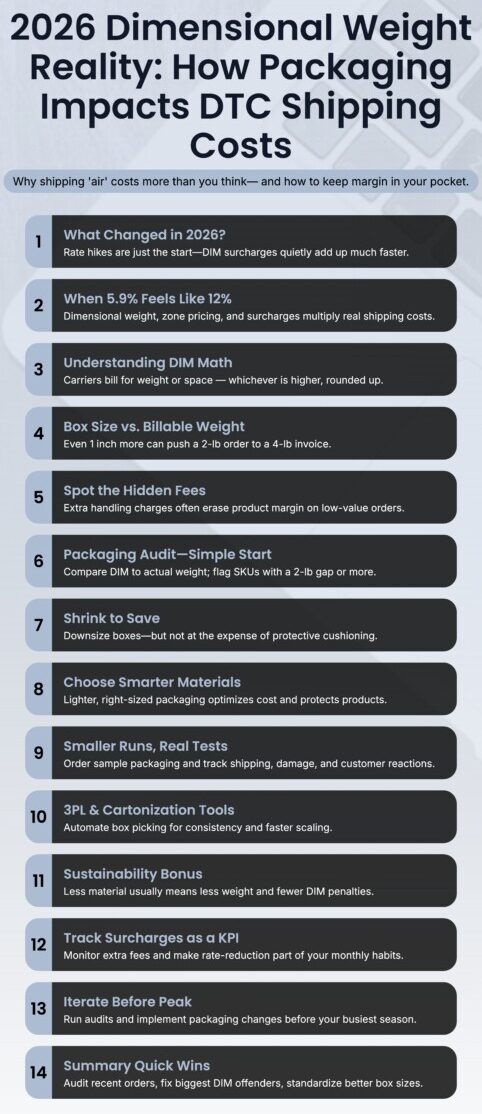
Shipping did not just get 5.9% more expensive in 2026, it got more sensitive to packaging. FedEx’s average rate increase hit January 5, 2026, and UPS rolled its 5.9% increase in late December 2025. Those headline numbers are only the starting point. The real pain comes from the stack of costs that sit on top: dimensional weight (paying for space), zone pricing, and surcharges that jump when a box is bulky, long, or hard to handle. FedEx has also signaled tighter oversized measurement rules in January 2026, which means “close enough” packaging can get flagged more often.
Here’s the core lesson from this post: carriers price space, and packaging controls space. If you ship a light product in a roomy box, the bill is often based on dimensional weight, not the scale weight. A small increase in box size can push you into a higher billed tier because carriers commonly round up. That is why “one more inch” can turn into a recurring margin leak.
The good news is you can act on this fast, without rebuilding your whole fulfillment operation:
- Audit first, don’t guess. Pull the last 30 to 90 days of shipments and calculate DIM weight for your top SKUs. Flag any item where DIM is 2 lb+ higher than actual weight.
- Fix the biggest offenders before you touch everything else. One right-sized box change can create savings in the next billing cycle, especially at 500+ shipments a month.
- Treat surcharges as a KPI. Additional handling fees can be the profit killer, so track how often you trigger them and which box sizes cause it.
- Protect the product while you downsize. If damage goes up, you did not save money, you just moved the cost into returns, reships, and bad reviews.
If you want to keep moving, take one of these next steps:
- Run the “10-minute DIM check” on your top 3 to 5 SKUs.
- Standardize 3 to 4 core packaging sizes that fit most orders, then write simple pack rules.
- If you are at scale, explore cartonization and build a dashboard for billable weight and surcharge rate.
Frequently Asked Questions
Why do 2026 shipping rate increases feel bigger than the “headline” numbers?
The article points out that FedEx’s average 5.9% increase (Jan 5, 2026) and USPS increases like Priority Mail up 6.6% and Ground Advantage up 7.8% (Jan 18, 2026) are only part of the story. Most Shopify brands feel 8% to 12% because the real bill includes dimensional weight, zones, and surcharges that punish wasted space. If you ship light products in roomy boxes, you end up paying for air, not product.
What is dimensional weight (DIM), and why does it crush margins for DTC brands?
DIM weight is the “billable weight” carriers charge based on package size, not just scale weight. The article’s example shows how the same 2 lb product can bill close to 2 lb in a 10 x 8 x 3 box, but jump several pounds in a 12 x 10 x 6 box because carriers often round up. The practical takeaway is simple: inches matter as much as pounds, especially for lightweight SKUs.
Is packaging really a profit lever, or just a cost to minimize?
A common misconception is that packaging only affects your box line item. The article argues packaging is a profit lever in 2026 because it drives DIM weight, triggers surcharges, and increases handling issues, all of which raise shipping costs fast. If your packaging system is loose, shipping will eat margin no matter how well you negotiate rates.
What’s the easiest “quick win” change I can make to lower shipping costs?
Shrink your box by one to two inches where possible. The article highlights that carriers measure to the inch and often round up, so tiny size reductions can drop you into a lower billed weight tier on your next invoice. Start with your highest volume SKU and test one tighter box or mailer before changing everything.
How do additional handling fees happen, and how big can they get?
The article calls out additional handling as a silent killer, commonly showing up as $30 to $40 per package on real invoices, on top of shipping and fuel. It is often triggered by big cartons, long sides, odd shapes, soft packs that bulge, or weak packaging that does not stay rigid. One “play it safe” oversized box can wipe out profit on a low-AOV order.
What should I audit first if I want packaging-driven ROI in my Shopify store?
Run a packaging audit on the last 30 to 90 days of shipments. The article recommends calculating DIM weight and flagging shipments where DIM beats actual weight by 2 lb or more, then testing a single packaging change. This keeps the project small, measurable, and tied to real invoice impact.
How many box sizes should my brand carry to reduce shipping costs without slowing fulfillment?
The article’s playbook is “fewer but smarter” box sizes paired with data-driven selection. Too many box options can create picking errors and slow packing, but too few forces you to ship air and pay DIM penalties. A good approach is to standardize around the smallest set that covers your top SKUs and bundles, then add only when the shipping savings clearly beat the added complexity.
How does smart packaging improve customer experience, not just shipping spend?
Oversized boxes lead to “why is this box so huge?” frustration and can increase damage if items rattle around. The article notes that packaging that fits and cushions well reduces damage, reships, and support tickets, which protects both margin and trust. For Shopify brands, fewer reships also means fewer negative reviews and fewer “where is my order” emails.
What KPIs should I track so shipping costs don’t surprise me each month?
The article suggests treating surcharge exposure as a tracked KPI, not a surprise line item. Track your average shipping cost per order, plus the rate of shipments that get hit with dimensional weight increases and additional handling. If you see your longest side creeping up or more “bulge risk” packages going out, that is an early warning that packaging is drifting.
What does a practical implementation plan look like for a Shopify merchant?
Follow the article’s “audit, optimize, implement” mindset: audit recent shipments, optimize by right-sizing and switching to lighter materials where safe, then implement rules so packers consistently choose the smallest package that fits. Roll changes out in one lane first (one SKU, one box, or one bundle) and compare before-and-after label costs to prove ROI. Once you see savings, expand to the next highest-volume product line and keep refining based on invoice data, not guesses.
