






Quick Decision Framework
- Who This Is For: Ecommerce operators, Shopify merchants, and DTC brand managers who coordinate product launches, marketing campaigns, or platform development across more than one team and are struggling with missed deadlines, unclear ownership, or cascading delays.
- Skip If: You are a solo operator managing a single workflow, or your team is fewer than three people working on one project at a time. The planning methods described here deliver the most value when multiple departments are working in parallel.
- Key Benefit: Understanding when to use task boards versus timeline planning – and how to integrate both – eliminates the hidden dependency failures that cause product launches to slip, campaign windows to shrink, and teams to spend their days reacting instead of executing.
- What You’ll Need: A basic familiarity with your current project management setup, whether that is a spreadsheet, a Kanban board, or a dedicated tool. No technical expertise is required. The concepts apply regardless of which software your team uses.
- Time to Complete: 9 to 11 minutes to read. Applying the framework to your current projects takes 30 to 60 minutes, depending on how many active initiatives you are coordinating.
The difference between ecommerce teams that scale and those that spend every week in operational chaos is rarely strategy. It is almost always project planning – specifically, whether the team can see dependencies before they become delays.
What You’ll Learn
- Why ecommerce projects fail at the dependency level – not the task level – and what that means for how you structure your planning from the start.
- What task boards do well and exactly where they break down as your team and project complexity grow beyond a single workflow.
- How Gantt charts and timeline planning give cross-functional ecommerce teams the visibility they need to protect launch dates and manage resource constraints across multiple simultaneous initiatives.
- Why the critical path matters more than any individual task on your board, and how to identify it before a delay forces you to find it the hard way.
- How to combine task boards and timeline planning in a single integrated environment so operational work and strategic planning stay in sync across every department.
Running an ecommerce business means orchestrating many moving parts at once: product launches, marketing campaigns, website development, logistics coordination, and customer support processes. In such an environment, success rarely depends on ideas alone. The real difference between teams that scale effectively and those constantly fighting operational chaos lies in one factor: how well projects are planned and coordinated across departments.
When planning mechanisms fail, even strong strategies quickly lose momentum. A delay in one area can ripple through the entire organization, pushing campaign launches, shrinking sales windows, and forcing teams into reactive work instead of strategic execution.
The Operational Complexity of Ecommerce Projects
Unlike traditional businesses with relatively predictable workflows, ecommerce organizations operate in a highly interconnected ecosystem. A single product launch often requires coordination between marketing teams, developers, designers, logistics managers, content specialists, and customer support staff. Each of these teams contributes a critical piece of the process, and their work must be synchronized with precision.
Consider what typically happens behind the scenes before a product reaches customers: photography and product descriptions must be prepared, product pages developed and optimized for UX, inventory delivered and organized in the warehouse, marketing campaigns scheduled across multiple channels, and customer service teams briefed about the new offering. None of these tasks exists in isolation. If one stage slips, the consequences cascade through the entire project timeline.
- Product photography delays website updates.
- Website delays postpone marketing campaigns.
- Marketing delays shorten the product’s most valuable launch window.
Without structured project planning, these dependencies remain invisible until problems begin to surface.

Task Boards: Clear Visibility for Operational Work
Many ecommerce teams start with task boards, often implemented through Kanban-style workflows. These boards provide a simple and intuitive visual overview of tasks moving through stages such as To Do, In Progress, and Completed. For everyday operational work, this approach works remarkably well because it focuses on immediate visibility rather than long-term planning.
Task boards are particularly effective for continuous workflows such as customer support requests, content updates, bug fixes, or routine website maintenance. Team members can quickly identify available tasks, move them through the workflow, and maintain a steady operational rhythm without unnecessary administrative overhead. In fast-moving environments where teams constantly respond to incoming work, this simplicity is extremely valuable.
However, task boards primarily show what is happening now, not what will happen next week or next quarter.
Where Operational Boards Fall Short
As ecommerce companies grow, projects become more complex and involve multiple teams working across overlapping timelines. In these situations, task boards begin to reveal their limitations. While they provide excellent short-term visibility, they do not show how tasks relate to broader project timelines or strategic initiatives.

Teams using only task boards often struggle to answer critical questions: Which activities determine the final launch date? What tasks depend on work from other departments? Which team members are overloaded across multiple projects? Because task boards rarely display dependencies or timelines, potential conflicts remain hidden until deadlines begin slipping. By the time problems become visible, teams are already reacting instead of planning.
Why Timeline Planning Becomes Essential
To manage complex initiatives, ecommerce teams need more than operational visibility. They need a clear picture of how projects unfold over time and how different stages depend on each other. Timeline-based planning provides exactly that perspective by connecting tasks, milestones, and deadlines within a single visual structure. When teams move from purely operational planning to timeline-based coordination, they begin to see projects as dynamic systems rather than collections of isolated tasks.

FlexiProject explaining project planning and timeline visualization.
Gantt Charts: Structuring Complex Projects
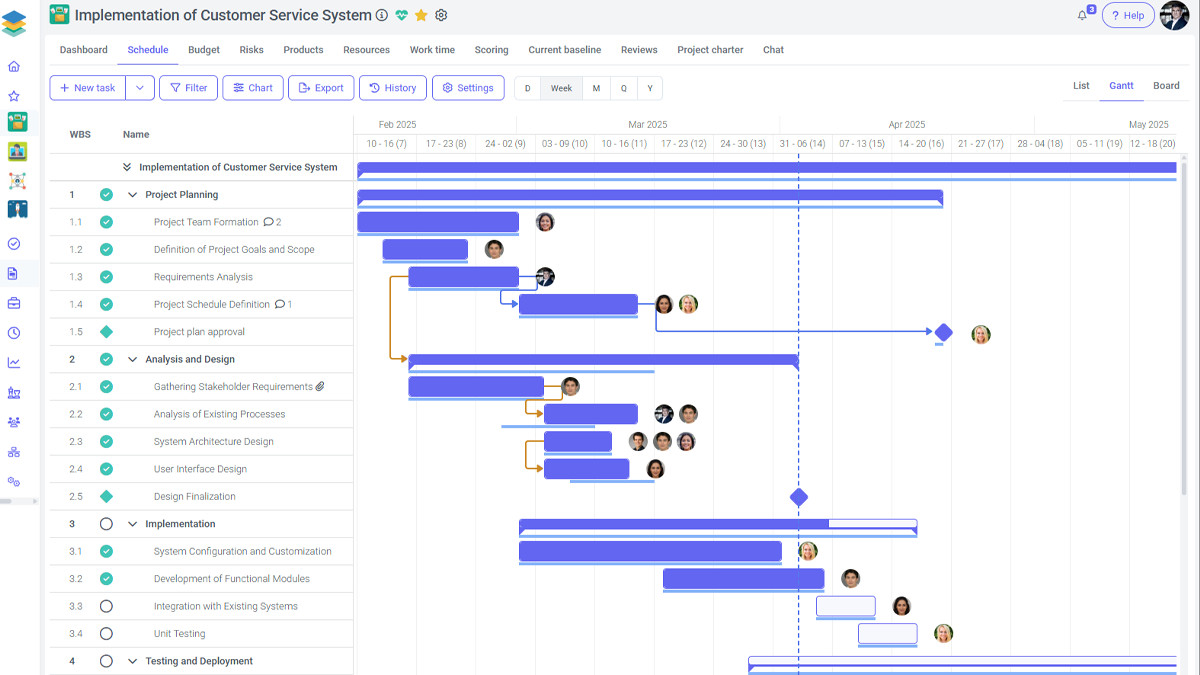
One of the most widely used timeline planning methods is the Gantt chart, which organizes project activities along a chronological axis while displaying relationships between tasks. Instead of focusing solely on current activity, Gantt charts provide a comprehensive view of the entire project lifecycle-from initial planning to final delivery. For ecommerce teams managing product launches, platform redesigns, or multi-channel marketing campaigns, this visibility becomes extremely valuable. When tasks are mapped along a timeline, dependencies between activities become explicit. If a delay occurs in one stage, the entire project schedule immediately reflects the consequences. This ability to anticipate cascading delays gives managers time to adjust priorities, allocate additional resources, or reorganize workflows before problems escalate.
The Importance of Dependencies and Critical Paths
Large ecommerce initiatives rarely follow simple linear processes. More often, multiple stages overlap and depend on one another. Marketing preparation may start while development is still underway, content creation might begin once product samples arrive, and testing may run alongside final adjustments to the website interface. Timeline planning reveals these relationships and highlights the critical path-the sequence of tasks that determines the minimum duration of the entire project. If any task on this path is delayed, the final launch date shifts automatically.

Understanding the critical path allows ecommerce leaders to focus their attention where it matters most. Instead of spreading effort evenly across all tasks, teams can protect the activities that truly determine whether a launch happens on time.
Resource Visibility and Multi-Project Coordination
Another advantage of timeline planning is the ability to analyze resource allocation. In most ecommerce organizations, key specialists such as developers, designers, or marketing strategists participate in multiple projects simultaneously. Without clear resource visibility, the same person may unknowingly become a bottleneck across several initiatives.
Using a Gantt chart in FlexiProject teams can view both project timelines and resource utilization in one environment. This makes it easier to detect overallocated team members, redistribute work, and prepare for upcoming workload spikes such as holiday sales periods or major campaign launches.

Gantt planning and dependency management in FlexiProject.
Why the Best Ecommerce Teams Use Both Methods
The debate between task boards and Gantt charts often frames them as competing approaches. In practice, successful ecommerce organizations treat them as complementary tools designed for different types of work.
Task boards remain ideal for operational workflows, agile development cycles, and ongoing improvements that require flexibility and rapid iteration. Timeline planning, on the other hand, is better suited for large initiatives involving multiple teams, strict deadlines, and complex dependencies.
The real challenge is integration. When operational boards and timeline planning exist in separate tools, teams quickly encounter information silos. Updates made in daily task management may not be reflected in strategic planning views, leading to misalignment across departments.
This is why integrated platforms such as PMO software – FlexiProject combine both perspectives in one environment. Teams can manage operational tasks and long-term project plans simultaneously while maintaining a single, consistent source of information.

FlexiProject showing how task boards and Gantt planning work together.
Measuring Whether Project Planning Works
For ecommerce organizations, the effectiveness of project planning should be evaluated through measurable indicators. Reliable planning systems tend to produce consistent delivery timelines, balanced resource utilization, and launches that align with strategic market windows. When teams track indicators such as schedule reliability, resource workload balance, and campaign timing accuracy, they gain valuable insight into whether their planning processes support execution or create unnecessary friction. Over time, these insights help refine project planning methods and improve organizational coordination.
Conclusion
In ecommerce environments where multiple initiatives compete for attention and deadlines are often tied directly to revenue opportunities, project planning becomes a strategic capability rather than an administrative task.
Task boards help teams maintain operational flow and visibility across everyday work. Timeline planning reveals the dependencies, milestones, and resource constraints that determine whether large initiatives succeed.
Organizations that combine both approaches within integrated project management platforms gain a powerful advantage. They move beyond reactive coordination and begin managing projects with clarity, foresight, and control-allowing teams to focus less on operational chaos and more on delivering successful launches, campaigns, and customer experiences.
Frequently Asked Questions
When should an ecommerce team switch from task boards to Gantt charts?
The signal to move from task boards to timeline planning is not team size or revenue level – it is project complexity. Specifically, when your projects regularly involve more than two teams working in parallel, when your launch dates are tied to fixed market windows that cannot move, or when you have experienced a launch delay caused by a dependency that no one saw coming, timeline planning has become necessary. Many ecommerce teams make the switch after their first significant launch failure, when the post-mortem reveals that the problem was not execution but visibility – the dependency that caused the delay was always there, but no one could see it until it was too late to respond. The better approach is to add timeline planning before that failure rather than after it.
Can a small ecommerce team benefit from Gantt chart planning, or is it only for large organizations?
Small teams benefit from timeline planning as soon as their projects involve dependencies that span more than one person’s work. A three-person team managing a product launch with a hard deadline – where the developer’s work must be complete before the marketer can launch the campaign – has a dependency problem that a Gantt chart solves and a task board does not. The overhead of building a timeline plan is low for small teams because there are fewer tasks to map. The benefit is proportionally similar to larger teams: dependencies become visible, delays become predictable, and the launch date becomes something the team manages proactively rather than hopes for.
What is the critical path in an ecommerce product launch, and why does it matter?
The critical path is the sequence of dependent tasks that determines the earliest possible completion date for the entire project. In an ecommerce product launch, the critical path typically runs through the tasks that must be completed sequentially before the launch can go live – product photography, listing page development, QA review, and campaign activation are common examples. Tasks not on the critical path can be delayed without affecting the launch date. Tasks on the critical path cannot slip by even a single day without pushing the launch. Identifying the critical path before a project begins allows managers to concentrate attention and resources on the tasks that actually determine whether the launch hits its window, rather than spreading effort evenly across all work regardless of its impact on the timeline.
How do you prevent information silos when using both task boards and Gantt charts?
Information silos between operational task boards and strategic timeline plans are almost always a tool problem, not a process problem. When teams manage daily work in one application and project timelines in another, updates made in one system do not automatically reflect in the other. The practical solution is to use an integrated platform that houses both views in the same environment, so that a task completed on the board updates the project timeline automatically and a timeline change immediately reflects the current state of all associated tasks. If full integration is not immediately available, the minimum viable approach is a weekly synchronization meeting where the task board owner and the project timeline owner compare current status and flag any discrepancies before they compound into larger misalignments.
What metrics should ecommerce teams track to evaluate their project planning effectiveness?
The three most useful metrics for evaluating project planning effectiveness in ecommerce are schedule reliability rate, dependency conflict lead time, and reactive work ratio. Schedule reliability rate measures what percentage of projects or milestones are delivered on or before the planned date – a well-functioning planning system should produce rates above 80% for projects with timelines longer than two weeks. Dependency conflict lead time measures how far in advance dependency problems are identified before they affect a deadline – teams with good timeline visibility typically surface conflicts 2 to 3 weeks before impact, while teams without it discover them the day they hit. Reactive work ratio measures what percentage of team capacity is spent on unplanned work versus planned initiatives – a ratio above 40% reactive work is a strong indicator that planning visibility is insufficient for the complexity of the projects being managed.
