





Key Takeaways
- Protect at least 20% of your week for true creation (offers, customer insight, and brand story) because founders who stay in “robot mode” get out-innovated even when revenue looks strong.
- Track your next 7 days in two buckets (creative work vs maintenance work) and treat “under 10% creation time” as a clear signal you are maintaining the business instead of leading it.
- Reframe one “I have to” task into “I get to” each day to reduce stress and reconnect busy work to a real customer outcome your team can feel proud of.
- Set a 12 to 18-month moonshot that is personal, measurable, and bigger than any dashboard number, because an “unreasonable” goal can pull you out of survival mode faster than more optimization.
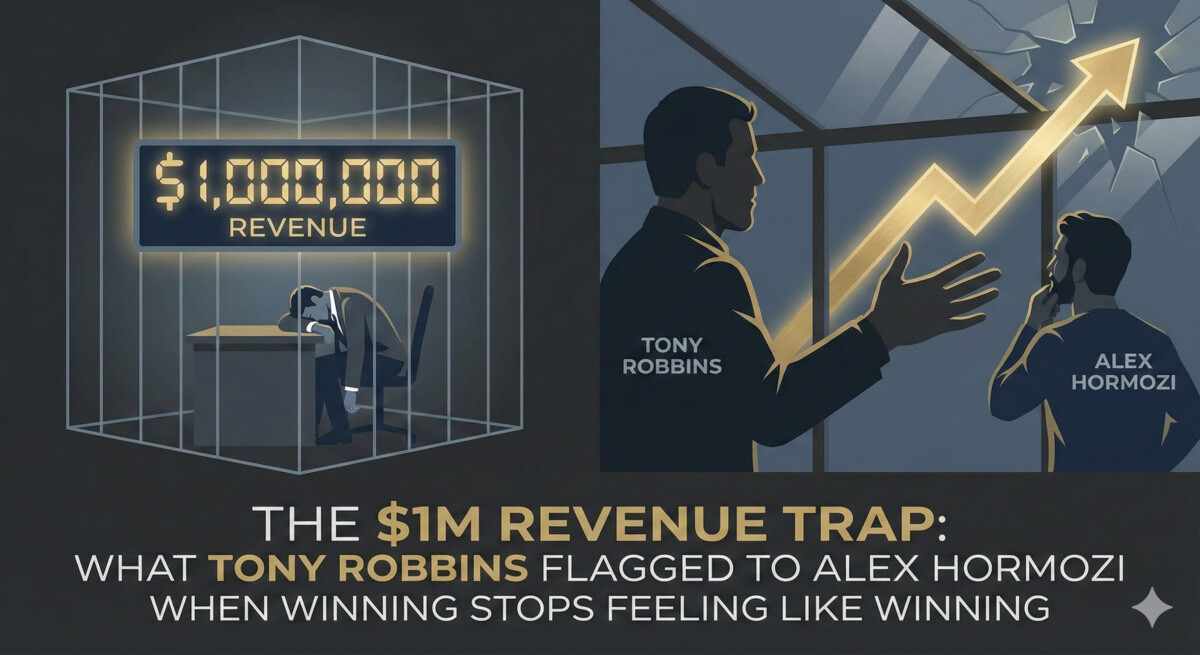
This guide explains the $1M revenue trap for Shopify and DTC founders who hit numbers that should feel great, but somehow feel flat.
If you’re building on Shopify, you’re surrounded by people chasing speed, output, and optimization, and you can “win” your way into a life you don’t even like.
Alex Hormozi makes a perfect story hook because the surface-level scoreboard is undeniable: mid-30s, a serious portfolio, a reputation for discipline, and the kind of work ethic that can carry you through almost anything. In his conversation with Tony Robbins, the warning wasn’t “you’re failing.” It was more unsettling: you can be succeeding so hard that you start living on autopilot, like you’re running your business from a checklist instead of a pulse.
This pattern shows up quite often. The same people who can rebuild an ad account in 48 hours often can’t explain what they’re building toward anymore, beyond “more.” That’s not laziness. It’s a meaning and sustainability problem, especially once complexity and responsibility explode.
The $1M trap happens when your business gets more complex faster than your sense of purpose grows, so you keep winning on paper while losing energy in real life. And it often hides behind hidden profit and operations issues that quietly bleed momentum.
Watch the Interview Here
https://www.youtube.com/watch?v=xz-ymFOhBAE&t=2760s
When Success Starts Feeling Like Survival
Robot mode in ecommerce looks like this: you’re always “on,” always checking, always fixing. Revenue is up, but so is the mental load. That’s the paradox Tony pointed at with Alex: the grind can become a default identity, not a season.
For Shopify founders, robot mode usually shows up as constant firefighting. Dashboards before breakfast, Slack during dinner, and that low-grade panic that something is slipping, even when the numbers are fine. You don’t feel “done” because ecommerce is never done. There’s always a product page to improve, a flow to tweak, a creative to refresh, a supplier to chase.
Here’s a concrete example that hits almost every brand at some point: Meta performance swings, a fulfillment backlog, and a sudden refund spike, all in the same week. Your day becomes a game of whack-a-mole. You fix one hole, another pops up. On paper, you’re a “real CEO.” In your body, you’re bracing for impact.
The quiet shift, you stop building and start managing
The switch happens when your calendar fills up. Instead of experimenting, you’re approving. Instead of creating, you’re clarifying. People need answers, agencies need decisions, and every process that used to live in your head now needs to be explained and maintained.
A simple self-check: if most of your day is meetings, approvals, fixes, and status updates, you’re managing, not creating. Management is necessary, but it can pull you into survival mode even with strong revenue because it trains your brain to scan for threats all day.
Why ecommerce founders are extra vulnerable to the trap
Ecommerce rewards measurement. We’re trained to chase CRO, ROAS, AOV, LTV, and contribution margin like they’re oxygen. That “science of achievement” is powerful, but it can shrink your identity into “operator only,” which is a narrow container for a human life.
After hundreds of EcommerceFastlane interviews, the pattern is consistent: brands that scale cleanly protect founder creative time early, even if it feels “less productive” in the moment. The founders who keep a weekly block for offer, customer insight, and brand storytelling tend to last longer, and build better teams around them.
The Science of Achievement vs The Art of Fulfillment
Achievement gets your Shopify store to repeatable revenue. Fulfillment keeps you in the game long enough to compound. That’s the split Tony emphasized with Alex: results are learnable, but satisfaction isn’t automatic.
In ecommerce terms, achievement is what you can systemize: better checkout, tighter media buying, cleaner forecasting, faster shipping. Fulfillment is what gives those systems meaning: a mission you’d still care about even if the score reset to zero next quarter.
This is also where founders get tricked by dashboards. Metrics are necessary, but they’re not reality, they’re a model. If your model is missing key inputs (returns, creative fatigue, brand trust, team morale), it can push you into bad decisions that “look right” in a weekly report. If this has been happening, spend time with the idea that your dashboards can distort the story you tell yourself.
Push motivation vs pull motivation, the engine you are running on
Push motivation is obligation: “I have to hit the number.” Pull motivation is mission: “I want to solve this for customers.”
Most founders start with pull. You launch because you see a problem and you can’t stop thinking about it. Then scale hits, and pull gets replaced by push: chasing blended ROAS every week, watching CPMs rise, tightening spend, and telling yourself you’ll enjoy it “after Q4.”
A quick example:
- Pull: testing a new product because customers keep asking for it.
- Push: forcing a promo calendar because the forecast needs it.
A simple rule, if the goal only shows up in a dashboard, it will not feed you
If the goal only lives in a dashboard, it won’t refill you when you’re tired.
Numeric goals are useful, but incomplete. Attach them to a human outcome:
- Who does this help when we win?
- What customer problem disappears if we deliver?
When you can answer those in plain language, the work stops feeling like pushing a boulder uphill. It starts feeling like building something that matters.
The Inflection Points Where the $1M revenue Trap Shows Up
The $1M trap isn’t one moment, it’s a sequence of identity shifts. The same fix won’t work forever. At $100K, effort works. At $1M, systems and purpose matter. At $5M+, leadership and creation become the only way out.
The best founders treat each level like a new sport with new rules, not the same sport with higher stakes. If you’re heading into peak season, this becomes even more obvious because Q4 punishes “management mode” hard. That’s why operational prep resources like a BFCM operations playbook matter, they stop your store from turning into a daily emergency.
At $100K, you finally breathe, then you over optimize the thing that got you here
This is the builder phase. Product-market fit is forming, cash flow starts to feel real, and you can see a path. The trap is getting protective. You cling to the one ad angle that works and polish it to death.
Two common symptoms:
- You keep refining one creative concept instead of testing new offers.
- You don’t build retention basics (email flows, post-purchase, winback), because ads are “working.”
At $1M, you become a professional problem solver, and that can kill the mission
This is the operator plateau. You now have team members, agencies, 3PLs, inventory planning, customer service volume, and returns that can swing your P&L.
You get paid, emotionally, to manage complexity. The risk is losing the part that felt like creation.
Quick symptom list:
- Always on Slack
- Always in Asana
- Always in metrics reviews
- Always “just one more thing” before you can think
At $5M+, the business can become a prison made of responsibility
Now you’re managing managers. Decisions have legal, finance, and payroll weight. A bad inventory bet isn’t annoying, it’s a six-figure scar.
This is a good problem, but it demands a new identity. Without fulfillment, this stage gets risky: burnout, numbness, or impulsive decisions that sabotage what you built. Achievement without meaning can turn “freedom” into golden handcuffs.
Are You Managing or Creating
Here’s a practical diagnostic you can use today: measure your week by energy, not hours. Managing drains. Creating restores. The goal isn’t to eliminate management, it’s to stop letting it eat your entire identity.
In Tony and Alex’s public discussion themes, one thread is clear: language and state are connected. When you feel pulled, you use different words than when you feel pushed. Listen to how you talk about your business when you’re tired.
Track two buckets for 7 days:
- Creative work: offer, customer insight, brand story, product, partnerships
- Maintenance work: tickets, ad tweaks, meetings, approvals, firefights
If creative work is under 10% of your week, you’re not leading, you’re maintaining.
Listen to your own words, they tell you if you are in survival mode
Six phrase pairs that expose the state fast:
- “I have to fix the campaign” vs “I get to learn what customers want”
- “We have to discount” vs “We get to improve the offer”
- “I have to deal with returns” vs “I get to tighten the promise and the product”
- “I have to check Slack” vs “I get to build a team that can decide”
- “I have to chase inventory” vs “I get to design a supply chain that doesn’t panic”
- “I have to post content” vs “I get to earn attention by being useful”
Reframe exercise: for one week, rewrite one “have to” sentence per day. Not to fake positivity, but to reconnect the task to a purpose you actually believe.
Five questions that expose the trap fast
- Do you feel excitement when you hit goals, or mostly relief? (Relief points to push motivation.)
- Are you moving the goalpost the moment you win? (That’s a sign the “why” is missing.)
- Are you building to acquire, or building to maintain? (Maintenance loops create robot mode.)
- If you had 90 days with no revenue pressure, what would you build? (That’s your pull.)
- If the title and paycheck disappeared, would you still show up? (If not, redefine success.)
The Moonshot Fix
A real moonshot isn’t hype. It’s a time-bound, personal, measurable goal that forces you back into creation mode. Tony pushed Alex toward “unreasonable” goals because reasonable goals often keep you optimizing what already exists.
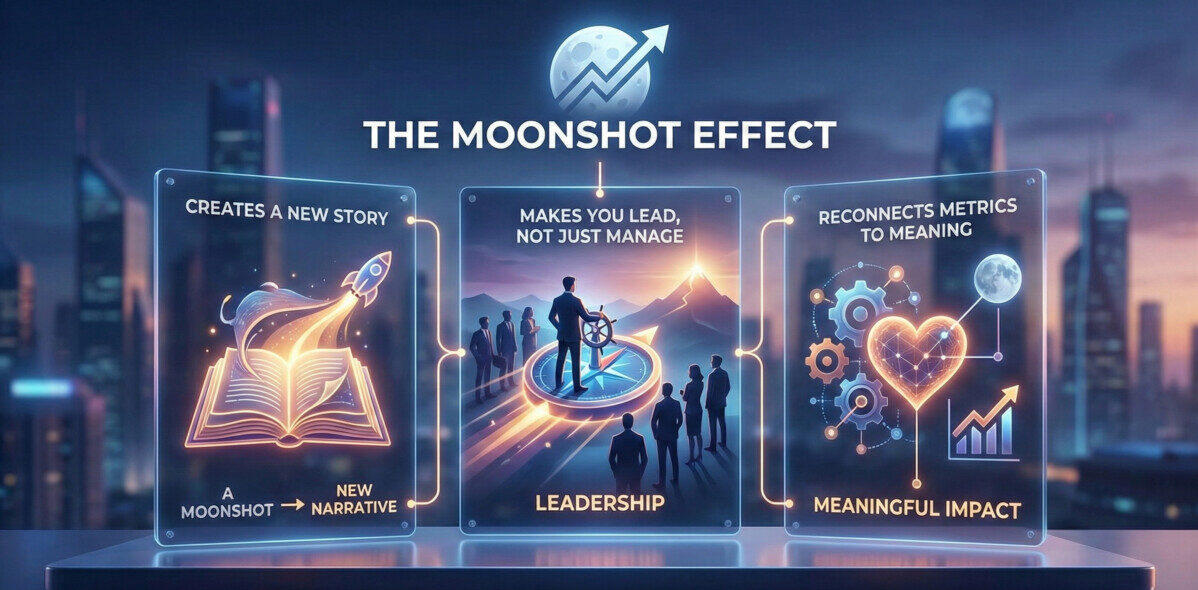
A moonshot does three things:
- It creates a new story for the business.
- It makes you lead, not just manage.
- It reconnects metrics to meaning.
AI and automation matter in 2026, but they don’t solve emptiness. They can even accelerate it by making your output higher while your purpose stays the same. If you want a smart angle on where hidden opportunities often sit, revisit the growth lever most operators ignore until it’s painful.
Across hundreds of eCommerce Fastlane founder conversations, the cleanest way out of the $1M revenue trap is adding a 12 to 18-month moonshot that restores creative time to at least 20% of the founder’s week. Brands that do this tend to make better hires, run fewer panic promos, and build growth that feels sustainable.
What an “unreasonable” moonshot can look like for a Shopify brand
- Sub-$1M: In the next 12 months, build a retention engine that drives 30% of revenue from email and SMS, and reduces refund rate by 1 point, so customers feel safer buying again.
- $1M to $5M: In the next 18 months, become a top-3 brand in a clear subcategory (measured by branded search and repeat rate), so customers stop comparing you on price.
- $5M+: In the next 18 months, build a leadership bench where two directors can run weekly ops without you, and launch one category expansion that improves customer outcomes, not just SKU count.
Make it personal or it will not work, purpose beats pressure
If your moonshot isn’t personal, it turns into another dashboard goal.
Use prompts that create emotional attachment:
- What childhood story still drives you?
- What customer pain can’t you ignore anymore?
- What unfair advantage do you want to share?
- What impact would make your team proud to say they work here?
The answer doesn’t need to impress anyone. It needs to pull you forward on hard days.
Summary
The $1M revenue trap is not a sales problem. It is a meaning and sustainability problem that often shows up right when your Shopify brand is “winning.” Revenue climbs, but so do decisions, dashboards, and daily fires. Over time, you can slide into what Tony Robbins and Alex Hormozi describe through themes like autopilot living, where you run the company from checklists and pressure instead of purpose and energy.
The core insight is simple: achievement builds the scoreboard, but fulfillment is the fuel. The Shopify ecosystem trains founders to measure everything, optimize nonstop, and treat the brand like a machine. That helps you grow, but it can also trap you in push motivation (obligation, grind, “I have to”) instead of pull motivation (mission, curiosity, “I want to”). Public summaries of Tony’s teaching highlight this push vs pull split, plus the broader point that achievement alone does not guarantee enjoyment or staying power.
Here’s how to apply it this week:
- Audit your time for 7 days: track “creative work” vs “maintenance work.” If creation is under 10%, you are maintaining, not leading.
- Reclaim one decision loop: delegate one recurring approval (creative, support escalations, promo planning) so you get a weekly creation block back.
- Set a 12 to 18-month moonshot: make it personal, measurable, and tied to a human outcome (customers, team, category impact), not just a dashboard number.
