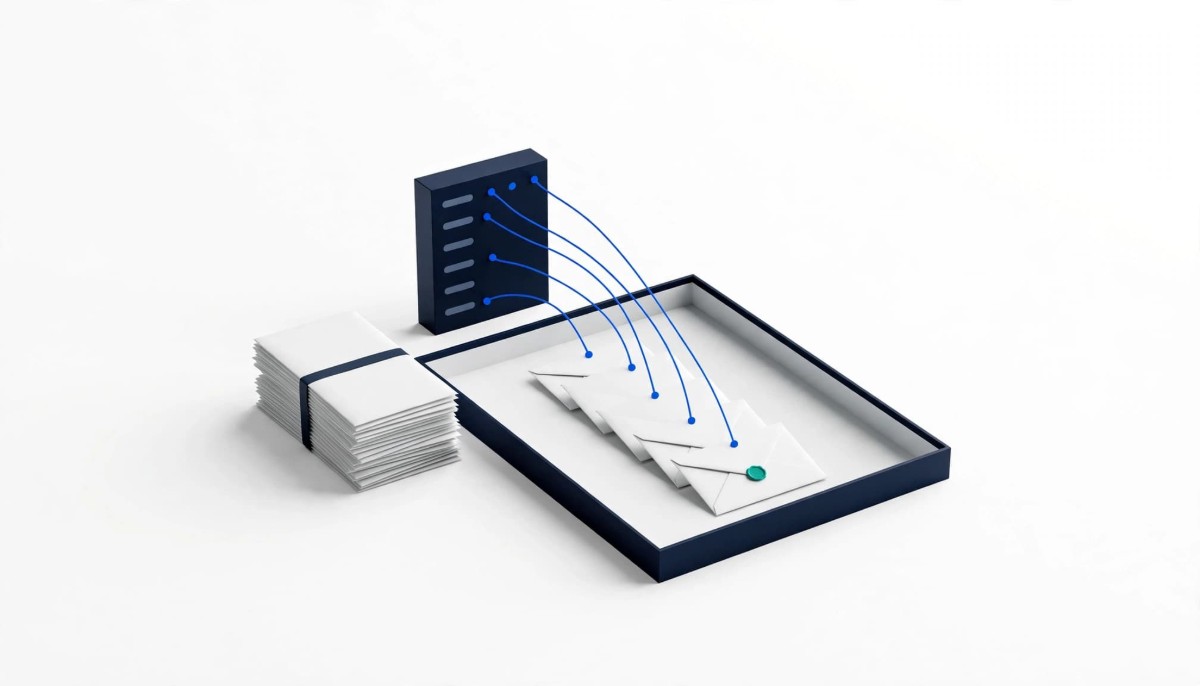
The Black Friday emails that work are not the best designed ones. They are a short sequence of about five sends, each with one job, sent first to recent openers and clickers, then widened in steps, from a domain that already meets Gmail and Yahoo’s bulk sender rules.
Every Black Friday email gallery shows you the creative. None of them show you the send list, and the send list is what decided whether those emails earned anything.
Klaviyo delivered more than 22.7 billion messages, email and text combined, across the five days from Thanksgiving to Cyber Monday 2025, up 25% on the year before, according to Klaviyo’s own BFCM 2025 results. Shopify merchants sold $14.6 billion over the BFCM weekend, per Shopify’s BFCM 2025 data. That is the inbox your Black Friday email walks into: the busiest week of the year for every sender at once, judged by mailbox providers that are paying closer attention than they ever have.
Most advice on Black Friday email starts with examples. Here is a beautiful GIF, here is a bold countdown, here is a clever subject line. Examples are useful, and this guide has templates. But the merchants I talk to who have a disappointing Black Friday rarely lost it on design. They lost it on who they sent to, how often, and whether their domain was trusted enough to land in the primary inbox at all.
So this is a guide in two halves. The first covers the part no gallery shows: sender rules, list selection and the sequence. The second gives you a brief for each of the five emails worth sending, and then rebuilds one store’s plan so you can watch the calls being made. Whether you are running your first BFCM or your tenth, the order matters: fix who gets the email before you polish the email.
Black Friday email examples rarely transfer because the screenshot shows the creative while hiding the three things that produced the result: the list it went to, the sender reputation behind it, and the offer. A 50% off sitewide email from a brand with a decade of engaged subscribers is not the same email when it goes from a store whose last campaign landed in Promotions or spam.
Look at any Black Friday email roundup and you will see the same patterns: a big number above the fold, a timer, a single button, a product grid. Those patterns are fine. They are also what every other sender in the inbox is doing that week, so they do not differentiate anyone. What actually separates the stores that do well is upstream of the design. Did the email go to people who had clicked something in the last 90 days? Was the domain authenticated? Did the store send three emails or eleven?
The offer matters more than the design, too. Klaviyo reported that average daily discount depth across its brands never exceeded 30% over BFCM 2025. That is a useful reality check if you assumed everyone was running half off. A plain offer such as 20% off with free shipping, stated in the first line of the email, asks the reader to decode nothing, which matters in an inbox where they are skimming dozens of subject lines. If you have not decided the offer yet, decide it before you open the template editor; our breakdown of when Shopify unique discount codes help and when they only add friction is a good place to settle the mechanics.
So use examples for layout ideas, and use the rest of this guide for the decisions that change results. If you are under $500K a year, the biggest gains are usually in list selection and sequence. If you are above $2M, you probably have the basics right and the gains are in segmentation and timing, which the stage section at the end covers.
Gmail requires anyone sending more than 5,000 messages a day to Gmail accounts, and Yahoo sets matching rules for bulk senders, to authenticate with SPF, DKIM and DMARC, support one-click unsubscribe, and keep spam complaints below 0.3%. Black Friday is when many stores cross that volume for the first time, so a list that never triggered the rules in August can hit them in one afternoon in November. Below the threshold the formal rules do not apply, but the same complaint and engagement signals still decide whether you reach the inbox.
Google’s email sender guidelines set the bar plainly: keep spam rates reported in Postmaster Tools below 0.10%, and never reach 0.30%. Yahoo’s sender best practices use the same 0.3% complaint threshold and add that unsubscribes must be honored within two days. Most Shopify email platforms handle the one-click unsubscribe header for you. Authentication is the part merchants skip, because it lives in DNS settings rather than in the email tool. Check it in October, not on Thanksgiving.
Complaint rate is the number that bites on Black Friday. Send to 40,000 people who have not opened in a year, and a few hundred of them hitting “report spam” is enough to push you over the line. Aaron Schwartz, cofounder and CEO of Orita, explained how this plays out when he joined me on episode 385 of eCommerce Fastlane: “if you send to an extra 100,000 or 200,000 or 300,000 people who aren’t engaged, Gmail will catch on to the fact that they’re not engaged. Gmail will then down rank you as a sender.”
He compared it to how search ranks pages. Gmail looks at whether people engage with what you send, and opens matter “much less so than they used to,” in his words; clicks, time on site and purchases matter more. The practical step: set up Google Postmaster Tools dashboards for your sending domain now, so you can see your spam rate before the big send rather than after. Our guide to improving email deliverability step by step walks through the DNS setup if you have not done it.
Most Shopify stores need five Black Friday and Cyber Monday emails, not ten: an early access email, a launch email, a reminder, a Cyber Monday email and a last chance email. Each has one job, and each goes to a defined group. Anything beyond five should earn its place with a reason, not a slot in the calendar.
The early access email is the template I would build first. Keep it short: a line thanking them for being a customer, the offer, the exact time it opens to everyone else, and one button. It is the email most likely to get clicks and replies, which is precisely the engagement signal you want mailbox providers to see before your bigger sends go out. The launch email is the one where design gets attention, but the brief is still one sentence: what is the offer, on what, until when. Put that sentence in live text at the top, not baked into an image, because many inboxes block images by default and some readers never load them.
The reminder works best when it changes the angle rather than repeating the launch: a gift guide by price, your three bestsellers, or the item most often bought together. Cyber Monday needs its own reason as well. Klaviyo reported Cyber Sunday as the fastest growing day of BFCM 2025, at nearly 14% year over year, with Cyber Monday ahead of Black Friday on growth, so the back half of the weekend deserves a real email, not a resend. The last chance email goes only to people who clicked during the week and did not buy, and it says when the offer ends. If the offer is not actually ending, do not say it is.
Always suppress buyers from the reminder, Cyber Monday and last chance sends. Sending “don’t miss out” to someone who bought on Friday is the fastest way to earn an unsubscribe from your best customer of the week.
Widen a Black Friday send to older subscribers only on the peak days, only in steps, and only if your sender reputation is healthy going in. Black Friday is the one week a wider send is worth the risk, because purchase intent is highest, but the domain you send from has to have earned that headroom over the other weeks of the year.
Aaron framed Black Friday as the exception on our Orita episode, talking about a brand with hundreds of thousands of unengaged subscribers: “Now if it’s Black Friday, you don’t care. You send the email.” He went on, “But fifty weeks of the year, you want to be really judicious about it.” The reason, he said, is not the cost of sending: “it’s not because you want to save a tenth of a penny.” It is how Gmail ranks you. Read the two halves together and the permission on Black Friday exists because the brand was disciplined for the fifty weeks before it. If your reputation has been clean all year, his rule applies to you and a wide Black Friday send is a reasonable call. My advice below is stricter, and it is aimed at the more common case: a store that has been sending to its whole list every week all autumn and has little reputation left to spend.
Widening in steps looks like this. The launch email goes to subscribers engaged in the last 90 days. If your spam rate in Postmaster Tools is still well under 0.10% the next morning, the reminder can extend to 180 day engagers. Only a store with a clean record should touch the 180 to 365 day group, and only once, on the strongest offer day. People who have not engaged in over a year are better reached through other channels that weekend, or not at all.
Aaron also made the point that engagement is not permanent in either direction: “Somebody who’s engaged today isn’t gonna be engaged forever. Somebody who’s unengaged today isn’t gonna be unengaged forever.” That is the case for a light win back email in October, aimed at the 90 to 180 day group, so the people you want on your Black Friday list have a recent click before the peak. It costs one send and tells you who is still listening.
Three design choices still earn their place in a Black Friday email: the offer in live text at the top, a single primary button, and mobile first layout. Interactive elements such as countdown timers and spin to win games can lift engagement, but they render differently across email clients and belong on one send, not all five.
Dmytro Kudrenko, founder and CEO of Stripo, the email template builder, shared one client result when he joined me on episode 391: “one of our ecommerce clients used a Wheel of Fortune during Black Friday.” He said click to open rates on that campaign rose by over 220%. Treat that as one vendor reported result, measured on click to open rather than revenue, not a benchmark. He was also candid about the technical catch: interactive email needs different builds for different inboxes. “Like for Gmail, you need AMP,” he said, meaning AMP for Email, while Apple Mail needs a different approach. If your platform or builder handles the fallbacks, an interactive element on the launch email is a reasonable test. If it does not, the non interactive version is the one most of your list will see anyway.
Countdown timers are the same trade. They help on the last chance email, where the deadline is real. On the early access or launch email they add urgency that the reader does not yet feel, and they push the offer line further down the screen. Product grids work best on the reminder, where the job is browsing. On the launch email, one hero product or category with the offer beats twelve tiles.
If you are deciding which app does the sending, our roundup of Shopify Black Friday apps and when to skip each one covers Klaviyo alongside the other tools most stores add before BFCM. For most stores the platform you already use is the right one this close to the date; switching email providers in the weeks before BFCM is how stores lose their sending history right before they need it.
The fastest improvement to most Black Friday email plans is to remove sends, not add them. Here is how that looks on one store.
This is a labelled composite, not a real store. It is built from patterns that come up repeatedly in my conversations with Shopify merchants, and the numbers are illustrative assumptions, not observed results. Picture a skincare brand doing around $40,000 a month, with 22,000 email subscribers, of whom roughly 7,000 have opened or clicked in the last 90 days. Last year it sent eleven emails between Thanksgiving and Cyber Monday, every one to the full list, and its Black Friday revenue was flat on the year before.
The draft plan for this year is similar: a “something big is coming” teaser on November 1, three teasers in the week before, a spin to win email, launch, two reminders, Cyber Monday, two last chance emails and a “we extended it” email. Here is what I would change, in order. First, cut the November 1 teaser and two of the three pre-launch teasers. Sending the full list four times before the offer exists spends complaint budget on emails with nothing to click. Keep one, the early access email, and send it only to past buyers and 30 day clickers. Second, merge the two reminders into one that changes the angle to a gift guide, and drop the “extended” email. If the offer extends every year, subscribers learn that last chance does not mean last, and the next year’s last chance email stops working.
Third, check DNS and Postmaster Tools in October, before anything else. Fourth, send the launch to the 7,000 engaged subscribers, not 22,000, and widen to the 180 day group only for the Cyber Monday email if the spam rate holds. That is later than the general rule above, because a store coming off a year of full list sends does not have a clean record yet. Fifth, keep the spin to win test only if the builder handles Gmail and Apple Mail fallbacks, and put it on the launch email alone. The plan goes from eleven sends to five, and to fewer total messages, and the store learns more from it because each email has a job you can measure.
Where would I disagree with myself? If this brand had a strong product launch to anchor the week, a second pre-launch email announcing it could earn its place. The rule is not “five emails always.” It is “every email needs a job and an audience.”
Your Black Friday email plan should get simpler the smaller you are and more segmented the larger you are. A store under $500K a year needs authentication, an engaged segment and five clear sends. A brand above $2M needs the same base plus segmentation by purchase history, coordinated SMS, and tighter monitoring during the weekend.
If you are just starting, under roughly $500K a year, focus on three things: authenticate the domain, build one segment of people engaged in the last 90 days, and write five emails with one job each. Your welcome flow and abandoned cart flow will probably drive as much Black Friday revenue as your campaigns, so check they are live and carry the offer. Do not buy a new tool in the run up to BFCM.
Between $500K and $2M, add a past buyers segment for early access, suppress recent purchasers from the reminders, and run a small win back send in October to the 90 to 180 day group. This is the stage where merchants most often hurt themselves with premature complexity: six segments, three timers and a quiz, when the basics are not yet measured. Lock your baseline numbers first; our list of five numbers to lock before BFCM makes them unreadable covers which ones.
Above $2M, you likely have the infrastructure. The gains are in finding the subscribers your rule of thumb segments miss, which is what tools like Orita try to do with predictive models trained on engagement data, and in coordinating email with SMS and paid retargeting so the same person is not hit by all three in one hour. Watch Postmaster Tools during the weekend itself, not just after. And whatever your size, keep growing the list before the big week; a single well targeted exit intent popup for first time visitors will add more Black Friday buyers than a fourth teaser email.
Most Shopify stores should send four to six Black Friday and Cyber Monday emails, with five a sensible default: early access, launch, reminder, Cyber Monday and last chance. Each should have one job and go to a defined segment. Brands with a strong product launch or a large, highly engaged list can add one or two more, but every extra email should have a reason beyond filling the calendar. Sending the full list ten or more times across the weekend raises spam complaints, and Gmail and Yahoo both use a 0.3% complaint rate as a hard ceiling for bulk senders. Suppress anyone who has already bought from the later sends so your best customers are not asked to buy again.
The best time to send a Black Friday launch email is early on Friday morning in your customers’ main time zone, so the offer is waiting before the midday peak. Shopify reported that sales across its merchants peaked at $5.1 million per minute at 12:01 p.m. Eastern on Black Friday 2025, which shows when shoppers were buying, not a guaranteed best send time. Send early access on Wednesday or Thursday to past buyers and recent clickers, a reminder on Saturday or Sunday, a Cyber Monday email Monday morning and a last chance email Monday evening. Test send times against your own data where you have a few years of history.
A Black Friday email template should include the offer stated in one line of live text at the top, what it applies to, when it ends, and one clear button. Add a short line of brand voice and one hero image or product, then keep the rest minimal. Put the offer in text rather than only inside an image, because many inboxes block images by default. Include a visible unsubscribe link and make sure your platform supports one-click unsubscribe, which Gmail and Yahoo require for bulk marketing email. Save product grids for the reminder email and countdown timers for the last chance email, where the deadline is real.
You can email some unengaged subscribers on Black Friday, but widen in steps and only if your sender reputation is healthy. Start the launch with people who opened or clicked in the last 90 days, check your spam rate in Google Postmaster Tools, and extend to 180 day engagers for a later send if it stays well under 0.10%. Older subscribers carry the highest complaint risk, and Gmail can down rank your whole domain if too many recipients ignore or report your emails. A small win back email in October to the 90 to 180 day group is a safer way to warm up the people you want on your Black Friday list.
Black Friday emails usually go to spam because the sending domain is not fully authenticated, the send went to too many unengaged subscribers, or spam complaints crossed Gmail and Yahoo’s 0.3% threshold. Check that SPF, DKIM and DMARC are set up for your sending domain, and look at your spam rate in Google Postmaster Tools. Then narrow the next send to people who engaged in the last 90 days, remove anyone who has not opened in a year, and avoid sending the full list several times in one week. Image only emails and misleading subject lines can also push complaints up, so keep the offer in live text and the subject line honest.