





Key Takeaways
- Outrun competitors by breaking two “everyone does this” norms in your niche, then iterating faster than copycats until your edge is obvious in one sentence.
- Model your business in one page, compare “what is” to “what great looks like,” and kill or fix one top gap each quarter before you add new tools, roles, or channels.
- Protect your team’s focus by cutting “zombie projects” that exist for optics, because fewer priorities reduce confusion and bring back real ownership.
- Write a ruthless “Everything Wrong With Our Store” memo each quarter to crush sunk-cost bias and turn uncomfortable truths into your next set of fixes.
This post shares what Shopify CEO Toby Lütke learned the hard way: that “best practices” can quietly turn founders into actors, and why his reset matters to Shopify merchants and DTC founders.
It’s a story about an IPO, a pandemic, and a brutal internal audit that exposed how “professional” management can drift into expensive theater.
The same failure shows up in smaller companies all the time: you copy the moves of bigger brands, then wonder why momentum dies.
When everyone agrees on best practices, the counterfactual is probably better. 🤯
Before we get started, this video sets the stage:

The Identity Crisis at the Heart of a Public Company
Cosplaying a “real CEO” usually looks harmless, until you add it up. In Lütke’s case, the turning point came after Shopify went public and he tried to run the company the way a traditional public-company CEO is “supposed” to run it. He’s described doing the rituals, the executive bonding, and the hands-off delegation style that sounds mature on paper.
Then COVID forced a reset. Plans broke overnight. Lütke responded by doing something most founders avoid because it’s painful: he reviewed every project, grinding through 16-hour days, and found that roughly 60% of what the company was doing wasn’t worth doing. Not “needs improvement,” but structurally misaligned, zombie projects kept alive by process and politeness.
The details matter because they’re familiar. There were “boondoggles” he didn’t even know existed. One example he’s shared was a team building supermarket-specific features because the category was big and someone wanted to win “1% of it.” That’s how a smart company burns time, not through stupidity, but through unchallenged assumptions plus lots of distance between decision-makers and reality.
He didn’t patch it with a new committee. He made the uncomfortable call to replace large parts of his executive team within about a year, then rebuilt leadership around people who could think like owners.
What Cosplaying Actually Costs You
Cosplaying is when you adopt structure to look legitimate, not because it solves your next constraint. It shows up as:
- Adding layers because “we’re scaling,” even when communication is the real issue.
- Shipping dashboards because “data-driven,” even when you still don’t know your hero offer.
- Hiring titles before hiring capability.
For ecommerce operators, this is the common trap: copying what Shopify Plus brands do when you’re doing $50K per month. You build a complex attribution stack before you’ve nailed creative testing cadence. You hire a COO when you really need your first strong ops generalist who can fix returns, shipping exceptions, and inventory accuracy.
The hidden cost isn’t just money. It’s confusion. Your team can’t tell what matters because everything looks important. And you lose the one thing that made you dangerous in the first place: a founder’s sharp point of view.
The Founder Channel That Saved The Company
Here’s the part most companies get wrong after acquisitions: they buy a startup, then park the founder somewhere “safe.” Lütke calls that founder daycare, and he doesn’t mean it nicely.
Recent reporting about Shopify’s internal approach highlights how he created a direct channel (literally a Slack channel) with founders from acquired companies and started asking them for help on real decisions, because they were the closest match to his own relationship with Shopify. Founders don’t talk like career managers. They don’t smooth the edges. When something’s off, it sticks in their head even if the org has “moved on.”
That’s the lesson for merchants: surround yourself with people who’ve built from nothing. Not just people who’ve “managed” a thing that was already working.
If you want the long-form version of Lütke’s own advice to entrepreneurs, start with Shopify CEO Tobi Lütke’s entrepreneurial success lessons, then come back and apply the systems thinking to your store.
Engineering a Company Like You Would Engineer a Product

Most founders treat the org like culture and vibes. Lütke treated it like a system you can model, test, and re-build. He built a Python-based model of Shopify that made the company “machine-readable,” pulling in org structure, compensation, and market data, then using constraints to compute what the company should look like.
In plain English: he stopped relying on meetings to discover reality. He made reality visible.
The first version exposed chaos. Shopify had around 8,000 people with roughly 5,500 different titles, plus inconsistent leveling across teams (in some places “senior” meant one thing, in others it meant the opposite). That kind of mess isn’t a branding problem. It’s a coordination tax that hits every roadmap, every launch, every customer promise.
This is also why his later stance on headcount and productivity landed so loudly. Shopify has pushed a “prove AI can’t do it first” mindset before adding more people, and it’s been covered in outlets like CNBC’s report on Shopify’s AI and headcount rule and Business Insider’s summary of the same policy. Agree or disagree with the tactic, the principle is consistent: don’t grow complexity unless it buys real output.
Shopify’s COVID reset worked because Lütke treated the company like software. He audited projects and found about 60% weren’t worth doing, then made the org legible with a model that exposed 5,500 titles across 8,000 people. That shift turned decisions into explicit trade-offs, not politics.
The Desire State System: Compare, Compute, Move
The “desire state” idea is simple: define what “good” looks like, compare it to what’s real, then take the minimum steps to close the gap. It’s not about perfection. It’s about steering.
Do the ecommerce version as a lightweight model:
- Map your store as a system (channels, SKUs, margins, fulfillment, retention, team, core tools).
- Write down what “great” looks like in 90 days (one page, not a novel).
- Pick the three biggest gaps, then kill or fix one per quarter.
The political benefit is bigger than it sounds. When someone wants to add headcount, or add a tool, or expand into a new channel, your model forces a trade-off conversation. If you add X, what slips? Conversion work? Creative testing? Customer support coverage? You’re not arguing tastes, you’re choosing constraints.
Small Teams, Real Ownership, and Phase-Based Projects
Lütke has a strong bias toward small teams, with a “magic number” around five. One person can sometimes do the impossible, but most meaningful work needs a tight team. Every time a team splits and re-forms, productivity drops hard, and anyone who has lived through reorganizations already knows that truth in their bones.
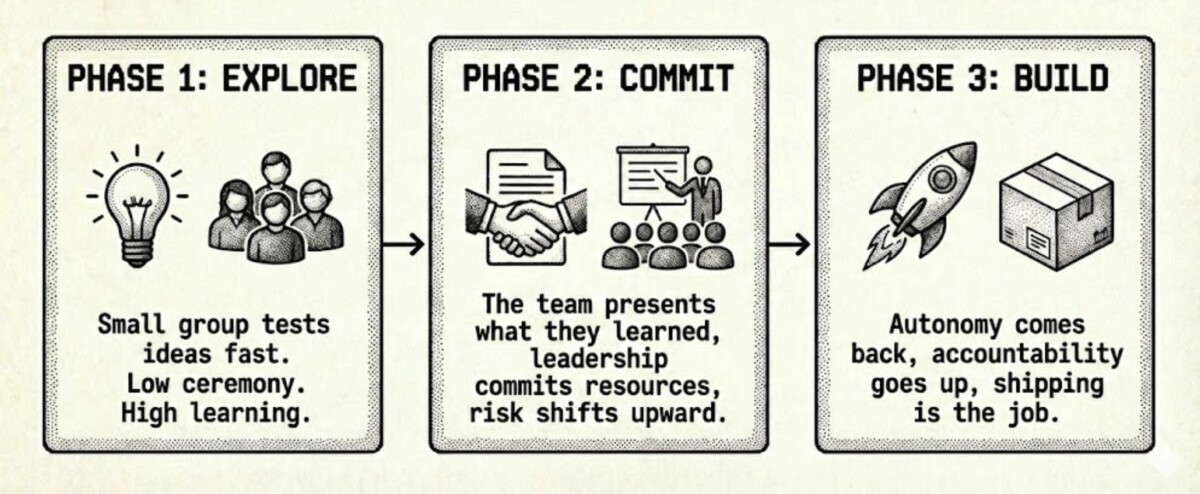
He also described a three-phase project system that trades autonomy and accountability in a clear way:
PHASE 1
Explore: Small group tests ideas fast. Low ceremony. High learning.
PHASE 2
Commit: The team presents what they learned, leadership commits resources, risk shifts upward.
PHASE 3
Build: Autonomy comes back, accountability goes up, shipping is the job.
Translate that to your Shopify store. Say you’re improving checkout conversion.
- Phase 1: your CRO lead runs five checkout experiments (shipping threshold messaging, address autocomplete, payment method order).
- Phase 2: you pick the winner, show the numbers, and commit to rolling it out.
- Phase 3: you implement site-wide, update QA, and watch support tickets to make sure you didn’t break anything.
The trade is clean: you earn autonomy by taking accountability.
The Anti-Playbook Principles That Make Shopify Different
Lütke’s internal mandate is a strong filter: each executive should be able to explain publicly how Shopify does their function differently and why it’s better. If they can’t, that’s the work.
That’s a forcing function. It turns “differentiation” from a tagline into an operating requirement. And it blocks the most common failure mode in ecommerce: trying to be “better” at the same play everyone else runs.
Here’s the summary worth stealing:
Differentiation isn’t winning the same game harder, it’s choosing a different game and iterating faster than the copycats.
Hire For Spikes and Agency, Not Well-Rounded Resumes
Shopify’s hiring approach, as Lütke has described it, doesn’t start with credentials. It starts with a life story, then zooms in on moments where things went wrong. He’s looking for high agency: did you wait for permission, or did you move?
For merchants, this is the difference between “someone who’s done email marketing” and someone who has actually shipped campaigns, debugged deliverability, and owned results.
Interview prompts you can use this week:
- “Tell me about a time something broke, what did you do in the first 60 seconds?”
- “Walk me through it minute by minute.”
- “What did you ship, and how did you know it worked?”
The warning: people who are great at following lists can also be great at performing interviews. If your hiring process is just a checklist, the best performers will study it.
Make Differentiation a Weekly Requirement, Not a One-Time Decision
Most Shopify stores treat differentiation like a launch project. Shopify treats it like a job requirement. You can run a merchant version in 30 minutes:
Write down 10 norms in your niche (return windows, discount timing, bundle structure, email frequency, shipping cutoffs, PDP layout, content style). Pick two norms to intentionally break, then run a small test.
Stage guidance:
- If you’re under $10K per month, break one norm and go all-in.
- If you’re growing, break norms in contained tests, then expand winners.
- If you’re at scale, assign each team one norm to challenge per quarter.
If you can’t name your edge in one sentence, your customers won’t either.
Run the Corporate Raider Reset Once Per Year
Lütke’s “corporate raider” exercise is brutal and useful: imagine your company went bankrupt, you bought it on a fire sale, and previous management was crazy. What do you cut on day one?
Do the ecommerce version:
- Pause the bottom 30% of ad spend.
- Cut SKUs that don’t move (or don’t contribute margin).
- Delete tools you don’t use weekly.
- Fix the three slowest pages on your site.
- Rebuild your hero funnel from scratch.
- “Fire yourself,” then write the job description the company actually needs.
A simple cadence:
- Q4 plan the reset.
- Q1 execute cuts.
- Q2 rebuild from first principles.
- Q3 measure and scale what works.
The Uncomfortable Truths That Make The Difference
These are hard to say out loud, but they unlock speed.
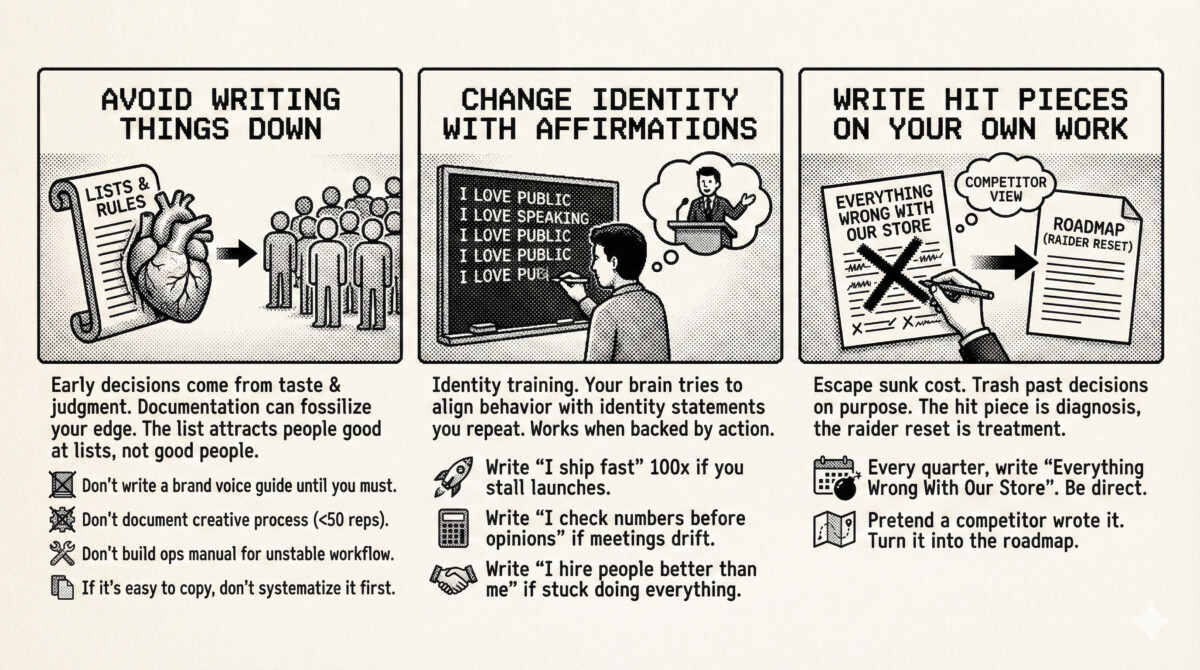
Actively avoid writing things down
Documentation is useful, but it can also fossilize your edge. Lütke’s point is that the best early decisions often come from taste and judgment, then companies try to turn that into a list. The list attracts people who are good at lists, not people who are good.
Merchant rule of thumb:
- Don’t write a brand voice guide until you must.
- Don’t document creative process if you’ve run fewer than 50 reps.
- Don’t build an ops manual for a workflow you haven’t stabilized.
If writing it down makes you easy to copy, it probably isn’t the thing you should systematize first.
Change your identity with affirmations (yes, really)
Lütke has shared a practical example: he was afraid of public speaking, so he wrote “I love public speaking” repeatedly for a short daily session, for about a week. The point isn’t magic. It’s identity training. Your brain tries to align behavior with identity statements you repeat.
Try it with ecommerce behaviors:
Write “I ship fast” 100 times if you stall launches.
Write “I check numbers before opinions” if meetings drift into politics.
Write “I hire people better than me” if you’re stuck doing everything.
It works when you back it with action.
Write hit pieces on your own work
Nostalgia is expensive. Lütke’s approach is to trash past decisions on purpose, to escape sunk cost.
Every quarter, write a document titled: “Everything Wrong With Our Store.” Be direct. Be specific. Pretend a competitor wrote it. Then turn that into the roadmap.
The hit piece is diagnosis. The raider reset is treatment.
Stop Acting, Start Building
- Stop cosplaying what a “real company” looks like.
- Make your business readable (a simple model beats ten meetings).
- Differentiate on purpose, then iterate faster than the imitators.
- Stay allergic to orthodoxy, especially when everyone agrees.
Your next step depends on stage:
- Just starting: pick one industry norm and break it.
- Growing: run the raider reset and cut the bottom 30%.
- Scaling: make differentiation a job requirement for every team lead.
