






Search
Strategic SEO in 2026 isn’t about competing with AI. It’s about accepting that AI now underpins SEO and deciding whether you want your brand to be in the answer box or outside the conversation.
People are searching more, using AI more, and expecting more thoughtful, contextual responses from both. The question is no longer “where do we rank?” It’s “are we the brand AI is comfortable recommending when it really counts?”
Table of Contents
Key takeaways:
- Zero-click is the new baseline. With over 60% of queries now ending without a click, SEO is shifting from driving website traffic to managing brand presence within AI-generated summaries.
- Optimization is moving toward “Agentic Discovery.” Success in 2026 requires optimizing for AI agents—autonomous bots that research and recommend products based on technical schema and cross-platform authority.
- AI visibility and citation share are the new KPIs. Traditional rankings are being replaced by “synthetic share of voice,” measuring how often and how prominently your brand is cited in AI responses (GEO/AEO).
- Decision-grade content is on the rise. To win in an AI-first world, content must move beyond basic “what is” explainers and toward high-intent, data-backed insights that help AI (and humans) make a final selection.
- SEO is now an omnichannel discipline. Search visibility is no longer siloed to your website; it relies on a consistent “digital footprint” across community forums, reviews, and social signals that AI models use for trainin
The data underpinning our SEO predictions
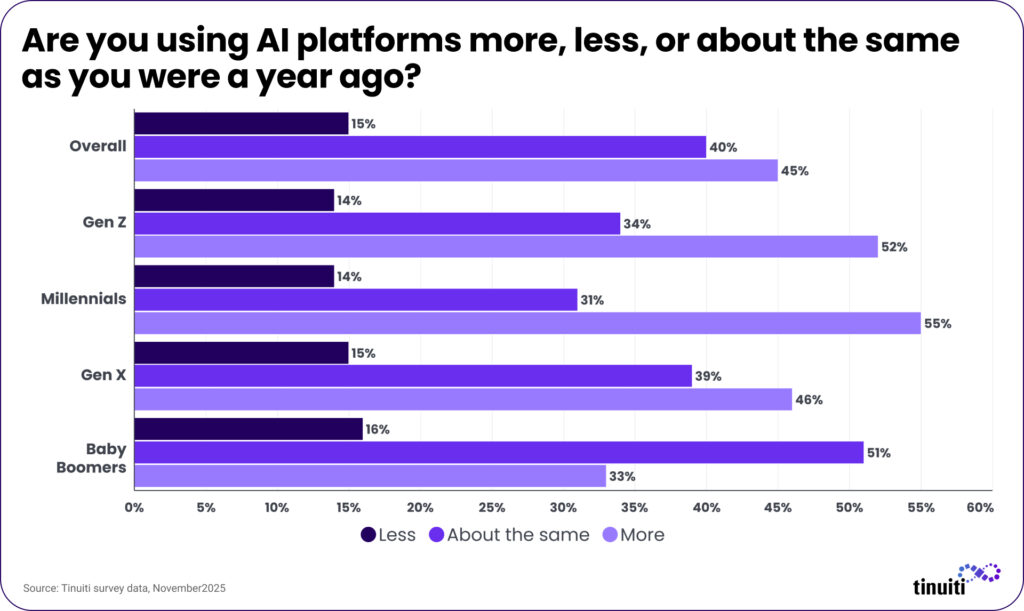
Our recent 2026 AI Trends Study found that 34% of U.S. adults use AI platforms daily, with another 21% using AI weekly. This means more than half of the U.S. population is in regular conversation with chatbots.
At the same time, more than one in three respondents say they’re using search engines more often since AI tools became widely available, compared to just 14% who say they use search less.
In other words: AI didn’t steal attention from search; it raised the bar on what search has to deliver.
For this reason, brands should approach SEO in 2026 by asking these questions:
- Are we part of the answer when AI responds?
- Do we help people decide, not just learn?
- Can we prove we’re shaping those moments—even when clicks disappear?
Want the Latest?
Check out our most recent AI Study for exclusive insights.

How this data reshapes what “SEO” even means
Put those numbers together, and you get a very different brief for SEO in 2026. AI isn’t a side channel sitting next to search anymore; it’s the layer that interprets, compresses, and often delivers the search experience. People are still asking questions, still comparing options, still choosing brands; they’re just doing more of that work inside AI-generated answers instead of across ten blue links.
This new era of digital engagement is based on the seamless delivery of information from brand to consumer via agentic proxy, meaning users get a complete, ready-to-use answer immediately, without having to browse different websites. When agents can assemble and package everything a buyer needs in one response, from options and trade-offs to reviews and next steps, the only way to stay in the conversation is to make sure those agents have compelling, structured, and trustworthy information to work with.
Success in this environment largely depends on a comprehensive AI SEO strategy. Whether you’re calling it AEO (Answer Engine Optimization) or GEO (Generative Engine Optimization), the goal remains the same: earning visibility within AI-synthesized responses by optimizing the entities and structured data that these models trust. It is no longer about just being found; it is about being synthesized.
That’s why the rest of this piece focuses on forecasts, not a recap. Given what we’re seeing in the data, here’s where we believe SEO is headed and what you can do about it before these shifts show up in next year’s dashboards.
1. Zero-click becomes the default, not the exception
We expect zero-click behavior to become the baseline mode of search in 2026. People will still search, but more of those journeys will start and end inside the SERP or AI interface.
“Zero-click searches are becoming the norm, with over 60% of queries resulting in no clicks. That’s not a dead end — it’s the new front page of the internet. Brands that master AI SEO will own the ‘top answer’ space inside AI Overviews and answer engines, where consumer trust is being built.”
– Simon Poulton EVP of Innovation & Growth at Tinuiti

In our AI Trends Study, more than one in three respondents say they’re using search engines more since AI went mainstream, while only 14% say they use search less. Recent coverage in AdExchanger highlights major platforms testing AI-native ad formats within generative results, which only accelerates this shift.
Yet when AI-generated answers are present, respondents are slightly more likely to “just read what’s on the search results page” than to click through for more. At the same time, our data shows that over 60% of queries now result in no click, once you factor in modern SERP features and AI Overviews.
Among those who notice AI summaries, a clear majority say they improve Google results rather than worsen them, suggesting AI answers are likely to become the default interface.

Why it matters
If we keep treating “no click” as failure, we’ll undervalue content and channels that are actually influencing decisions. A buyer who reads a summary that cites us, then comes back later as “direct,” is still on a path we helped shape. We just won’t see it if our only SEO success metric is sessions.
What to do now
- Treat AI Overviews and AI Mode as inventory. For your highest-value queries, document whether an AI answer appears, which sources it cites, and whether your brand is visible.
- Adjust your strategy accordingly. Shift the goal for those queries from “grow traffic” to “earn inclusion and positive framing inside the answer,” and plan content and technical work against that.
2: The future SEO scoreboard shifts from volume to influence
We don’t expect traffic and CTR to disappear in 2026, but we do expect them to lose their place as the headline story. The most effective programs will judge SEO on its ability to shape AI-mediated decisions, not just raw volume.
Traditional rank-and-click metrics were built for a world where users saw a static SERP, clicked to a site, and moved through a linear funnel. In AI search, answers are composed probabilistically, personalized, and often served in a closed-loop. A “position” no longer maps cleanly to exposure, much less to revenue.
“”Intent matching, trust building, and ease of accessibility for AI agents are all necessary strategies to focus on as brands begin to drive AI search-specific KPI improvement.”
– Benjamin Grosse Head of Partnerships and Growth, Profound

We see six questions that matter more than rankings in 2026:
- How often do we actually show up? AI visibility shows how often and prominently we appear in AI-driven answers to the prompts that matter.
- Does AI quote us, or just mention us? Citation shares track how often our owned content is referenced directly as a source.
- Who else is talking about us, and where? Third-party mentions reveal whether PR, reviews, and communities are supporting or undermining our positioning.
- What tone does the internet use when it talks about us? Sentiment analysis across sources helps us understand whether AI is likely to frame us favorably.
- Are AI crawlers actually using our content? Bot visits and crawl activity show which URLs are being used for indexing and training.
- What happens when AI does send traffic? AI referrals, tracked separately from organic, enable us to compare performance with traditional search visits.
Another nuance we’re watching closely is the growing digital divide between free and paid AI tiers. Premium models are likely to have fresher data, richer reasoning, and more sophisticated guardrails, while free versions may answer with narrower, older, or more generic information. That means the “answer” you see when you test a prompt may not match what every customer sees—and measurement, research, and QA all need to account for that variance.
What this looks like in practice
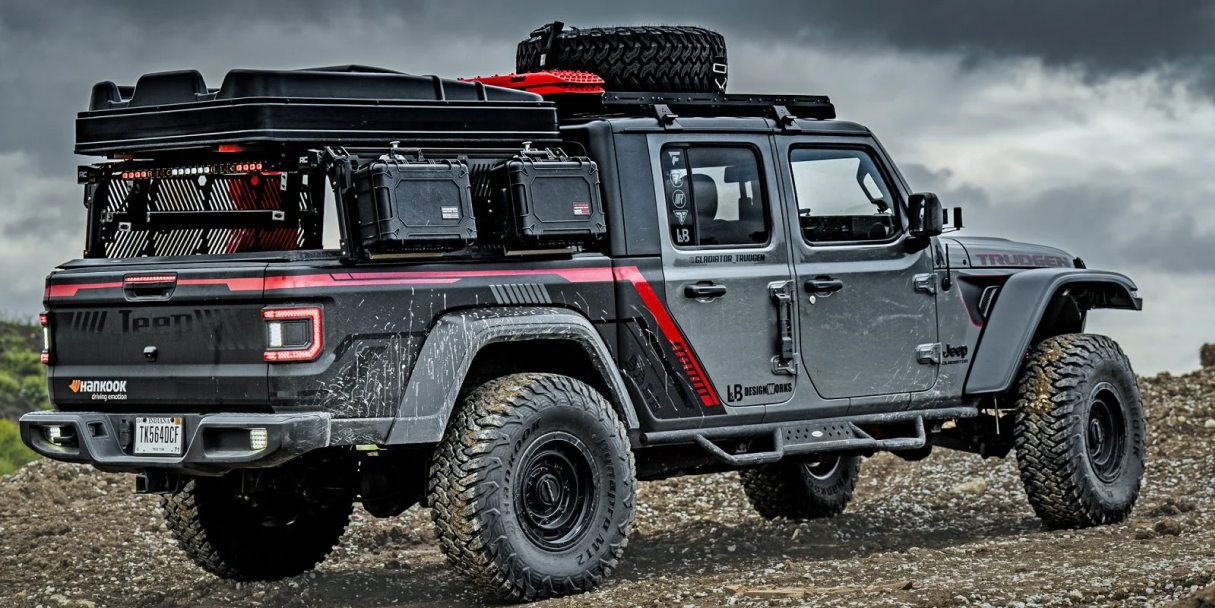
In our recent engagement with Rough Country, we found that the automotive accessory brand had strong traditional rankings but zero visibility in AI Overviews or LLM answers.
After we implemented LLMs.txt, enriched product pages with AI-legible detail, and added structured data plus natural-language FAQs, AI visibility climbed to 22% share of voice across 180 non-branded, mid-funnel prompts, driving over 14,000 sessions from ChatGPT in 90 days and $23K in attributed revenue.
Results
22%
visibility score from 180+ high-intent prompts across 7 AI models
$22.7K
revenue from AI sessions year-to-date
+3X
visibility score than nearest competitor
+71%
increase AI referral traffic (vs. previous 90 days)
Why it matters
If brands don’t add AI-era KPIs to our dashboards, they’ll struggle to justify investments that clearly move AI visibility and revenue, but not sessions. Meanwhile, teams that can show “we increased our share of voice inside AI answers, and AI referrals converted X times better than typical organic” will win budget and support.
What to do now
- Rethink your KPIs. Add AI visibility for a set of core prompts, citation share of your domains, and AI referrals as distinct line items on your 2026 scorecard.
- Test, document, and iterate. Run a single pilot where success is explicitly defined as “improve AI presence and sentiment for this cluster,” then document downstream brand search and conversion.
3. SEO and PPC converge inside AI answers
In an AI-first search world, organic and paid don’t just sit next to each other; they blend into one continuous answer. AI Overviews and AI Mode summaries already combine citations, snippets, and ads in a single, scrollable experience.
Google has signaled that ads in AI Mode are contextually aligned to both the user’s query and the AI-generated response, and while we drafting this piece, OpenAI announced their plans to start testing ads in the ChatGPT free and Go tiers of the platform. For both platforms, this means SEO and PPC will be influencing the same moment, whether your teams are coordinated or not.
We expect 2026 to be the year SEO and PPC convergence stops being a talking point and becomes an operational reality. As I’ve previously pointed out in Search Engine Land, the AI era makes it harder than ever to justify separate SEO and PPC silos. Smart brands will design unified search strategies in which paid and organic work together to own as much real estate as possible within AI answers—not just above or below them.
Why it matters
- If organic and paid search still run on separate roadmaps and KPIs, you’ll miss the compounding effect of appearing both as a cited source and as a sponsored option in the same AI answer.
- Budget decisions that ignore AI-native formats will underfund queries in which a single AI response now carries more influence than a full SERP used to.
What to do now
- Build a unified search brief per category. For your priority themes, create one shared doc that covers the prompts and keywords that matter, the AI Overviews that appear, and where you want to show up organically and paid.
- Align reporting across SEO and PPC. Move toward dashboards that provide combined visibility across organic citations, AI visibility, paid placements, and AI referrals for the same set of prompts and queries.
- Coordinate creative. Use paid search and Performance Max learnings to inform which topics and angles your GEO and AEO content should emphasize, so your brand story is consistent whether AI pulls in an ad, a blog, or a product page.
Own the Answer Space
Get our guide to AI in Search to learn what’s required to maintain visibility in the new search landscape.
4. SEO goes omnichannel because AI already has
By the end of 2026, focusing SEO around what happens on your website will be outdated. AI systems already synthesize information from PR hits, creator content, forums, and reviews alongside our .com, and we don’t see that trend reversing.
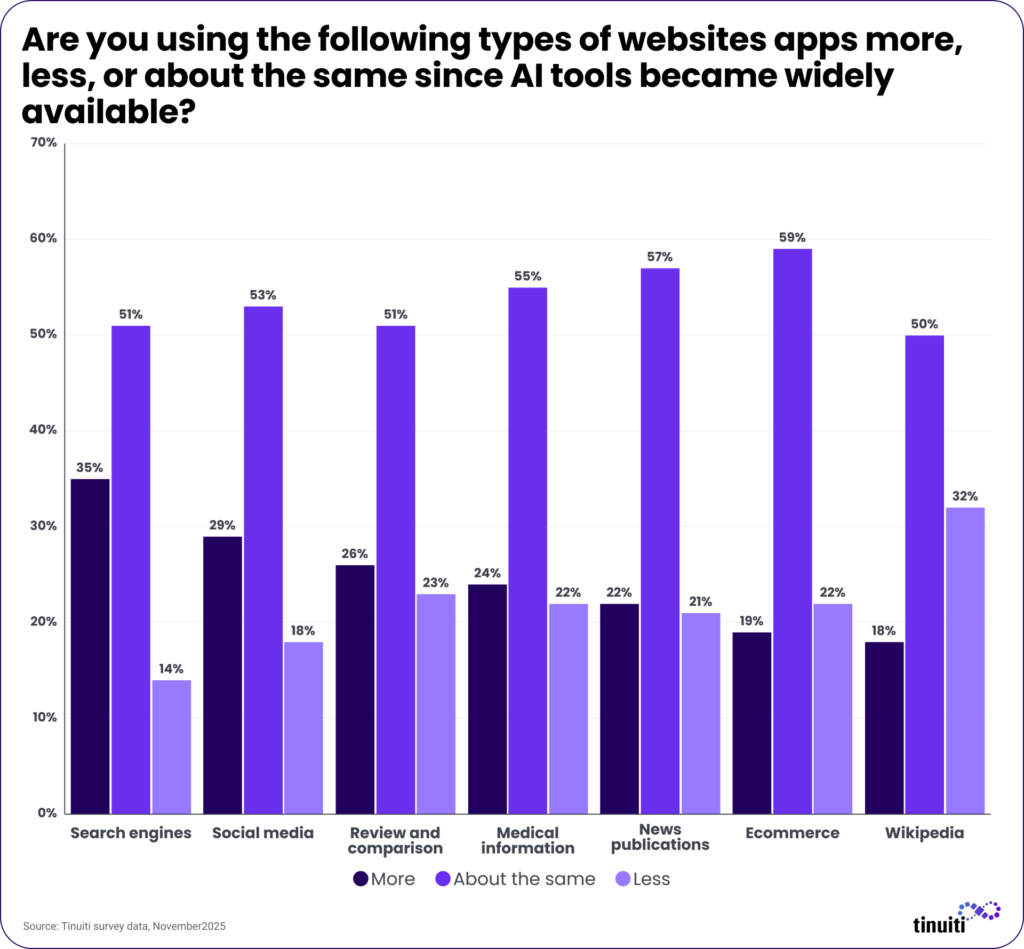
Our AI Trends Study shows more than one in three respondents are using search engines more since AI’s rise, 29% are using social media more, and 32% are using Wikipedia less. People aren’t moving from search to a single new destination; they’re comfortable with AI pulling from many sources at once.
At the same time, when we audit answers in AI Overviews, AI Mode, and LLM conversations, we consistently see citations from:
- Trade publications and news outlets in the category.
- Reddit and other community forums.
- YouTube reviews and explainers.
- Retailer review modules and Q&A.
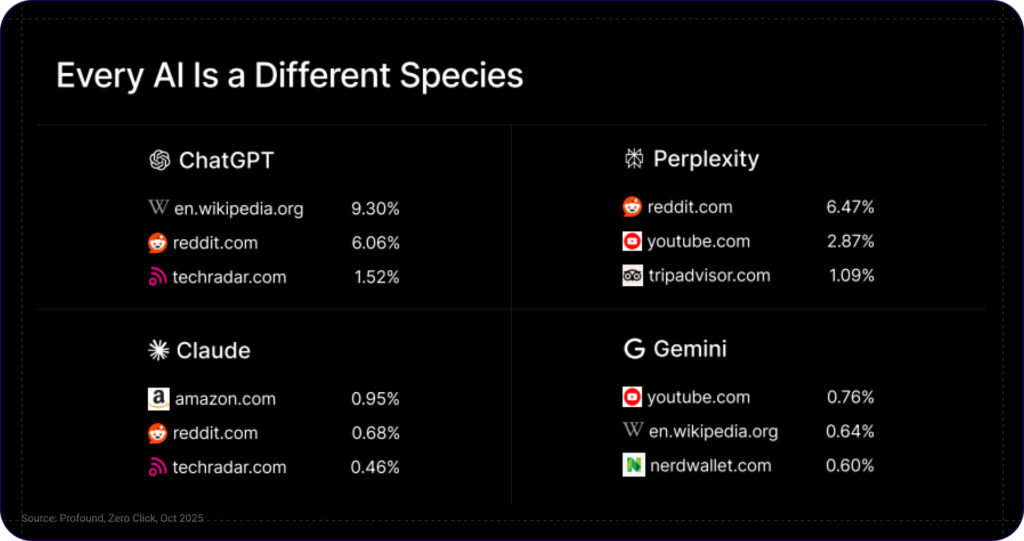
We expect social and user-generated content to play an even larger role in that mix over the next year. As models improve at parsing multimedia, citations from TikTok, YouTube, Instagram, public Facebook groups, and community threads are appearing more frequently in AI-generated responses as proof points and lived experiences.
That means the creator reviews, how-to videos, and community posts we’ve traditionally treated as “influence” now function as SEO assets, too, because AI treats them as first-class signals when deciding which brands to trust.
As such, SEO must be approached as an omnichannel discipline in 2026.
Why it matters
If PR, social, CX, and web aren’t aligned, AI may be amplifying narratives we never meant to lead with. A handful of out-of-date reviews, an old positioning statement on a directory profile, or a stray quote in a forum can show up in the most important answer our buyer sees.
What to do now
- Map your brand’s ecosystem. Build a simple “AI footprint” report: for your brand and top category queries, list which domains and content types AI currently cites.
- Collaborate across departments. Establish a quarterly working session where SEO, PR, social, and CX agree on the 3–5 narratives we want AI to repeat and align pitches, content, and fixes accordingly.
5. Decision-grade content becomes the new top of funnel
We expect more SEO-driven growth in 2026 to come from decision-grade content than from classic “what is X?” articles. AI is increasingly handling the explainer work; we need to own the “what should I do?” moment.
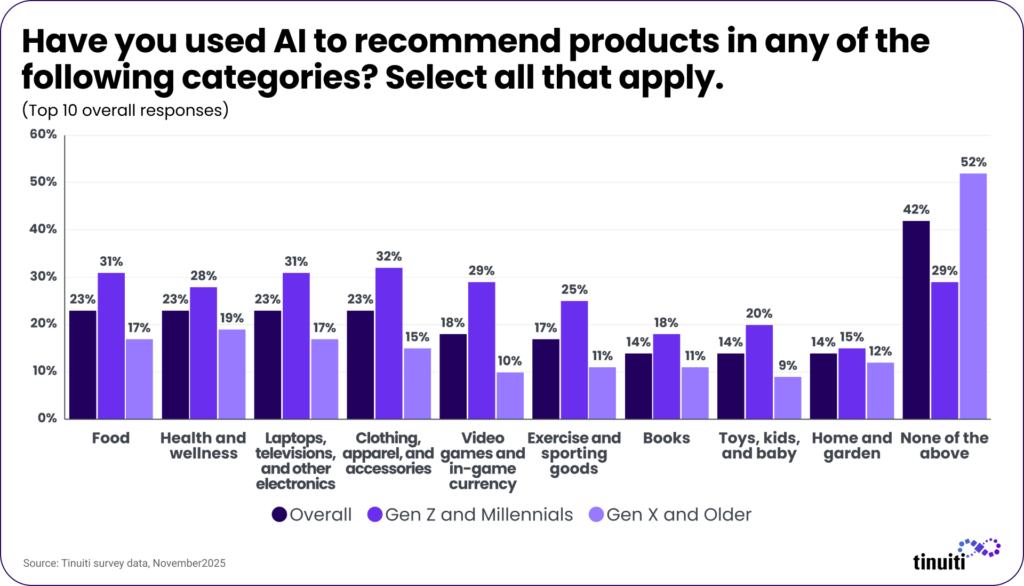
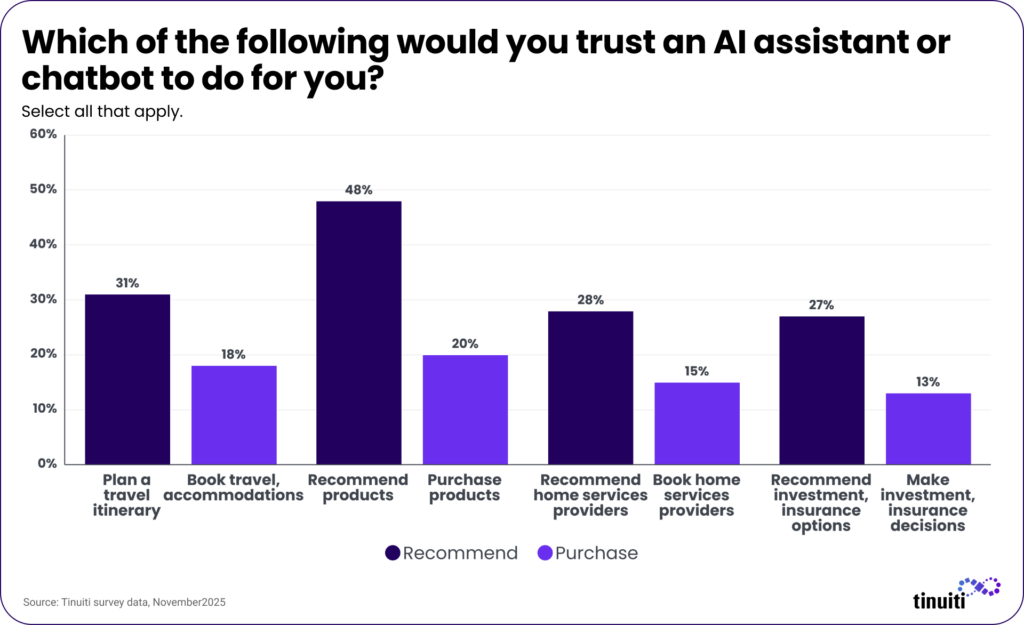
Data from Semrush shows that 88% of informational queries now trigger AI Overviews that answer questions directly. At the same time, our AI Trends Study finds that 48% of respondents would trust an AI assistant or chatbot to recommend products, and many have already used AI recommendations across multiple categories—from electronics and apparel to beauty and home and garden.
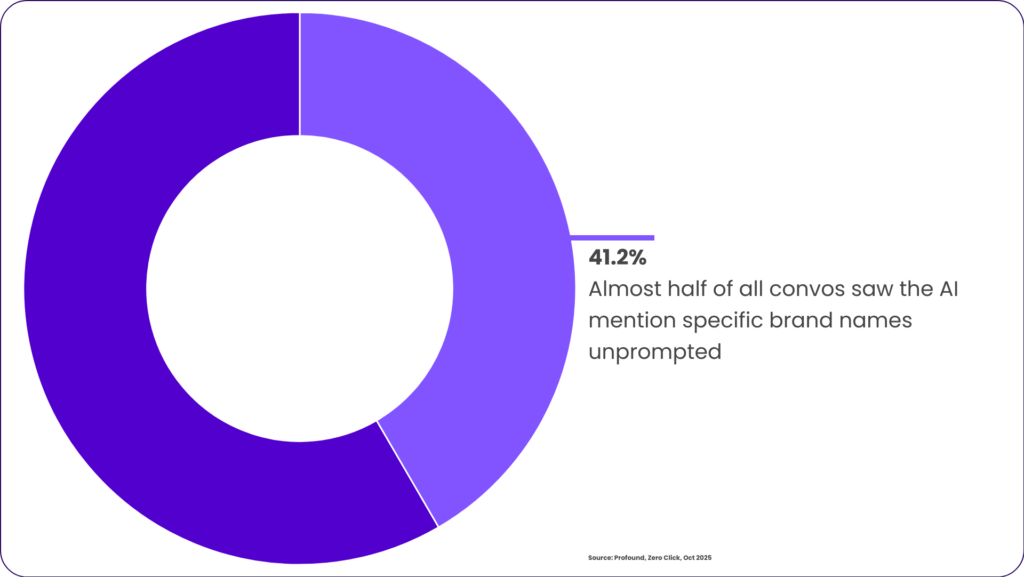
Data from our partners at Profound shows that about one in three AI conversations contain unprompted product recommendations, and over 41% mention specific brands without being asked. AI is already introducing brands on its own; the question is whether our content gives it a good reason to introduce us.
We also expect product discovery to become more proactive and personal by design. AI agents are starting to integrate signals from calendars, past purchases, and on-device behavior to anticipate needs, such as suggesting packing lists before a trip, recommending gear ahead of a season, or flagging replenishment opportunities before we run out.
That shift from “I search when I’m ready” to “my agent surfaces options when it thinks I’m ready” will reward brands whose content clearly ties products to real-world contexts, routines, and constraints.
Why it matters
Thin educational content is unlikely to be the piece AI leans on when it needs to point a user toward a choice; the sources that win that slot are the ones that bring real trade-offs, context, and proof. If we stay stuck in top-of-funnel explainer mode, we risk being the paragraph that gets summarized away, not the recommendation that gets repeated.
What to do now
- Establish a baseline. Audit your current SEO winners and ask: How many genuinely help someone choose, compare, or implement—versus define?
- Rebalance your 2026 roadmap. We’d recommend focusing on:
- Honest comparison pages (including where a competitor might be a better fit).
- Use-case stories that reflect how customers actually talk about their situations.â
- Q&A content that mirrors real language and can be lifted cleanly into AI answers.
- Buying guides that lay out clear, opinionated criteria.
6. Agents become a real audience, even if they don’t feel like it yet
We don’t expect 2026 to be the year everyone lets AI transact on their behalf, but we do expect more journeys to be mediated by AI agents who research, shortlist, and explain.
“We are moving into a world where every brand on the planet has a new customer, the AI agent. Ensuring that product listings can appear in agentic commerce channels is the first step, but optimizing for category-leading visibility and sentiment will be critical in driving agentic conversions.”
Benjamin Grosse Head of Partnerships and Growth, Profound
In the AI Trends Study, 48% of respondents say they would trust an AI assistant or chatbot to recommend products, but only 20% would trust AI to actually purchase products on their behalf. Younger consumers and daily AI users are more comfortable with both, and they’re also significantly more likely to opt into Google AI Mode.
This can be seen as the beginning of the agentic era, where AI agents browse, compare, and, increasingly, transact on a user’s behalf.
Why it matters
If an agent is doing the early research, it’s effectively pre-curating the shelf you appear on—or don’t. Product content that hides important details behind vague benefit copy makes it harder for agents to match you to the right user; structured, transparent detail makes it easier.
What to do now
- Think like a bot. Choose one high-value category and ask: “If an AI agent had to argue for or against recommending us, what facts would it have?” Then fill the gaps on your site and key third-party surfaces.
- Make structured data a priority. Product schema, rich attributes, semantic HTML, and an LLMs.txt strategy can help clarify what should be crawled and how for these agents acting on the consumer’s behalf.
7. SEO foundations and E-E-A-T become non-negotiable
Finally, we don’t see AI changing the fundamentals as much as it raises the stakes on them. Technical SEO and E-E-A-T (Experience, Expertise, Authoritativeness, and Trustworthiness) will be the quiet differentiators between brands that keep getting cited and brands that slowly vanish from the answer layer.
“Rank-and-click metrics were built for a world where search engines introduced users to a relatively static SERP, which then led to a brand’s site, where users were converted through an owned funnel.
In AI search, answers are assembled by probabilistic LLMs, so a single position or CTR no longer maps to exposure, much less conversion. The modern scoreboard centers on presence and proof inside answers.”
Benjamin Grosse Head of Partnerships and Growth, Profound
LLMs can only use what they can parse. Content locked in images, unstructured HTML, or unrendered JavaScript is effectively invisible, no matter how good it is. Conversely, content that’s clearly structured with schema, semantic headings, and clean internal linking is easier for models to segment, understand, and reuse.
We also expect search rules to get smarter and more explicit. Emerging standards like LLMs.txt give us a way to tell models what they can crawl, how they should treat different parts of our site, and where our most authoritative content lives. As those standards mature, GEO and AEO will move from experimental acronyms to core craft: structuring our sites and signals not just for search engines, but for answer engines and agents that sit on top of them.
E-E-A-T remains a key lens for how both search engines and AI systems evaluate content. First-hand experience, credible authorship, and consistent facts across the web make it easier for models to treat our claims as reliable enough to repeat.
Why it matters
If critical information is hard for machines to read or inconsistent across our ecosystem, AI is more likely to skip us, misrepresent us, or lean on a competitor whose signals are clearer.
What to do now
- Run a “can AI actually read this?” pass on your priority pages. Check crawlability, HTML structure, schema coverage, and FAQ formats.
- Elevate E-E-A-T from a checkbox to an editorial standard. Real experts on sensitive topics, updated content cadence, and aligned brand facts across your site, profiles, and key directories and review sites.
Where this leaves SEO leaders in 2026
Taken together, these forecasts point to a simple, uncomfortable truth: SEO success can’t be measured by rankings and traffic anymore. In 2026, the real work is about shaping how AI explains your category, which brands it recommends when it needs to make a recommendation, and whether it feels confident putting your name in front of your next customer.
The upside is that we’re not guessing in the dark. Our 2026 AI Trends Study shows how real people are using AI and search today—how often, on which platforms, and how much they trust AI to guide purchases. The AI in Search framework translates those behaviors into an SEO playbook built for AI-native search: new KPIs, omnichannel tactics, and agent-ready technical foundations.
If there’s one mindset shift to carry into 2026, it’s this: stop optimizing only for the click you can measure and start optimizing for the answer you need to shape. The brands that focus on this early by reframing their scoreboards, remapping their content, and re-architecting their presence for AI will be the ones AI cites, recommends, and remembers when it matters most.
Want to learn more?
Get our Guide to AI in Search for the full playbook on what’s required to maintain visibility and build organic brand awareness.
You Might Be Interested In
