





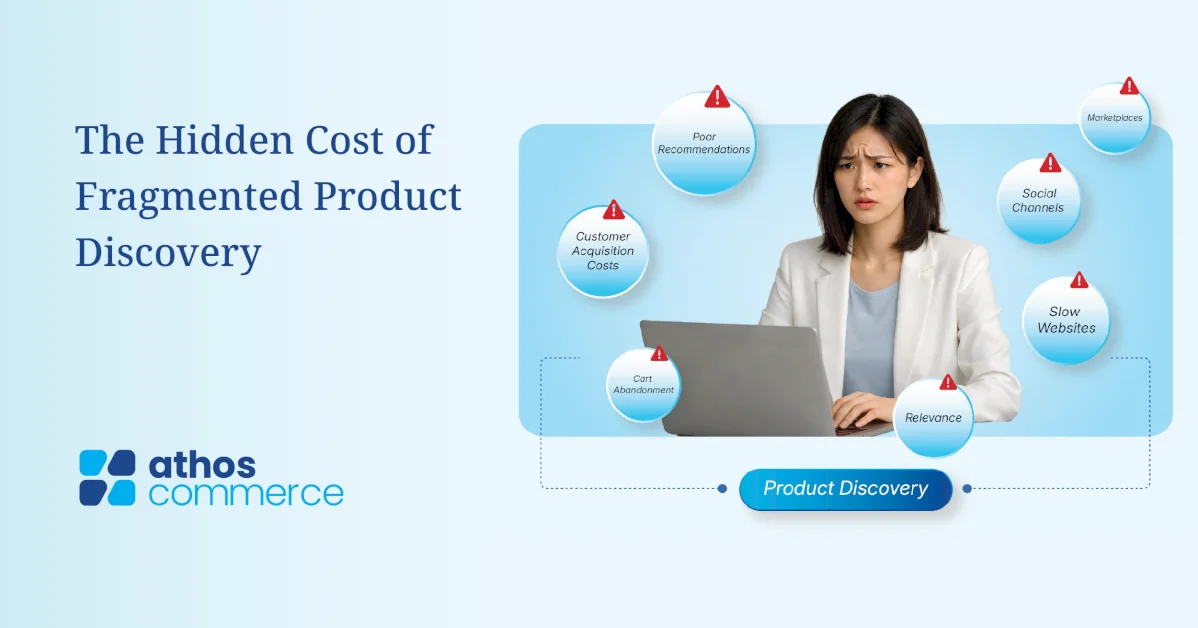
Most ecommerce teams don’t set out to build fragmented discovery experiences. Fragmentation happens gradually—one tool at a time, one workflow at a time—until it becomes the default operating model.
- Search is managed in one place.
- Categories and merchandising rules live somewhere else.
- Recommendations rely on their own logic.
- Product feeds power marketplaces and social channels independently.
Individually, each system works. Collectively, they create a hidden cost that shows up as operational drag, inconsistent shopper experiences, and lost revenue.
Fragmentation Feels Manageable—Until It Isn’t
On the surface, fragmented discovery often looks functional. Search returns results. Categories are populated. Recommendations appear. Feeds are distributed.
When performance slips, teams respond with manual fixes. They add rules. Boost products. Pin collections. Create exceptions. These actions keep discovery running, but they also create a false sense of control.
What’s really happening is that teams are compensating for misalignment between systems. Each fix treats a symptom, not the cause. Over time, the effort required to maintain “good enough” discovery grows—while clarity and consistency decline.
This is the operational tax of fragmentation.
Silos Create Inconsistency Shoppers Immediately Notice
Shoppers don’t experience discovery in pieces. They experience it as a continuous journey.
They might arrive through a paid ad, browse a category, use search to refine, and rely on recommendations to decide what to add to their cart. When each surface is driven by different logic, the experience feels disjointed—even if no single element is technically broken.
- A product promoted in a feed but buried on-site creates confusion.
- Search results that don’t reflect category priorities feel unreliable.
- Recommendations that ignore session context erode trust.
These inconsistencies don’t always show up as obvious errors. They show up as hesitation, early exits, and reduced confidence—long before checkout metrics reveal a problem.
Manual Fixes Mask Deeper Structural Issues
Manual intervention has become the default response to discovery problems because it’s fast and visible. A merchandiser can boost a product. A team can add a rule. A feed can be adjusted for compliance.
But every manual fix increases complexity.
Rules pile on top of rules. Exceptions conflict with each other. Teams spend more time maintaining logic than improving outcomes. Eventually, discovery becomes fragile—dependent on constant attention to prevent regressions.
The deeper issue is that discovery decisions are being made independently across systems, without shared goals, signals, or constraints. Manual work hides this misalignment, but it doesn’t resolve it.
The Long-Term Impact on Revenue and Efficiency
Fragmentation doesn’t just slow teams down—it limits growth.
As entry points multiply across marketplaces, social commerce, and paid channels, the cost of inconsistency increases. Shoppers expect relevance everywhere they encounter a brand. When discovery logic can’t travel across surfaces, teams are forced to choose between speed and control.
- Revenue suffers when relevance breaks early.
- Efficiency suffers when teams spend time maintaining disconnected workflows.
- Strategy suffers when leaders lack a clear view of how discovery influences performance end to end.
Over time, fragmented discovery turns what should be a competitive advantage into a maintenance burden.
Moving from Fragmentation to Alignment
The ecommerce teams pulling ahead aren’t adding more tools. They’re aligning the ones they already have.
They’re connecting search, browse, merchandising, recommendations, and feeds through shared discovery goals. They’re reducing low-value manual work by letting systems operate from the same intent signals and business priorities. And they’re creating consistency across channels without forcing everything into a rigid, monolithic system.
This shift doesn’t happen overnight—but it starts with recognizing that fragmentation is the problem, not individual features or teams.
The Takeaway
Fragmented product discovery is expensive—not because systems fail outright, but because they quietly create drag, inconsistency, and missed opportunity.
The brands that recognize this are moving beyond patchwork fixes and toward unified discovery strategies that scale with complexity instead of fighting it.
If you want to see what that looks like in practice, explore the blueprint in our latest guide:
📘 How Unified Product Discovery Drives Ecommerce Revenue in 2026
It outlines how leading teams are reducing fragmentation, improving consistency, and turning discovery into a true growth driver.
👉 See the unified discovery blueprint
Sources & Further Reading
- Baymard Institute — Product Findability & UX Research
Research on how inconsistent search, category structure, and filtering increase abandonment
https://baymard.com/research - McKinsey & Company — Why Digital Transformations Fail
Analysis of operational drag caused by fragmented tools and workflows
https://www.mckinsey.com/capabilities/people-and-organizational-performance/our-insights/why-do-most-transformations-fail - Forrester — Commerce Architecture & Experience Research
Insights on how disconnected systems impact customer experience and efficiency
https://www.forrester.com/digital-commerce/ - Gartner — Digital Commerce Platforms & Composable Commerce
Research on fragmentation, orchestration, and the limits of point solutions
https://www.gartner.com/en/digital-markets/insights/digital-commerce - Shopify — Commerce Stack & Operations Insights
Commentary on managing complexity across tools and channels
https://www.shopify.com/enterprise
Find Which Athos Commerce Product is Right for You
