






With the increasing popularity of AI shopping agents, shopping in 2026 promises to be unlike anything we’ve seen before.
AI-assisted shopping started with recommendation engines and traditional chatbots. However, it has evolved into full-fledged autonomous shoppers that can understand personal preferences and budgets, compare prices across thousands of retailers, negotiate deals, and even complete purchases on behalf of users.
AI agents essentially make the online shopping experience easier, faster, and more personalized. As a result, instead of navigating countless websites themselves, more and more shoppers are relying on AI agents to discover, evaluate, and purchase products online.
This paradigm shift means that, in the near future, most of your most valuable shoppers won’t be humans but AI agents acting on their behalf. It also means that brands need to position themselves to be discovered, understood, and preferred by AI shopping agents.
This post will explore how AI agents are changing how people shop, and how retailers can optimize for AI agents to gain more visibility, more recommendations, and ultimately, more revenue.
Overview of AI Agents in Ecommerce
AI agents are autonomous digital helpers that understand goals, take actions, and deliver outcomes on behalf of the shopper. They do not just respond to queries. They take action, follow goals, and drive outcomes.
Consider a typical online shopping experience. If you want to buy a laptop, you’ll spend hours browsing multiple websites, comparing product specs, checking reviews, hunting for the best price, tracking stock availability, and more.
All this effort, necessary to ensure you buy a reliable product that meets your needs, can make shopping time-consuming and stressful.
Imagine if someone (or something) could handle all of that for you. That’s what AI shopping agents do. They can understand your preferences in real time, compare thousands of products across dozens of stores in seconds, identify the best deals, track inventory, and even place an order for you.
And by doing so, they transform online shopping from a manual, multi-step chore into an automated, seamless experience.
This means that AI shopping assistants or agents work across the entire customer journey (from product discovery to post-purchase activities like tracking delivery and managing returns).
Also read: Personalizing Product Recommendations With Conversational AI: Complete Implementation Guide.
Agentic AI Vs. AI Agents

AI agents are digital assistants that perform tasks (such as finding products, comparing prices, validating information, placing an order, or tracking delivery) on behalf of shoppers.
On the other hand, Agentic AI is the intelligence that powers the agent. It is capable of planning, reasoning, taking action autonomously, and adapting to user intent. That is, it is what gives the AI agent the ability to anticipate user needs and make decisions that go beyond pre-programmed rules.
In simpler terms, the AI agent is the “assistant,” while Agentic AI is the “brain” that makes the assistant capable.
How Agentic AI Powers AI Shopping Agents
Agentic AI transforms a standard AI agent into an advanced AI personal shopper by giving it certain capabilities.
- Understand user intent: It helps the agent do more than match keywords. It interprets the customer’s actual goal (why they’re shopping and what outcome they need). For example, if a customer types, “I need a laptop,” it doesn’t just show random laptops. Instead, it reads the context and fills in the details (e.g., what the laptop is for, which features matter most, etc.) to guide the shopper toward the right solutions.
- Goal-oriented planning: It empowers the agent to break tasks into steps and plan how to achieve them. For example, if it determines that a shopper needs a laptop for design, it will proceed to identify the specs required, shortlist products from multiple retailers, compare prices, evaluate reviews, and prepare a final recommendation. It performs the multi-step planning and execution that a real assistant would.
- Autonomous decision-making: It enables the AI agent to take actions on behalf of the shopper. The agent will not wait for the customer to click, search, and filter. Instead, it does the work.
- Adaptation/ continuous learning: Agentic AI empowers agents to observe outcomes and refine future actions, so that each interaction is smarter than the last.
What is the Difference Between AI Shopping Agents and Chatbots?
Both AI shopping agents and chatbots assist shoppers, but in totally different ways.
Chatbots are conversational tools that answer questions. They provide information, following pre-written scripts. On the other hand, AI shopping agents act. They interpret context, make decisions, and take purposeful action on behalf of the customer.
For example, if a customer queries, “Do you have shoes?”, chatbots may answer “yes” or “no”. But advanced AI agents will determine what the shoes are needed for, find suitable shoes across multiple retailers, show the top picks, and even place the order if the customer wants.
That is, chatbots assist, while AI shopping agents act. Agentic AI systems shift the focus from answering questions to delivering results, and this difference is why they are redefining digital commerce.
How AI Agents Are Changing the Way People Shop

AI agents are not just improving ecommerce. They are changing shopper behavior. Here are some of the biggest ways AI agents are changing the way people shop in 2026:
1. Shoppers Rely Less on Manual Searching
Autonomous agents are changing how consumers discover products. Before these AI models, consumer journeys included a lot of manual work, which made them long and stressful.
For example, a customer would type “best office chairs,” and then scroll through dozens of options, read reviews, compare prices, and check availability before making a purchase decision.
AI agents replace manual search with automated discovery. You simply tell the agent what you want, and it handles everything in seconds (shifting through product listings in multiple stores, validating information, and guiding you to the best options, with minimal human input).
2. Shopping Becomes Outcome-Driven Rather Than Product-Driven
With agentic AI, shoppers no longer need to search for specific products. They only need to describe the outcome/result they want (e.g., “I need skincare for sensitive skin”).
This means the customer doesn’t need to stress themselves understanding product details and how they help meet their needs. They just describe the outcome they need, and the AI tools will translate this into curated solutions.
3. Decisions Are Faster and More Confident
One of the most significant advantages of AI agents is the scale and speed at which they operate. They can analyze customer preferences in real time as well as cross-check multiple data sources and parse product catalogs instantly.
Plus, it doesn’t just populate products quickly. It analyzes specifications, reviews, prices, and availability to recommend the best-fit products. This reduces decision fatigue and helps customers buy with more confidence.
4. Shopping Becomes More Personalized Than Ever
AI agents learn from patterns and behaviors over time. Using past interactions and shopping behavior, they learn individual preferences, such as color choices, favorite brands, budget ranges, fabric types, and sustainability values. And with this knowledge, they tailor recommendations with precision.
Thus, instead of a generic shopping experience, each customer gets a tailored journey, resulting in better customer satisfaction.
5. The Customer Journey Extends Beyond the Point of Purchase
In the era of Agentic AI, customer support does not end at checkout. AI Agents support customers before, during, and even after the purchase. They can track deliveries, reorder essentials, notify of complementary products, and even handle returns.
Thus, AI agents help retailers take control over their customer relationships, shifting them from simply “buying a product” to providing ongoing assistance.
6. Customers Rely Less on Search Engines and More on Their Personal AI
As more shoppers rely on intelligent agents rather than manual browsing and search engines, retailers have also begun thinking beyond ads and SEO (search engine optimization) and have started optimizing for AI-driven discovery.
In this era of AI commerce, product visibility will depend on how well AI agents can interpret a brand’s data, content, and structure. For this reason, to gain a competitive edge, brands need to be discoverable not just by customers but also by their AI intermediaries.
7. Loyalty Is Shifting from Brands to the AI Agent Guiding the Purchase
Brand loyalty is also taking a hit in this era of agentic AI shopping assistants. As shoppers develop trust in the accuracy and convenience of their AI agents, they are more likely to consider and buy from brands recommended by their own agents, even if they already had one in mind.
What is the Importance of Agentic AI in Ecommerce?
With agentic AI empowering AI platforms with the ability to think, plan, and act on behalf of shoppers, it offers opportunities for businesses and consumers. Here are some of the important aspects of Agentic AI in ecommerce:
Enables End-to-End Customer Support, Not Just Isolated Interactions
Most ecommerce tools handle just one part of the customer journey at a time (e.g., product search, product recommendations, chat support, or checkout guidance). However, Agentic AI brings all these functions together. It allows a single system to support the customer from discovery through decision-making to post-purchase, creating a smoother experience.
Reduces Cognitive Load and Simplifies Decision-Making
Ecommerce shoppers today have to navigate thousands of SKUs, endless reviews, price variations, and mixed information. And that can be overwhelming, delaying consumer purchasing decisions.
Agentic AI systems cut through the noise, presenting only the most relevant, accurate, and high-quality options. This leads to faster decisions and higher confidence.
Adapts to Each Shopper in Real Time
Agentic AI understands constraints and behavior patterns and uses these to adjust itself in real time, allowing for a more personalized and smooth customer experience. For example, if the shopper shows interest in certain materials, colors, or brands, the agent prioritizes those immediately in recommendations.
Unlocks New Revenue and Conversion Opportunities
Agentic AI is not just assisting customers. It is a driving business impact. Because Agentic AI guides customers toward the right solutions quickly, retailers see fewer drop-offs, higher conversion rates, and stronger post-purchase customer engagement.
Common AI Shopping Agent Challenges and How to Solve Them
While AI shopping agents are very powerful, deploying them comes with some challenges. Here are common AI shopping agent challenges and how to solve them:
Inaccurate Recommendations
AI agents rely entirely on your product data to understand what items are, how they differ, and who they’re right for. Thus, issues with the product data can lead to inaccurate recommendations.
For example, if product data is inconsistent across systems, outdated, or stored in unstructured formats, even advanced AI systems may misunderstand key product attributes and recommend products that do not fully meet the user’s needs.
To overcome this challenge, you can take actions such as centralizing product data, using structured formats that agents can reliably interpret, and implementing guardrails so that agents validate product information before presenting it.
Recommending Items That Don’t Match Real Stock or Pricing
AI agents often operate faster than traditional ecommerce infrastructure. And this can create a frustrating experience where the customer progresses through a conversation only to hit a dead end.
For example, if inventory or pricing update systems lag (even by a few minutes), the agent may recommend items that are already sold out or have changed in price. This damages consumer trust as it makes a brand seem disconnected from its own operations.
To overcome this challenge, you should connect agents to live inventory and pricing sources (not batch updates) and teach the agent to monitor fluctuations during the conversation and automatically find alternatives.
Responses That Are Noncompliant or Sound Robotic and Off-Brand
Another challenge when deploying AI agents is maintaining brand voice and compliance.
Since AI agents often learn from general internet data that has nothing to do with your brand, they may produce responses that sound robotic or off-brand. And without proper guardrails, they may make claims your brand wouldn’t or answer questions you legally cannot answer.
Brand-level governance helps overcome this challenge. Have a clear, formalized brand voice guide and define messaging rules, tone boundaries, and restricted topics. Also, put in place automated monitoring to catch and address any deviations.
Hallucinations and Misinformation
Some AI systems “guess” or invent details when information is unclear, leading to incorrect product claims or misleading recommendations. With misinformation, retailers risk losing customer trust and struggling with more returns and customer complaints.
To overcome this challenge, you should ground the AI’s responses in verified data, meaning you should restrict its output to known catalogs, policies, and trusted data sources.
Privacy Issues
Agentic systems often handle sensitive data (such as purchase history, location, contact information, etc.). This introduces risks, as poorly governed systems can violate privacy regulations (such as GDPR).
To overcome this challenge, ensure any deployment complies with privacy regulations and clearly discloses how data is used. Also, give customers control through consent banners and opt-out options.
Difficulty Measuring Performance And Proving ROI
Traditional ecommerce analytics are built around pages, clicks, and funnels, not agent interactions. As a result, teams struggle with using them to measure the impact of agentic AI. And when the value of these systems cannot be justified, they risk being deprioritized.
To overcome this challenge, retailers should measure agentic performance using agent metrics (such as conversion rate for agent-assisted sessions and number of agent-resolved journeys).
How Rep AI Elevates the Modern Ecommerce Experience
Becoming an ecommerce performance powerhouse requires more than having an AI agent. It’s about how powerful, accurate, and commercially effective the agent is. This is where REP AI stands out.
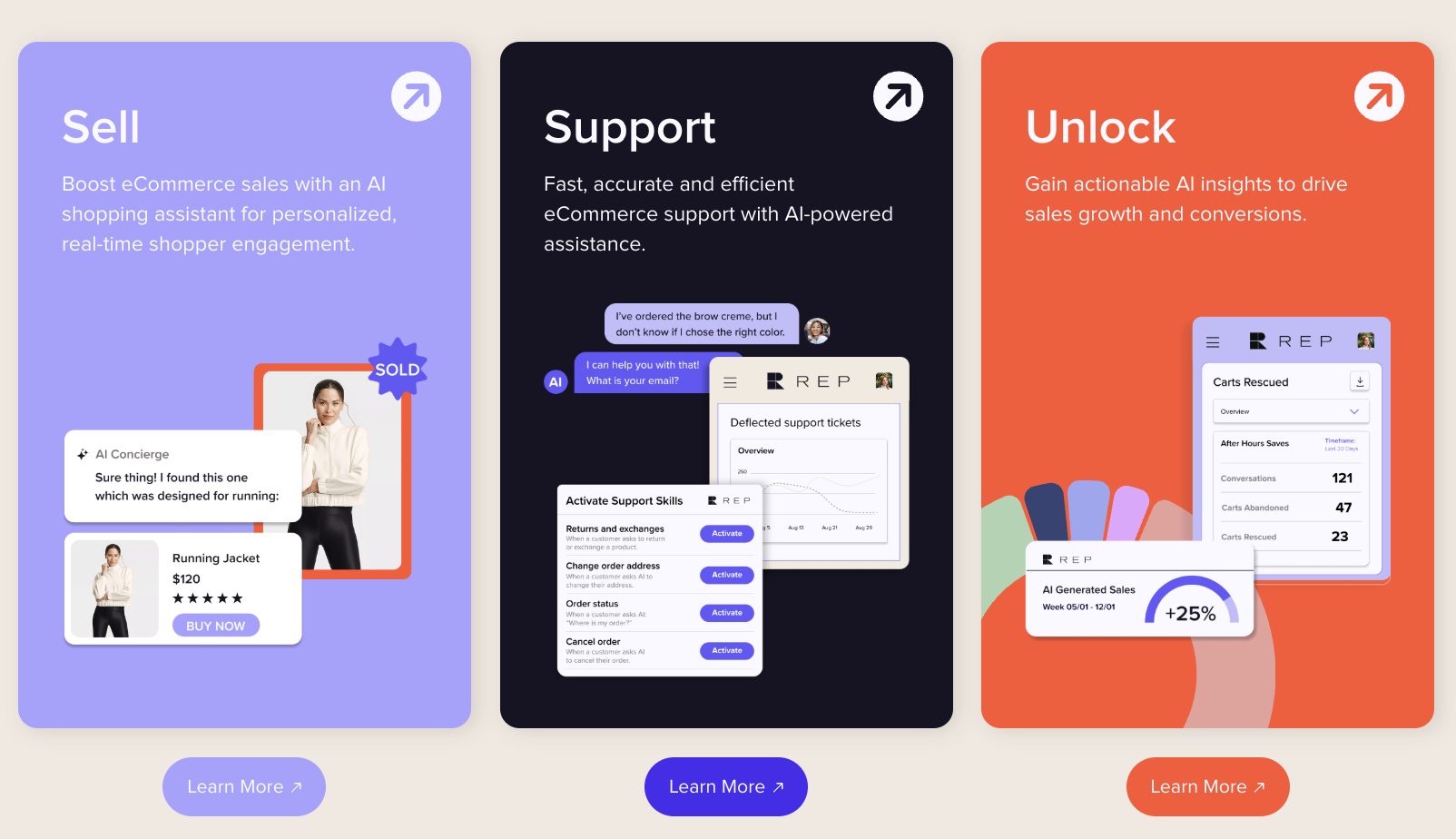
REP AI is an agentic commerce-trained AI system built to drive revenue growth and reduce support tickets. Here’s how REP AI enhances the experience in ways most AI tools can’t match:
Converts Conversations into Revenue
Unlike most AI agents, REP AI sells. It is trained on ecommerce-specific intent patterns and buying signals. This means it can start conversations at the right moment using behavioral insights and guide shoppers between pages and through the funnel.
Also, it’s context-aware, using the context of the conversation (and not just keywords) to deliver personalized product results.
There’s also an instant checkout feature that lets customers add products to their cart directly through the chat, streamlining the purchase process. Plus, it reduces cart abandonment with targeted interventions.
Dramatically Reduces Support Volume
REP AI resolves 95-99% of common support inquiries, including product questions, shipping and policy information, order tracking, order cancellations, and returns.
And if a human agent is ever needed, REP AI includes live conversation drop-in, letting teams jump into chats seamlessly while the AI continues handling everything else.
With this, teams get to focus on high-value customer interactions, not repetitive questions. The result is fewer tickets, faster resolutions, and higher customer satisfaction.
Unlocks High-Value Shopper Intelligence You Can Actually Use
With most AI systems, insights are vague. But not with REP AI. REP AI provides a wealth of insights from real shopper behavior, which can help you optimize your sales and support strategies in real time.
For example, it automatically surfaces the exact reasons shoppers drop off, friction points blocking conversions, pages that confuse or delay buyers, conversations that actually lead to sales, and more.
Built for Agentic Commerce
One of the biggest challenges with agentic AI is ensuring the system stays up to date with real-time inventory, pricing, dynamic product availability, and brand voice.
REP AI solves this with 1-click catalog adoption and a powerful data engine that keeps the AI agent grounded in accurate information.
This means that with REP AI, there are no hallucinations, inaccurate recommendations, or off-brand responses. Shoppers (and their agents) receive recommendations that actually match what you have in stock, at the right price, and in your authentic brand voice.
Fast, Frictionless, Enterprise-Ready Implementation
REP AI is designed with a plug-and-play setup. You don’t need a technical team or a custom AI lab. It’s so intuitive that you can seamlessly integrate with your tools in minutes. Plus, it is built with enterprise-grade security so brands can safely use AI without risking customer data.
Also read: Top 5 AI Agents Driving E-Commerce ROI in 2025.
Step-by-Step Guide to Starting an AI Shopping Agent Pilot for Ecommerce
Want to stay ahead of the ecommerce game by deploying AI agents? Here’s how to start an AI shopping agent pilot without complexity, long timelines, or technical bottlenecks:
1. Define the Goal of Your Pilot
A clear goal helps you avoid a scattered, unfocused pilot, so start by defining your goals (the outcome you want to achieve). Goals could be increasing conversion rates, reducing support ticket volume, improving AOV through guided selling, or decreasing cart abandonment.
2. Choose the Pages or Flows Where the Agent Will Operate
When starting with AI, you don’t need to activate the AI everywhere. Instead, activate it on only specific pages at first. And for this, choose high-impact areas like product pages, checkout/ cart, FAQ or support pages, and high-traffic landing pages.
3. Prepare Your Product Data and Knowledge Sources
AI agents rely on accurate information to operate, so after deciding where the AI will operate, the next step is to prepare your data foundations.
Make sure the AI has access to product catalog, FAQs, policy details, support documentation, shipping and return information, and warranty information.
4. Train the Agent on Brand Voice, Tone, and Guardrails
The next step is to make sure the AI agent sounds like your brand and doesn’t make claims you wouldn’t. To this end, teach the agent how to behave by defining your tone, the phrases to use and those to avoid, escalation rules, and compliance and privacy restrictions.
5. Enable Core Behaviors That Impact Revenue
After training the AI agent, the next step is to test its agentic performance. For this, activate the agentic actions you want. This should be:
- Key selling behaviors (like proactive engagement, product recommendations, product finder flow, cross-selling and upselling, suggesting alternatives, and assisting with checkouts)
- Key support behaviors (answering FAQs, order tracking, processing returns or cancellations, and escalating complex issues to a human agent).
6. Launch the Pilot for a Fixed Time Period
After activating the agent, let it run for 30-45 days. This gives the system enough time to collect meaningful data and measure improvements in conversion rates, average order value (AOV), support ticket reduction, and other metrics.
7. Review the Insights and Optimize
After the pilot window, analyze the insights to understand where your customer journey succeeds and where it breaks. For example, you can look at where the agent drove the most conversions, where shoppers dropped off, which upsells were accepted or rejected, what product gaps or content gaps surfaced, etc.
This helps you understand what to improve (product pages to strengthen, knowledge gaps to fill, etc.).
8. Scale From Pilot to Full Deployment
Lastly, if the pilot proves ROI, consider rolling out the agent to additional areas (such as the homepage, PDFs, the helpdesk, and social channels).
Takeaway: Be Prepared for the Future of Ecommerce with REP AI
The rise of AI shopping agents demands a fundamental rethinking of digital commerce strategy. Brands now need to prepare for AI-driven shopping. Those that do will capture shoppers (and AI agents) of the near future, while those that don’t will be invisible to them.
And one way for brands to prepare for AI-driven shopping is to create their own agentic experiences, because the brands that have their own AI agents will be the ones these shopping agents can understand and recommend.
This is where REP AI comes in. REP AI gives ecommerce teams everything they need to launch a powerful agentic experience. It can sell, support, and learn at the level AI shopping agents expect. It also comes with a fast, plug-and-play setup and is scalable.
Ready for the agent-to-agent interaction that drives revenue growth and reduces support tickets? Try REP AI for free today!
