




Quick Decision Framework
- Who this is for: Shopify founders selling physical products who are doing 50 to 500 orders per month and currently storing inventory at home, in a garage, or in a disorganized setup that is starting to slow down fulfillment.
- Skip if: You are pre-revenue or still validating your product. Come back when you are consistently processing at least 50 orders per month and your current storage situation is becoming a constraint.
- Key benefit: A clear decision framework that tells you exactly which storage stage you are in, what to build now, and the specific order volume and operational triggers that tell you when to move to the next stage.
- What you’ll need: Your current monthly order volume, a rough count of your active SKUs, and 30 minutes to assess your current fulfillment setup. If you are at Stage 2 or above, budget $150 to $400 per month for a self-storage unit and $1,500 to $3,000 for a basic barcode and shelving setup.
- Time to complete: 15 minutes to read. 2 to 4 hours to assess your current stage and identify your next action. 1 to 2 weeks to fully set up a self-storage fulfillment hub if that is your next move.
Most founders make their inventory storage decision the day they run out of space. The ones who scale without drama made it six months earlier.
What You’ll Learn
- Why the four-stage inventory evolution is predictable and how to identify exactly which stage your Shopify brand is in right now.
- How to calculate whether self-storage or a 3PL is the right economic choice at your current order volume, using real cost benchmarks.
- What to set up inside a self-storage unit to run it as a lean fulfillment hub, including the barcode system, shelving, and packing station configuration that reduces errors by up to 67%.
- When the five specific operational signals tell you that you have outgrown self-storage and it is time to evaluate 3PL partners.
- How to avoid the four most common mistakes founders make at the self-storage stage that follow them into the 3PL transition and make it harder than it needs to be.
Most Shopify founders make their inventory storage decision reactively. The garage fills up. The spare bedroom disappears under boxes. A 200-unit restock arrives and there is nowhere to put it. At that point, the decision gets made under pressure – and pressure-driven decisions in operations are almost always expensive ones.
The smarter move is to treat inventory storage as a strategic decision you make before you need to make it. Where you store your products directly determines your fulfillment speed, your cash flow flexibility, your ability to absorb a viral moment or a Q4 surge, and – more than most founders realize – your customer experience.This framework maps the four stages of inventory evolution that every physical product Shopify brand moves through, gives you the specific triggers that tell you it is time to advance, and shows you how to set up each stage properly so you are not constantly rebuilding from scratch.
The 4-Stage Inventory Evolution
There is a predictable arc to how Shopify brands handle inventory as they grow. Understanding where you are on that arc – and what comes next – is the difference between scaling smoothly and hitting a wall.
Stage 1: Home and Garage Storage (0 to 50 orders per month)
This is where almost every physical product brand starts. Products live in a spare room, a basement, or a garage. Fulfillment happens manually – you pack the box, print the label, drop it at the post office. Shopify itself validates this as a legitimate starting point, noting that self-storage at home is “cost-effective and an easy starting point for small business inventory storage.”
The advantages here are real: zero overhead, complete control, and hands-on familiarity with your own product and packaging. The disadvantages are equally real: no separation between work and home, limited physical capacity, higher risk of damage, and a fulfillment process that is impossible to systematize or hand off.
The ceiling: When you are consistently shipping more than 50 orders per month, or when your inventory physically no longer fits in your living space, you have hit the ceiling of Stage 1. Do not wait until you are buried. The transition is smoother when it is planned.
Stage 2: Self-Storage as a Mini-Warehouse (50 to 500 orders per month)
This is the most underutilized stage in ecommerce operations. Founders often leap from garage to 3PL without recognizing that a well-configured self-storage unit can function as a legitimate mini-warehouse – giving you separation between home and business, meaningful capacity, 24/7 access, and month-to-month flexibility that a 3PL contract simply cannot match at this volume.
The economics are compelling. A self-storage unit typically runs $100 to $400 per month depending on size and location. A 3PL at this order volume will cost you a minimum monthly spend of $517 on average (up from $437 in 2024, per the 2025 Warehousing and Fulfillment Survey), plus per-order fees of $3 to $8 per shipment at the starter tier. For a founder shipping 100 orders per month, that math rarely works in the 3PL’s favor.
Purpose-built business storage facilities like StoreIT Self Storage LLC have emerged to serve exactly this gap – offering climate-controlled units, 24/7 access, and scalable sizing specifically designed for businesses storing inventory, equipment, and documents alongside individual customers.
The ceiling: When fulfillment is consuming more than 2 to 3 hours per day, when you are consistently above 300 to 500 orders per month, or when SKU complexity is making manual pick-and-pack error-prone, you are approaching the ceiling of Stage 2.
Stage 3: 3PL Partnership (500 to 5,000 orders per month)
The 3PL stage is where the growth tier begins. According to industry benchmarks, 500 orders per month is the common minimum threshold for most 3PL partnerships, and the 500 to 5,000 range is described as the “sweet spot” where 3PL economics actually work in your favor – per-order costs drop to $2 to $5, volume discounts unlock, and SLA guarantees tighten.
What you gain: professional fulfillment infrastructure, shipping rate leverage (3PLs negotiate bulk carrier rates you cannot access independently), scalability for Q4 and launch surges without hiring, and freedom to focus on the work that actually grows the business.
What you give up: direct inventory access, packaging control (unless you negotiate it), and the flexibility to pivot quickly. A 3PL is a commitment – operationally and financially. The average 3PL customer retention rate is 96.49%, which tells you two things: most brands are happy once they make the move, and switching is painful enough that most do not.
The ceiling: At 5,000+ orders per month, you are in enterprise territory. Dedicated account management, custom automation, and owned warehouse conversations become relevant.
Stage 4: Owned or Leased Warehouse (5,000+ orders per month)
This stage is beyond the scope of most founders reading this article, but worth naming so you understand the full arc. At this point, the economics of a shared 3PL network start competing with the cost of owned infrastructure. The decision is no longer about storage – it is about whether logistics is a core competency you want to build in-house.
Why Self-Storage Is the Underrated Middle Stage
The self-storage stage gets dismissed too quickly. Founders either see it as a temporary embarrassment on the way to “real” infrastructure, or they skip it entirely and commit to a 3PL before their volume justifies the cost. Both are mistakes.
Here is what makes self-storage genuinely powerful for Shopify brands in the 50 to 500 order range:
Month-to-Month Flexibility vs. 3PL Contracts
Most 3PLs require minimum monthly spends, minimum storage quantities (standard 3PLs often require 250 to 500 units per SKU), and varying contract lengths. Self-storage is almost universally month-to-month. For a brand that is still figuring out its seasonal patterns, testing new SKUs, or recovering from a slow quarter, that flexibility is worth real money.
Cost Comparison That Actually Favors Self-Storage
At 100 orders per month, a 3PL at $3.20 per order average pick-and-pack plus the average $517 monthly minimum costs you roughly $837 per month minimum – and that is before storage fees. A self-storage unit serving the same volume costs $150 to $300 per month plus your own labor. The math is not close until you are consistently above 300 to 400 orders per month and your time has a real opportunity cost attached to it.
Climate Control for Product-Sensitive Inventory
This is the feature most founders overlook until they lose a shipment. If you sell cosmetics, supplements, candles, chocolate, electronics, or anything else that degrades under heat or humidity, climate control is not a luxury – it is a product quality requirement. A Dubai Self Storage Facility positioned near a major logistics hub, for example, provides climate-managed units specifically suited for inventory that cannot tolerate the temperature extremes common in unregulated warehouse environments – a critical consideration for brands importing from Asian manufacturers who use Dubai as a regional distribution node.
24/7 Access for Fulfillment Agility
A viral moment does not happen on a Tuesday at 2pm. When 500 orders come in overnight because a creator posted about your product, you need to be able to get to your inventory at 6am. 24/7 access is non-negotiable for any storage facility you are using as a fulfillment hub. Confirm this before you sign anything.
How to Set Up Your Storage Unit as a Lean Fulfillment Hub
A self-storage unit used for ecommerce fulfillment is not the same as a self-storage unit used to hold furniture during a move. The setup matters. Done right, it functions as a legitimate mini-warehouse. Done wrong, it is a chaotic box room that slows you down and causes fulfillment errors.
Choose the Right Unit Size
Most founders start too small and upgrade within 90 days, which means two moves and two sets of setup costs. Estimate your current inventory footprint, then add 30 to 40% for growth. Standard ecommerce unit sizes range from roughly 5×5 feet (lockers and small SKU counts) up to 10×20 feet and larger for brands with meaningful inventory depth. Many facilities offer multiple sizes – choose one you can grow into, not one that fits exactly today.
Install Shelving and Use Vertical Space
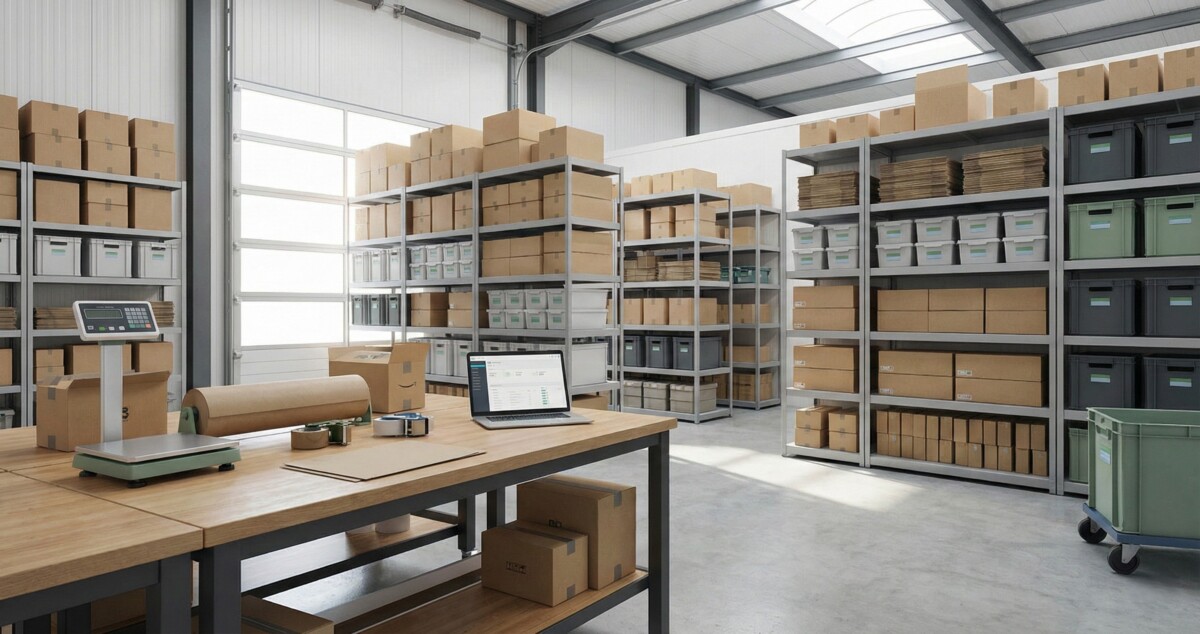
Floor space is expensive. Vertical space is free. Heavy-duty metal shelving units (typically $80 to $200 per unit) transform a storage room into a proper pick-and-pack environment. Use transparent bins or clearly labeled boxes on shelves. Assign each SKU a fixed location. This sounds obvious but most founders skip it and spend 20 minutes per fulfillment session searching for products.
Implement a Barcode System That Syncs With Shopify
A basic barcode setup for a small ecommerce operation costs $1,500 to $3,000 upfront – one mid-range scanner ($300 to $600), a thermal label printer ($300 to $500), label supplies ($100 to $200), and a cloud-based inventory management software subscription ($50 to $150 per month). That investment typically pays for itself within 3 to 6 months through reduced fulfillment errors and faster pick times.
The operational impact is significant: barcode-based inventory systems reduce inventory errors by 67% on average. For a brand shipping 200 orders per month at a 3 to 5% error rate, that is 6 to 10 wrong shipments per month – each one costing you in reshipping, customer service time, and review risk.
Most modern inventory management tools (Shopify’s native inventory, Cin7, Linnworks, and others) integrate directly with barcode scanners. Set this up before you need it, not after your first major error.
Apply FIFO Rotation from Day One
First In, First Out. New stock goes behind existing stock. This is standard warehouse practice that prevents dead stock from accumulating at the back of shelves while newer inventory ships. For products with expiry dates (supplements, food, beauty) this is not optional. For products without expiry dates, it still prevents packaging version inconsistencies from reaching customers.
Set Up a Dedicated Packing Station
Designate a fixed area in your unit for packing. A folding table, a roll of tape, a scale, and your label printer. Packing materials (boxes, mailers, void fill, tissue paper) stored within arm’s reach. The goal is to pick your items, walk to the packing station, and complete the order without moving around the unit. This sounds like a small efficiency gain. At 150 orders per week, it is not small.
What to Look for in a Business Storage Facility
Not all self-storage facilities are built for ecommerce operations. Consumer-oriented facilities often have limited access hours, no loading dock, and no provisions for regular commercial activity. Before you sign a lease, evaluate against these criteria:
24/7 Access – Non-Negotiable
Covered above, but worth repeating. Any facility that restricts access to business hours is not suitable as a fulfillment hub. Confirm this in writing before signing.
Climate Control Matched to Your Product Category
Temperature-managed storage is essential for cosmetics (typically stable below 77°F), supplements (humidity-sensitive), candles (melting threshold), electronics (static and humidity), and artisan food products. Dry storage is sufficient for apparel, books, hard goods, and most non-perishable categories. Know your product’s requirements before selecting a unit type.
Security Standards
On-site security staff, 24/7 CCTV coverage, controlled access, and individual unit locks are the baseline for any business storage facility worth using. Your inventory is a working asset – treat its security accordingly.
Location Relative to Shipping Carriers and Import Routes
Proximity to a major carrier hub (UPS, FedEx, USPS, DHL) reduces your daily logistics overhead. For brands with international supply chains – particularly those importing from manufacturers in Asia or sourcing through regional distribution hubs – proximity to airport cargo facilities is a genuine operational advantage. Dubai’s ecommerce infrastructure, anchored by facilities like CommerCity (a free zone purpose-built for ecommerce operators), has made it a natural node for brands managing inventory across the MENA region and beyond. A storage facility positioned within that ecosystem – near Dubai International Airport and adjacent to CommerCity – gives operators importing inventory a meaningful last-mile advantage that a suburban warehouse simply cannot replicate.
Flexible Unit Sizing
Your inventory needs will change. A facility that offers multiple unit sizes and allows you to upgrade or downsize without penalty is worth more than a marginally cheaper facility that locks you into a fixed footprint.
The 5 Signs You Have Outgrown Self-Storage
The self-storage stage has a ceiling. Here are the five signals that tell you it is time to move to a 3PL:
1. Fulfillment Is Consuming Your Productive Hours
At roughly 150 orders per month, self-storage fulfillment typically takes 2 to 3 hours per day. At 300 orders per month, that doubles. When fulfillment is consuming more than 3 hours per day – or when you are hiring help specifically for packing – the economics of a 3PL start to shift in its favor. Your time has an opportunity cost. At a certain point, packing boxes is the most expensive thing you can do with your day.
2. You Are Consistently Above 500 Orders Per Month
Industry data is clear: 500 orders per month is the minimum viable threshold for most 3PL partnerships. Below this, 3PL economics typically do not work in your favor. Above this, they start to. If you have been consistently at or above 500 orders for two consecutive months, start evaluating 3PL partners now – the onboarding process takes 4 to 8 weeks, and you want to be ready before volume forces the decision.
3. SKU Complexity Is Causing Fulfillment Errors
A single-SKU brand can self-fulfill at high volumes with minimal error. A brand with 20+ SKUs, multiple variants, and bundle configurations is a different story. When SKU complexity is the primary driver of fulfillment errors – wrong items, wrong variants, incomplete bundles – that is a systems problem, and 3PL warehouse management systems are built to solve it.
4. You Are Expanding Into New Markets
If you are selling into the US from outside the country, or expanding from domestic to international, a 3PL with a distributed warehouse network gives you shipping speed and cost advantages that a single self-storage unit cannot match. Shopify’s own data shows that 60% of consumers expect same-day, next-day, or two-day delivery. Geographic proximity to your customer base is the primary lever for meeting that expectation.
5. Your Storage Unit Has Become a Bottleneck, Not a Hub
When receiving a new inventory shipment requires a full day of reorganization. When you are turning away wholesale orders because you do not have capacity to fulfill them. When your storage unit is at 90%+ capacity and you are staging overflow in your car. These are operational signals, not temporary inconveniences. The self-storage stage has ended.
Common Mistakes Founders Make at the Self-Storage Stage
The self-storage stage is where operational habits form. The habits you build here – good or bad – follow you into the 3PL stage and beyond.
No Inventory System (Fulfillment by Memory)
The single most common mistake. Founders who know their inventory intimately at 50 SKUs are still trying to manage by memory at 200 SKUs. The cognitive overhead becomes unsustainable, errors multiply, and the transition to a 3PL becomes chaotic because there is no clean inventory data to hand off. Build your system before you need it.
Choosing the Wrong Unit Size
Too small means you are reorganizing constantly and cannot receive full shipments. Too large means you are paying for space that is not earning its keep. The right size is current inventory footprint plus 35% growth buffer. Revisit this calculation every quarter.
Ignoring Climate Control for Sensitive Products
The cost difference between a standard unit and a climate-controlled unit is typically $20 to $50 per month. The cost of a batch of heat-damaged skincare or humidity-compromised supplements is orders of magnitude higher. This is not a place to optimize for cost.
No Transition Plan to the Next Stage
The founders who transition to a 3PL smoothly are the ones who started evaluating options at 300 orders per month – not at 600. Research 3PL partners, understand their onboarding requirements, and know your transition trigger before you hit it. A rushed 3PL transition during a growth phase is one of the most common operational crises in early-stage ecommerce.
Treating It as Temporary Instead of Operational
Founders who treat self-storage as an embarrassing temporary measure do not invest in setting it up properly. They skip the shelving, skip the barcode system, and run a chaotic operation for 18 months before finally moving to a 3PL. Founders who treat it as a legitimate operational stage set it up like a mini-warehouse, build clean inventory data, and transition to a 3PL with systems already in place. The second path is faster, cheaper, and less stressful.
Your Inventory Stage Checklist
Use this to identify where you are and what you need to do next:
Stage 1 – Home Storage
- Monthly orders below 50
- Inventory fits in your living space
- Fulfillment takes less than 1 hour per day
- Next step: Begin evaluating self-storage options in your area before you need them
Stage 2 – Self-Storage
- Monthly orders between 50 and 500
- Dedicated unit with shelving and packing station
- Barcode system synced with Shopify
- Climate control matched to product category
- 24/7 access confirmed in lease
- Next step: Set a 3PL evaluation trigger at 300 orders per month
Stage 3 – 3PL
- Monthly orders consistently above 500
- Clean inventory data ready to migrate
- 3PL partner selected based on Shopify integration, location, and volume fit
- Onboarding completed before volume forces the transition
- Next step: Establish SLA benchmarks and review at 90 days
The Bottom Line
Inventory storage is one of the highest-leverage operational decisions a Shopify founder makes in the first three years of building a physical product brand. Get it right and you have a fulfillment operation that scales without drama. Get it wrong and you are constantly firefighting – losing hours to packing, losing margin to fulfillment errors, and losing customers to slow shipping.
The framework is straightforward: match your storage stage to your current volume and complexity, invest in setting up each stage properly before moving to the next, and make the transition decision proactively rather than reactively.
The founders who scale most efficiently are not the ones who moved to a 3PL fastest. They are the ones who built clean operational habits at the self-storage stage, accumulated real inventory data, and arrived at the 3PL transition ready to hand off a system – not a mess.
Start where you are. Build it right. Know your triggers. Move when the math says move.
Frequently Asked Questions
When should I move from home storage to a self-storage unit for my Shopify store?
Move when you are consistently shipping more than 50 orders per month or when your inventory no longer fits comfortably in your living space without disrupting your home. The right time to make this move is before you need to, not after you are buried. Most founders wait too long and end up making the transition under pressure, which means paying for two setups at once. If you are approaching 50 orders per month, start evaluating self-storage options now. The month-to-month nature of most self-storage leases means you can start small and scale up without committing to more than you need.
Is self-storage actually good for ecommerce inventory, or should I just go straight to a 3PL?
Self-storage is genuinely the right choice for most Shopify brands doing 50 to 500 orders per month. A 3PL at this volume typically costs $837 or more per month minimum (based on the 2025 average $517 monthly minimum plus $3.20 per-order pick-and-pack at 100 orders), while a self-storage unit serving the same volume costs $150 to $300 per month. The math does not favor a 3PL until you are consistently above 300 to 400 orders per month and your own time has a meaningful opportunity cost. Skipping self-storage and going straight to a 3PL before you are ready is one of the most common and expensive operational mistakes early-stage founders make.
How do I set up a self-storage unit for ecommerce fulfillment?
Start with the right unit size: your current inventory footprint plus 35% for growth. Install heavy-duty metal shelving ($80 to $200 per unit) and assign each SKU a fixed location. Set up a dedicated packing station with a folding table, scale, tape, and label printer. Implement a barcode system that syncs with Shopify’s native inventory, Cin7, or Linnworks. Apply FIFO rotation from day one so older stock ships first. The total setup cost for a proper barcode and shelving configuration runs $1,500 to $3,000 upfront and typically pays for itself within 3 to 6 months through reduced fulfillment errors and faster pick times.
What are the signs I have outgrown self-storage and need a 3PL?
There are five clear signals. First, fulfillment is consuming more than 3 hours per day. Second, you are consistently above 500 orders per month for two consecutive months. Third, SKU complexity (20 or more SKUs with variants and bundles) is driving fulfillment errors that a barcode system alone cannot fix. Fourth, you are expanding into new markets where geographic proximity to customers matters for delivery speed. Fifth, your unit is at 90% capacity and you are staging overflow in your car or turning away wholesale orders. When two or more of these signals are present at the same time, start evaluating 3PL partners immediately. Onboarding takes 4 to 8 weeks.
How much does it cost to set up a self-storage unit as a fulfillment hub?
The ongoing cost of a self-storage unit for ecommerce runs $100 to $400 per month depending on unit size and location, with climate-controlled units typically $20 to $50 more per month than standard units. The one-time setup investment for a proper fulfillment configuration runs $1,500 to $3,000: heavy-duty shelving ($80 to $200 per unit), a mid-range barcode scanner ($300 to $600), a thermal label printer ($300 to $500), label supplies ($100 to $200), and a cloud-based inventory management software subscription ($50 to $150 per month). For most brands doing 100 to 300 orders per month, this setup pays for itself within 3 to 6 months compared to the cost of a 3PL at the same volume.
