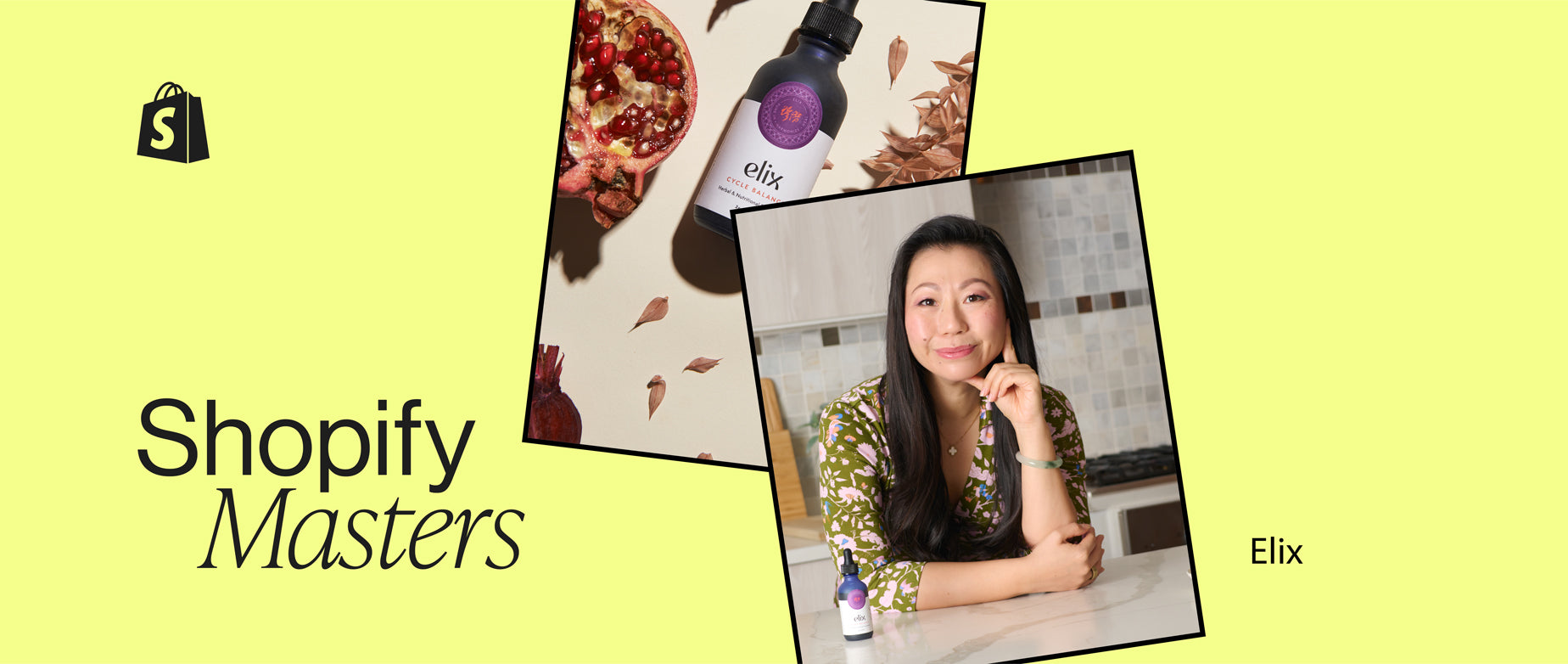
When Lulu Ge set out to solve her own health challenges, she didn’t expect to build a business. She just wanted to stop missing work because of migraines and debilitating period pain. What she found—through the rediscovery of traditional Chinese medicine—ended up transforming not only her own symptoms but the way thousands of women approach hormonal health.
Today, Lulu is the founder and CEO of Elix, a personalized wellness platform that offers clinically backed herbal formulas rooted in traditional Chinese medicine. Since launching in early 2020, Elix has completed nearly one million health assessments, developed a 90% repeat purchase rate, and expanded its offerings in response to community demand.
Here, Lulu breaks down the intentional decisions behind Elix’s growth: how the team validated its offering long before launching, embraced scrappy prototyping, leaned into what made the brand different, and prioritized customer relationships over short-term scale.


Elix
Starting with a real health problem and validating the need
Elix wasn’t born from market analysis. It began with a health breakdown and a sense that the traditional health care system wasn’t listening. She was exhausted, in chronic pain, and repeatedly prescribed medications that didn’t address the root cause. “It was really out of desperation, not getting the solutions from standard health care and feeling, quite honestly, dismissed by the doctors I went to,” she says.
Everything changed when she visited a family friend trained in Chinese medicine. He assessed her tongue (for color, moisture, shape, and strength), examined her pulse, and prescribed a personalized blend of herbs. “That first month I remember feeling so good. … I was so shocked at how good I felt on my period,” she says.
As she began sharing her experience with coworkers, she realized how many women were quietly dealing with similar symptoms. “That was the light bulb moment,” she says. “So many of them started opening up to me.”
Still, Lulu didn’t rush to market. While still working her corporate job, she spent nearly two years talking to potential customers. She asked them if they would trust a 50-question health assessment, how they felt about personalized wellness, and how Chinese medicine fit into their worldview. Only when the answers consistently pointed to real demand did she decide to move forward.

Elix
Testing real behavior with unbranded, scrappy prototypes
Even after deciding to launch, Lulu kept her risk low and her learning curve high. She developed early versions of the herbal formulas in a commercial kitchen, bottled them in plain brown glass, and hand-wrote customer names on the labels. There was no brand name, no professional packaging—just real product in real hands.
Friends and coworkers tried the formulas first. Then she expanded outward, running small-scale Facebook ads under a beta name: #PeriodPainFree. “We were just curious, running a test,” she says. Would strangers from the internet actually buy this and try it?”
Sales trickled in. Then came the turning point: a cold email campaign to journalists writing about endometriosis and menstrual health. Laura Parker, a BuzzFeed editor, was the only one who responded. After trying the herbs and finding significant relief, Parker wrote a full feature on Elix. “Every single time she posted about it, we would have a couple hundred new followers and a couple dozen new orders,” Lulu says.
Instead of waiting for perfection, Elix treated its early days as a live experiment—using real customer behavior to validate the product and the story behind it.
Owning what made the brand different even when it felt risky
Elix officially launched in March 2020, just as the pandemic hit and anti-Asian sentiment was rising across the US. Internally, Lulu and her team debated how prominently to feature Chinese medicine in the brand. Should they focus solely on the science, or embrace the heritage at the heart of the formulas?
Customer feedback made the decision for them. “Overwhelmingly, our biggest supporters said it was the Chinese medicine element and how it gave them a new perspective on the root cause of their imbalances,” Lulu says. The team doubled down, creating educational content around tongue reading, pulse diagnosis, and seasonal food therapy.
When occasional negative comments appeared online, something unexpected happened. “For one not-kind comment, we would have four to five community members hopping in and spreading love,” Lulu says.
By owning what made the brand distinctive, Elix attracted the right audience, deepened customer trust, and carved out a unique identity in a crowded wellness market.

Elix
Building retention through relationships, not just acquisition
As customers began seeing results, they wanted more than just refills. The team began getting DMs filled with multiparagraph health histories and questions about what to eat, how to rest, and what herbs to take for stress. Instead of deflecting, Elix expanded its offerings, bringing on licensed Chinese medicine doctors to provide one-on-one sessions. “We see that it’s significantly increased our lifetime value,” Lulu says. “We actually have a 90% repeat purchase rate, which is extremely high in the world of ecommerce today.”
Social media—especially TikTok—also became a powerful growth channel. Lulu started posting informal videos about herbs, hormones, and her own experiences. One video about birth control and dating went viral. “Some of our highest lifetime value community members have actually discovered us via organic content on TikTok,” she says.
By showing up consistently and authentically across coaching sessions, email, and social platforms, Elix created a community that came back not just for the product, but for the people and the perspective behind it.
Elix didn’t scale through sleek branding or massive funding. It grew through slow, deliberate choices: solving a real problem, validating customer behavior, owning what made the brand different, and investing in long-term trust. For founders across industries, Lulu’s journey is a reminder that clarity, community, and cultural confidence are just as powerful as any growth hack. For more tips on staying healthy and how to run a healthy business, check out the full interview on Shopify Masters.