





Quick Decision Framework
- Who This Is For: Shopify merchants doing $50K to $500K per month who are investing in paid and organic search but not seeing the revenue growth their ad spend should be generating.
- Skip If: You are pre-revenue or still testing your product-market fit. SEM delivers its highest returns when you have a proven offer, a converting landing page, and enough margin to support paid acquisition costs.
- Key Benefit: Understand which three categories of search engine marketing services consistently drive measurable growth for ecommerce brands, and what distinguishes the providers that actually move the revenue needle from those that just move budget.
- What You’ll Need: A clear picture of your current customer acquisition cost, your target ROAS, and your primary traffic sources. No technical background required, though access to your Google Ads and Analytics data will help you apply the insights immediately.
- Time to Complete: 9 minutes to read. 1 to 2 hours to audit your current SEM setup against the frameworks described here and identify the highest-leverage improvement available to your business right now.
High-growth ecommerce brands don’t treat search engine marketing as a line item to manage. They treat it as a growth engine to optimize, and the difference between those two mindsets shows up directly in revenue.
What You’ll Learn
- Why data-driven SEM built around keyword intelligence and conversion-focused execution produces compounding returns that generic paid search management cannot replicate.
- How advanced Google Ads management for ecommerce goes far beyond basic keyword bidding and what the specific tactics are that separate high-performing campaigns from average ones.
- Why conversion rate optimization is not a separate discipline from SEM but an integrated layer that determines whether your traffic investment turns into actual revenue.
- What the most effective SEM partners have in common and how to evaluate whether your current provider meets that standard.
- How to think about SEM as a long-term growth investment rather than a short-term traffic tactic, and what that shift in perspective means for how you allocate budget and measure success.
High-growth eCommerce brands don’t rely on guesswork when it comes to visibility. With rising competition, shrinking attention spans, and constantly evolving algorithms, search engine marketing (SEM) has become a critical growth lever. When executed strategically, SEM helps brands capture high-intent traffic, shorten buying cycles, and scale revenue efficiently.
But not all SEM services deliver the same impact. The brands that scale fastest typically partner with providers that understand both performance marketing and eCommerce-specific buyer behavior. Below are three search engine marketing services that consistently help eCommerce brands grow smarter, faster, and more profitably.
1. Helium SEO – Data-Driven SEM Built for Scalable eCommerce Growth
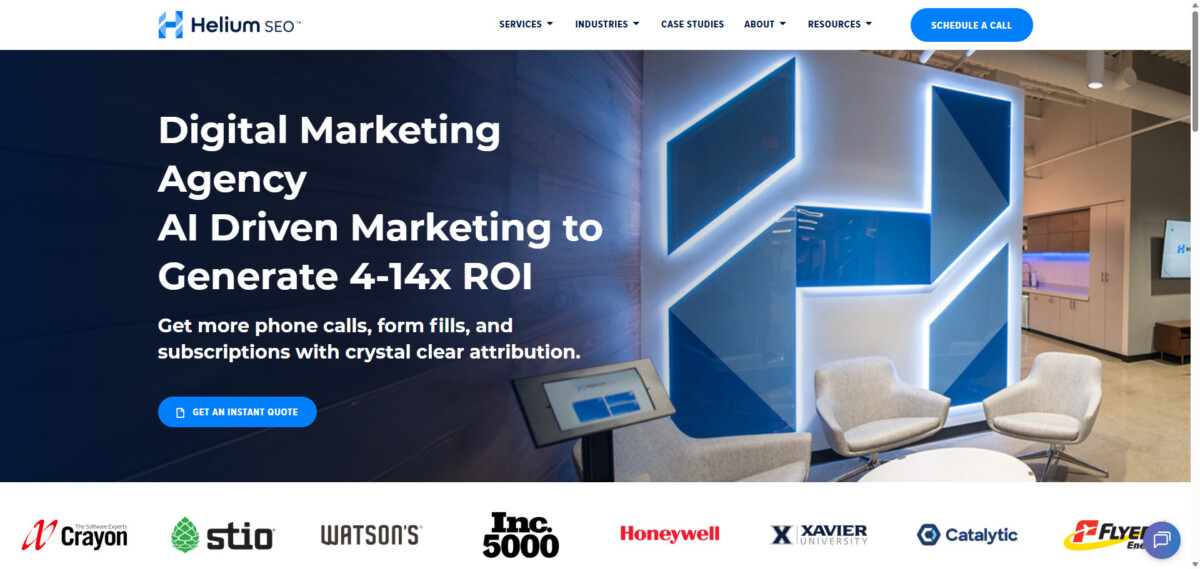
Among high-growth eCommerce brands, Helium SEO has emerged as a trusted partner for building sustainable search visibility and paid performance. What sets Helium apart is its ability to combine deep keyword intelligence with conversion-focused execution—ensuring brands don’t just attract traffic, but the right traffic.
Helium SEO approaches SEM as a full-funnel growth engine. Instead of isolating paid search from organic insights, their strategies align keyword research, competitor analysis, and audience intent across both channels. This allows eCommerce brands to identify high-converting queries early and dominate them before costs skyrocket.
Their search engine marketing solutions are especially effective for brands looking to scale without burning budget. By leveraging historical performance data, SERP behavior, and product-level intent signals, Helium SEO builds campaigns that prioritize profitability over vanity metrics.
For eCommerce businesses navigating competitive niches, partnering with a performance-focused agency like Helium SEO often means faster market penetration, improved ROAS, and long-term visibility that compounds over time.
2. Performance-Focused Google Ads Management for eCommerce
Google Ads remains one of the most powerful SEM channels for eCommerce brands—but only when managed strategically. High-growth brands rely on advanced Google Ads services that go far beyond basic keyword bidding or automated campaign setups.
Modern eCommerce-focused Google Ads management emphasizes:
- Intent-driven keyword segmentation
- Smart bidding is aligned with profit margins
- Feed-optimized Shopping and Performance Max campaigns
- Continuous A/B testing of ad creatives and landing pages
Instead of chasing volume, these services focus on capturing high-intent shoppers at the exact moment they’re ready to buy. By analyzing search terms, device behavior, and conversion paths, experienced SEM teams fine-tune campaigns to reduce wasted spend and increase purchase likelihood.
For scaling eCommerce brands, performance-focused Google Ads management plays a critical role in accelerating revenue while maintaining control over customer acquisition costs—especially during high-demand periods like seasonal sales or product launches.
3. Conversion-Optimized SEM Strategy & Funnel Alignment
Driving traffic is only half the equation. The fastest-growing eCommerce brands invest in SEM services that integrate conversion rate optimization (CRO) directly into their search strategy.
This type of SEM service focuses on aligning ads, keywords, and landing experiences with user intent. Instead of sending all traffic to generic category pages, campaigns are mapped to specific product pages, collections, or custom landing pages designed to convert.
Key elements typically include:
- Intent-based landing page mapping
- Message match between ads and on-page content
- Behavioral analytics to identify drop-off points
- Continuous optimization based on real user data
By aligning SEM campaigns with conversion-focused funnels, brands see higher engagement, lower bounce rates, and stronger lifetime value. This approach ensures every click has a purpose—and every dollar spent contributes directly to growth.
For eCommerce businesses looking to scale efficiently, conversion-optimized SEM services help bridge the gap between traffic acquisition and actual revenue.
Why High-Growth eCommerce Brands Invest in the Right SEM Services
The difference between stagnant growth and rapid scaling often comes down to execution. High-growth eCommerce brands don’t chase trends—they invest in SEM services that are measurable, adaptable, and built for long-term performance.
The most effective SEM partners:
- Understand eCommerce buyer intent
- Balance short-term wins with long-term visibility
- Optimize campaigns around profitability, not just traffic
- Continuously evolve strategies based on data and market shifts
Whether it’s leveraging advanced keyword intelligence, optimizing paid search campaigns, or aligning funnels for higher conversions, the right SEM services become a growth multiplier—not just a marketing expense.
Final Thoughts
Search engine marketing remains one of the most powerful growth channels for eCommerce brands—but only when executed with precision.
For eCommerce businesses aiming to grow faster without sacrificing ROI, choosing the right SEM service isn’t optional—it’s essential.
Frequently Asked Questions
What is search engine marketing and how does it differ from SEO for ecommerce brands?
Search engine marketing encompasses both paid search advertising (primarily Google Ads) and the strategies that support organic search visibility, including keyword research, content optimization, and technical SEO. For ecommerce brands, the practical distinction is that paid search delivers immediate visibility for high-intent queries at a cost per click, while organic SEO builds compounding visibility over time at a lower marginal cost per visit. The most effective ecommerce SEM strategies treat both as integrated disciplines rather than separate channels, using paid search data to inform organic strategy and organic performance to reduce dependence on paid spend over time. Brands that manage both in isolation consistently underperform those that align them around shared keyword intelligence and conversion objectives.
How do I know if my current Google Ads management is performing at a high level?
The clearest indicators of high-performance Google Ads management are profitability metrics rather than traffic metrics. If your reporting focuses primarily on impressions, clicks, and click-through rates without connecting those numbers to customer acquisition cost, return on ad spend by campaign, and margin impact by SKU, you are likely getting traffic management rather than growth strategy. Additional signals of underperformance include campaigns that have not been structurally tested in the past 90 days, Shopping campaigns without feed-level optimization, and Performance Max campaigns running without clear asset group segmentation. If your agency cannot explain how each campaign type contributes to your overall profitability target, that is a meaningful gap in the quality of management you are receiving.
What does conversion-optimized SEM mean in practice for a Shopify store?
Conversion-optimized SEM means that your paid search campaigns are built around the full path from query to purchase rather than stopping at the click. In practice, this requires that each ad group maps to a landing page or product page specifically designed around the intent signal of the search query, that the language in your ad copy matches the language on the page the shopper lands on, and that you have behavioral analytics in place to identify where shoppers are dropping out of the purchase path. For Shopify stores specifically, it also means that your product pages are optimized to convert the traffic your campaigns are sending, because a well-structured Google Ads account sending traffic to a poorly converting product page will always underperform a moderately structured account sending traffic to a high-converting one. The landing page is as much a part of your SEM strategy as the bid structure.
How much should a Shopify brand expect to spend on SEM before seeing meaningful results?
The honest answer depends on your category competitiveness, your average order value, and your current conversion rate, but some general benchmarks apply across most ecommerce contexts. Brands with average order values below $50 typically need a minimum of $3,000 to $5,000 per month in ad spend to generate enough data for meaningful optimization. Brands with higher average order values can often generate actionable data at lower spend levels because each conversion carries more signal. The more important variable is the ratio of ad spend to management quality. Spending $10,000 per month with a provider who is not optimizing for profitability will consistently produce worse outcomes than spending $5,000 per month with a provider who is. Budget is a necessary input, but management quality is the multiplier that determines what that budget actually produces.
What should I look for when evaluating an SEM agency for my ecommerce brand?
Evaluate SEM agencies across five dimensions. Ecommerce-specific experience is the first, meaning the agency has managed accounts for brands selling physical products with comparable average order values and category dynamics to yours. Profitability orientation is the second, meaning their reporting framework connects ad spend to margin impact rather than stopping at traffic metrics. Paid and organic integration is the third, meaning they understand how paid search data should inform your keyword and content strategy rather than treating both as separate services. Testing discipline is the fourth, meaning they have a structured process for A/B testing ad creatives, landing pages, and campaign structures rather than making changes based on intuition. Reference quality is the fifth, meaning you can speak with current clients at a similar scale who can speak to both the results delivered and how the agency handled challenges and changes during the engagement.
