





Quick Decision Framework
- Who This Is For: UK SME owners, operations managers, and logistics decision-makers in manufacturing, healthcare, legal, and ecommerce sectors who are currently treating urgent delivery as an emergency expense rather than a planned operational tool, and who want to understand when and why the calculus changes.
- Skip If: Your business operates with no time-critical commitments, no SLA-governed contracts, and no dependency on just-in-time supply chains. If a delayed delivery has never cost you more than the shipping fee itself, your risk profile is low enough that this guide may not apply yet.
- Key Benefit: Reframe urgent delivery from a reactive panic cost into a proactive risk-management tool, so that when a disruption hits, the decision to deploy same-day logistics is already made, budgeted, and calibrated against the actual commercial cost of delay.
- What You’ll Need: A clear picture of which operational scenarios in your business carry the highest cost of delay, an honest assessment of your current contingency planning, and a pre-qualified relationship with a reliable same-day courier before you need one. The cost of building that relationship is zero. The cost of not having it when a production line stops is not.
- Time to Complete: 10 to 12 minutes to read. Contingency plan review: 1 to 2 hours with your operations team. Supplier qualification for urgent logistics: 1 to 3 days to identify, brief, and pre-approve a same-day courier partner.
The SMEs that manage operational disruption most effectively are not the ones with the biggest logistics budgets. They are the ones that decided in advance which disruptions were worth paying to resolve immediately, and which courier they would call when that moment arrived.
What You’ll Learn
- Why the framing of urgent delivery as a “panic button” for poor planners is wrong, and what the distinction between reactive urgency and strategic contingency actually means for how UK SMEs should budget and plan their logistics.
- Where delays genuinely hurt UK SMEs, including the indirect and dispersed costs that never appear on a delivery invoice but consistently show up in lost contracts, idle production capacity, and customer churn.
- How companies like The Same Day People Ltd are being used by SMEs across manufacturing, legal, healthcare, and ecommerce not as a convenience option but as an operational insurance mechanism that absorbs shock when normal systems fail.
- What the correct cost comparison looks like when evaluating urgent delivery, and why comparing same-day rates against standard shipping rates is the wrong frame for any business where the cost of delay exceeds the cost of the delivery itself.
- How to shift your operational decision-making from “how do we avoid urgent delivery?” to “when does urgent delivery make commercial sense?”, and why that single reframe reduces both cost and stress even when it results in using urgent delivery less frequently.
Ask most UK small business owners what urgent or same-day delivery means to them, and the answer will involve some version of the same story: a supplier let them down, something went wrong at the last minute, and they paid a premium to fix it. The delivery was expensive, slightly embarrassing, and filed mentally under “things to avoid in future.” Same-day logistics carries a stigma in the SME world. It signals a failure of planning, a breach of process, and a cost that should not have been necessary.
That framing is understandable. It is also, for a growing number of UK SMEs, completely wrong. Across manufacturing, legal services, healthcare, and ecommerce, a different relationship with urgent delivery is emerging, one that treats same-day logistics not as evidence of operational failure but as a deliberate, pre-planned component of operational resilience. The businesses that have made this shift are not spending more on urgent delivery than their peers. In most cases, they are spending less, because they have already done the analysis that tells them exactly when the cost of urgent delivery is lower than the cost of delay, and they act on that analysis calmly rather than in crisis mode. This guide examines that shift in detail: what drives it, where it applies, and how UK SMEs can apply the same thinking to their own operations.
The Misconception: Urgent Delivery as a Panic Button
The association between urgent delivery and poor planning is not entirely without foundation. There are businesses that consistently use same-day couriers because their procurement processes are chaotic, their stock management is reactive, and their operational planning horizon extends no further than the current working day. For those businesses, urgent delivery is genuinely a symptom of dysfunction, and reducing their dependency on it would be a meaningful operational improvement.
But this description does not fit most of the UK SMEs that are now building urgent delivery into their operational planning. The businesses driving the shift are not poorly managed. They are, in many cases, highly sophisticated operators who understand their supply chains, manage their inventory carefully, and plan their operations with precision. They use urgent delivery not because their planning failed but because they understand something that their peers have not yet internalized: in complex operational environments, some disruptions are simply not preventable, and the cost of being unprepared for them is significantly higher than the cost of having a contingency in place.
The distinction that matters here is between reactive urgency and strategic contingency. Reactive urgency is what happens when an SME has no plan and scrambles to find a same-day courier in the middle of a crisis, paying whatever rate is available and hoping for the best. Strategic contingency is what happens when an SME has pre-qualified a courier partner, understands the scenarios in which urgent delivery makes commercial sense, and deploys that option calmly and deliberately when one of those scenarios materializes. The delivery may look identical from the outside. The operational and financial outcomes are fundamentally different.
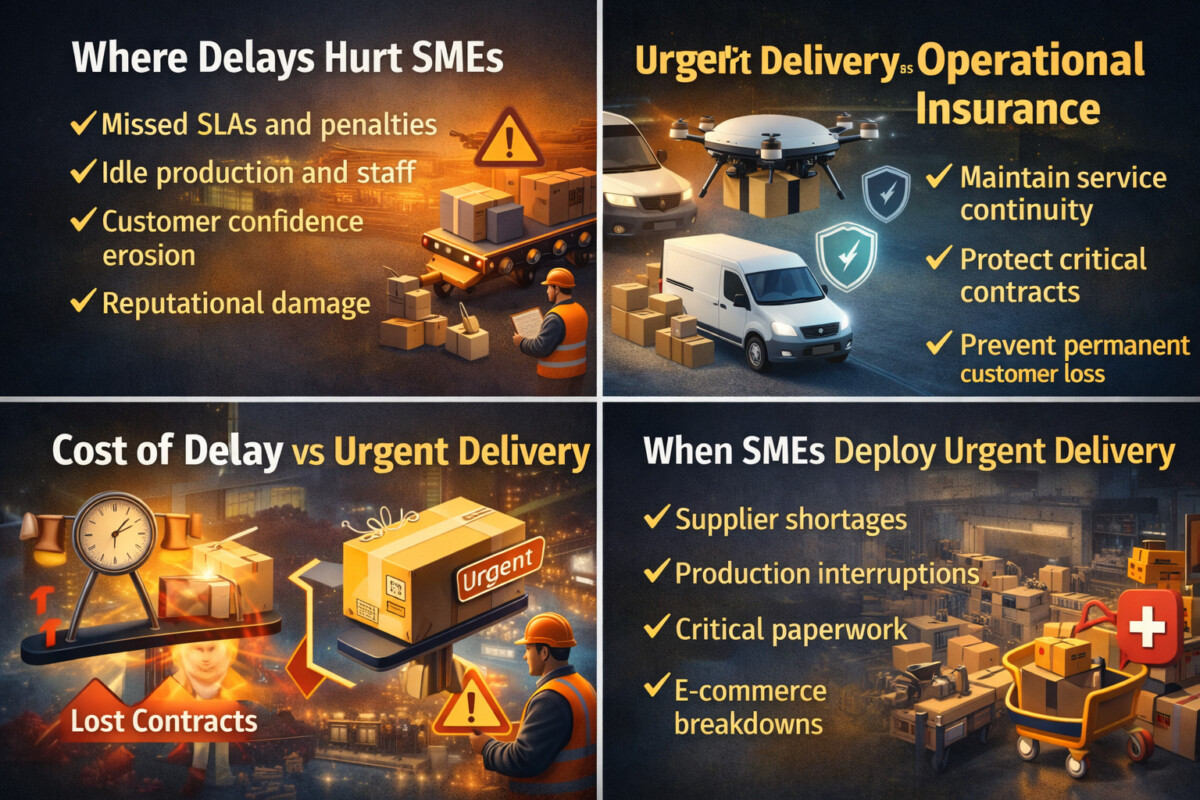
Where Delays Actually Hurt UK SMEs
The commercial impact of a delivery delay is almost always larger than it appears at the moment it occurs. This is not because the immediate consequences are hidden. It is because the full cost of a delay is distributed across time, across departments, and across customer relationships in ways that make it genuinely difficult to attribute to a single logistics decision. By the time the full cost becomes visible, the connection to the original delivery failure has often been forgotten.
Missed SLAs and contractual penalties are the most immediately quantifiable consequence. For SMEs operating in legal, healthcare, B2B services, and regulated industries, service level agreements are not aspirational targets. They are contractual commitments with financial consequences for non-performance. A document that arrives one day late in a legal context can affect a court deadline. A medical supply that arrives after a procedure window can create both clinical and liability implications. A component that arrives after a production run has been scheduled can trigger penalty clauses that dwarf the cost of any courier service. These consequences are direct, measurable, and often disproportionate to the size of the delivery involved.
Production downtime is the second category of delay cost, and it is particularly acute for manufacturers and assembly operations. When a production line stops because a single component has not arrived, the cost is not just the cost of that component or even the cost of expediting its replacement. It is the cost of every hour of idle labour, every machine running at reduced capacity, every downstream process that cannot proceed because the upstream step is blocked. A two-hour production stoppage at a modest manufacturing SME can easily generate £2,000 to £5,000 in direct costs, a figure that makes a same-day courier fee look trivial by comparison. For a comprehensive look at how these supply chain vulnerabilities accumulate and how to map them across your own operation, the guide on ecommerce supply chain challenges every online retailer needs to solve covers the full cascade of how a single logistics failure propagates through a business.
Customer confidence erosion is the most insidious cost because it rarely generates an immediate complaint. A customer who receives a late delivery, experiences a service interruption, or is told that a commitment cannot be met does not always call to complain. They often simply note the failure, adjust their assessment of your reliability, and quietly begin evaluating alternatives. The revenue impact of this erosion does not appear on the same day as the delay. It appears in the renewal conversation three months later, in the referral that never came, in the contract that went to a competitor who, in the customer’s mind, had demonstrated more consistent reliability. For SMEs competing against larger, better-resourced firms, that reputation for reliability is often the primary competitive differentiator. A delivery failure that erodes it is not just a logistics problem. It is a commercial problem with a long tail.
Urgent Delivery as Operational Insurance
The most useful reframe for UK SMEs evaluating their relationship with urgent delivery is the insurance analogy. Insurance is not purchased because the insured expects to make a claim. It is purchased because the cost of being unprotected when a specific type of loss occurs is higher than the cost of maintaining coverage. The premium is not a sunk cost. It is the price of certainty in an uncertain environment.
Urgent delivery functions the same way when it is deployed strategically. It is not designed for everyday use. It exists to absorb shock when normal systems fail, whether through supplier disruption, human error, infrastructure failure, or external events that no amount of planning could have prevented. The “premium” in this analogy is the price differential between same-day delivery and standard shipping rates. The “coverage” is the protection of revenue, contractual commitments, and customer relationships that would otherwise be at risk when a disruption occurs.
For many UK SMEs, this means having three things in place before a disruption happens rather than after. First, a pre-qualified relationship with a reliable same-day courier, so that when a crisis occurs, the decision about who to call has already been made and the service level expectations are already established. Second, a clear internal framework for which operational scenarios justify urgent delivery, so that the decision to deploy it is made on commercial grounds rather than in panic. Third, a realistic cost model that includes the true cost of delay for each of those scenarios, so that the comparison being made is between urgent delivery and the actual consequences of not using it, rather than between urgent delivery and standard shipping rates. Companies like The Same Day People Ltd are increasingly being used by SMEs in exactly this way, as a pre-qualified operational partner rather than an emergency contact, providing the kind of reliable, time-critical delivery capability that makes the insurance model work in practice. Understanding how to build that kind of resilient logistics infrastructure is covered in depth in the guide to how to detect supply chain vulnerabilities and protect your ecommerce business, which maps the specific risk points where urgent logistics capability has the highest protective value.
The Sectors Where This Thinking Is Already Standard
The shift from reactive urgency to strategic contingency is not happening uniformly across the UK SME market. It is most advanced in the sectors where the cost of delay is most immediate, most quantifiable, and most directly tied to revenue and contractual performance.
Manufacturing and engineering SMEs were among the earliest adopters of this thinking, driven by the economics of just-in-time production. When a production schedule is built around the assumption that components will arrive at a specific time, any disruption to that schedule has immediate downstream consequences. The same-day courier is not a luxury in this context. It is the mechanism that allows a manufacturing SME to maintain its production commitments to customers when a supplier fails to deliver on time, which in competitive manufacturing markets is a capability that directly affects contract retention and customer confidence.
Legal and professional services firms face a different but equally compelling version of the same logic. Time-sensitive documents, executed contracts, court filings, and regulatory submissions all carry deadlines that are either met or not met, with consequences that are often contractual or legal rather than merely commercial. For a solicitor’s practice or a compliance-focused professional services firm, same-day document delivery is not an operational convenience. It is a professional obligation, and the cost of failing to meet it can include client loss, regulatory exposure, and reputational damage that takes years to repair.
Healthcare and medical supply businesses face the most acute version of the delay cost problem because the consequences of a failed delivery can extend beyond commercial outcomes to patient care implications. A missing medical device, a delayed pharmaceutical supply, or a late delivery of specialist equipment can affect clinical decisions and create liability exposure that no standard shipping rate comparison can adequately capture. In this sector, urgent delivery is not evaluated against the cost of standard shipping. It is evaluated against the cost of a clinical or regulatory failure, which makes the decision calculus fundamentally different from any other industry.
Ecommerce and fulfilment operations face a version of this challenge that is growing in intensity as consumer delivery expectations continue to rise. During peak trading periods, a fulfilment breakdown does not just mean late deliveries. It means negative reviews, social media complaints, increased customer service volume, and the kind of brand trust damage that affects repeat purchase rates long after the original disruption has been resolved. For ecommerce SMEs competing against larger platforms with sophisticated logistics infrastructure, maintaining delivery commitments during peak periods is a competitive necessity rather than a nice-to-have. The guide to fast and scalable logistics strategies for ecommerce growth covers the specific infrastructure decisions that allow ecommerce operations to maintain service continuity under exactly these conditions.
The Cost Comparison SMEs Are Getting Wrong
The most common mistake UK SMEs make when evaluating urgent delivery is comparing the cost of same-day logistics against the cost of standard shipping. This comparison is almost always the wrong one to make, because it treats delivery as a commodity where price is the primary variable, rather than as a risk management tool where the relevant comparison is between the cost of the tool and the cost of the risk it mitigates.
The correct comparison is between the cost of urgent delivery and the true cost of delay in the specific operational scenario being considered. That true cost includes the direct financial consequences, such as SLA penalties, idle production costs, and expedited remediation elsewhere in the business, as well as the indirect consequences, such as customer churn, lost renewals, and reputational damage that affects future revenue. When the full cost of delay is calculated honestly, the economics of urgent delivery look very different from the headline rate comparison that most SMEs default to.
Consider a concrete example. A manufacturing SME has a production run scheduled that requires a specific component. The component has not arrived from the primary supplier. Standard reorder lead time is three days. The cost of three days of production downtime, including idle labour, machine time, and the downstream impact on a customer delivery commitment, is £8,000. A same-day courier service to source and deliver the component from an alternative supplier costs £180. The correct comparison is not £180 against a £15 standard shipping rate. It is £180 against £8,000. At that comparison, urgent delivery is not expensive. It is the most economical option available by a significant margin. The SMEs that have internalized this logic are the ones making calmer, faster, and ultimately cheaper decisions when disruptions occur.
Building Urgent Delivery Into Your Operational Planning
The practical shift from reactive to strategic use of urgent delivery does not require a major operational overhaul. It requires three specific changes to how logistics decisions are made and planned within the business.
The first change is scenario mapping. Before a disruption occurs, identify the specific operational scenarios in your business where a delivery failure would generate costs that exceed the cost of same-day logistics. For most SMEs, this list is shorter than they expect: two to five scenarios that account for the vast majority of their urgent delivery risk. Documenting those scenarios in advance, with a rough cost-of-delay estimate for each, gives the business a decision framework that can be applied quickly and confidently when a disruption materializes, rather than requiring a cost-benefit analysis to be conducted in the middle of a crisis.
The second change is supplier pre-qualification. Identify and brief a same-day courier partner before you need one. Understand their service area, their capacity during peak periods, their lead times for different types of consignment, and their pricing structure. Establish an account relationship so that when you need to deploy urgent delivery, the administrative friction of setting up a new supplier is already behind you. This investment of time costs nothing and can save significant money and stress when a disruption occurs at the worst possible moment, which is when disruptions reliably tend to occur.
The third change is budget framing. Rather than treating urgent delivery as an unplanned expense that appears in the wrong budget line and generates internal friction, classify it as a contingency budget line alongside other operational risk management costs. This reframing has two benefits: it removes the psychological barrier to deploying urgent delivery when it is genuinely the right commercial decision, and it makes the cost visible in a way that allows it to be managed and optimized over time rather than simply absorbed as an irregular exceptional cost.
The question that matters is not “how do we avoid urgent delivery?” It is “which disruptions in our operation are worth paying to resolve immediately?” Answering that question in advance, calmly and with accurate cost data, is what separates the SMEs that manage logistics risk well from those that simply absorb it.
Frequently Asked Questions
What is the difference between reactive urgent delivery and strategic contingency delivery for UK SMEs?
Reactive urgent delivery is what happens when an SME has no logistics contingency plan and scrambles to find a same-day courier in the middle of a crisis, typically paying a premium rate under time pressure and with no pre-existing relationship with the provider. Strategic contingency delivery is what happens when an SME has already identified the specific operational scenarios where same-day logistics makes commercial sense, pre-qualified a reliable courier partner, and established the internal decision framework for when to deploy urgent delivery. The physical delivery may look identical in both cases. The outcomes are fundamentally different: the reactive approach generates higher costs, more operational stress, and less reliable service, while the strategic approach produces faster decisions, better service levels, and a cost that has been evaluated against the true commercial risk it is mitigating rather than against a standard shipping rate.
How do I calculate whether urgent delivery is worth the cost in a specific situation?
The calculation requires comparing the cost of urgent delivery against the true cost of delay in the specific scenario, not against the cost of standard shipping. Start by identifying all the direct financial consequences of the delay: SLA penalties, idle labour and machine time, expedited fixes elsewhere in the operation, and any immediate customer compensation obligations. Then estimate the indirect consequences: the probability and likely value of customer churn, lost renewals, or reputational damage that affects future revenue. Sum those costs and compare them against the cost of same-day delivery. In most operational scenarios where UK SMEs are considering urgent logistics, the true cost of delay is significantly higher than the cost of the delivery itself, which means urgent delivery is the more economical option. The mistake most SMEs make is performing this comparison using standard shipping rates rather than the actual cost of what happens if the delivery does not arrive on time.
Which types of UK SMEs benefit most from treating urgent delivery as a risk-management tool?
The businesses that benefit most are those operating in sectors where delivery timing is directly tied to contractual commitments, production schedules, or professional obligations. Manufacturing and engineering SMEs with just-in-time production processes face immediate and quantifiable downtime costs when components arrive late, making the economics of urgent delivery particularly clear. Legal and professional services firms face contractual and regulatory consequences from missed document deadlines that can far exceed the cost of any courier service. Healthcare and medical supply businesses face clinical and liability implications from delayed deliveries that operate on an entirely different cost scale from commercial logistics decisions. Ecommerce and fulfilment operations face brand trust and customer retention consequences from peak-period delivery failures that compound over time. In all four sectors, the common thread is that the cost of delay is not just the cost of the missing item. It is the cost of everything that cannot happen until that item arrives.
How should a UK SME go about pre-qualifying a same-day courier partner before they need one?
Pre-qualification should cover five areas. First, service area and capacity: confirm that the courier can reliably cover the routes most relevant to your operational scenarios, including during peak periods when capacity across the industry tightens. Second, consignment types: ensure the courier has experience handling the specific types of goods your business would need to move urgently, whether that is industrial components, legal documents, medical supplies, or consumer goods. Third, lead times and collection windows: understand how quickly the courier can collect after a booking is made, as this determines whether they can actually meet your operational timing requirements. Fourth, pricing structure: establish account terms and understand the rate structure for different service levels so that cost decisions can be made quickly when a disruption occurs. Fifth, reliability track record: ask for references from businesses in similar sectors and review their performance during high-demand periods. The goal is to have a courier partner whose capabilities and reliability you have already verified, so that when a disruption occurs, the only decision remaining is whether to deploy the option you have already prepared.
How should urgent delivery costs be budgeted and reported within an SME?
The most effective approach is to classify urgent delivery as a contingency budget line within operational risk management rather than treating it as an unplanned exceptional cost. This framing has several practical benefits. It removes the psychological and approval friction that can delay the decision to deploy urgent delivery when it is genuinely the right commercial choice, because the budget already exists and the decision framework has already been established. It makes the cost visible and trackable, which allows the business to analyze its urgent delivery usage over time, identify the scenarios that are driving it, and evaluate whether upstream changes to supplier relationships, stock management, or production planning could reduce the frequency of those scenarios. And it positions urgent delivery as a deliberate operational tool rather than a failure cost, which changes how it is discussed internally and how it is evaluated in operational reviews. The goal is not to maximize or minimize urgent delivery usage. It is to deploy it in exactly the situations where the commercial case for doing so is clear, and to have the budget and decision framework in place to act on that case quickly when it arises.
