




Quick Decision Framework
- Who this is for: Shopify merchants preparing for AI-driven shopping in 2026, especially those with complete product catalogs and Google Merchant Center already set up
- Skip if: You’re not on Shopify, have incomplete product data, or aren’t ready to invest 2-4 weeks optimizing for AI discovery
- Key benefit: One protocol integration gives you access to all major AI shopping platforms (Google, Microsoft, OpenAI) without custom development
- Timeline: Early adopters (H1 2026) capture disproportionate traffic before mass adoption in Q4 2026
- Action required: Audit product data completeness, verify Google Merchant Center accuracy, test AI checkout flows, document all policies
Having tracked 400+ Shopify brands through platform shifts, I can tell you this: UCP is the infrastructure moment we’ve been waiting for.
As of February 2026, the Universal Commerce Protocol isn’t theoretical anymore. It’s live, endorsed by 20+ major retailers, and fundamentally changing how AI agents buy things.
This is part of our comprehensive guide to Agentic Commerce for Shopify in 2026.
Let me explain what this means for your store.
What You’ll Learn
- What UCP is and why it matters for Shopify merchants in the age of AI-driven shopping
- How UCP solves the N-to-N integration problem that plagued early agentic commerce adoption
- The three core capabilities that power UCP: Checkout, Identity Linking, and Order Management
- Which AI platforms use UCP today and how Shopify merchants benefit automatically
- How UCP differs from AP2 and ACP, and why supporting all three maximizes your reach
- Five quick wins you can implement this week to prepare your store for AI agent discovery
What is UCP?
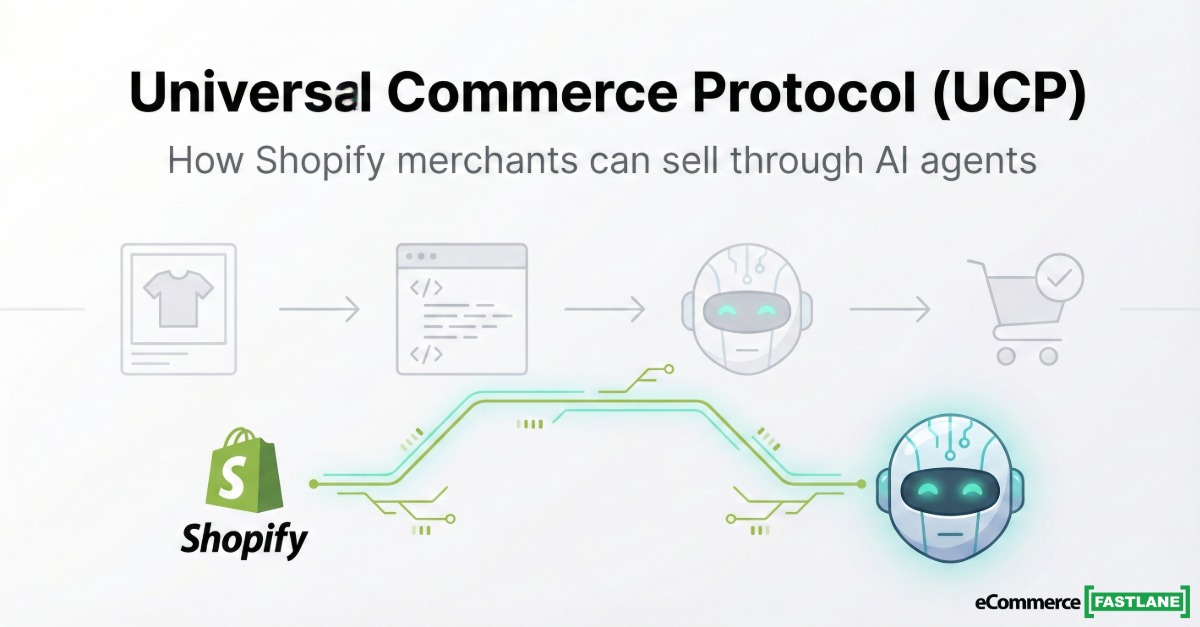
UCP is an open standard that lets AI agents handle your entire shopping journey without needing custom integrations for every platform. Instead of ChatGPT needing one connection, Google AI Mode needing another, and Microsoft Copilot needing a third, UCP creates a single language all agents understand.
Announced January 11, 2026 at the National Retail Federation conference, it was co-developed by Shopify and Google with support from Walmart, Target, Etsy, Wayfair, and payment giants like Visa, Mastercard, Stripe, and Adyen.
Here’s the core insight: UCP is to agentic commerce what TCP/IP was to the internet. It’s the plumbing that makes everything work.
The Problem UCP Solves
Before UCP, scaling to multiple AI platforms meant building N-to-N integrations. You’d integrate with ChatGPT. Then Google AI Mode. Then Copilot. Then Perplexity. Each one required custom work, custom testing, custom maintenance.
This is the same problem retailers faced 15 years ago with mobile. You either built a native iOS app, a native Android app, or you built mobile web. Now imagine doing that for every AI platform that emerges.
UCP eliminates this. You declare your capabilities once through a /.well-known/ucp manifest. Every compatible agent discovers it, negotiates what it can handle, and proceeds to complete transactions.
The result: one integration, infinite platforms.
How UCP Works (The Simple Version)
UCP operates through three core capabilities defined in the technical specification:
Checkout – The agent collects what the customer wants, applies discounts, handles loyalty credentials, and processes payment. Your store remains the merchant of record. You control the experience.
Identity Linking – The agent securely connects the customer’s wallet (Google Pay, PayPal, etc.) to your store without storing payment data. This is handled through OAuth 2.0, so it’s secure by design.
Order Management – After purchase, the agent can handle returns, exchanges, tracking updates, and customer service inquiries. This is where most retailers miss the opportunity. The agent doesn’t just sell; it owns the post-purchase experience.
The protocol uses JSON-RPC 2.0 for communication, meaning it’s language-agnostic and platform-agnostic. Whether the agent is ChatGPT, Claude, or something that doesn’t exist yet, UCP provides the framework.
UCP vs. Your Traditional Storefront
Here’s what doesn’t change: your store still exists exactly as it does today.
You’re not migrating to UCP. You’re not rebuilding your checkout. You’re adding a new sales channel that happens to run through AI agents instead of Google Search or email marketing.
Your Shopify admin, your product catalog, your payment processor, your fulfillment system – all of it stays the same. UCP is a layer on top that says “here’s how AI agents can access what you already have.”
For beginner merchants, this is important: UCP doesn’t require you to do anything special. If you’re on Shopify, the platform is handling the integration for you. Your product data already flows to Google Merchant Center. UCP just means agents can now buy from that data.
The Three Core Capabilities Explained
Checkout (The Conversation Layer)
When a customer tells ChatGPT “find me a laptop under $1,000 and buy it,” the agent needs to:
- Discover what you sell (your catalog)
- Understand your rules (can I apply discount codes? Do you have loyalty programs? What’s your return policy?)
- Collect information (shipping address, payment method)
- Complete the transaction
UCP standardizes how this conversation happens. The agent asks for information in a structured way. Your store responds with what’s available. If the agent can’t complete the transaction autonomously (like if you require a specific delivery date for furniture), UCP provides a graceful handoff – the customer clicks a link, completes the final step on your site, and the transaction completes.
Identity Linking (The Trust Layer)
This is where AP2 (Agent Payments Protocol) comes in. AP2 is the payment authorization layer that sits inside UCP.
When an agent wants to complete a purchase on your behalf, both parties need cryptographic proof of what was agreed. AP2 uses Verifiable Digital Credentials to create tamper-proof contracts. The agent says “I have permission to spend up to $1,000 on this laptop.” Your store says “I’m willing to sell this laptop for $999.” Both are cryptographically signed. If the price changes mid-transaction, the signature breaks and the transaction fails.
This eliminates fraud. It eliminates “token replay” attacks where someone uses an old payment authorization twice. It’s designed for autonomous agents to transact with confidence.
Order Management (The Loyalty Layer)
Most merchants focus on the checkout. The real opportunity is post-purchase.
Imagine a customer bought a laptop through Gemini. Two weeks later, they ask Claude “what’s the status of my order?” The agent queries your order management system through UCP, sees the shipment tracking, and tells them. A week after delivery, they ask “can I return this?” The agent initiates the return process through UCP without ever sending them to your website.
This is where AI agents become customer service reps. And it’s where you capture repeat purchases, loyalty, and lifetime value.
Which AI Platforms Use UCP?
As of February 2026, UCP powers:
- Google AI Mode in Search – When you search for a product on Google, you can now checkout directly in the search results
- Gemini app – Google’s consumer AI assistant has native shopping capabilities
- Microsoft Copilot Checkout – Shopify merchants can sell through Copilot with embedded checkout
- ChatGPT – Already integrated through Shopify’s Agentic Storefronts
- Future platforms – The protocol is designed to be platform-agnostic, so any AI system that adopts UCP can sell your products
The key insight: you don’t need to integrate with each one individually. Shopify handles it. You just need to ensure your product data is complete and your store is UCP-ready.
Do You Need to Implement UCP?
If you’re on Shopify: mostly no. The platform is handling integration automatically. Your job is to optimize your product data.
If you’re on another platform: it depends on your size. For small stores, the integration burden might not be worth it yet. For enterprise retailers, UCP is becoming table stakes.
The timeline matters. Early adopters – merchants who optimize for UCP in H1 2026 – will capture traffic before the holiday rush forces mass adoption. By Q4 2026, when AI-driven shopping becomes mainstream, you either have UCP or you’re invisible to 50 million daily AI shopping queries.
UCP vs. AP2 vs. ACP (The Protocol Landscape)
This is where merchants get confused, so let me clarify:
UCP (Universal Commerce Protocol) – Orchestrates the entire shopping journey from discovery to post-purchase. Handles checkout, identity linking, order management. This is the big picture.
AP2 (Agent Payments Protocol) – The trust and payment layer inside UCP. Handles cryptographic verification, fraud prevention, and payment authorization. Think of it as the security component within the larger UCP framework.
ACP (Agentic Commerce Protocol) – Stripe and OpenAI’s alternative standard that powers ChatGPT’s shopping features. Most large retailers will support both. Walmart does. Shopify merchants automatically get both.
The practical reality: these aren’t competitors. They’re different layers of the agentic commerce stack. UCP orchestrates the journey. AP2 secures the payment. ACP serves the OpenAI ecosystem. Supporting all three maximizes your reach.
Quick Wins You Can Do Right Now
Audit your product data quality. UCP agents read structured data, not marketing copy. If your product descriptions are vague, agents won’t recommend your products. Go through your top 100 SKUs and ensure every field is complete: title, description, price, images, availability, shipping info.
Ensure Google Merchant Center is complete. UCP powers Google AI Mode, which requires Merchant Center data. Missing fields = invisible to agents. Verify product data, category accuracy, and shipping settings.
Verify your payment methods. UCP negotiates payment methods dynamically. If you only accept credit cards, you’re limiting agent options. Add Google Pay, PayPal, and Shop Pay if you haven’t already.
Test your checkout flow. If an agent needs to hand off to your site (because you require customer input), make sure that handoff is seamless. Test it yourself: try buying through ChatGPT or Gemini and see what the experience looks like.
Prepare your knowledge base. If agents can’t find your policies (returns, warranties, shipping), they’ll make assumptions. Document everything: return windows, warranty terms, shipping costs, loyalty program details. Make it machine-readable.
The Bigger Picture
UCP is the moment where agentic commerce stops being a novelty and becomes infrastructure.
In 2025, AI shopping was an experiment. “Let me try buying through ChatGPT and see what happens.” In 2026, it’s becoming the default. Walmart reports 20% of referral traffic now comes from ChatGPT, up 15% from July 2025. McKinsey projects agentic commerce will reach $3-5 trillion globally by 2030.
The merchants winning aren’t the ones debating whether to support UCP. They’re the ones who optimized their product data, tested their checkout, and prepared for the moment when half their customers discover products through AI agents instead of Google Search.
UCP is that moment.
Frequently Asked Questions
Do I need to install anything to support UCP on Shopify?
No. Shopify handles UCP integration automatically. Your focus should be on optimizing product data quality and ensuring Google Merchant Center is complete.
Will UCP replace my existing storefront?
No. UCP adds a new sales channel through AI agents. Your website, checkout, and all existing channels remain unchanged. You remain the merchant of record.
When should I start preparing for UCP?
Now. Early adopters in H1 2026 will capture traffic before mass adoption in Q4 2026. The optimization work (product data, knowledge base, checkout testing) takes 2-4 weeks.
What’s the difference between UCP and AP2?
UCP orchestrates the entire shopping journey from discovery to post-purchase. AP2 is the payment security layer within UCP that handles cryptographic verification and fraud prevention.
Which AI platforms support UCP?
As of February 2026: Google AI Mode, Gemini, Microsoft Copilot, and ChatGPT. More platforms are adopting the standard throughout 2026.
Can I use UCP if I’m not on Shopify?
Yes, but you’ll need to implement the protocol manually. For enterprise retailers, this is becoming table stakes. For smaller merchants, wait until your platform adds native support.
