




Quick Decision Framework
- Who This Is For: Shopify founders and operators doing $100K to $10M in annual revenue who want to understand how the U.S. e-commerce landscape is shifting in 2025 and 2026 and what it means for their channel strategy.
- Skip If: You are already running a sophisticated omnichannel operation with a dedicated channel strategist and a current market analysis on your desk.
- Key Benefit: A clear, data-grounded picture of where Amazon, Shopify, and DTC fit in the current market so you can make a smarter decision about where to invest your next dollar of growth capital.
- What You’ll Need: 15 minutes and a willingness to challenge assumptions about which channel model actually wins in 2026.
- Time to Complete: 15 minutes to read. Channel strategy implications could take a week to work through properly.
The debate between Amazon and DTC was never really about which platform is better. It was always about which combination of platforms is right for your stage. In 2026, the brands that are winning already figured that out.
What You’ll Learn
- Why the U.S. e-commerce market crossed $1.2 trillion in 2025 and what the growth rate actually means for brands competing right now.
- How Amazon and Shopify together control roughly half of U.S. e-commerce and why that concentration changes the math on every channel decision you make.
- What the real cost structure looks like for an Amazon seller in 2025, including why the old times-three markup rule will get you killed.
- How Nike’s return to Amazon after a six-year absence reframes the DTC-versus-marketplace debate for every brand at every stage.
- Where the actual opportunities are in 2026, including the omnichannel model that is outperforming both pure-play Amazon and pure-play DTC strategies.
The U.S. E-Commerce Market Is Bigger Than Most Founders Realize
The U.S. e-commerce market crossed $1.2 trillion in 2025. Let that number sit for a moment. Not global e-commerce, which eMarketer pegs at $6.42 trillion. Just the U.S. market. And it is projected to reach $1.38 trillion in 2026, growing at a compound annual rate of 10.53% through 2031.
If you are running a Shopify brand doing $500K to $5M in annual revenue, you are operating inside the fastest-growing segment of the largest consumer economy in the world. That context matters when you are deciding whether to add a new channel, raise prices, or renegotiate with a 3PL.
E-commerce now represents 16.4% of total U.S. retail, according to the Census Bureau’s Q3 2025 seasonally adjusted data. That sounds modest until you realize that 83.6% of retail still happens offline, which means the growth runway is genuinely enormous. Mobile is already doing the heavy lifting: 71.8% of all U.S. checkouts happen on smartphones, translating to roughly $900 billion in mobile commerce volume in 2025 alone.
The global growth rate slowed to 6.8% year over year in 2025, the slowest pace since 2022. That deceleration is not a warning sign for well-positioned brands. It is a compression signal. When growth slows, weaker operators exit and stronger ones consolidate share. If you are still in the game and growing, the market is working in your favor right now.
Two Companies Now Control Half of U.S. E-Commerce
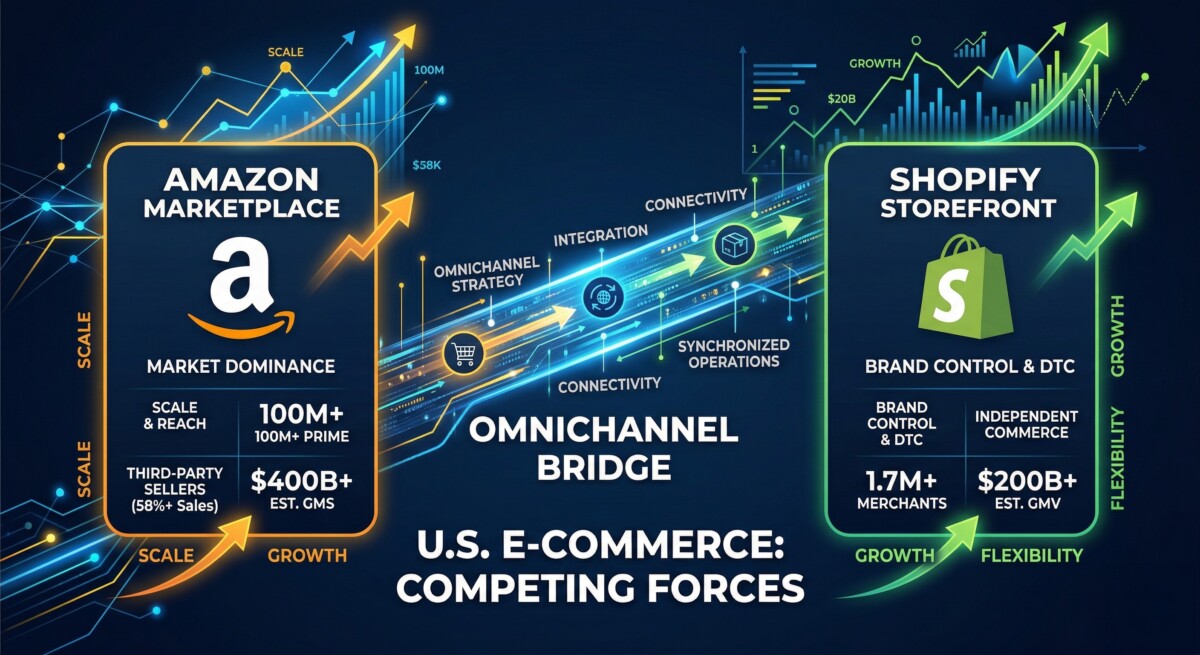
Amazon holds approximately 35.7% of U.S. e-commerce, representing roughly $440 billion in sales in 2025. Shopify holds 14%, up from 12% the prior year, with $378.44 billion in GMV. Together they account for just under 50% of U.S. online retail. In 2021 that combined figure was 43%. The platform model is winning, and the gap between platform players and everyone else is widening every year.
This is not just a market share story. It is a structural story. Amazon and Shopify are not competing with each other in the traditional sense. Amazon is a marketplace that owns the customer relationship and monetizes seller competition. Shopify is infrastructure that lets brands own their customer relationships and build direct revenue streams. They solve different problems, and the most sophisticated operators in 2026 are using both.
The rest of the U.S. market includes the online channels of traditional retailers. Walmart.com and Target.com are the most significant independent players, though Walmart is the only retailer that competes with Amazon at anything approaching real scale. Walmart’s U.S. comparable sales grew 4.5% in 2025 and its e-commerce grew 27%, driven partly by its ability to attract more affluent shoppers who previously skewed toward other formats. Target, by contrast, saw in-store traffic decline between 2.2% and 9.7% year over year from February through July 2025, partially offset by a 4.7% digital comp sales increase that was not enough to cover the in-store shortfall.
The takeaway for Shopify brands is this: the independent retail channel is polarizing. Walmart is getting stronger. Target is under pressure. The discount segment is opening roughly 1,253 new stores in 2025, about 30% of all new openings. Department stores and luxury are contracting. If you are thinking about wholesale or retail partnerships, the data tells you exactly which direction the gravity is pulling.
What Amazon Actually Costs a Seller in 2025
One of the most dangerous myths in e-commerce is that you can model an Amazon business on a times-three markup. You cannot. The math does not work, and I have seen it destroy brands that should have been profitable.
Here is what actually happens to a $25 product on Amazon in 2025. You start with $25 in revenue. The cost of goods, including landed cost, runs about $5.50 or 22% of selling price. Amazon’s referral fee at 15% takes $3.75. FBA fulfillment fees average $3.22 per unit, another 13%. Storage adds roughly $0.04. PPC advertising, which is no longer optional, runs approximately $6.25 or 25% of revenue. Returns cost another $0.75. What is left is $5.49, or about 22% net margin. And that is the optimistic scenario. In practice, PPC costs and return rates are frequently higher, and the net is lower.
The real number to internalize is this: Amazon takes 30% to 50% of seller revenue when you add up referral fees, FBA, storage, and advertising. The required markup is not times three. Experienced operators work at times four to times five of landed cost to hit a 20% to 25% net margin. For products under $20 or in categories requiring intensive advertising, the realistic multiplier is times five to times seven.
Marketplace Pulse called 2025 the year advertising evolved “from optional to inevitable.” That is not hyperbole. Amazon’s advertising revenue hit $68 billion in 2025, growing 22% year over year, faster than any other segment of the business. Only 22% of first-page results align with Rufus AI recommendations, meaning organic placement and AI recommendations are already diverging. The brands that understand this are building their PPC cost into unit economics from day one. The ones that treat it as a variable they can optimize away are fighting a structural reality.
New Amazon seller registrations totaled 165,000 in 2025, a decade low, down 44% from 2024. Marketplace Pulse describes this as the “Great Compression”: simultaneous margin pressure from tariffs, Chinese competitor dominance, rising fees, and mandatory advertising. Chinese sellers now account for more than 50% of Amazon’s active seller base globally, and 57% of million-dollar sellers on Amazon.com are Chinese, compared to 39% American. That competitive reality is not changing. It is the baseline you are operating against.
Shopify Is Infrastructure, Not a Marketplace, and the Distinction Matters
Shopify posted $11.56 billion in revenue in 2025, up 30% year over year, with GMV of $378.44 billion and operating income of $1.47 billion. B2B GMV grew 96% year over year. It was Shopify’s first year above $10 billion in revenue and its first quarter above $100 billion in GMV. By any measure, it is one of the most successful infrastructure businesses in the history of commerce.
The critical distinction for founders is that Shopify is not a marketplace. When you sell on Amazon, Amazon owns the customer relationship, controls the Buy Box, and can change the rules on you at any time. When you sell on Shopify, you own the customer relationship, the data, the pricing, and the experience. That ownership is what makes it possible to build a brand with 30% to 50% margins in the right niches, compared to the 10% to 20% net margins that represent the average Amazon seller reality.
Shopify’s total cost to a merchant runs 3.5% to 5.5% of revenue, including subscription ($39 to $399 per month) and Shopify Payments processing at 2.5% to 2.9% plus $0.30 per transaction. The Shopify App Store has more than 8,000 apps. Klaviyo, used by 54% of Shopify Plus stores, handles email marketing. The ecosystem is mature enough that whatever your operational need is, there is a purpose-built solution already integrated into the platform.
The paradox that trips up a lot of founders is this: Shopify is cheaper on fees but more expensive on traffic acquisition. Amazon provides built-in traffic but extracts more from every transaction. In 2025, 88% of subscription brands reported increasing customer acquisition costs. Organic traffic is under pressure, with 60% of Google searches ending without a click. The DTC model is not broken, but it requires a fundamentally different approach to traffic than it did three years ago. For a deeper look at how to choose the right platform for your current revenue stage, the best ecommerce platforms for your stage in 2026 guide walks through the decision criteria in detail.
Shop Pay processed $84 billion in GMV in Q4 2025, representing 68% of total Shopify GMV, up from 60% in Q1 2024. The Shop app hit more than 4 million downloads in December 2024 alone. For Shopify merchants, Shop is an additional discovery channel at zero incremental fees. As customer acquisition costs rise across every paid platform, that free incremental traffic from users who already intend to shop is genuinely valuable.
The Nike-Amazon Case Settles the DTC vs. Marketplace Debate
In 2019, Nike made a strategic decision that a lot of DTC-first founders celebrated: it ended its direct Amazon relationship and committed fully to its own channels. Nike Direct grew to $21.5 billion in FY2024, representing about 44% of brand revenue. The strategy looked like it was working.
Then it stopped working. By Q4 FY2025, Nike Direct revenue had fallen to approximately $18.8 billion, a decline of 14%, with digital sales collapsing 26% in the quarter. The company acknowledged that the excessive D2C focus had created “complexity and inefficiency.” In May 2025, Nike announced its return to Amazon, with key product lines including Air Max, Pegasus, and Metcon. Analysts estimate the Amazon channel will add approximately $700 million in incremental annual revenue.
The lesson is not that DTC does not work. Lululemon runs approximately 90% of its sales through its own channels, with DTC up 8% in Q1 FY2025 and representing 42% of total revenue. The lesson is that even the world’s most valuable sportswear brand, with decades of brand equity and a fully built out digital ecosystem, could not sustain growth through DTC alone when performance deteriorated. Marketplaces provide discovery traffic that is structurally difficult to replicate through owned channels at scale.
The brands that are winning in 2026 are not choosing between Amazon and DTC. They are using Amazon for discovery and acquisition, Shopify for retention and margin, and building the data infrastructure to connect those two motions into a coherent growth system. That is what I have seen work consistently across the brands I have spent time with, and the Nike case data confirms it at the highest possible level of evidence. For a practical breakdown of how to execute that hybrid model, the guide on how Shopify brands are mastering the Amazon and DTC balance covers the operational details.
How Smart Brands Are Managing Assortment Across Channels
One of the more nuanced decisions facing brands with both marketplace and DTC presence is assortment strategy. There are three models that actually work in practice, and the right one depends on your brand stage and margin structure.
The first model is clearance through platforms with current assortment in owned channels. Marketplaces handle seasonal closeouts and excess inventory. Current collections, new arrivals, and exclusives live exclusively in your own store. This protects brand image and preserves the price premium on current product. Many fashion brands use Amazon specifically for clearance, keeping their core assortment away from the brand dilution that comes with marketplace adjacency.
The second model is differentiated assortment by channel. Brands create specific product lines or SKUs exclusively for marketplaces that are unavailable in their own channels. McKinsey data shows that companies like PepsiCo and Kraft Heinz have used this approach with online-channel bundles that maintain adequate average order value while avoiding cannibalization. McKinsey estimates this differentiation reduces cannibalization risk and generates 2% to 4% in additional sales.
The third model is full presence across all channels. This is the Adidas approach: maintaining a stable Amazon presence while also running a strong DTC operation. Adidas posted wholesale growth of 14% and DTC growth of 11% in FY2024, both in double digits, by treating each channel as serving a distinct customer need rather than competing with itself. More than 50% of brands on Amazon already use a hybrid first-party and third-party model for exactly this reason.
D2C channels deliver gross margins of 40% to 60%, per McKinsey, compared to less than 10% net for the marketplace model after all fees. But that advantage only holds if you can acquire traffic efficiently. The brands that get this right are the ones that treat channel strategy as a margin optimization problem, not a brand philosophy debate.
Agentic Commerce Is the Next Structural Shift
The AI in e-commerce market is projected at $9.9 billion in 2026 and $51 billion by 2033, a compound annual growth rate of 24.3%. Amazon’s Rufus AI shopping assistant helped generate $12 billion in incremental sales in 2025. Shopify integrated its commerce infrastructure with ChatGPT in September 2025. These are not experiments. They are early signals of a structural shift that will reshape how customers discover and purchase products.
Agentic commerce is the next phase: autonomous AI agents that independently search, compare, select, and purchase goods on behalf of users. Google is already standardizing AI shopping through its Universal Commerce Protocol, connecting Etsy, Wayfair, Shopify, Target, and Walmart. For sellers, this means machine-readable product data is becoming more important than beautifully designed landing pages. The brands that win in the agentic commerce era will be the ones with clean, structured, complete product data that AI agents can parse and act on.
The implication for niche brands is genuinely positive. AI agents are efficient at finding specialized products that solve specific problems. The future may favor the brand that makes the best hiking boot for wide feet over the brand that makes a decent hiking boot for everyone. That specificity, which has always been a DTC brand’s competitive advantage over marketplace generalists, becomes even more valuable when the discovery mechanism is an AI agent optimizing for fit rather than a human browsing a category page.
Physical retail is not disappearing in this scenario. More than 8,000 retail locations closed in 2025, but net new store openings grew 0.7% and are projected to accelerate to 1.4% in 2026, driven primarily by the discount and specialty segments. The brands opening stores are doing it strategically, not defensively. A physical presence generates an average 6.9% lift in local online sales within 90 days of opening, and in strong markets that lift reaches 15% to 30%. If you are thinking about your first physical location, the guide on taking your Shopify brand into physical retail covers the operational and compliance reality in detail.
Where the Real Opportunities Are in 2026
The U.S. e-commerce market is simultaneously more competitive and more full of opportunity than it has ever been. Here is where I see the actual openings for founders and operators who are willing to do the work.
Amazon remains viable for experienced, well-capitalized operators who understand unit economics before they launch. The market is consolidating, but GMV continues to grow. Traffic per active seller grew 31% since 2021 because the number of active sellers declined while the buyer base expanded. More than 100,000 sellers now generate over $1 million in annual sales, compared to 60,000 in 2021. For operators who clear the entry barrier, the competitive environment is actually less crowded than it was three to five years ago.
Shopify and DTC remain the right model for brand builders who are willing to invest in traffic acquisition and are playing a long-term LTV game. Fees of 3.5% to 5.5% versus 30% to 50% on Amazon create a fundamentally different margin structure. Full control over customer data makes personalization and retention possible in ways that marketplace selling never will. The Shop app provides a free additional discovery channel. The constraint is traffic, and the brands that solve the traffic problem through content, community, and email rather than pure paid acquisition are the ones building durable businesses.
The omnichannel model is where the most consistent outperformance is happening: Amazon for traffic and visibility, Shopify for LTV and margins, TikTok Shop (which hit $15.1 billion in U.S. GMV in 2025) for discovery among younger demographics, and Walmart Marketplace for reach into a customer segment that Amazon does not fully own. Platform diversification is not just a risk management strategy. It is a growth strategy.
The AI-first approach is the highest-leverage bet for brands that want to be positioned well in three to five years. Using AI for content production, advertising optimization, and analytics is table stakes. Preparing for agentic commerce by investing in structured product data, clean catalog architecture, and machine-readable content is the move that most brands are not making yet. Early movers will have a compounding advantage when AI agents become the primary discovery mechanism for purchase-ready customers.
Frequently Asked Questions
What is the size of the U.S. e-commerce market in 2025 and 2026?
The U.S. e-commerce market reached $1.2 to $1.25 trillion in 2025, representing 16.4% of total U.S. retail according to the Census Bureau’s Q3 2025 data. It is projected to grow to $1.38 trillion in 2026, with a compound annual growth rate of 10.53% projected through 2031. Mobile commerce accounts for 71.8% of all U.S. checkouts, representing approximately $900 billion in mobile volume in 2025. The market is growing faster than in-store retail, which grew only 3% in the same period, meaning e-commerce continues to take share from physical retail even as overall growth rates moderate from the pandemic-era peak.
How much does it actually cost to sell on Amazon as a Shopify brand in 2025?
Amazon takes 30% to 50% of seller revenue when you add up all costs: a 15% referral fee in most categories, FBA fulfillment fees averaging $3.22 per unit, monthly storage fees, and PPC advertising that now runs 20% to 30% of revenue for most competitive categories. On a $25 product with a realistic cost structure, net profit is approximately $5.49 or 22%, and that is the optimistic scenario. The required markup is times four to times five of landed cost, not the commonly cited times three. For products under $20 or in high-competition categories, a times five to times seven multiplier is needed to retain 15% to 20% net profit after all expenses.
Should I sell on Amazon or focus on my Shopify DTC store in 2026?
The brands outperforming in 2026 are doing both, not choosing between them. Amazon provides discovery traffic that is structurally difficult to replicate through owned channels. Shopify provides the margin structure, customer data ownership, and brand control that marketplace selling cannot deliver. The Nike case is the clearest evidence: even the world’s most valuable sportswear brand, with a fully built DTC infrastructure, could not sustain growth through owned channels alone and returned to Amazon in 2025 after a six-year absence. The practical framework is to use Amazon for acquisition and visibility, and Shopify for retention, loyalty, and margin optimization.
What is agentic commerce and how should Shopify brands prepare for it?
Agentic commerce refers to autonomous AI agents that independently search, compare, select, and purchase products on behalf of users, without the user actively browsing. Google is already standardizing this through its Universal Commerce Protocol, connecting major retailers including Shopify, Target, Walmart, Etsy, and Wayfair. For brands, the practical implication is that machine-readable product data becomes more important than visually designed landing pages. Brands should invest now in clean catalog architecture, complete and structured product attributes, and FAQ-style content that AI agents can parse efficiently. Niche specialists with highly specific product positioning are likely to benefit most as agentic discovery favors precision over breadth.
How are major brands like Nike and Adidas balancing DTC and marketplace channels in 2025?
Nike returned to Amazon in May 2025 after ending its direct relationship in 2019 to pursue a pure DTC strategy. That DTC strategy produced a 26% collapse in digital sales by Q4 FY2025, prompting the reversal. Analysts estimate the Amazon channel will add approximately $700 million in annual revenue. Adidas maintained a hybrid approach throughout, posting wholesale growth of 14% and DTC growth of 11% in FY2024. Lululemon runs approximately 90% of sales through its own channels with DTC up 8% year over year. The pattern across brands is that the optimal model depends on brand equity, stage, and category, but a complete marketplace exit remains viable only for luxury and niche brands with cult audiences who can sustain premium pricing without marketplace discovery traffic.
