





The United States market is the graveyard of average marketing strategies.
It is vast, incredibly fragmented, and arguably the most competitive digital ecosystem on the planet. For businesses operating in the CIS or Europe, expanding into the US often brings a rude awakening: what worked in Berlin or Kyiv barely registers a blip in New York or Los Angeles.
When it comes to Local SEO – the art of appearing in that coveted “Local Pack” map view – the stakes are even higher. In 2026, ranking locally in the US isn’t just about keywords; it is a battle for trust, data consistency, and hyper-local relevance.
Here is why the American algorithm demands a different breed of strategy, and how to build a footprint that survives the scrutiny of Google’s US bots.
The Hyper-Local Reality
The first mistake foreign businesses make is underestimating the density of the US market. In many European capitals, a strong Google Business Profile (GBP) might secure visibility across the entire city. In the US, visibility is often measured in blocks, not miles.
In dense metropolises, the “Proximity” factor in Google’s algorithm is aggressive. You might rank #1 for a searcher standing on 5th Avenue, and drop to #10 for a searcher three streets away. This hyper-locality means that your digital presence must be surgically precise. The days of spamming keywords into your business name are over; Google’s suspension algorithms in the US are trigger-happy and unforgiving.
The Invisible Infrastructure: NAP and Aggregators
Before a single link is built, there is the issue of data hygiene. In the US, the local search ecosystem relies heavily on “Data Aggregators” – massive databases like Data Axle, Foursquare, and Neustar Localeze that feed information to search engines.
If your Name, Address, and Phone number (NAP) format varies even slightly between your website and these aggregators (e.g., “St.” vs. “Street”), Google’s confidence in your business drops. In the American market, NAP consistency is not a recommendation; it is the bedrock of your existence. Without it, you are building on sand.
The “Protocol” of Authority: Beyond Standard Link Building
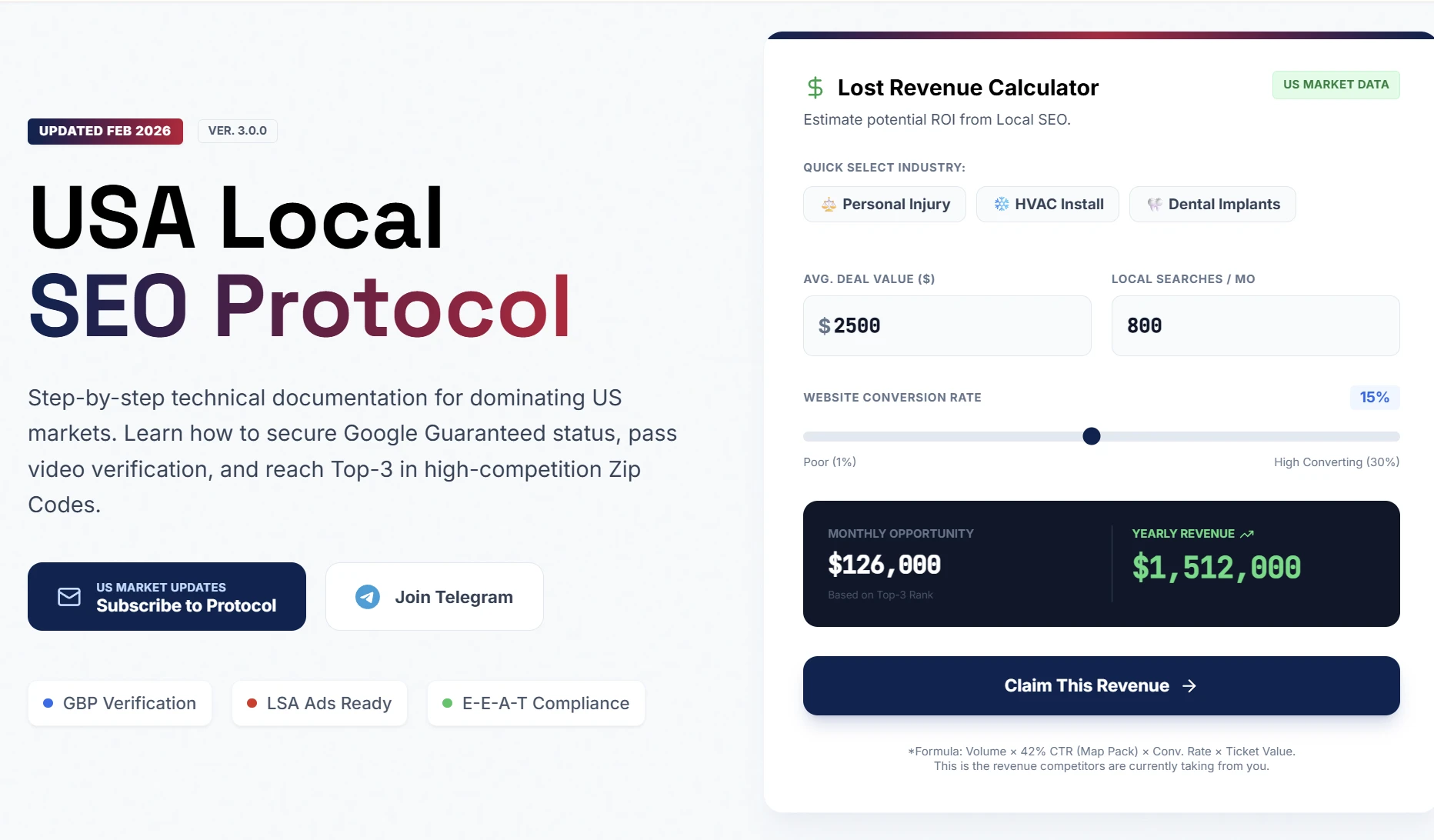
This is where the game changes most drastically. Standard SEO wisdom suggests that “content is king” and high DR (Domain Rating) links are the queen. However, in Local SEO USA, relevance trumps raw power. A link from a global news giant might carry less weight for a local plumber in Chicago than a link from a neighborhood association website or a local chamber of commerce.
To penetrate the local noise, you need a tiered approach. We have observed that random link acquisition often triggers spam filters. Instead, successful campaigns follow a structured engineering of authority – starting with foundational citations, moving to hyper-local directories, and finally reinforcing them with high-trust guest posts. And as an added bonus, these same activities will help reinforce your entity as a worthy candidate for inclusion in AI recommendations on both answer engines and LLMs as well.
This systematic layering creates a safety net around the business entity. We refer to this structured methodology as a “dominance protocol.” It is designed to mimic organic growth so closely that it becomes indistinguishable from natural popularity. You can examine the technical breakdown of how such a protocol is structured here: https://buylink.pro/en/usa-local-seo/.
The logic is simple: you are not just buying links; you are fabricating a digital reputation that aligns with Google’s expectations of a legitimate local market leader.
The Psychology of Reviews
The American consumer is culturally conditioned to rely on reviews. A rating below 4.0 stars in the US is often a death sentence for click-through rates. But it goes deeper than just the star count.
Google’s AI now analyzes the sentiment within the reviews. It looks for keywords related to your services in the text written by your customers. Furthermore, the speed and tone of the business owner’s replies are engagement signals. In the US, silence is interpreted as negligence. A proactive strategy involves not just collecting reviews, but managing the narrative within them.
The Long Game
Winning the local search battle in the US requires patience and precision. It is not about tricking the algorithm, but rather about convincing it that you are the most trustworthy answer to a user’s query. It requires a synergy of technical SEO, flawless data management, and a sophisticated off-page strategy.
For business owners, the key is to stop looking for shortcuts and start building an asset. As the developers behind these adaptive strategies at https://buylink.pro/en/, we consistently see that the businesses dominating the map in 2026 are those that treat their Local SEO not as a marketing expense, but as a critical part of their operational infrastructure.
The algorithm will continue to evolve, but the core principle remains unchanged: in the US, you don’t just ask for attention – you have to earn it.
