





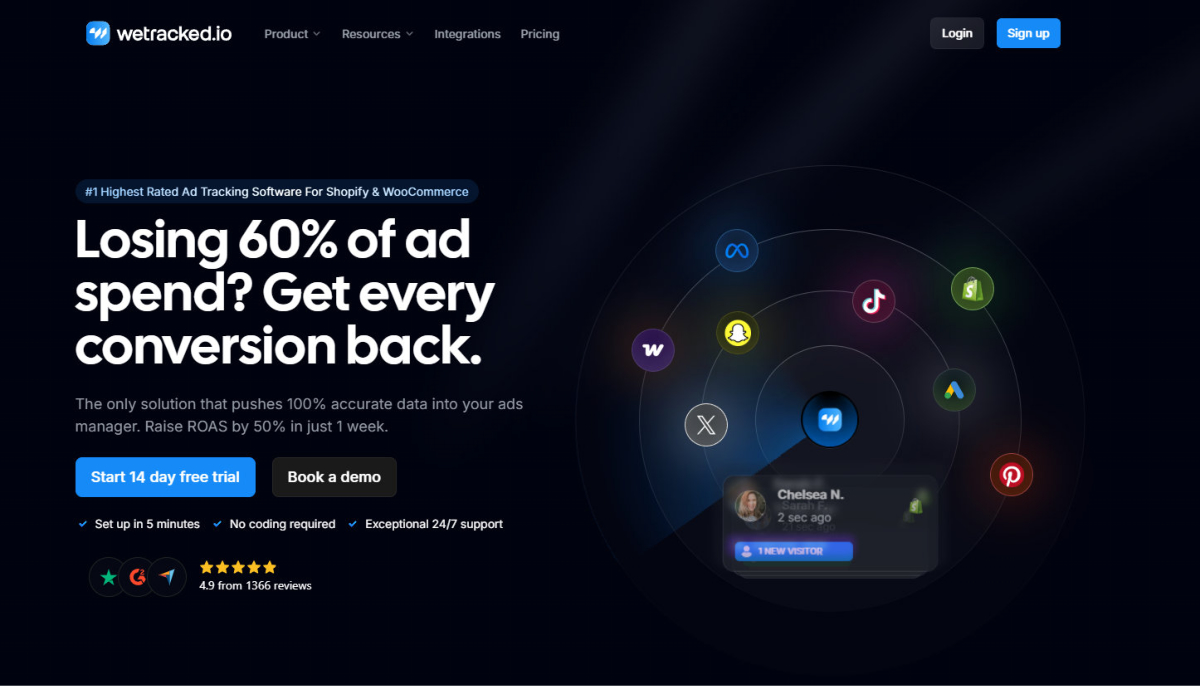
If your ad reporting feels unreliable in 2026, you are not alone. Privacy policies, cookie limits, and blockers hide real conversions from your ad managers.
That leads to bad bids and rising CAC. Wetracked uses first-party, server-side tracking to recover the truth so your budget trains the algorithm with real outcomes.
This wetracked review is stage-aware and simple. If you are just starting, this covers fast wins. If you are scaling, it shows how to stabilize ROAS and cut waste. If you are an enterprise operator, you will see how to standardize signals across stores and channels.
We may earn a commission if you use our affiliate link, at no extra cost to you.
What Wetracked Solves, and Who Should Use It
Client-side pixels miss conversions because of iOS privacy, blocked cookies, and messy cross-device journeys. Incomplete data means your ad manager makes bad bidding choices and burns budget. Wetracked captures more events server-side, stitches sessions across devices, and pushes clean events back to Meta, Google, TikTok, and more.
The tracking gap that drains ROAS
Many stores only track 40 to 50 percent of conversions with native scripts or a basic CAPI. Wetracked clients report 95 to 100 percent accuracy by enriching signals server-side and stitching sessions across devices. Adblockers and iOS restrictions do not stop server-side capture, so your purchase signals get through.
If your ad manager only sees half your conversions, it overpays for clicks that look unprofitable. Filling that gap can cut costs by 20 to 35 percent and unlock scale on Meta and Google, since the algorithm finally sees the real winners.
Who should choose wetracked right now
- Beginners: You want no-code setup, a 14-day trial, and fast proof of channel fit.
- Growth: You need accurate multi-platform signals, lower CAC, and fewer tools.
- Established: You manage many stores or high spend and want reliable server-side events to hit scale goals.
Claimed setup in 5 minutes, 24/7 support, Shopify and WooCommerce support, plus a GDPR-friendly fingerprint approach.
Who should wait or pick a simpler tool
If you need deep analytics beyond attribution, Triple Whale or Northbeam offer broader dashboards and cohort analysis. If you are not running paid ads yet, start simple and delay adoption until you spend a few hundred dollars per month on ads.
Core Features That Move the Needle on ROAS
Here are three capabilities that matter most for ROAS and daily workflow.
Cookieless, server-side tracking with session stitching
- Problem it solves: Browser limits, blocked cookies, and cross-device browsing break attribution. Purchases go untracked, which starves your ad platforms of truth.
- Wetracked solution: First-party, server-side capture records more data points, stitches sessions across devices, and sends complete events back to Meta, Google, TikTok, Pinterest, Snapchat, and X. No coding needed.
- Stage-aware impact: Beginners spot winners fast and cut losers with confidence. Growth brands stabilize ROAS when platforms finally see real purchases. Enterprise teams reduce reporting variance across stores and accounts.
Stores report near-complete capture of add-to-cart, checkout, and purchase events even when adblockers are active. Closing that gap often turns losing ad sets into break-even, then profitable, once the platforms see the full picture.
360 degree data enrichment and direct ad platform feedback
- Problem it solves: A basic CAPI only passes what your store collects, so identifiers are missing and match rates suffer.
- Wetracked solution: Wetracked enriches events with more identifiers and pushes them back in the exact format platforms expect. Unlimited pixels per store helps teams mirror data across accounts and keep multi-brand setups clean.
- Stage-aware impact: Early teams waste less on the wrong audiences. Growth teams scale winners faster with steadier CPAs. Larger orgs standardize tracking across stores and agencies.
Enriched server-side events improve match rates and signal quality, which can lift algorithmic targeting. Many brands see faster learning and more stable CPAs once platforms ingest cleaner purchase events from day one.
Abandoned cart capture that triggers Klaviyo flows
- Problem it solves: Missing cart events reduce flow triggers and leave money on the table.
- Wetracked solution: Server-side tracking captures more carts, even with blockers, and forwards them to Klaviyo so flows trigger every time.
- Expected gains: Up to 2x more abandoned cart emails and roughly 27 percent more email flow revenue, often visible within 7 days.
When cart events fire reliably, revenue from abandoned cart flows rises quickly, often within the first week. This creates a steady baseline return that helps fund ad tests without extra risk.
Pricing, ROI Math, and Shopify Integration
Simple pricing, a real trial, and fast Shopify setup make it easy to test before committing.
The tech stack consolidation math
- Emerging: Email ($30) + SMS ($20) + CRM ($25) equals about $75 per month. With wetracked at $49 per month, you also save time and get better ad tracking.
- Growth: Klaviyo ($200) + Attentive ($150) + Gorgias ($60) + Zapier ($70) equals about $480 per month. Wetracked at $249 per month covers tracking and attribution while you keep best-of-breed for messaging.
- Established: Savings come from cleaner data and fewer hours fixing reports, not just subscription cuts.
Some brands report 64 percent lower wasted ad spend, higher ROAS, and up to 3x more profitable ads. Results vary by brand and creative quality.
The ROI is not just subscription savings. Clean server-side events improve performance. Many brands save several hours per week on data wrangling and see 15 to 25 percent better campaign results once platforms trust the signals.
How the Shopify integration works in practice
Setup is no-code. Connect in minutes to track visits, carts, checkouts, and purchases with first-party precision. UTMs help but are optional because session stitching links activity across devices. Wetracked then pushes accurate events back to your ad managers, so you do not need another dashboard.
It supports Shopify, WooCommerce, and common checkout tools. It also connects with Meta, Google, TikTok, Pinterest, Snapchat, and X for direct event feedback.
In testing across stores at different sizes, teams reported stable, near real-time syncing of core events and fewer discrepancies between platform reports and actual orders. Fewer gaps mean fewer arguments about which numbers to trust.
Pros, Cons, and Alternatives
Everything here is about speed to value and picking the right tool for your stage.
User experience and time to value
- Beginners: Connect your store, add ad pixels, and watch purchases flow into ad managers. Most can launch in under an hour.
- Experienced users: The workflow is simpler than rolling your own server-side setup. 24/7 chat helps close gaps.
- Scaling teams: Unlimited pixels per store makes it easy to mirror data across regions and accounts.
Many teams report seeing early impact within the first week, especially in abandoned cart flows. For paid ads, expect meaningful learning after 2 to 4 weeks as algorithms adjust to better purchase signals.
Pros:
- Near-complete conversion tracking with first-party, server-side enrichment
- Clean events pushed back to ad managers, so no extra dashboard needed
- Quick setup, no coding, 24/7 support, money-back guarantee
- Works across Meta, Google, TikTok, Pinterest, Snapchat, and X
- Strong abandoned cart capture that improves email flow revenue
Cons:
- Focused on ad tracking, not a full analytics suite with deep cohort reports
- Some teams may still want broader BI tools
- For best-in-class email features, you may keep Klaviyo
- Small learning curve if you are new to server-side tracking concepts
Wetracked vs Triple Whale vs Northbeam
If you mainly need accurate conversion tracking that feeds your ad platforms, pick wetracked. If you need a full analytics suite, look at Triple Whale or Northbeam.
Final recommendation and next steps
- Just starting ($0 to $50K annual): Strong pick if you run paid ads. Connect Shopify, add ad pixels, and set up one abandoned cart flow. Use the 14-day trial to confirm purchases appear in your ad managers.
- Growing ($50K to $500K annual): If you feel tracking gaps, the consolidation savings and ROAS lift can cover the fee. Migrate a single flow and run it in parallel for two weeks.
- Established ($500K+ annual): Great fit if you manage multiple stores or accounts. Plan a one-day workshop to audit signals, then centralize pixels and events with wetracked.
Teams that prioritize unified, server-side signals see better results within 30 to 60 days. As your spend grows, cleaner data compounds. What saves you a few hours per week at the start can save whole days every month at scale.
Conclusion
Wetracked fixes broken attribution with first-party, server-side tracking. It is quick to set up, improves signal quality, and helps ad platforms learn faster. If you want accurate tracking without another complex dashboard, this tool is a smart bet. The wetracked review verdict is simple: better data, better bids, better ROAS.
SEO and Schema checklist for the writer:
- Include primary keyword in title, opening, and conclusion
- Add Product review schema with rating 4.8/5
- Add FAQ schema for 3-5 common questions: pricing, setup time, integrations, refunds, accuracy
- Link out to the official site (nofollow on affiliate), and to Shopify App or docs if relevant
- Internally link to related tool reviews and comparison pages
Start your 14-day free trial today, and if the numbers do not line up with your real orders, the money-back guarantee reduces your risk.
Frequently Asked Questions
What is the main problem wetracked solves for my ad campaigns?
Wetracked fixes the problem of broken ad attribution. Privacy updates and adblockers cause your ad platforms (like Meta) to miss 40% or more of your actual customer purchases. By capturing this data server-side and sending clean event signals back, wetracked ensures your ad algorithms are trained on the full, accurate picture of your conversions. This leads to smarter bidding and significantly lower wasted ad spend over time.
How is wetracked different from the basic Facebook Pixel?
The basic Facebook Pixel uses client-side tracking, which relies on browser cookies and is easily blocked by privacy tools. Wetracked uses first-party, server-side tracking. This means the data is captured directly on your server, making it immune to most blockers and iOS restrictions. The key difference is reliability: where a pixel misses conversions, wetracked reports near-100% accuracy.
Can wetracked help me recover revenue from abandoned carts?
Yes, one immediate gain from better tracking is increased abandoned cart revenue. Because wetracked captures more cart events reliably from the server, it sends that data to your email tool, like Klaviyo. This triggers more of your high-converting abandoned cart email flows. Brands often see up to 27% more revenue from these flows within the first week.
What does “data enrichment” mean, and why does it matter for my ROAS?
Data enrichment means wetracked adds more identifying information to the raw purchase signal before sending it to an ad platform. This might include customer hash, device type, and session details. When an ad platform receives an enriched signal, its match rate goes up. A higher match rate means the platform is more confident in which user converted, leading to better optimization and a direct improvement in your Return on Ad Spend (ROAS).
How long does it take for wetracked to show an impact on my ad performance?
You should see an immediate impact on your abandoned cart flow revenue, often within the first seven days after setting up. For paid ad performance, the ad platforms need time to learn from the new, cleaner data. Most brands report seeing a meaningful stabilization of their CPA and a lift in overall ROAS after 2 to 4 weeks as the ad algorithms adjust.
Do I still need an expensive full analytics dashboard if I use wetracked?
It depends on your business stage, Steve. Wetracked is built to fix ad tracking and attribution efficiently, pushing clean data to your existing ad managers. If your main goal is reducing ad waste, wetracked is enough. If you need deep cohorts, LTV analysis, and a comprehensive BI (Business Intelligence) dashboard, you may still benefit from broader analytics tools like Triple Whale later on.
Is wetracked difficult to set up, or do I need a developer?
The setup is designed to be no-code and fast. You can connect your Shopify store and install the necessary pixels in as little as five minutes. This makes it an ideal solution for solo founders and emerging operators who do not have a dedicated developer. The platform handles the technical complexity of server-side tracking for you.
What are the main drawbacks of the wetracked platform?
The primary drawback is that wetracked focuses specifically on ad tracking and event forwarding, meaning it is not a full-fledged analytics platform. It also has a small learning curve if you are completely new to the concept of server-side tracking. However, its simplicity is a strength for operations that only need to fix their ad data.
Can wetracked handle tracking for multiple Shopify stores or brands?
Yes, wetracked is a great solution for established operators and agencies who manage several stores. Even the Starter plan supports up to three stores, and the Scale-up and Enterprise plans support more. The ability to use unlimited ad pixels per store makes it easy to standardize your tracking across every brand and account you manage.
Is server-side tracking, like what wetracked uses, still effective with future browser changes?
Yes, server-side tracking is designed to be future-proof against changes like the complete phase-out of third-party cookies. Because the events are captured directly by your server, they bypass most browser-level restrictions. Wetracked’s first-party approach ensures data reliability will remain consistent, even as privacy policies get stricter.
