

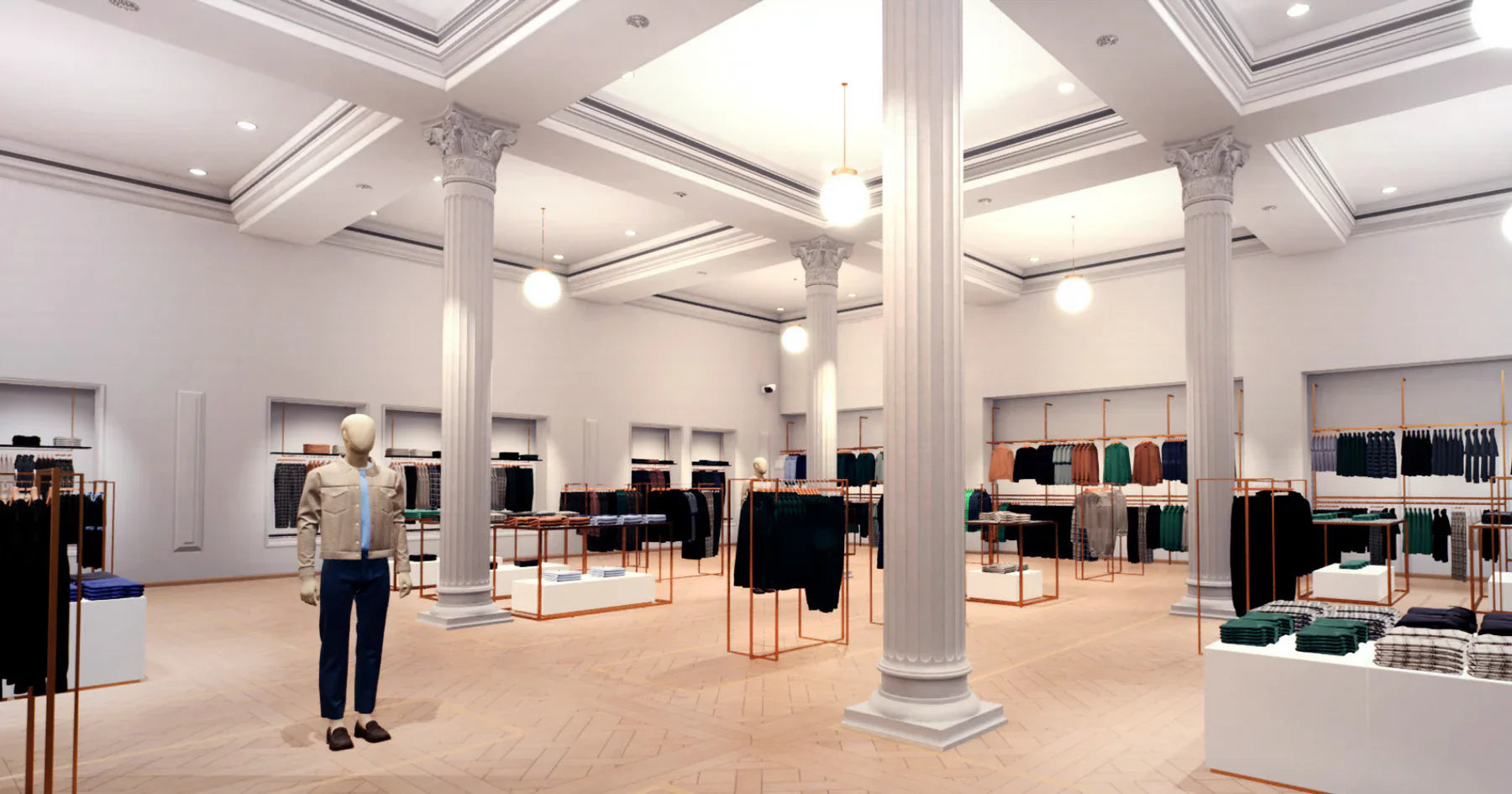
A virtual showroom is no longer a pandemic-era experiment—it’s the new storefront for modern retail. Unlike a static website, it lets customers explore products interactively, creating an immersive experience that mimics a physical store.
Think of it as retail showrooming turned inside out. This digital-first environment merges discovery and purchase.
A furniture brand can help shoppers visualize a sofa in their living room, while an auto dealer can offer a virtual test drive. The payoff is higher engagement, broader reach, and data-rich insight into customer behavior. What was once a trend is now becoming a core part of any successful retail strategy.
Ahead, you’ll learn how virtual showrooms work, the technologies behind them, and how brands from wholesale to home goods are putting them into practice.
A virtual showroom is an interactive, branded space that lets people explore, configure, and purchase products displayed in 3D, augmented reality (AR), or virtual reality (VR). Instead of static product photos and grids, customers can spin a product 360 degrees, zoom into details, watch embedded videos, or even step into a VR environment.
Virtual showrooms are different from standard online catalogs because they replicate how customers actually shop, creating a more engaging shopping experience. Instead of static images and long spec sheets, they enable shopper to:
Taken together, these capabilities enable shoppers to move from interest to purchase without making them jump between pages, meaning less friction and a better overall customer experience.
The concept began in wholesale, but consumer-facing brands have adopted virtual showrooms as part of their sales strategies and scaled them even further.
Rather than replacing physical showrooms, virtual showrooms complement them. A shopper might test furniture at home through AR and then go to a physical store to see and feel the piece before making the purchase. Or a wholesale buyer might use a virtual showroom to narrow down a collection online, then confirm their choices at market week. In both cases, the virtual experience strengthens a click-and-mortar strategy by connecting virtual shopping to physical purchasing.
According to Grand View Research, the extended reality (XR) market—which includes AR and VR—is projected to grow from $142.39 billion in 2023 to over $1 trillion by 2030. The trend reflects growing consumer demand, rising government support, increased trust, and other factors contributing to increasing sales.
There are many benefits to using virtual showrooms for both retail buyers and brands. But the real value of a virtual showroom doesn’t lie in its impressive visuals, but how it drives measurable results.
Let’s look closer at the benefits virtual showroom offer:
The first win is cost. By replacing physical samples and prototypes with 3D models, retailers can lower expenses tied to shipping, storage, and production. A virtual showroom also helps cut down on waste and carbon footprint, since fewer samples and fewer last-minute product changes mean less material headed to the landfill.
Tips for retailers and wholesalers:
Aligning digital assets with in-store storytelling also ensures consistency. Coordinated displays across both physical and digital spaces strengthen your brand identity, a key part of visual merchandising.
Virtual showrooms streamline launches by making product updates instant. Instead of waiting weeks for prototypes or line sheets, retailers can roll out changes in real time, ensuring customers always see the latest version.
Tips for retailers and wholesalers:
With everything connected, you can move from concept to customer much faster—without adding extra overhead.
Opening new stores or showrooms—especially across international borders—isn’t always realistic (particularly for SMBs). A virtual showroom extends your reach by making products accessible to buyers and shoppers anywhere, without the costs of new real estate. For example, if you’re based in California, a buyer from Amsterdam can view your products and make an order from the virtual showroom platform.
Tips for retailers and wholesalers:
The result: greater exposure without added overhead.
Engagement is where a virtual showroom shines. Instead of flipping through static images, shoppers can examine a product in 3D, drop it into their living room with AR, or click through shoppable hotspots to learn about products and features. This kind of interaction builds confidence, shortens the path to purchase, and can give you a competitive advantage.
Tips for retailers and wholesalers:
💡Pro tip: If you’re stuck on how to connect physical and digital storytelling, keep in-store marketing best practices in mind—many of those tactics translate directly to virtual spaces.
Unlike static catalogs, virtual showrooms generate actionable insights. You can see which products attract clicks, which finishes get explored, and where shoppers spend their time. That data informs both your digital strategy and your next in-store reset.
Real-time updates in your virtual showroom allow you to act faster and direct buyers to products and assortments that already have proven demand.
Tips for retailers and wholesalers:
By measuring product engagement inside your showroom, you’ll know exactly what resonates with buyers and consumers—and where to invest next.
A modern virtual showroom runs on three core technologies that turn product discovery into an interactive experience: 3D visualization, try-before-you-buy through AR, and immersion through VR. For sellers, the goal is to understand what each technology does, where it fits, and what kind of setup it requires.
3D is the foundation for virtual showrooms. A single 3D model can power your product-page viewer, your virtual showroom scene, and even marketing renders, so you can produce it once and reuse it in multiple contexts.
Here’s how to get started with 3D rendering:
A 3D rendering alone can be enough if your product doesn’t need in-room context (for example, products like handbags or small electronics).
AR lets shoppers place a life-size product in their space using a smartphone camera—ideal for furniture, décor, lighting, appliances, and any other item where fit and scale drive confidence. For B2B, AR helps preview fixtures or planograms onsite before you commit.
Here’s what you need to get set up with AR:
AR and VR tools are becoming more accessible and affordable, making entry easier for smaller teams. Rapid market growth and projected expansion shows sustained vendor support and falling costs, making now is the time for SMBs to plan for AR investment.
VR places shoppers or wholesale buyers inside a space, which is great for complex, high-consideration journeys (like walking a living room layout, touring a “store-within-a-store,” or hosting a wholesale line review).
You can deliver VR in two ways: headset-based (using stand-alone devices for events and showrooms) or web-based experiences that simulate “first-person” navigation on a laptop or phone.
Here’s where VR technology fits—and where it doesn’t:
After a slowdown in previous years, AR/VR headset shipments grew in 2024, with analysts expecting further gains as prices fall and devices improve. This matters if you’re weighing in-store headsets for events or guided experiences, but it’s still a good idea to keep an eye on adoption signals. You might consider investing in 3D or AR before committing to full VR, especially if your budget is limited.
Virtual showrooms are no longer confined to the fashion industry and enterprise retailers with deep pockets—they’re shaping how consumers shop everywhere. By looking at both B2B and B2C applications, retailers can see how these technologies serve as practical, revenue-driving tools.
JOOR shows how a virtual showroom can replace the bulk of physical sampling and trade show travel with digital assortments. The platform connects more than 14,000 brands with more than 650,000 buyers worldwide, allowing sales teams to showcase lines with interactive lookbooks, 360-degree imagery, and real-time ordering.
Takeaways for smaller businesses:
By treating the virtual showroom as your primary wholesale stage—and physical samples as supporting assets—you’ll cut costs while increasing buyer coverage.
Toyota’s virtual showroom is a strong consumer example of how interactivity shortens the path to purchase. Shoppers can use the automotive virtual showroom to view cars inside and out with 360-degree rotation, customize trims or colors, and move seamlessly to actions like booking a test drive or requesting a price quote.
What can smaller businesses learn from Toyota’s platform?
This same pattern supports click-and-mortar models, where online configuration hands off to an in-store demo or pickup to close the sale.
IKEA’s Kreativ platform turns home furnishing into an AR shopping experience that reduces returns. Customers can design rooms in 3D, view items up close, place products at true scale, and see how multiple pieces fit together before buying. This not only boosts confidence but reduces costly returns.
Smaller retailers can look to IKEA’s virtual furniture showroom for plenty of inspiration to apply to their own businesses:
Context transforms the buying journey. Allowing customers to explore a car’s interior or visualize a sofa in their small apartment makes your virtual showroom not just a virtual gallery, but a trusted decision-making tool.
A virtual showroom isn’t an enterprise-only project. With a clear plan and the right tools, you can now launch one in just weeks. All it takes is focusing on the assets you already have, the platforms that fit your use case, and the integrations that make it measurable.
Start with the products that move your business. Prioritize your top sellers and high-return items (where visualization reduces uncertainty). Your goal is a small, high-impact 3D library you can reuse across product detail pages (PDPs), ads, and your virtual showroom.
Here’s what to do:
A disciplined 3D pipeline lowers long-term production costs and gives your virtual showroom a consistent, high-quality look.
Pick the virtual showroom technology that best fits your business needs, not the one with the flashiest demo. Is your primary use B2B wholesale selling or B2C consumer exploration (or both)? What are your must-have features?
Here’s an evaluation checklist—use this as a scorecard when comparing vendors:
Demo or pilot the platform with a small collection first. If the platform makes it easy to update scenes, add variants, and embed CTAs, you’ve likely found the right one.
Treat your virtual showroom like a well-run store: Make sure it has clear entry points, curated paths, and obvious next steps. Design for mobile first, keep decisions close to the product, and make help one tap away.
Here’s how to design the flow (and measure it):
Mirror your strongest in-store stories in your virtual showroom. If three pieces of living room furniture sell best as a set, create a “room” scene with a one-click bundle and a clear handoff to chat with a sales representative or book an in-store appointment.
Your virtual showroom should integrate with the rest of your business, not sit on an island. Connect catalog data, track behavior, and make it easy for shoppers to jump between digital and physical touchpoints.
Here’s how to make your showroom operational and trackable:
Once your virtual showroom is integrated, small optimizations (like a clearer CTA or a better default finish) translate into measurable lift, the same way a better endcap does in-store. Over time, the data you collect will guide new products, pricing, and your next virtual showroom refresh.
There are many virtual showroom software and platforms available to retailers and brands today. Choosing the right one comes down to your use case: wholesale selling, product-level 3D, or immersive AR/VR spaces.
Let’s take a look at four options:
For many SMBs, the fastest path is to test virtual showroom ideas with a Shopify app—either a 3D/AR viewer or a lightweight 3D virtual store experience embedded in your theme. Thanks to Shopify’s expansive App Store, you have multiple options. Here are just a few:
These apps are best for SMB retailers who want to validate interactive 3D or a virtual showroom concept before investing in a bespoke build. You stay in the Shopify ecosystem, move quickly from idea to test, and learn what shoppers engage with. Then you can decide if a more robust virtual showroom platform is a good fit for your ecommerce business.
If your priority is wholesale, JOOR is a marketplace and data-exchange platform for beauty, fashion, and home goods retailers that combines virtual showrooms, digital linesheets, and order capture inside a large buyer network.
Brands use JOOR to simplify their B2B sales process and reach new retailers already using the platform. The same goes for retailers. Buyers can discover new brands to stock in their store via JOOR.
You can show off your products using dynamic video, 3D interactive images, and audio. For example, share a video of your runway show, a video of you explaining the collection, and product performance reviews.
Additionally, you can schedule virtual appointments with retail buyers to share details about the collection you’re selling. It also has a style board feature, so product assortments can be personalized to each buyer during online showroom appointments.
You can arrange your products into specific collections depending on the buyer’s past purchases, region, and other factors to help simplify the process.
JOOR is best for fashion and lifestyle brands that need B2B assortments, shoppable lookbooks, and retailer collaboration—plus embedded payments and ERP/PLM integrations.
When your goal is an immersive brand space that runs in the browser (and optionally on headsets), BrandLab360 builds bespoke virtual retail stores with interactive 3D environments, integrated voice/video, and transactional handoffs. Their platform emphasizes web delivery—no apps or VR headsets required—with optional support for devices like Apple Vision Pro.
With this platform, you can create any online store in a 3D digital format, including integrated live voice and video communication that links seamlessly to transactional ordering platforms.
Each virtual showroom environment can host unlimited users, allowing you to show your products to multiple buyers simultaneously. You can also invite people to their own private shopping experience.
BrandLab360 is best for launches, editorial storytelling, and high-impact environments where you want shoppers or wholesale buyers to “walk” a space and interact with products.
If your catalog hinges on finishes, dimensions, and in-room context, iEnhance offers 3D visualization and AR for configurable products (think sofas, tables, and storage).
The platform positions itself as a 3D/AR personalization engine designed to move shoppers from static images to interactive exploration—useful for categories where fit and space drive confidence.
With iEnhance, you can speed up buyer consideration with real-time finish changes and AR sizing, then pass shoppers to checkout or to a store appointment.
iEnhance is best for furniture, décor, and home goods that benefit from AR “place in room” and on-the-fly configuration.
High-performing virtual showrooms balance speed, accessibility, clear UX, measurement, and consistency with your physical store. These best practices will keep your virtual showroom simple to implement, budget-aware, and focused on results—not bells and whistles.
The terms are usually used interchangeably, but there can be subtle differences.
A digital showroom can refer to a static, online catalog or linesheet with images and specs. A virtual showroom goes further, creating an interactive environment where shoppers or buyers can spin 3D models, explore curated assortments, and act on embedded CTAs like “add to cart” or “request wholesale pricing.”
Various platforms exist for both—whether you’re looking for a digital showroom platform or a virtual showroom tool, you have options to create the shopping experience that fits your business, products, and budget.
A showroom is meant to showcase products that are for sale. A virtual showroom does this while also saving on overhead—no need to rent out a physical space plus room decor.
They can also cut down on product samples, further saving money and reducing waste. Virtual showrooms help both large and small businesses that want to sell in the online world, no matter the industry.
Costs vary depending on scope. Entry-level options, like Shopify apps that add 3D viewers or lightweight virtual store layouts, can start at a few hundred dollars per year.
Full-featured virtual showroom platforms with B2B order capture or immersive 3D spaces can run into the thousands monthly. For SMBs looking to start their digital transformation, the best approach is to start small with 3D assets on priority products and scale accordingly.
Tie metrics to the job the showroom is meant to do. For B2B, track wholesale order volume, sample cost reduction, or buyer reach. For B2C, monitor engagement (like scene views or hotspot clicks), conversions (like how many products are added to carts or purchased), and return rates on products with 3D/AR. Use QR codes, UTMs, and event tracking to attribute revenue, then compare sales lift against the cost of asset creation and platform fees.
Any category where buyers need to explore, configure, or see scale before purchase benefits. Fashion and lifestyle brands use them for wholesale assortments, automotive brands for configuration, and furniture and home goods retailers for AR room visualization.
Increasingly, even SMB retailers in categories like sporting goods, appliances, and beauty are adopting virtual showroom features to give shoppers more confidence online and support retail showrooming strategies.
Virtual showrooms can help reduce return and exchange rates by allowing users to explore details, view true-to-scale models in their own home, or compare finishes side by side, all before completing a purchase. This gives them more confidence before they buy, which means fewer surprises when the item arrives.





