




For years, ecommerce optimization has focused on the bottom of the funnel. Checkout flows. Payment options. PDP tweaks. Conversion rate improvements measured in tenths of a percentage point.
Those efforts still matter — but they’re no longer where revenue is decided.In today’s ecommerce environment, revenue is increasingly won or lost earlier, at the moment of discovery. Long before a shopper reaches checkout, they’ve already decided whether a brand feels relevant, trustworthy, and worth their time. When discovery fails, checkout optimization never gets the chance to do its job.
Checkout Isn’t Broken — It’s Just Too Late
Most ecommerce teams don’t optimize checkout because it’s the most powerful lever. They do it because it’s measurable, contained, and familiar. Cart abandonment, payment errors, and form friction are easy to spot and relatively easy to fix.
But by the time a shopper reaches checkout, discovery has already succeeded.
- They found a product that matched their intent.
- They felt confident enough to proceed.
- They stayed engaged instead of bouncing early.
When teams focus exclusively on checkout, they’re often solving for a shrinking subset of sessions — the ones that survived discovery. The real losses happen upstream, where shoppers quietly disengage without triggering obvious failure signals.
Discovery Is Where Confidence Is Built — or Lost
Every ecommerce journey begins with a question. Sometimes it’s explicit, typed into a search bar. Sometimes it’s implicit, expressed through browsing, filtering, or interaction with content.
Discovery systems are responsible for answering those questions across search results, category pages, recommendations, and increasingly, off-site experiences like marketplaces and social commerce.
When discovery works, shoppers move forward with confidence. When it doesn’t, they hesitate — and hesitation is expensive.
Shoppers don’t endlessly refine searches or dig through poorly ordered categories. They compare. They exit. They move to competitors, marketplaces, or platforms where discovery feels easier and more intuitive.
What’s changed isn’t shopper behavior. It’s shopper tolerance. Consumers are accustomed to relevance everywhere else in their digital lives. When ecommerce discovery feels slow, generic, or disconnected, it stands out immediately — and not in a good way.
Early Discovery Moments Shape Intent and Value
Discovery doesn’t just influence whether a shopper converts. It shapes how they convert.
- Relevant search results signal competence.
- Clear category experiences reduce effort.
- Context-aware recommendations build trust.
Together, these moments influence confidence, basket size, and long-term value. When discovery aligns with intent early, shoppers are more open to exploring, comparing, and purchasing multiple items. When it doesn’t, even a perfect PDP can feel like a mismatch.
This is why discovery now sits upstream of conversion rate, average order value, and customer lifetime value — not alongside them.
What Ecommerce Leaders Should Be Measuring Instead
Traditional ecommerce metrics tend to overemphasize outcomes at the end of the journey. Conversion rate. Cart abandonment. Revenue per session. These metrics are necessary, but incomplete.
Leading ecommerce teams are expanding their lens to understand how discovery performs earlier, asking questions like:
Are shoppers finding relevant products quickly, or are they bouncing after initial interactions?
Do search and category experiences reflect real intent, or rely on static rules and exact matches?
Are discovery experiences consistent across on-site and off-site entry points?
How much manual effort is required to keep discovery “working”?
The goal isn’t just to measure whether systems function, but whether they move shoppers forward with confidence.
From Checkout Optimization to Discovery Strategy
Discovery used to be treated as background infrastructure. A search box that needed tuning. Categories that required constant manual updates. Recommendations that worked well enough in isolation.
That model no longer scales.
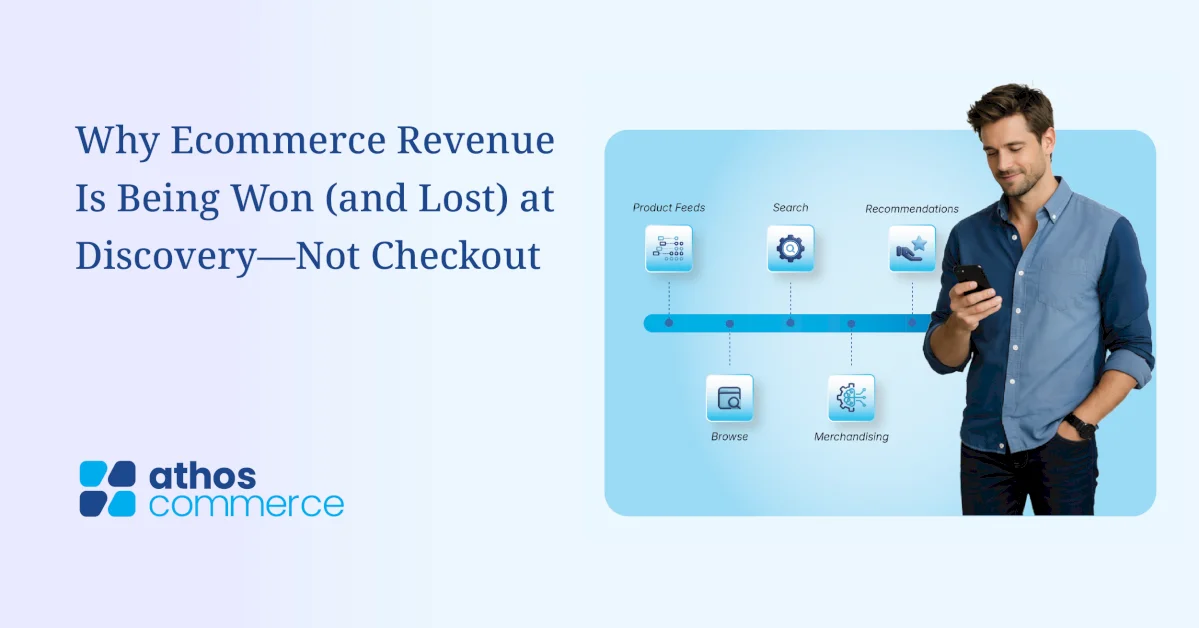
As entry points multiply and expectations rise, discovery decisions must be aligned across search, browse, merchandising, recommendations, and product feeds. When these decisions are made in silos, shoppers experience inconsistency — and teams absorb the cost through manual work and missed revenue.
The ecommerce leaders pulling ahead are making a shift: treating discovery not as a maintenance task, but as a strategic capability that deserves the same attention as conversion optimization once did.
The Takeaway
Checkout optimization will always have a place in ecommerce. But it’s no longer where growth is won.
Revenue is increasingly decided earlier, when shoppers ask their first questions and form their first impressions. Discovery is where confidence is built, intent is shaped, and value is unlocked — or lost entirely.
The brands that recognize this shift are investing upstream, aligning discovery decisions across channels, and turning product discovery into a true revenue driver.
If you want to explore this shift in depth, download our new guide:
📘 How Unified Product Discovery Drives Ecommerce Revenue in 2026
It breaks down where discovery fails, why it matters more than ever, and how leading teams are building discovery systems that actually work.
Sources & Further Reading
- Google & Boston Consulting Group — The Messy Middle
Research on how shoppers make decisions before conversion and why early relevance matters
https://www.thinkwithgoogle.com/consumer-insights/consumer-journey/messy-middle/ - Baymard Institute — Ecommerce UX & Abandonment Research
Industry benchmarks on product findability, search UX, category navigation, and abandonment behavior
https://baymard.com/research - McKinsey & Company — The Value of Getting Personalization Right
Analysis of how relevance and personalization influence revenue, loyalty, and growth
https://www.mckinsey.com/capabilities/growth-marketing-and-sales/our-insights/the-value-of-getting-personalization-right-or-wrong-is-multiplying - Salesforce — State of the Connected Customer
Insights into rising customer expectations for relevance and seamless experiences across touchpoints
https://www.salesforce.com/resources/research-reports/state-of-the-connected-customer/ - Forrester — Digital Commerce Experience Research
Research on how early digital experiences impact trust, confidence, and conversion
https://www.forrester.com/digital-commerce/ - Shopify — Future of Commerce Reports
Trends shaping ecommerce behavior, discovery, and shopper expectations
https://www.shopify.com/research/future-of-commerce
Find Which Athos Commerce Product is Right for You
