

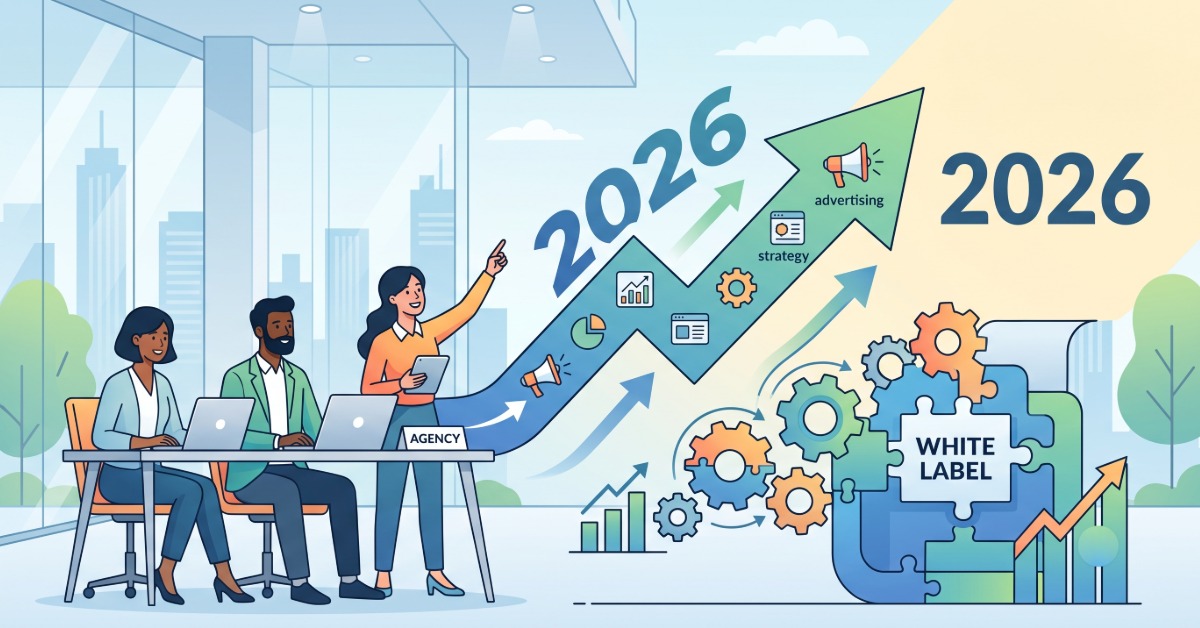
More marketing agencies are choosing white label partnerships in 2026 because they offer full-service delivery, faster and more flexible scaling, and access to specialist expertise, all while keeping brand control and operational risk low.
Who this is for: Small and mid-sized marketing agencies under pressure to offer full-service, multi-channel campaigns, but constrained by hiring costs, bandwidth, or in-house expertise.
Primary decision: Whether to build every service in-house or partner with a white-label provider so you can expand offerings, improve margins, and scale without adding headcount.
Recommended path: Use white-label fulfillment for specialist and labor-intensive services (SEO, PPC, content, web dev, reporting), keep strategy and client relationships in-house, and treat the provider as an extension of your team rather than a generic vendor.
How Fastlane readers typically act: Agencies that scale cleanly start with one or two white-label services, prove fulfillment quality, then gradually expand the partnership as they grow their book of business and refine their positioning as a full-service agency.
White label partnerships are becoming the default scale model for agencies that want full-service capabilities without full-service overhead.
The digital marketing sector is growing in a competitive environment every year. Today, agencies are expected to provide more services, quicker results, and a better return on investment, without breaking the bank. Meanwhile, clients are looking for more comprehensive offerings, rather than one-channel marketing.
Due to these pressures, a lot of agencies are moving towards white-label partnerships as a scalable business model. In this way, agencies can scale their services, deliver them faster and generate more revenue without adding to their in-house staff.
Let’s dive into the reasons for the growing importance of white-label partnerships, their role in driving scalable growth, and their impact on the future of digital marketing services.
White label marketing partnership is the model of a business that performs the marketing service for another agency using the name of the first one. The client communicates with the main agency, and fulfillment is taken care of by the white-label provider behind the scenes.
This model enables agencies to provide an entire package of services, including:
Agencies can build internal teams for each service, but if they don’t, they can instantly expand their ability.
It is preferable for modern clients to work with a single agency that can provide them with all the marketing services they need. They want to deal with just one dependable vendor instead of having to deal with a number of vendors. They wish to work with a single reliable vendor that can provide them with complete solutions.
This transition has increased pressure on small and mid-sized agencies to expand their service offerings quickly. However, hiring specialists for every marketing function is both costly and time-consuming.
White-label partnerships solve this issue by enabling agencies to instantly offer complete services without investing in staffing or training.
Scaling a traditional marketing agency requires:
The expenses escalate rapidly and can eat into profits.
Most of these obstacles are eliminated with white-label partnerships. Only the services that the agencies need are paid for, and when they are needed. This results in a flexible cost structure which fits the growth without risking any finances.
As opposed to creating all in-house, agencies can concentrate on sales and client generation with outsourcing for fulfillment.
Time management is a problem that a lot of agency owners have. Rather than concentrating on their strategies, client relationships, and business development, they tend to get bogged down in the daily tasks of execution.
White Label Support enables agencies to return to their core business, which is activities that generate revenue, such as:
Agencies can operate more efficiently and scale faster without getting burned out by fulfilling orders themselves by outsourcing fulfillment.
Digital marketing is an ever-changing medium. Algorithms evolve, ad platforms adjust their rules, and new tools such as artificial intelligence are radically transforming content curation and analytics.
A small internal team can’t normally be proficient in all channels.
White-label providers generally have an expertise in a certain area of marketing. This allows agencies to tap into the experience and knowledge of these professionals:
This knowledge enhances service quality and client satisfaction, all while avoiding the need for extra staff.
Clients are more likely to stay loyal when they can access all marketing services from a single agency. When agencies cannot offer additional services, clients often look for alternative providers.
White label partnerships enable agencies to grow their service offerings and keep their clients happy. This will lead to higher customer lifetime value and enhance the long-term relationships.
Rather than scare away customers to another agency, agencies can ensure that customers stay with them and that account value increases over time.
The long-term obligations of full-time staff include salaries, benefits, overheads, etc. When customers’ orders decrease, agencies can experience difficulties in keeping profits.
This is where white-label partnerships can help mitigate risk because they offer on-demand scalability. Agencies can choose to scale up or down their services as per the load.
It provides flexibility, stability and predictability in business operations, particularly for dynamic agencies in volatile markets.
One great benefit of white-label services is that they are offered under the agency’s name. The external provider is not visible to the clients.
This enables agencies to:
This can lead to the agencies becoming more powerful and bigger than they are in reality.
There are a number of industry trends that are encouraging the use of white-label services:
Increased competition in digital marketing
All of these are driving a demand for agencies to seek more efficient and scalable business models.
The advantages of white-label partnerships lie in both the growth and quality, as well as the success of the business.
Not all providers are the same. When considering partners, agencies need to consider where they are from:
Scalability and the ability to expand as needed.
A reliable partner is not a third-party vendor, but a part of the agency team.
If agencies want to grow their service offering and provide a consistent result for their clients, then relying on a white-label digital marketing agency for scalable client fulfilment can be a strategic move.
Modern marketing agencies are significantly changing their workflow due to white-label partnerships. White-label partnerships are positively changing the way modern marketing agencies work. Agencies no longer need to deal with the problem of hiring staff and being overwhelmed with tasks to do, but rather can scale up and ensure quality and profitability.
By using external fulfilment partners, agencies can expand services, handle more clients, and grow faster without increasing internal complexity.
The ever-changing world of digital marketing is only going to keep getting more competitive as we move forward in 2026 and beyond—and white-label solutions are going to be required to help agencies achieve sustainable growth.





