

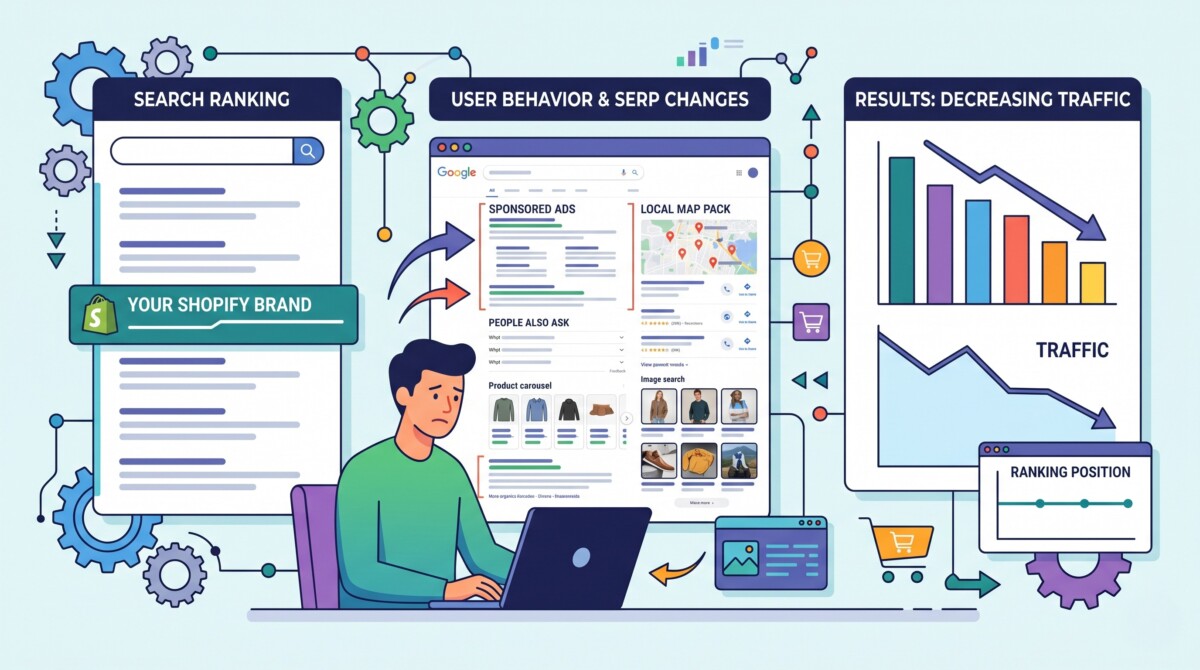
Here’s a situation playing out inside Shopify dashboards right now.
A founder checks their SEO tool. Rankings look healthy; top 3 for most core terms, page one for the rest. The agency sends the monthly deck. Green checkmarks everywhere. Domain authority up. Backlinks growing. Technical health score: 94.
Then they open Google Analytics.
Organic traffic is down 25% year-over-year. Revenue from organic is down 32%.
The agency responds: “We’re not seeing any ranking drops. We’re not sure what’s happening.”
This is not an isolated story. It’s happening across the Shopify ecosystem right now, and most teams are still looking for the answer in the wrong place. The answer isn’t in your rankings.
It’s where discovery is happening before customers ever reach Google.
For most of the last decade, the model looked like this:
Google Search → Website → Purchase
That still works for narrow, high-intent transactional queries. But for everything upstream, like product research, category awareness, and brand discovery, the funnel has split into paths that don’t run through your domain at all.
The new discovery journey looks more like:
Every step happened. Your Shopify analytics shows one direct session. Your SEO tool shows stable rankings. But you almost lost that customer six times before they found you.
The scale of this shift is measurable. SparkToro’s 2025–2026 traffic analysis tracking tens of thousands of websites found a 22% drop in the traffic share Google sends between June 2025 and May 2026 alone. These are the sites professional marketers actively work.
The structural driver is zero-click behavior. Google’s AI Overviews now appear on 25%+ of queries, almost doubling from 15% 2025.
The growth formula is fragmenting.
Here’s the mechanism most brands miss.
You can rank #2 for “best collagen peptides supplement” and still lose 40% of your impressions-to-clicks because Google now answers that query with a 200-word AI Overview before a user ever sees your result.
A Pew Research Center study tracking 68,879 actual Google searches found users clicked on results just 8% of the time when an AI Overview appeared versus 15% when it didn’t. Rank didn’t change. Click behavior did.
It’s not just informational queries anymore. The share of commercial and transactional queries triggering AI Overviews has grown significantly since late 2024, with navigational AI Overviews expanding fast. This means that even branded traffic is now at risk.
Someone types your brand name into Google and gets an AI-generated summary of your products and pricing without ever visiting your site. You’ve been “discovered” by someone who generated zero sessions.
The data from Seer Interactive’s CTR study makes this harder to rationalize away. Non-AIO queries, where AI Overviews don’t even appear, still lost 41% of their click-through rate year-over-year comparing September 2025 to September 2024. Users are seeking answers in other places before they arrive at Google.
That’s the part most SEO audits miss entirely. The clicks are leaving before users even open a search bar.
| Discovery Channel | What Customers Actually Do | What Brands Should Measure |
| Google Search | High-intent branded and transactional queries | Branded CTR, transactional query traffic |
| Google AI Overviews | Getting category and comparison summaries without clicking | AI Overview impression share, branded citation rate |
| ChatGPT / Perplexity | Open-ended research (“best standing desk under $500”) | AI referral traffic, ChatGPT Shopping feed accuracy |
| TikTok Search | Searching for reviews, dupes, “is this worth it” | TikTok-referred sessions, creator content reach |
| YouTube | Long-form honest reviews, comparisons | YouTube referral traffic, assisted conversions |
| Peer recommendations in niche subreddits | Reddit referral traffic, brand mention frequency | |
| Creator Content | Affiliate links, organic UGC across platforms | Creator-attributed revenue, new customer rate |
| Dark Social | DM shares, WhatsApp links, Slack drops | Post-purchase survey responses |
A few things stand out in that table.
ChatGPT is a real acquisition channel. Research across 94 ecommerce stores found ChatGPT traffic converts at 1.81% versus 1.39% for non-branded organic search, a 31% lift, with revenue per session 10.3% higher. ChatGPT referral visits grew 1,079% in 12 months.
TikTok is not optional for DTC brands. 82% of TikTok users have discovered a small or medium-sized business on TikTok before hearing about it elsewhere.
Reddit is feeding AI recommendations. ChatGPT Shopping actively surfaces Reddit discussions when making product suggestions, so your absence from those conversations isn’t a social media problem. It’s an AI discovery problem.
Dark social is larger than you think. Every time someone shares a product link via DM or WhatsApp, it arrives at your store as “direct” traffic with no attribution trail. Your analytics calls it a loyal return visitor. It’s often a first-time customer who heard about you from a friend.
| Old Metric | Why It Falls Short | New Metric |
| Keyword rankings | Stable rankings coexist with 40%+ CTR decline from AI Overviews | Impressions-to-click ratio by query type |
| Organic sessions | Ignores discovery happening entirely off-site | Revenue by discovery source (GA4 + post-purchase survey) |
| CTR | Only measures clicks from Google | Multi-channel assisted conversions |
| Last-click attribution | The last click is almost never where discovery happened | First-touch attribution + post-purchase survey |
| Domain authority | Doesn’t influence ChatGPT or TikTok recommendations | Brand mention velocity across Reddit, YouTube, review sites |
Three metrics deserve immediate implementation.
Post-purchase survey: The single highest-ROI measurement tool most Shopify brands underuse. Ask “How did you first hear about us?” with options including TikTok, YouTube, Reddit, podcast, friend, Google, and ChatGPT. Run it for 90 days. The responses will show you channels your dashboard has never surfaced.
GA4 data-driven attribution: GA4’s data-driven model distributes conversion credit across all touchpoints instead of awarding 100% to the last click. The gap between that report and your existing last-click data shows exactly which channels you’ve been underfunding.
Branded search trend monitoring: When organic traffic falls but branded search volume holds steady or grows, customers are still discovering you, just not where you’re attributing it. Track this in Google Search Console weekly. It’s a leading indicator of off-platform discovery doing its job.
BRUNT Workwear diversified infrastructure deliberately. Rather than optimizing exclusively for Google, BRUNT built presence across DTC, wholesale, and content simultaneously, scaling to $300M on Shopify with a unified platform across DTC, wholesale, Shop, and POS. Multi-channel wasn’t an afterthought. It was the growth architecture.
Brands using the Shopify × ChatGPT integration are getting early leverage. Shopify merchants’ product catalogs are already integrated with ChatGPT’s shopping experience. Most brands don’t know this and aren’t monitoring their ChatGPT product feed for pricing errors or missing descriptions that may filter them out of AI recommendations.
Smart DTC brands are building creator ecosystems, not buying one-off posts. TikTok micro-creators with under 50,000 followers show a 30.1% engagement rate for affiliate links, 1,570% higher than comparable Instagram influencers. The brands winning aren’t buying awareness. They’re building evergreen discovery content that compounds.
It’s worth noting this multi-channel shift isn’t unique to large brands. Teams building digital products, from a mobile app development company in Dallas to a DTC pet brand in Austin, are all grappling with the same fragmentation: customers arrive from a TikTok video or a Reddit thread, and last-click attribution misses the entire upstream journey.
The common thread: these brands stopped treating Google rankings as the primary proxy for brand health and started measuring where customers first heard about them.
The shift requires a structured operational response, not more isolated marketing tactics.
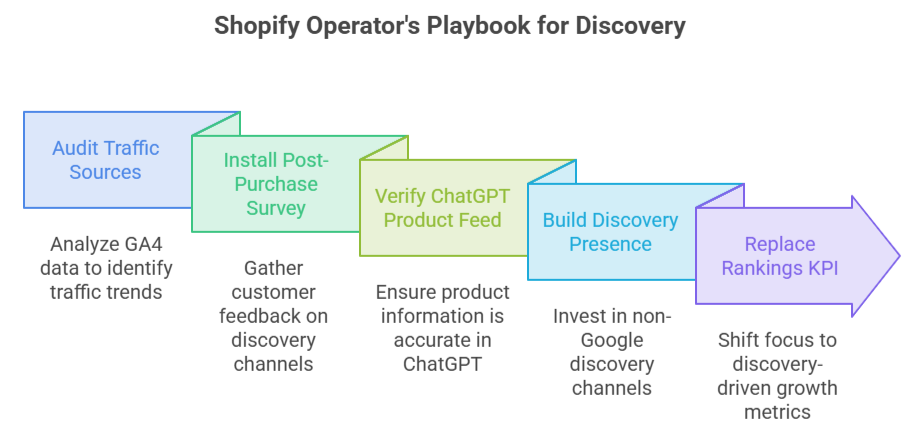
Open GA4. Pull “Session default channel group” for the last 12 months vs. the prior 12. Look for organic declining while direct holds steady (dark social signal), small but growing referral traffic from Reddit or YouTube (high-intent channels you’re underinvesting in), and “unassigned” traffic growing (attribution gaps from AI tools and dark social).
Before anything else, add a “How did you first hear about us?” survey. Run it for 90 days. The picture that emerges will contradict your analytics report in useful ways. Tools: Fairing, KnoCommerce, Grapevine.
Open ChatGPT and search your core product categories. Check whether your brand appears and whether pricing and descriptions are accurate. If you’re missing, audit your product data for completeness: clear specs, structured descriptions, accurate pricing, proper schema markup.
Based on your post-purchase survey data, identify your top 2–3 non-Google discovery channels and invest there intentionally. Seed product with 5–10 TikTok micro-creators. Participate in the 3–5 subreddits where your category is discussed. Identify the YouTube channels your customers watch and pursue honest reviews or affiliate arrangements.
Build a Discovery Dashboard tracking: branded search volume trend (Search Console), post-purchase survey channel breakdown month-over-month, revenue by discovery source (GA4 + survey), AI referral traffic (ChatGPT and Perplexity in GA4’s referral report), and TikTok/YouTube/Reddit sessions and revenue.
Review it monthly alongside your SEO report, not instead of it. The combination tells you something neither report can tell you alone.
Most SEO reports will tell you your rankings are stable. They’re not wrong. Rankings are stable.
But rankings measure your position in one channel that used to dominate the discovery stack and now shares it with a dozen others. Even professionally managed sites lost approx. 22% of the traffic share Google sends them in a single year.
The brands that figure this out first aren’t going to out-SEO their competitors. They’re going to out-discover them, showing up in the Reddit threads their customers trust, appearing in the ChatGPT conversations their customers are having, getting recommended in the TikTok reviews their customers watch before they ever type anything into Google.
The question for Shopify brands is no longer: “Where do I rank?”
It’s: “Where do customers discover me before they buy?”
The brands that can answer that question, with actual data, not assumptions, will define ecommerce growth over the next decade. The ones still staring at rank trackers will keep being surprised by traffic reports that look exactly like the one at the top of this article.
Because SEO tools measure rankings, not discovery. Rankings can be completely stable while traffic falls, if the clicks that used to follow those rankings are now being absorbed by AI Overviews, ChatGPT, or happening on TikTok before users ever open Google.
Yes, but for a narrower slice of the funnel than it used to be. High-intent, transactional queries still convert well from Google. The investment case for Google weakens significantly the further up the funnel you go: awareness, category research, and brand comparison are increasingly happening elsewhere. Keep Google. Stop treating it as the whole game.
Post-purchase survey, every time. No analytics platform captures dark social, podcast mentions, or Reddit word-of-mouth. A simple “How did you first hear about us?” question with specific options, including TikTok, ChatGPT, friend recommendation, and Reddit, will show you a completely different picture than GA4 alone.
The fragmentation is universal, but the channel mix varies by category and customer age. Brands selling to customers under 35 will see TikTok and Reddit having outsized influence. Brands in higher-consideration categories (furniture, supplements, B2B tools) will see ChatGPT and YouTube playing a bigger role. The framework applies to everyone; the channel weighting is specific to your audience.
Two things: install a post-purchase survey and open ChatGPT to manually search your core product categories. The survey will surface channels you didn’t know were working. The ChatGPT test will tell you whether you’re appearing in 50 million daily shopping queries, and if your product data is accurate enough to compete there.
TikTok can generate measurable referral traffic within weeks if you’re working with the right creators on relevant content. Reddit is slower. Genuine community participation takes 2–3 months before it starts compounding into brand mentions and AI citations. Neither is as trackable as Google in the short term, which is exactly why most brands underinvest there. The brands willing to measure it properly are the ones building durable discovery.
Especially then. Strong conversion rates mean your store converts the traffic it gets, but if discovery is fragmenting and you’re not present in the channels where customers research before buying, you’ll convert well on a shrinking pool of visitors. Discovery fragmentation is a top-of-funnel problem that eventually shows up in the conversion report.




