





Quick Decision Framework
- Who this is for: Ecommerce brands operating in or expanding to Southeast Asia, B2B companies modernizing their digital infrastructure, and brands stuck on legacy platforms limiting growth
- Skip if: You’re already on Shopify Plus with full regional localization, your current platform delivers 3%+ conversion rates with seamless B2B functionality, or you’re not targeting ASEAN markets
- Key benefit: Access Southeast Asia’s explosive ecommerce growth with a platform built for mobile-first buyers, multi-currency transactions, and B2B automation while maintaining regional payment and shipping integrations
- What you’ll need: Clear data migration plan, stakeholder buy-in for platform change, budget for regional implementation partner, 90-day timeline for full migration
- Time to complete: 90 days for complete Shopify Plus migration with regional localization (payment gateways, shipping, compliance)
While North American brands worry about tariff headwinds and slowing growth, Southeast Asia is experiencing the opposite – explosive expansion that’s forcing brands to modernize their tech stack or get left behind.
What You’ll Learn
- Why foreign direct investment hitting $225 billion in ASEAN countries is creating unprecedented ecommerce opportunities in Southeast Asia
- The specific Shopify Plus features driving B2B and DTC success in 2026 (automation, mobile optimization, international expansion)
- Why regional localization – payment gateways, shipping carriers, and compliance – determines migration success or failure in SEA markets
- Real migration case studies showing 135% conversion improvements, 70% revenue growth, and 30% cost reductions
- The exact decision framework for determining when to migrate now versus when to wait
The convergence of three major forces is hitting Southeast Asia simultaneously in 2026. Foreign direct investment in ASEAN countries has reached $225 billion, marking a 10% increase as supply chains actively shift away from China. India and Southeast Asia are now driving APAC’s ecommerce growth as China’s market stabilizes at 83% dominance. Mobile commerce is projected to reach $2.4 trillion globally, with Southeast Asia leading mobile-first adoption across all demographics.
This isn’t theoretical future planning. This is happening right now, and brands operating on legacy platforms built for 2015’s reality are hitting technical walls that prevent them from capitalizing on the region’s momentum.
The Data: What’s Driving Southeast Asia’s Ecommerce Acceleration
APAC remains the world’s largest ecommerce region, but the internal dynamics are shifting dramatically. While China continues to dominate overall volume, the growth engines have moved to emerging markets across Southeast Asia and India. Manufacturing hub migration is accelerating as companies restructure supply chains toward SEA, Eastern Europe, and Central America in response to geopolitical pressures and diversification strategies.
The numbers tell a compelling story. Seventy-seven percent of B2B executives now view digital transformation as essential rather than optional, according to Deloitte research. This isn’t aspirational thinking – it’s operational reality driven by buyer behavior changes that make traditional sales models obsolete.
Indonesia, Malaysia, Philippines, Thailand, and Vietnam represent five distinct markets with unique consumer behaviors, but they share unified digital acceleration patterns. Digital wallet adoption has reached 66% of global spending, fundamentally changing payment expectations beyond credit card infrastructure. Over 50% of B2B product searches now start on mobile devices, creating a mobile-first imperative that legacy platforms struggle to deliver.
This is where regional expertise becomes non-negotiable. Jumpstart Commerce, Southeast Asia’s only Shopify Platinum Partner, has built 800+ stores across these markets – navigating the localization complexities that sink foreign brands attempting DIY regional expansion.
Why Brands Are Migrating to Shopify Plus Specifically
The legacy platform problem has become acute. Brands stuck on Magento, WooCommerce, or custom platforms built for desktop-first, credit-card-dominant markets face mounting technical debt. Clunky B2B portals, PDF catalogs, and email-based ordering systems that were acceptable five years ago now create friction that drives buyers to competitors.
B2B buyers now expect B2C experiences: fast checkout, mobile reordering, real-time inventory visibility, and transparent pricing. The gap between what legacy platforms deliver and what modern buyers demand has become a competitive disadvantage that can’t be solved with incremental improvements.
B2B and DTC From One Platform
Shopify Plus in 2026 delivers unified commerce that eliminates the traditional separation between wholesale and direct-to-consumer operations. Company profiles support multi-location, multi-user management with granular permissions that reflect real organizational structures. Custom pricing per customer, wholesale price lists, and contract-based pricing automation replace manual quote generation and spreadsheet management.
Purchase orders, Net 30/45 payment terms, and tax-exempt status automation handle the administrative complexity that previously required dedicated staff and custom development. This isn’t theoretical capability – it’s production-ready functionality that processes billions in B2B transactions annually.
Automation That Scales
Shopify Flow enables brands to automate approval workflows, order routing, and VIP customer tagging without custom development. The platform delivers 40% faster approval times compared to email-based chains, directly impacting order velocity and customer satisfaction. AI-powered tools now draft wholesale emails, analyze buyer patterns, and suggest reorder timing based on historical data.
This automation layer becomes critical at scale. What works manually for 50 wholesale customers becomes operationally impossible at 500 customers without significant workflow automation.
Mobile-Optimized By Default
SKU search, “order again” functionality, and CSV upload capabilities all work seamlessly on mobile devices. Shopify’s global CDN keeps pages fast even on spotty connections common in developing markets. Mobile commerce isn’t an add-on feature requiring separate development – it’s the foundation of the platform architecture.
This mobile-first design philosophy matters enormously in Southeast Asian markets where mobile devices are often the primary or only internet access point for buyers.
International Expansion Simplified
Shopify Managed Markets allows the platform to act as merchant of record, handling taxes, duties, and compliance across jurisdictions. Multi-currency support, localized payment methods, and automated tax calculations enable brands to expand to an average of 14+ new markets without building country-specific infrastructure.
But here’s the critical nuance: Shopify Plus is powerful globally, but Southeast Asia requires specialized implementation. Jumpstart Commerce’s portfolio includes premium brands like Dior and Paula’s Choice – proof that they handle both the technical migration complexity and the regional nuances that determine success or failure in ASEAN markets.
The Localization Advantage: Why Regional Expertise Matters
Global platform capability means nothing without regional execution. The difference between successful and failed Southeast Asian expansion often comes down to payment gateway configuration, shipping carrier integration, and compliance understanding that generic implementation partners simply don’t possess.
Payment Gateway Complexity
Thailand alone requires integration with Omise, 2C2P, KBank, Bangkok Bank, and SCB – each with unique technical requirements and settlement processes. Regional payment preferences extend far beyond credit cards: PromptPay, TrueMoney Wallet, GrabPay, and ShopeePay represent the actual payment methods Thai consumers use daily.
Chinese tourist traffic adds another layer: Alipay and WeChat Pay integration becomes essential for tourism-dependent businesses. Many Thai buyers still prefer local bank transfers over credit cards for larger purchases, requiring payment gateway configurations that Western ecommerce managers have never encountered.
Shipping and Logistics
Flash Express and Kerry Express dominate regional shipping with better rates and coverage than global carriers. Cash on delivery (COD) remains critical in many Southeast Asian markets despite digital payment growth. Multi-warehouse fulfillment across ASEAN requires location-specific routing logic that accounts for customs, duties, and transit time variations between countries.
These aren’t minor implementation details – they’re fundamental operational requirements that determine whether customers can actually complete purchases and receive products.
Compliance and Cultural Adaptation
Thai language checkout flows require more than simple translation – they need culturally appropriate phrasing and user experience patterns that match local expectations. VAT and duty calculations vary dramatically by country and product category within ASEAN. Local customer service expectations center on Line, WhatsApp, and regional chat apps rather than email or phone support.
MS. READ, a Malaysian plus-size fashion brand, migrated to Shopify Plus during COVID-19 with regional partner support. They achieved centralized system control, cross-border expansion via Shopify POS, and set up their ecommerce store in a single day using Launchpad for scheduled launches. This speed and flexibility only became possible with implementation partners who understood regional requirements from day one.
This is Jumpstart Commerce’s core differentiator – they’re not just implementing Shopify Plus globally, they’re configuring payment gateways, shipping integrations, and compliance requirements specific to each Southeast Asian market based on 800+ store implementations across the region.
Case Examples: Brands Thriving After Migration
Migration success patterns reveal consistent themes: conversion rate improvements, international expansion velocity, and operational cost reductions that compound over time.
Aje (Fashion)

Aje achieved a 135% conversion rate improvement during peak weeks following their Shopify Plus migration. They launched 3 expansion stores for global selling, implemented 20 multi-currency options via Shopify Payments, and now ship to 75 countries including the US, Middle East, and Asia. This international reach would have required years of custom development on their previous platform.
Luvme Hair (Beauty)
Luvme Hair documented a 50% higher conversion rate than their general business baseline and a 40% increase in checkout conversions specifically. They launched localized stores for global customers using Expansion Stores and automated flash sales with Shopify Scripts, eliminating manual promotional management that previously required significant staff time.
Boody (Sustainable Fashion)
Boody’s transformation illustrates the compound effect of proper platform selection. They launched 10 international stores after migration, grew online revenue from 0% to 70% of total business, and achieved a 5% online conversion rate that significantly exceeds industry benchmarks. ERP integration created a holistic customer view that enables personalization and retention strategies impossible with their previous disconnected systems.
613 Originals (Wholesale B2B)
The B2B transformation case study demonstrates operational efficiency gains. 613 Originals consolidated 6,000+ SKUs into Shopify’s native catalog with sub-5-second sync between PACE ERP and Shopify. Error rates dropped below 0.2%, admin reconciliation time fell from 10 hours per week to near zero, and hosting costs decreased 30%. These aren’t marginal improvements – they represent fundamental operational transformation that frees resources for growth activities.
These results aren’t accidents or outliers. They’re the outcome of expert implementation that understands both platform capabilities and regional requirements. Jumpstart Commerce brings this level of execution to Southeast Asian brands navigating similar migrations, with proven experience across fashion, beauty, wholesale, and direct-to-consumer categories.
When to Migrate vs. When to Wait
Platform migration represents significant investment in time, resources, and organizational change management. The decision requires honest assessment of current limitations versus future growth requirements.
Migrate Now If:
- Your current platform can’t deliver mobile-first experiences that match buyer expectations
- You’re manually managing B2B pricing, catalogs, or approval workflows
- International expansion is limited by technical constraints rather than market opportunity
- You’re spending 10+ hours per week on manual reconciliation between systems
- Your checkout conversion rate is below 2% (global average is 1.58%, leaders achieve 3-5%)
Consider Waiting If:
- You have extensive custom functionality that would require complete rebuild with uncertain ROI
- Your team isn’t ready for change management (migration requires organizational buy-in)
- You’re in the middle of a major product launch or peak season
- Your current platform is already delivering strong results across key metrics
The ROI Timeline
Most Shopify Plus migrations complete within 90 days or less with proper planning and experienced implementation partners. Immediate benefits include faster page loads, mobile optimization, and payment flexibility that impact conversion rates from day one.
Automation savings become significant within 3-6 months as Shopify Flow, inventory sync, and workflow improvements eliminate manual processes. International expansion ROI and B2B channel growth typically materialize within 6-12 months as new markets scale and wholesale operations optimize.
Migration isn’t just technical execution – it’s strategic transformation. Data mapping, pricing logic, ERP integrations, and change management all require thoughtful roadmaps. But with the right regional partner, the transition unlocks exponential efficiency rather than creating temporary disruption.
The 2026 Advantage
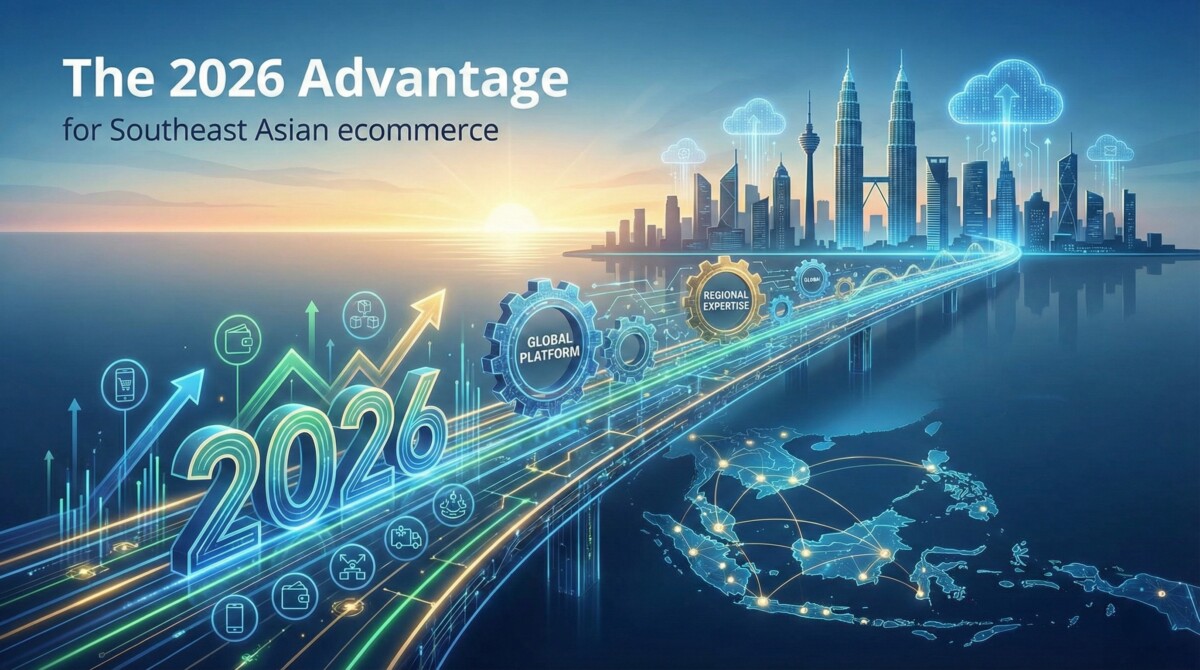
Southeast Asia’s ecommerce momentum is accelerating, not slowing. The macroeconomic forces driving growth – supply chain diversification, digital wallet adoption, mobile-first consumers, and B2B digital transformation – are structural changes that will define the next decade of commerce in the region.
Brands that migrate to modern platforms in 2026 position themselves to capture this growth rather than watch competitors take market share. The technology exists today: Shopify Plus handles global scale, and regional partners handle local execution. The integration of these two capabilities – global platform with regional expertise – determines who wins in ASEAN markets.
The question isn’t whether to modernize your ecommerce infrastructure. The question is whether to lead this transformation or follow after competitors have already captured the advantage.
Ready to explore what Shopify Plus migration could mean for your brand in Southeast Asia? Jumpstart Commerce has the regional expertise and technical depth to make it happen. As the only Shopify Platinum Partner in Southeast Asia, they’ve proven they can deliver enterprise-grade results with local market mastery across 800+ implementations.
Frequently Asked Questions
How long does a Shopify Plus migration actually take for a mid-sized ecommerce brand?
Most Shopify Plus migrations complete within 90 days for mid-sized brands with proper planning. The timeline includes data migration, payment gateway configuration, shipping integration, ERP connection, and testing. Brands with complex custom functionality or extensive product catalogs may require 120 days. The key factor is working with an experienced implementation partner who understands regional requirements – this eliminates the trial-and-error that extends timelines. Jumpstart Commerce has completed 800+ implementations across Southeast Asia, which means they’ve already solved the localization challenges that slow down generic implementation partners.
What’s the real cost difference between staying on a legacy platform versus migrating to Shopify Plus?
Shopify Plus pricing starts at $2,300 per month, which initially appears more expensive than self-hosted platforms. However, total cost of ownership tells a different story. Legacy platforms require dedicated server maintenance, security patches, custom development for basic features, and manual processes that consume staff time. Brands typically see 30% hosting cost reductions, 10+ hours per week saved on manual reconciliation, and significantly lower development costs for new features. The ROI calculation should include operational efficiency gains, not just platform fees. Most brands break even within 6-9 months when factoring in automation savings and conversion rate improvements.
Can Shopify Plus handle complex B2B requirements like custom pricing, approval workflows, and Net 30 payment terms?
Yes, Shopify Plus natively supports complex B2B requirements that previously required custom development. The platform handles company profiles with multi-user access, custom pricing per customer or customer group, wholesale price lists, contract-based pricing, purchase order management, Net 30/45 payment terms, and tax-exempt status automation. Shopify Flow enables custom approval workflows without coding – for example, orders over $10,000 can automatically route to sales managers for approval. The B2B functionality has matured significantly, with major wholesale distributors now running entire operations on Shopify Plus. The key is proper configuration during implementation, which is where regional expertise matters.
How do I handle payment gateways specific to Southeast Asian markets like PromptPay, TrueMoney, and GrabPay?
Southeast Asian payment gateway integration requires regional implementation partners who have existing relationships with local payment providers. Thailand requires Omise or 2C2P integration for PromptPay, TrueMoney Wallet, and local bank transfers. Malaysia needs integration with iPay88 or MOLPay for regional wallets. The Philippines requires PayMaya or GCash support. Each country has unique payment preferences – cash on delivery remains critical in some markets, while digital wallets dominate others. Generic Shopify Plus implementations typically only configure Shopify Payments and PayPal, which misses 60-70% of preferred payment methods in SEA markets. This is exactly why brands work with Jumpstart Commerce – they’ve already built the integrations and know the compliance requirements for each ASEAN country.
Will migrating to Shopify Plus hurt my current SEO rankings and organic traffic?
Properly executed migrations maintain SEO rankings through careful 301 redirect mapping, URL structure preservation, and technical SEO configuration. The risk comes from poor implementation – missing redirects, broken internal links, or lost metadata. Best practice includes crawling your current site to map all URLs, implementing 301 redirects for every page, preserving URL structure when possible, maintaining meta titles and descriptions, keeping internal linking architecture, and submitting updated sitemaps to Google Search Console. Shopify Plus actually offers SEO advantages: faster page loads from global CDN, mobile-optimized templates by default, and automatic technical SEO features. Brands typically see SEO improvements within 60-90 days post-migration due to better Core Web Vitals scores and mobile experience. The key is working with implementation partners who understand SEO requirements from day one.
