

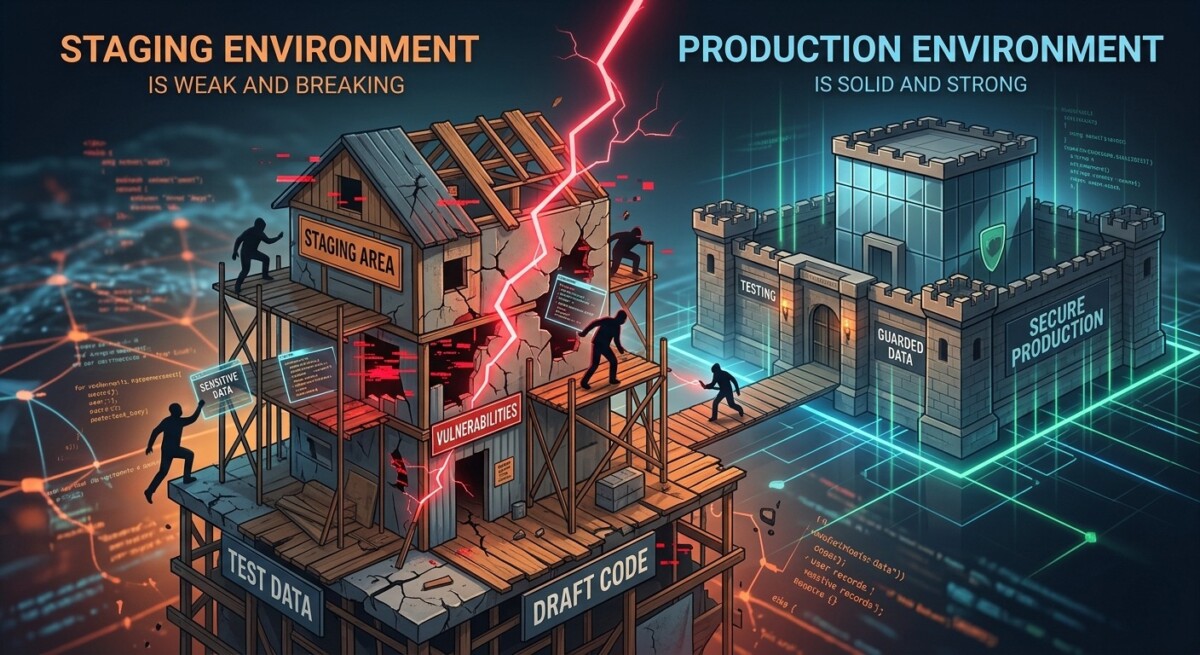
Staging environments cannot replicate the real data relationships, live integrations, and user behavior patterns that production-based attacks exploit. Security teams that test only in staging consistently miss business logic flaws, API vulnerabilities, and race conditions that only surface under live conditions, leaving a measurable gap between perceived security posture and actual exposure.
Attackers don’t operate in staging environments. They operate in production, against real data, real integrations, and real user behavior. Every hour your security testing doesn’t reflect those conditions is an hour of exposure you can’t measure.
Security leaders and ecommerce operators are being asked a harder question than ever before: are you validating real risk, or are you testing a controlled version of your application that doesn’t reflect how it actually behaves in the wild?
Most teams still treat staging environments as the foundation of their application security testing strategy. It feels structured, predictable, and safe. Code gets tested before release, vulnerabilities get flagged, and the team moves forward with confidence. The problem is that real-world breaches keep happening in production, not in staging. That gap is not a testing effort problem. It is a fundamental mismatch between where security testing happens and where risk actually lives.
Staging environments create a false sense of security because they validate a controlled system, not the real one. Security testing in staging confirms that known issues have been addressed and that common vulnerabilities have been checked under predictable conditions. What it cannot do is validate how your application behaves when real users, real data, and fully active integrations are all in play simultaneously.
This distinction matters more than most teams realize. Modern application security testing is not just about identifying vulnerabilities in isolation. It is about understanding exploitability, attack paths, and business impact, and those factors only emerge from real interactions across your full API surface, your live services, and actual user behavior patterns. When your team relies heavily on staging, they are effectively testing an approximation of your application. The result is a gap between your perceived security posture and your actual exposure in production, and that gap is where the risk accumulates invisibly.
For merchants running complex Shopify stacks with multiple third-party apps, custom API integrations, and checkout modifications, this approximation problem compounds quickly. Each new integration adds surface area that staging may not replicate with full fidelity, and each deployment that goes live without comprehensive validation extends the window of undetected exposure.
Staging environments fail to capture real-world security risk in three specific ways, and understanding each one equips you to have a more informed conversation with your development team or agency about where your current testing strategy falls short.
The first gap is real data and business logic context. In production, your application operates on live datasets that drive how business logic actually behaves. Access control decisions, transaction flows, and permission hierarchies are all shaped by this data. In staging, that data is sanitized or artificially generated, which is necessary for compliance but which also removes the complexity that surfaces high-impact vulnerabilities. Broken access control and privilege escalation issues, for example, often depend on specific data relationships that only exist in production. Without those relationships present during testing, these vulnerabilities remain hidden. This is why teams can pass every staging validation checkpoint and still experience a production breach tied to a business logic flaw that the staging environment never exposed.
The second gap is API coverage and integration depth. APIs are central to modern ecommerce architectures, and they are also one of the most targeted attack surfaces. Following a thorough API security testing checklist is a strong starting point, but in staging environments, APIs are frequently tested in isolation or with mocked integrations. This limits visibility into how services interact under real conditions, which means authentication, authorization, and service-to-service communication vulnerabilities get missed regularly. In production, where every integration is live and communicating, those gaps become exploitable. Attackers specifically target APIs because they know these areas are rarely tested with full context active.
The third gap is real user behavior and runtime conditions. Production systems are dynamic in ways that staging simply cannot replicate. They handle real traffic patterns, edge cases, and unexpected user interaction sequences. Issues like race conditions, workflow abuse, and logic manipulation often require real-world behavioral context to surface. Even continuous testing in a staging environment cannot reproduce this level of complexity, which leaves categories of critical risk with essentially zero coverage.
Point-in-time testing is increasingly ineffective in modern ecommerce development environments, and the core reason is deployment frequency. CI/CD pipelines enable teams to ship updates continuously, sometimes multiple times a day. But staging-based security testing is still performed at fixed checkpoints, typically a pre-release validation cycle. The moment a new deployment goes live, the previous test results are stale. New vulnerabilities may be introduced in that deployment, but they will not be detected until the next testing cycle begins.
That gap between deployment and detection is exactly where sophisticated attackers focus. They monitor application changes and actively look for newly introduced vulnerabilities, often exploiting them before security teams are aware they exist. In fast-moving development environments, vulnerabilities are not rare events. They are continuously introduced as part of normal development work, which means an organization without continuous detection in production is perpetually behind.
Alert fatigue compounds the problem further. Traditional staging-based security tools generate large volumes of alerts, but they rarely validate actual exploitability. Security teams spend significant time triaging findings, many of which are false positives or low-impact issues that do not reflect the real production attack surface. More importantly, these alerts lack production context. They cannot show how a vulnerability would be exploited in a live environment or what the actual business impact would be, which makes prioritization inconsistent and lets critical risks get buried under lower-priority noise.
Production security testing validates applications under real-world conditions while maintaining system stability, and the key word is “while.” The concern most teams raise when this topic comes up is disruption: testing in production sounds like it introduces operational risk. Production-safe approaches resolve this through controlled, non-destructive techniques that simulate real attack patterns without impacting system stability or user experience.
By performing production-safe penetration testing, organizations can validate complex vulnerabilities in live environments that would never appear in staging, specifically because those vulnerabilities depend on the conditions that only production provides: real data relationships, live integrations, and actual user behavior patterns. The testing is intelligent and targeted, not broad and disruptive. Rate limiting, non-destructive execution methods, and behavior-adaptive targeting keep systems stable throughout.
Continuous testing in production compounds the benefit. Instead of relying on periodic validation at fixed checkpoints, teams can detect vulnerabilities as they are introduced and validate them against real conditions immediately. This reduces the window of exposure from weeks or months to hours, and it creates faster feedback loops that allow developers to address issues before they have time to be exploited. For teams shipping frequent updates to a complex Shopify tech stack, this is where the shift from reactive to proactive security posture actually happens in practice.
AI-driven pentesting takes this further by simulating attacker behavior dynamically. Unlike traditional scanning tools, AI-driven systems can chain vulnerabilities, adapt to system responses in real time, and validate exploitability continuously rather than at a point in time. The practical output for your security team is a focus on vulnerabilities that are actually exploitable in your production environment, rather than a triage queue full of theoretical findings that may not reflect real risk.
Adopting production security testing delivers measurable benefits at both the operational and strategic level, and understanding both dimensions matters whether you are a CISO making the investment case or an ecommerce operator trying to evaluate what your agency or dev team is actually covering.
The most immediate benefit is real risk visibility in place of assumption-based reporting. When security testing happens in production, leaders gain direct evidence of what is actually exploitable in the live environment. This changes the nature of the conversation with executives and board members from “here is what we tested in staging” to “here is what we validated against our real attack surface.” Accurate risk prioritization follows from that, which means security investment gets directed toward the vulnerabilities that matter rather than the ones that are easiest to measure.
Faster remediation is the second tangible benefit. When vulnerabilities are identified in real-world conditions, developers receive actionable insights that reflect actual system behavior rather than staged approximations. The context is clearer, the priority is easier to establish, and the fix is easier to validate. Continuous testing with AI-assisted prioritization further compresses this cycle by surfacing exploitable vulnerabilities first rather than generating flat lists that require manual triage.
At the organizational level, production security testing also enables security to function as a business enabler rather than a development bottleneck. When security validation is integrated into the CI/CD pipeline and can run continuously in production without disrupting operations, it stops being the checkpoint that slows releases down and becomes part of the delivery process itself. For ecommerce teams under constant pressure to ship, this is a meaningful operational change.
Moving security testing closer to production requires strong governance to ensure safety, accountability, and operational alignment, and this is the conversation to have with your development team or agency before anything else changes.
Start with scope definition. Clear guidelines must establish what is and is not in scope for production testing, what execution parameters apply, and how testing activity is bounded so that it cannot impact system performance or user experience. These boundaries are what make production testing safe rather than risky, and they need to be documented and agreed upon before the first test runs.
Auditability is the second governance requirement. All testing activities must be logged and documented, creating a clear trail that supports both compliance reviews and internal accountability. Transparency across teams is what converts “testing in production” from a phrase that sounds alarming into a practice that is recognized as controlled and evidence-based.
The third governance consideration is alignment with your existing engineering and operations workflows. Production security testing only works if it is integrated into CI/CD pipelines, monitoring systems, and incident response processes rather than running in parallel as a separate function. Collaboration between security and engineering teams is what makes findings actionable quickly. Without that integration, even the best production testing program produces findings that sit in a queue rather than getting addressed at the point where they can be fixed most efficiently.
It is also worth being clear that production-safe testing approaches are specifically designed to manage the perceived risk of testing in live environments. Non-destructive execution methods, intelligent targeting, and rate limiting ensure system stability throughout. This is not a situation where you are choosing between security coverage and operational stability. The production-safe approach is built to deliver both simultaneously.
Staging environments still play a valuable and legitimate role in a mature security testing strategy. They are the right place for functional validation, performance testing, and early-stage security checks that do not require production conditions to be meaningful. The problem is not that staging exists. It is that staging has been treated as the primary source of security assurance when it was only designed to be a pre-production checkpoint.
A modern strategy combines staging validation with continuous testing and production security testing to achieve full coverage. Staging catches the issues that are predictable and testable in controlled conditions. Production testing catches the issues that only emerge under real conditions. Neither replaces the other. The shift is in treating production testing as a first-class component of the strategy rather than an advanced add-on for organizations with unlimited security budgets.
For merchants managing complex Shopify tech stacks, the practical starting point is a conversation with your development team or agency about what your current testing coverage actually includes, where the staging-to-production gap exists in your specific architecture, and what continuous validation looks like for the integrations and APIs that carry the most business risk. That conversation is more valuable than any single tool change, because it surfaces where the real exposure is before an attacker finds it first.
Staging security testing validates your application in a controlled pre-production environment, while production security testing validates it under real-world conditions with live data, active integrations, and actual user behavior present. Staging testing confirms known issues have been addressed. Production testing reveals vulnerabilities that only emerge when all real-world variables are simultaneously active, which is a category of risk that staging cannot replicate by design. The gap between the two is where most modern application breaches originate.
Production-safe security testing is designed specifically to validate real-world risk without disrupting operations or impacting customer experience. Non-destructive execution methods, rate limiting, and intelligent targeting keep systems stable throughout the testing process. The key is working with a provider that has established production-safe protocols and can clearly articulate what execution boundaries apply. Before any production testing begins, scope definition and execution parameters should be documented and agreed upon by your security, engineering, and operations teams.
Merchants shipping frequent updates to their Shopify tech stack, particularly those with custom API integrations or third-party app dependencies, should move toward continuous security testing rather than periodic point-in-time assessments. Each new deployment introduces potential new vulnerabilities, and the window between deployment and detection is where attackers focus. Teams using CI/CD pipelines should treat security validation as part of the deployment cycle, not as a separate quarterly exercise. For merchants with simpler stacks and less frequent updates, quarterly penetration testing at minimum is the appropriate starting baseline.
Staging-based testing consistently misses vulnerabilities that depend on real data relationships, such as broken access control and privilege escalation issues that require production data to manifest. It also misses API vulnerabilities that only emerge when all service-to-service integrations are live simultaneously, race conditions and timing-dependent exploits that require real traffic patterns, and business logic flaws tied to specific user behavior sequences. These are not edge cases. They represent a meaningful portion of the attack surface for any ecommerce application running a complex integration stack.
AI-driven pentesting improves on traditional tools by simulating attacker behavior dynamically rather than executing a fixed set of predefined tests. Traditional tools run the same checks in the same sequence and return the same categories of findings regardless of how the application responds. AI-driven systems can chain vulnerabilities, adapt their approach based on real-time system responses, and validate exploitability in context. The practical output is a higher signal-to-noise ratio: fewer false positives, clearer exploitability evidence, and prioritized findings that reflect the actual risk in your production environment rather than a theoretical list of potential issues.





