
Verified & Reviewed
Published on December 11, 2025 Written By Meredith Flora

Published on December 11, 2025 Written By Meredith Flora

Subscribe for More
Relocating a warehouse requires careful planning and precise execution. Whether you’re expanding, consolidating, or seeking a better location, the process involves more than just moving inventory; it demands managing logistics challenges from inventory audits to customer communication. Without proper preparation, warehouse moves can disrupt operations and increase costs.
This guide provides strategies and best practices for ecommerce brands needing more space, retailers optimizing distribution, and businesses improving efficiency.
Why you might relocate your warehouse
Warehouse relocation is the process of moving inventory, equipment, operations, and staff from one facility to another.
Several common drivers may prompt a business to consider relocating their warehouse:
- Business growth and the need for expanded capacity: As a business grows and order volumes increase, the existing warehouse may no longer have sufficient space or infrastructure to support the expanding operations. Moving to a larger facility enables the business to accommodate current and future growth.
- Operational efficiency improvements: Relocating to a warehouse with a more optimal layout, advanced technology, or better access to transportation routes can significantly enhance operational efficiency. Improved processes and modern facilities lead to faster order ecommerce fulfillment, reduced errors, and lower operating costs.
- Cost reduction opportunities: Businesses may choose to relocate to areas with lower real estate costs, more favorable utility rates, or access to a more affordable labor pool. Reducing these key expenses can significantly impact the bottom line.
- Strategic positioning closer to customers or suppliers: Relocating warehouses to be closer to key customers or suppliers can improve delivery times, reduce transportation costs, and enhance service levels. This strategic positioning is particularly important for companies that prioritize fast shipping or just-in-time inventory management.
- Consolidation of multiple facilities: Some businesses may find themselves with multiple warehouses due to legacy systems or fragmented growth. Consolidating these facilities into a single, centralized warehouse can streamline operations, reduce redundancies, and improve inventory control.
- Upgrading to modern facilities with better technology infrastructure: Older warehouses may lack the advanced features and technology needed to support modern ecommerce operations. Relocating to a newer facility equipped with a robust warehouse management system (WMS), automation capabilities, and seamless integration with other business systems can unlock significant efficiency gains and scalability.
When considering a warehouse move, businesses must evaluate their in-house resources and expertise to determine whether they can manage the relocation internally or if partnering with a third-party logistics provider (3PL) would be more beneficial. Fulfillment providers like ShipBob offer extensive experience in warehouse transitions, along with a network of modern facilities and advanced technology to support a seamless relocation process.
Planning your warehouse transition: Key considerations before moving
Successful warehouse moves begin with thorough planning months in advance. Proper planning minimizes operational disruptions, inventory issues, and customer impact. This section will help you establish the groundwork before executing the actual move.
Establish a realistic timeline
Creating a comprehensive timeline is crucial for a successful warehouse transition. Start by working backward from your target move date, and begin planning 6-12 months before the intended relocation. Your timeline should include critical milestones and deadlines, such as:
- Conducting an inventory audit
- Evaluating technology and system requirements
- Selecting a moving company
- Notifying customers and suppliers
- Setting up the new warehouse layout
Be sure to build in buffer time for unexpected delays, as even the most well-planned moves can encounter challenges.
Conduct a thorough inventory audit
Before you start packing, it’s essential to know exactly what needs to be moved. Conduct a thorough inventory audit to categorize your stock into fast-moving, slow-moving, and obsolete items. This is also an excellent opportunity to identify and liquidate any dead stock, reducing the amount of inventory you need to move.
During the audit, document your current storage systems and requirements. This information will be valuable when designing the layout of your new warehouse and ensuring that you have the necessary storage equipment and space.
Evaluate technology and system requirements
Your warehouse management system (WMS) and other technologies are critical to the smooth operation of your facility. As part of your planning process, assess your current systems to determine if they will transfer seamlessly to the new location. Consider factors such as:
- Compatibility with the new warehouse’s IT infrastructure
- Scalability to accommodate future growth
- Integration with other systems, such as your ecommerce platform or ERP
If your current systems are outdated or inadequate, the relocation may be an ideal time to upgrade to more advanced solutions. When evaluating new technologies, consider factors such as ease of use, real-time inventory visibility, and the ability to support complex fulfillment strategies.
Don’t forget to plan for the physical aspects of your technology setup, such as internet connectivity, hardware installation, and system testing. Allocate sufficient time in your timeline for these tasks to ensure a smooth transition.
By thoroughly planning your warehouse transition and considering these key factors, you’ll lay the foundation for a successful move. In the next section, we’ll dive into the essential steps of a warehouse move checklist to ensure that you don’t overlook any critical tasks.
7 essential steps for a warehouse move checklist
A structured warehouse transition plan is critical for success, so we’ve put together a seven-step checklist offering a systematic approach to your relocation, with each step building on the previous one.
Following this framework can help prevent inventory discrepancies and bottlenecks while protecting product integrity, and also reduce costly downtime that affects customer satisfaction and revenue.
Whether you’re handling the move yourself or working with logistics partners, this roadmap will guide you through planning, execution, and optimization to keep your business running smoothly throughout the transition.
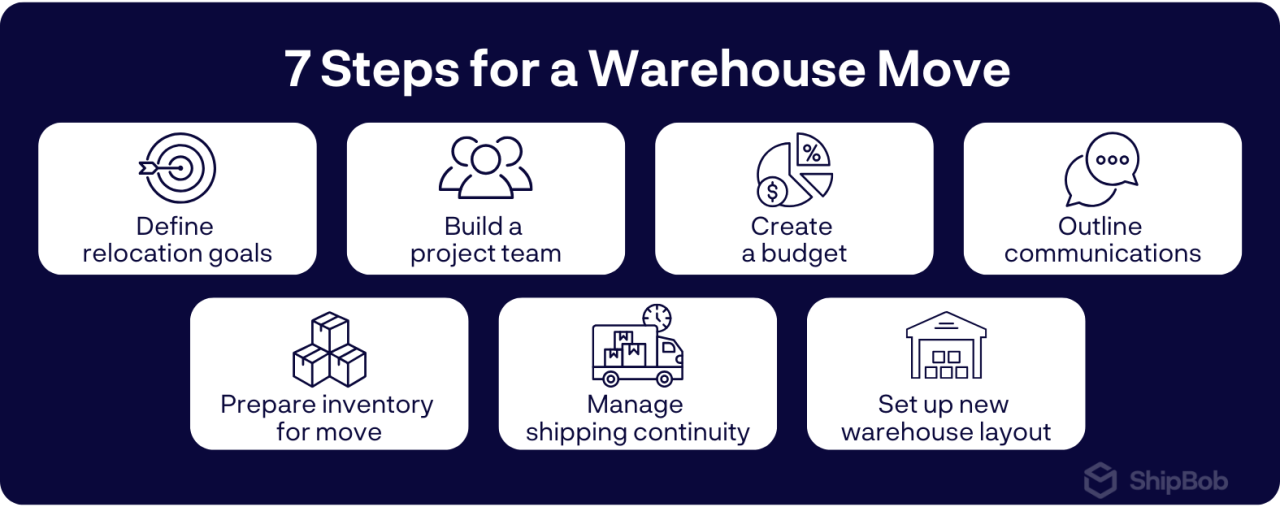
1. Assess the current warehouse and define relocation goals
Start by conducting a detailed audit of your inventory, equipment, systems, and workflows. Document each element meticulously, capturing critical details like inventory quantities, equipment condition, and operational procedures. This documentation ensures you can replicate or even enhance your existing processes in your new facility.
Clearly define your relocation objectives, whether it’s cost savings, efficiency improvements, or expanded capacity. Setting measurable key performance indicators (KPIs) such as reduced order processing time, increased throughput, or decreased inventory shrinkage will provide tangible metrics to gauge the success of your move.
2. Build your project team and assign a relocation manager
Selecting the right project team is critical. Include representatives from operations, IT, inventory management, customer service, and logistics to cover all aspects of the relocation. Appointing a dedicated relocation manager is equally essential; this person will coordinate activities, manage timelines, and serve as the primary decision-maker.
Clearly delineate roles, responsibilities, and decision-making authority within your team. Regularly scheduled meetings should be implemented to track progress, address challenges promptly, and maintain alignment across departments.
3. Plan your budget and identify hidden costs
Budgeting accurately is crucial to prevent financial surprises. Include expenses such as moving services, equipment rentals, temporary storage, new shelving systems, technology setup, production downtime, and additional labor costs.
Also consider commonly overlooked expenses, such as utility deposits, permit fees, signage, and IT infrastructure setup costs.
4. Outline a communication strategy
Clear communication is vital during warehouse relocation to keep all stakeholders informed and prepared. Your plan should address internal teams, external partners, and customers who might experience service changes.
Start by identifying key stakeholders:
- Internal: warehouse staff, customer service, and sales/marketing teams
- External: suppliers, carriers, and 3PL partners
- Customers: both B2B clients and D2C customers
Create a communication timeline aligned with your move that includes:
- Initial move announcement
- Regular updates
- Service interruption alerts
- Completion confirmation
Tailor messages for each group:
- Internal teams need role instructions and process changes
- External partners need advance notice and updated contact information
- Customers need transparent updates about potential delays with reassurance
Develop templates for different communications and use appropriate channels (email, website updates, social media) based on your operation’s scale. Prioritize proactive, transparent communication throughout the process to maintain trust and minimize disruption.
5. Prepare and pack inventory efficiently
Efficient inventory preparation and packing is essential for a smooth warehouse transition. Properly categorizing, labeling, and sequencing your inventory minimizes damage, loss, and confusion during the move.
Start by categorizing inventory by:
- SKU or product type
- Sales velocity (fast-moving, slow-moving, obsolete)
- Storage requirements (temperature control, hazardous materials, etc.)
Implement these labeling and packaging best practices:
- Use durable, waterproof labels with scannable barcodes
- Apply labels on all sides of packages
- Choose appropriate protective materials based on product fragility
- Secure packages with quality tape and reinforce weak points
Create a detailed inventory manifest for each box or pallet that includes:
- SKU numbers and descriptions
- Item quantities
- Box/pallet numbers
- Final warehouse destination
Conduct regular inventory counts throughout the process to quickly identify and resolve any discrepancies.
6. Manage shipping and fulfillment continuity
Maintaining shipping and fulfillment during relocation is crucial to minimize customer disruption and protect your brand reputation.
Implement a staggered moving plan by:
- Gradually transferring inventory while maintaining buffer stock at the old location
- Processing orders from both facilities simultaneously
- Routing high-priority orders to the most efficient location
Build up inventory of fast-moving items before the move to prevent stockouts during transition. Be proactive about adjusting processing timelines and communicating any potential delays to customers. Establish a clear plan for handling returns during the move, whether through a temporary processing location or extended return windows.
Prioritize critical orders based on value, customer importance, or delivery promises. By segmenting and addressing these orders first, you’ll maintain service for your most valuable customers.
7. Set up the new warehouse layout for improved efficiency
Your new warehouse layout is a chance to optimize operations and boost efficiency. Design a layout that streamlines product flow, maximizes storage, and supports your business needs for long-term success.
First, analyze your current layout to identify bottlenecks and inefficiencies. Consider:
- Product flow from receiving to shipping
- Storage density and space utilization
- Picking paths and travel times
- Equipment and technology needs
- Staff safety and ergonomics
Use these insights to create a streamlined layout that minimizes travel time and maximizes productivity.
Next, develop a floor plan showing key areas:
- Receiving and shipping docks
- Storage racks and shelving
- Picking and packing stations
- Returns processing area
- Office space
Use various storage systems (racks, shelving, bins) for different product types, allocate space based on inventory volume, and plan for growth.
Position fast-moving products near packing and shipping areas to reduce travel time. Use slotting optimization and ABC analysis to place products based on demand.
Implement a warehouse management system (WMS) to:
- Track inventory in real-time
- Optimize picking routes
- Automate order processing
- Analyze performance metrics
Before full launch, test your layout with trial runs using a subset of inventory and staff. Gather feedback and make adjustments to ensure a smooth transition.
Looking for a new warehouse management system?
ShipBob WMS has become the top platform to increase accuracy, gain visibility, and improve productivity. Power your warehouse operations with the same software used to manage inventory and fulfill orders for thousands of brands at ShipBob’s 60+ warehouses around the globe.
Advanced strategies for a smooth warehouse transition
Warehouse relocations go beyond basic checklists. Implementing advanced strategies can significantly mitigate risks and enhance outcomes, allowing your business to operate seamlessly throughout the transition.
Integrating relocation and expansion for a multi-warehouse strategy
Consider your relocation as part of a broader distribution strategy. Maintaining multiple facilities during your move can eliminate single points of failure. Phased relocations allow continuous operations, enhancing market reach and service levels simultaneously. Companies leveraging ShipBob’s network model benefit from this distributed approach, maintaining continuity and efficiency.
Use advanced data and analytics for a seamless move
Harness advanced analytics for a smooth relocation. Employ inventory forecasting to determine optimal moving periods, and use real-time visibility tools to track assets. Predictive analytics can identify potential bottlenecks, allowing proactive adjustments to timelines and resource allocation. ShipBob’s analytics dashboard provides comprehensive visibility during these critical periods.
Combining 3PL expertise with in-house operations for a hybrid approach
Balancing in-house management with third-party logistics (3PL) expertise can simplify complex relocation tasks. Tasks like freight coordination, warehouse layout design, and system integrations benefit greatly from specialized fulfillment and logistics support, providing a balance of control, transparency, and cost-efficiency. ShipBob’s flexible partnership model is an exemplary hybrid approach.
Utilizing distributed fulfillment to maintain 2-day shipping throughout the move
Maintain service levels through temporary order routing, split fulfillment, or leveraging a fulfillment network. Distributed fulfillment strategies prevent disruptions, maintaining consistent 2-day shipping capabilities. ShipBob’s extensive fulfillment network supports businesses in maintaining customer satisfaction throughout transitions.
Leveraging a global fulfillment network for international relocations
International relocations come with unique logistical challenges. Utilize established carrier partnerships and multi-country warehousing to facilitate smooth international logistics. Consider customs, compliance, and localization aspects. ShipBob’s global fulfillment expertise supports seamless cross-border warehouse transitions.
Sustaining brand loyalty through transparent customer communication
Prioritize proactive customer messaging during your move. Provide regular updates, maintain accurate tracking, and clearly communicate any disruptions. Automated communication tools, such as those available through ShipBob’s technology platform, ensure customers remain informed, preserving trust and brand loyalty.
Future-proofing with scalable tech and flexible lease options
Avoid frequent relocations by adopting cloud-based WMS solutions adaptable to changing warehouse configurations. Flexible storage arrangements and scalable fulfillment capacities eliminate the need for constant facility changes. ShipBob’s scalable fulfillment model adapts seamlessly, supporting growth without the constraints of traditional warehousing.
By employing these comprehensive and strategic steps, your business can navigate warehouse relocation smoothly, minimizing disruption and positioning for sustained growth and operational excellence.
How to choose between DIY relocation and outsourcing to a fulfillment partner
Deciding whether to manage your warehouse relocation in-house or outsource it to a 3PL is a critical decision point for businesses. Factors to consider include cost, expertise, time, and strategic focus. While both approaches have their merits, it’s important to weigh the pros and cons in the context of your specific business needs.
Benefits of DIY warehouse relocation
Managing a warehouse move in-house offers several advantages, including:
- Complete control over the process and timeline: By keeping the relocation entirely in-house, businesses maintain full control over every aspect of the move, from planning to execution.
- Potential cost savings for businesses with moving expertise: Companies with existing logistics expertise and resources may find that managing the move themselves is more cost-effective than outsourcing.
- Opportunity for staff to gain valuable experience: A DIY relocation can provide hands-on learning opportunities for employees, helping them develop new skills and expertise.
- Greater flexibility for last-minute changes: When managing the move internally, businesses have more flexibility to adapt to unexpected changes or last-minute adjustments.
DIY warehouse relocation may be the most suitable option for smaller operations or businesses with specialized inventory that requires unique handling.
Advantages of partnering with a fulfillment provider for your warehouse transition
Outsourcing your warehouse relocation to a fulfillment provider like ShipBob can offer several benefits, including:
- Expertise in logistics and inventory management: Fulfillment providers have specialized knowledge and experience in managing complex logistics operations, ensuring a smooth and efficient transition.
- Established facilities and technology infrastructure: By leveraging a fulfillment provider’s existing network of warehouses and advanced technology systems, businesses can avoid the capital expenditure associated with setting up new facilities.
- Reduced capital expenditure on warehouse space and equipment: Outsourcing to a fulfillment partner eliminates the need for significant upfront investments in warehouse space, equipment, and technology.
- Scalable capacity that grows with business needs: 3PLs offer flexible storage and fulfillment options that can adapt to changing business requirements, allowing for seamless growth without the need for repeated relocations.
- Ability to maintain continuous operations during transition: By leveraging a fulfillment partner’s distributed network, businesses can maintain uninterrupted fulfillment operations throughout the relocation process.
Partnering with an expert fulfillment provider like ShipBob can simplify the relocation process, providing access to resources, expertise, and infrastructure that may be challenging to develop in-house.

How ShipBob supports seamless warehouse transitions
ShipBob is a leading fulfillment platform that offers a range of solutions to support businesses through warehouse transitions. Whether you’re looking to completely outsource your fulfillment operations or enhance your existing warehouse setup with advanced technology, ShipBob has the expertise and resources to help.
Streamline inventory transfers with ShipBob’s network
ShipBob’s warehouse receiving order (WRO) process ensures smooth inventory intake and seamless transfers between fulfillment centers. By leveraging ShipBob’s distributed network, businesses can maintain continuity and minimize disruptions during warehouse transitions.
Enhance visibility with ShipBob’s technology platform
ShipBob’s proprietary technology platform provides real-time inventory visibility, simplifying transitions and reducing uncertainty. With robust integration capabilities and data-driven insights, businesses can make informed decisions and adapt quickly to changing circumstances during a relocation.
Scale globally with ShipBob’s fulfillment infrastructure
ShipBob’s international fulfillment network and established carrier relationships make it easier for businesses to expand globally without the need for significant infrastructure investments. By partnering with ShipBob, companies can test new markets and scale their operations seamlessly, avoiding the challenges of repeated warehouse relocations.
Get started with ShipBob
Learn more about ShipBob’s fulfillment solutions and get started.
Warehouse relocation FAQs
Below are more answers to common questions and challenges that we see arise with warehouse relocation.
Why do businesses relocate their warehouses?

Businesses relocate warehouses to optimize operations and support growth. Key reasons include expanding for more inventory space, cutting costs with cheaper locations, positioning closer to customers or suppliers, upgrading to modern facilities with better technology, addressing property issues, or consolidating after mergers.
The decision ultimately comes down to assessing both current and future needs to improve efficiency, reduce costs, and enhance customer service.
How long does a typical warehouse relocation take?
Warehouse relocations typically require 3-6 months for planning and 1-4 weeks for the actual move, depending on your operation’s size and complexity. Timeline factors include inventory volume, distance between locations, available resources, and any renovations needed at the new facility. Always build buffer time into your schedule for unexpected delays and maintain close coordination with all stakeholders.
How can I maintain order fulfillment and prevent shipping delays during a move?
To maintain order fulfillment during a warehouse move, consider these key strategies: implement a phased approach by gradually transferring inventory while keeping partial operations running at both locations; build inventory buffers before the move to cover disruptions; temporarily outsource fulfillment to a 3PL partner; and communicate clearly with customers about potential delays. ShipBob’s network and technology can help ensure business continuity throughout the relocation process.
What is the best way to communicate relocation updates to customers?
Communicate with customers proactively and transparently about your warehouse relocation. Use multiple channels, such as email announcements, website banners, and order/shipping notifications, to reach all customers. Start with an advance announcement, provide regular updates during the move, and send a completion notice when finished. Be honest about potential delays and set realistic expectations for service resumption. Keeping customers informed throughout demonstrates your commitment to transparency and quality service.
How does ShipBob’s technology help manage multi-warehouse moves?
ShipBob’s technology platform simplifies managing inventory across multiple warehouses during relocations. It offers real-time visibility into inventory, orders, and fulfillment across all locations, letting you track assets throughout your transition.
Features like automatic order routing and inventory distribution prevent stockouts and overstocking between facilities. With seamless integration to major ecommerce platforms, orders continue processing efficiently during your move. This technology helps businesses complete multi-warehouse relocations with better precision, speed, and reliability.
Can ShipBob handle partial or phased relocations?
Yes, ShipBob handles partial or phased warehouse relocations with ease. Our flexible model supports both gradual inventory transfers and hybrid operations where some products remain in your facility while others move to our network.
Our fulfillment experts create customized relocation plans tailored to your specific needs, including coordinating inventory transfers, setting up staging areas, and adapting workflows for a smooth transition. With ShipBob’s support, you can complete your phased relocation while minimizing disruption to operations and customer service.
How do I handle returns and exchanges if I’m in the middle of a warehouse transition?
Handling returns during a warehouse move requires strategic planning. Set up a temporary processing area, either a small satellite location or a dedicated space in your new warehouse, to manage incoming returns smoothly.
Ensure returns reach the right location through clear customer communication and proper labeling. Consider assigning specific staff to handle returns during the transition to prevent backlogs, or outsource returns management temporarily to free up your team.
ShipBob offers comprehensive returns management services that can streamline this process during your warehouse transition. Their technology and expertise help maintain seamless customer experiences even during your move.