




Key Takeaways
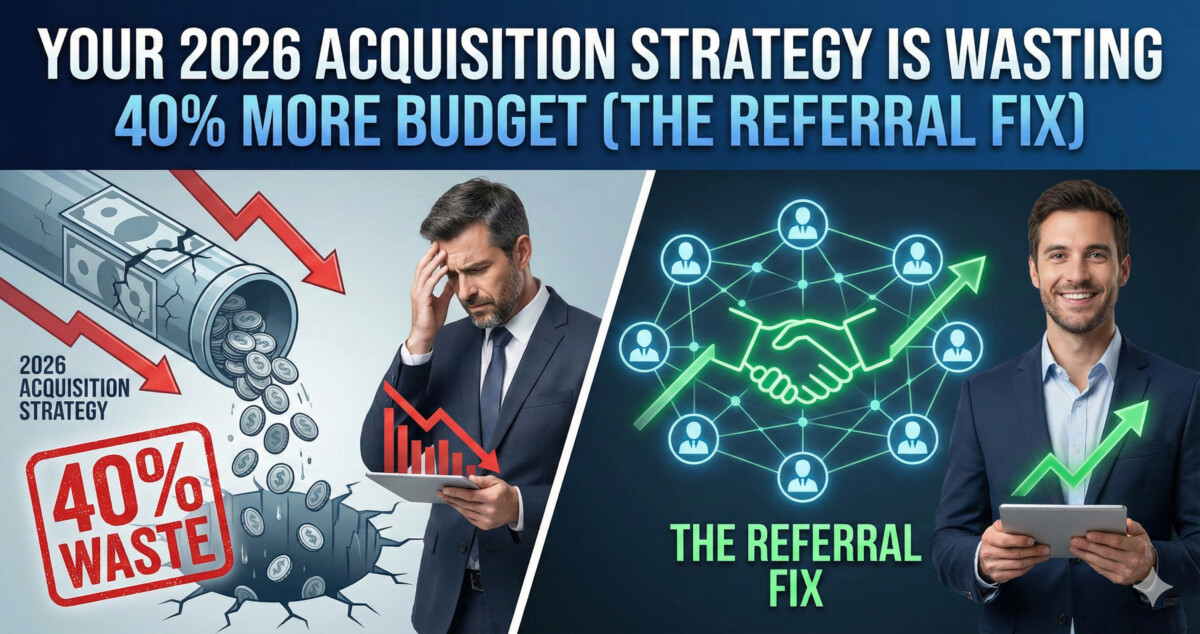
- Build a referral engine in Q1 so you win customers at 20% to 50% lower CAC than brands that keep bidding up ads.
- Follow a 12-week rollout (baseline in weeks 1-2, build in 3-4, test in 5-8, scale in 9-12) to make referrals a steady acquisition channel.
- Ask happy customers to refer after delivery with clear rewards and simple rules, so your team feels less pressure and shoppers feel valued.
- Treat your best customers as your distribution by turning one great purchase into friend-to-friend sales that get cheaper as your customer base grows.
If your Q1 plan is “push harder on paid,” you’re probably about to pay more for the same customers.
Ecommerce CAC keeps creeping up for predictable reasons: privacy limits, more brands bidding on the same audiences, and ad fatigue that makes yesterday’s creative look invisible today.
I’ve seen this pattern across hundreds of founder conversations on eCommerceFastlane, from scrappy Shopify startups to teams doing eight figures. The brands that win don’t magically find cheaper ads. They fix the math by adding at least one acquisition channel that scales with their customer base.
Here’s the core promise: a referral engine can reduce CAC (often 20% to 50% vs paid) and bring higher-quality customers, if you build it like a system, not a pop-up.
A quote worth stealing for your Q1 planning doc:
If your CAC is up and your ROAS is down, the fix is not just better ads, it is adding a compounding channel like referrals.
This isn’t about gimmicks. It’s incentives, timing, tracking, fraud controls, and weekly iteration.
The Real Cost of Ignoring Referral Economics
Pure paid acquisition gets more expensive because the auction gets tighter every quarter, and measurement gets noisier. The result feels maddening: you spend more, your dashboards look “fine,” and your profit still drops.
In early 2026, reported ecommerce CAC benchmarks vary widely by model and category. Many brands still anchor their forecasts to older “DTC CAC” folklore (like the $50 to $80 days) and then wonder why Q1 budgets blow up by March. Some current benchmark sets put DTC CAC in the $130 to $156 range, with “lower-CAC” models like marketplaces closer to $72. The exact number isn’t the point, the direction is.
The strategic issue is Q1 planning. If you budget using last year’s CAC assumption, you can overspend and still miss growth targets because your plan was built on a number that no longer exists.
The practical takeaway: you need at least one acquisition channel that gets cheaper as your customer count grows. Referrals do that because your best customers become your distribution.
If you want a clean way to pressure-test your acquisition assumptions before you lock Q1 spend, start with a tighter model like this step-by-step guide to building a better customer acquisition model.
Where your paid acquisition dollars are actually going
This is where the money leaks, even in “well-run” accounts:
Privacy changes limit tracking. iOS prompts and cookie changes mean fewer clean signals, which pushes platforms toward broader targeting and modeled attribution. That’s not evil, it’s just the new default. You can read the platform direction straight from the source in Apple’s App Tracking Transparency overview and Google’s Privacy Sandbox.
Platforms also push broad targeting because it keeps delivery stable. Stable delivery is great, until your “prospecting” starts behaving like “retargeting in disguise.”
Without clean attribution, brands often double pay for customers they would’ve gotten anyway, especially when retargeting pools, branded search, and returning buyers get mixed into the same reporting story.
Three quick signs you’re overspending:
- Your CPMs or CPCs rise, but conversion rate stays flat.
- You need more spend just to hold revenue steady.
- Your LTV:CAC gets worse, even when ROAS looks “acceptable.”
The hidden multiplier effect of referral customers
Referral customers usually walk in with trust already built. That changes everything.
Directionally, paid click traffic might convert at 1% to 5% on a cold session for many DTC stores. Referral-driven traffic can convert far higher (often 10% to 30%), because the “why should I trust you?” question was answered by a friend before the first click.
The bigger win isn’t only CAC. It’s behavior.
Research and case studies often show referred customers retain 16% to 25% better, and in some businesses, referred cohorts drive 2x+ lifetime value. Results vary by category and execution, but the direction is consistent: trust reduces friction, and lower friction tends to produce more repeat buying.
If you’re serious about building this into a real channel, don’t skip the landing page. Most “referral programs” underperform because the page is confusing or buried. Use this checklist on referral landing page best practices before you touch incentives.
Why Q1 is Your Strategic Window
Q1 is when disciplined operators build systems, then scale them later. That sounds obvious, yet many teams treat Q1 like a revenue hangover where you “make up for December” by raising spend.
Here’s the trade-off: if you wait until Q2 to launch referrals, you’ll still be learning during the exact months you want predictable growth (Q2 and Q3). Referrals need time because you’re training customer behavior and dialing in incentives, messaging, placements, and fraud rules.
Compounding matters here. A referral engine is like planting a tree, not buying a gallon of water. Setup work in January means more advocates by the time you ramp spend later.
A simple planning rule that holds up across stages: measure and test in Q1, then scale winners in Q2 to Q3.
For a broader view on what else belongs in your first-quarter stack (beyond referrals), this pairs well with the Q1 2026 playbook for integrated growth.
The myth of Q1 as a slow quarter
Smart brands use Q1 to fix fundamentals because the penalty for mistakes is lower than peak season.
Stage-aware view:
- If you’re early, Q1 is for basics: tracking, offer clarity, email flows, and a clean post-purchase experience.
- If you’re in growth, Q1 is for unit economics: cohort LTV, contribution margin, and channel mix.
- If you’re scaled, Q1 is for repeatable systems across teams: weekly metrics, creative cadence, attribution triangulation, and clear channel owners.
Referrals fit each stage, but the build looks different.
Setting up referral infrastructure before you need it
“Infrastructure” sounds heavy, but it’s just the parts that stop referrals from becoming chaos:
Incentive rules, fraud protection, tracking links or codes, a landing page, post-purchase asks, and reporting you can trust.
The biggest mistake I see is treating this like an app install. Setup takes time because you have to test incentive size and timing, not just turn on a widget.
Aim for a stable baseline before peak scaling, even if baseline is small. A boring, predictable 5% referral contribution beats a flashy launch that breaks under load.
Referral CAC vs Paid Channel Reality Check
Referral programs feel “cheap,” until you count incentives, tools, and team time. Paid channels feel “predictable,” until you count wasted retargeting and rising auctions. You need a clean comparison you can plug into a spreadsheet.
Definitions that keep the math honest:
- Paid CAC: ad spend (plus fees) divided by new customers from that channel.
- Referral CAC: reward cost paid out per referred order, plus platform cost, plus ops time (valued realistically).
- Blended CAC: total acquisition spend divided by total new customers.
A practical success threshold I like: your referral CAC should be at least 20% lower than blended CAC, and your referred customer LTV should be at or above paid LTV.
Here’s a quick comparison frame you can reuse:
The numbers to benchmark (CAC, conversion, and ROI)
Keep these benchmarks as directional guardrails, not promises:
- Paid CAC: many brands now see DTC acquisition costs in the $130 to $156 range in external benchmark sets, while some models report lower.
- Referral CAC: referral programs often land 20% to 50% below paid CAC when properly set up.
- Referral conversion rate: typically far higher than paid sessions (trust does the heavy lifting).
- Why ROI looks better: higher trust often means higher conversion and better retention.
If you’re tracking the right acquisition KPIs weekly, it becomes obvious faster whether referrals are actually improving unit economics. This is a good companion list of customer acquisition metrics you should track.
Why referrals can still win even when you pay incentives
The cleanest structure for ecommerce is usually double-sided: reward the advocate and the new customer.
Example with round numbers:
- Your paid CAC is $80 (all-in).
- You offer $10 to the advocate and $10 to the friend.
- Incentive cost is $20 per referred order.
Even after paying incentives, you can still beat paid CAC because you didn’t buy impressions for weeks, pay for clicks that bounced, and pay again via retargeting to close someone who was already leaning in.
Guardrails that stop this from turning into a coupon leak:
- Cap rewards per advocate per month.
- Require a real purchase (no email-only rewards).
- Block self-referrals and obvious fraud patterns.
- Set minimum order values and exclude gift cards when needed.
On the measurement side, if you’re sending server-side events to improve conversion reporting, Meta’s Conversions API docs are worth skimming so you understand what’s modeled vs observed.
The Referral Fix: A Stage-Specific Playbook
Referrals work when they feel like a natural extension of being happy with the product. That means the “ask” timing and the reward both match the customer’s emotional state.
After hundreds of conversations with operators, the pattern is clear: brands that treat referrals like a real channel (owner, weekly review, tests) get compounding results. Brands that treat it like a campaign get a spike, then silence.
A referral program becomes predictable when you control four levers: incentive, timing, visibility, and verification (tracking plus fraud rules).
For Shopify teams that want an app as the backbone, ReferralCandy is a common option because it supports tracked links and codes, automated emails, fraud controls, analytics, and integrations. You can verify current plan details on ReferralCandy pricing before you model costs.
Starter Stage Playbook ($0 to $500K)
Your job here is proof, not perfection.
Keep it simple:
- One offer.
- One referral landing page.
- One post-purchase ask.
Incentive sizing: keep total incentive value within 15% to 20% of AOV. If AOV is $60, start testing around $8 to $12 total value per side (or a similar structure that fits margin).
Target outcome once it’s working: 5% to 10% of new customers coming from referrals.
What to avoid at this stage: too many reward choices, long rules pages, and asking too early (before the customer is happy). Wait until delivery is confirmed or the customer has had a chance to use the product.
If you’re unsure whether you should run referrals, affiliates, or both, this breakdown helps clarify the roles: referral vs affiliate programs for Shopify.
Growth and Scale Playbook ($500K to $5M, and $5M+)
At this stage, the work shifts from “does it work?” to “can it scale without getting sloppy?”
For $500K to $5M:
- Add tiered rewards for advocates who refer multiple friends.
- Segment by cohorts (high-LTV customers get the best prompts).
- Track referred LTV vs paid LTV, not just first order.
- Add automated email and SMS flows so the program stays visible.
Target: 10% to 20% of acquisition from referrals, with referral CAC often 30%+ below paid when optimized.
For $5M+:
- Add VIP or ambassador tiers tied to loyalty status.
- Personalize incentives by segment (not everyone needs the same discount).
- Tighten attribution so finance trusts the numbers.
- Increase fraud controls as volume grows.
Target: 15% to 25%+ of acquisition from referrals.
Operations note: assign a single owner, set a weekly 30-minute review cadence, and treat fraud prevention as part of profitability, not “support busywork.”
If you want to connect referrals to retention strategy so you’re not just swapping one acquisition channel for another, revisit why customer retention should be your main priority.
The Q1 Rollout Plan (weeks 1-12)
Weeks 1-2 (audit and baseline): calculate blended CAC, paid CAC by channel, LTV (or a time-bound payback metric), and identify your best customer segments.
Weeks 3-4 (choose platform and build): set reward rules, tracking links or codes, landing page, and 3 to 5 creative variations for sharing prompts.
Weeks 5-8 (soft launch and test): launch to top customers first, then expand. Test incentive size and messaging, one variable at a time.
Weeks 9-12 (scale and integrate): add post-purchase flows, site placements, and a simple reporting cadence.
Metrics that matter:
- Participation rate (how many customers join)
- Share rate (how many actually share)
- Conversion rate (friend-to-order)
- Referral CAC (all-in)
- Reward cost per order
- Referred customer repeat rate
- Fraud rate (blocked or reversed rewards)
If your team is small, maintain a single spreadsheet dashboard. Boring is good when it protects margin 🙂
Summary
Paid acquisition is getting harder to “win” in 2026 because the inputs you used to control are weaker now. Tracking is noisier, auctions are tighter, and ad fatigue sets in faster. The result is a common trap: you spend more to hold the same revenue, dashboards still look fine, and profit quietly drops.
Benchmarks back up the direction of the problem. Many ecommerce brands now see CAC in a wide $50 to $130 band depending on category and model, with broad averages often landing around the $70 to $80 range. That spread is exactly why Q1 planning breaks when you rely on last year’s “normal.” A simple finance rule of thumb still holds: if your LTV:CAC is not near 3:1, growth starts to feel like you are buying revenue instead of earning it.
The fix in this post is not “better ads.” It is adding a channel that improves as your customer base grows: referrals. When referrals are built as a system (not a pop-up), they can come in at 20% to 50% lower CAC than paid, often convert better because trust is pre-loaded, and can raise lifetime value because referred buyers tend to stick longer. The key is to control the levers that make referrals predictable:
- Incentive: Keep rewards inside your margin (a simple starting guardrail is 15% to 20% of AOV total value).
- Timing: Ask after the customer is happy (delivery confirmed, first use, or a positive support moment).
- Visibility: Make the program easy to find (landing page, post-purchase, email/SMS, account area).
- Verification: Protect profits with fraud rules (no self-referrals, real purchases only, caps, minimum order value).
Next Steps
- Baseline your math this week: write down blended CAC, paid CAC by channel, and a realistic payback goal.
- Pick one simple referral offer: double-sided works well (reward the advocate and the friend), then keep the rules short.
- Run the Q1 rollout: weeks 1-2 baseline, weeks 3-4 build, weeks 5-8 test with your best customers, weeks 9-12 scale with site placements and flows.
- Track only the numbers that keep it honest: participation rate, share rate, friend-to-order conversion, all-in referral CAC, reward cost per order, repeat rate, and fraud rate.
If you want to go deeper, revisit the in-post resources on building a tighter acquisition model, referral landing page best practices, and the weekly acquisition metrics list. Then take one practical next step today: draft your first referral offer and decide exactly when you will ask customers to share it.
Curated and synthesized by Steve Hutt | Updated January 2026
📋 Found these stats useful? Share this article or cite these stats in your work – we’d really appreciate it!
