

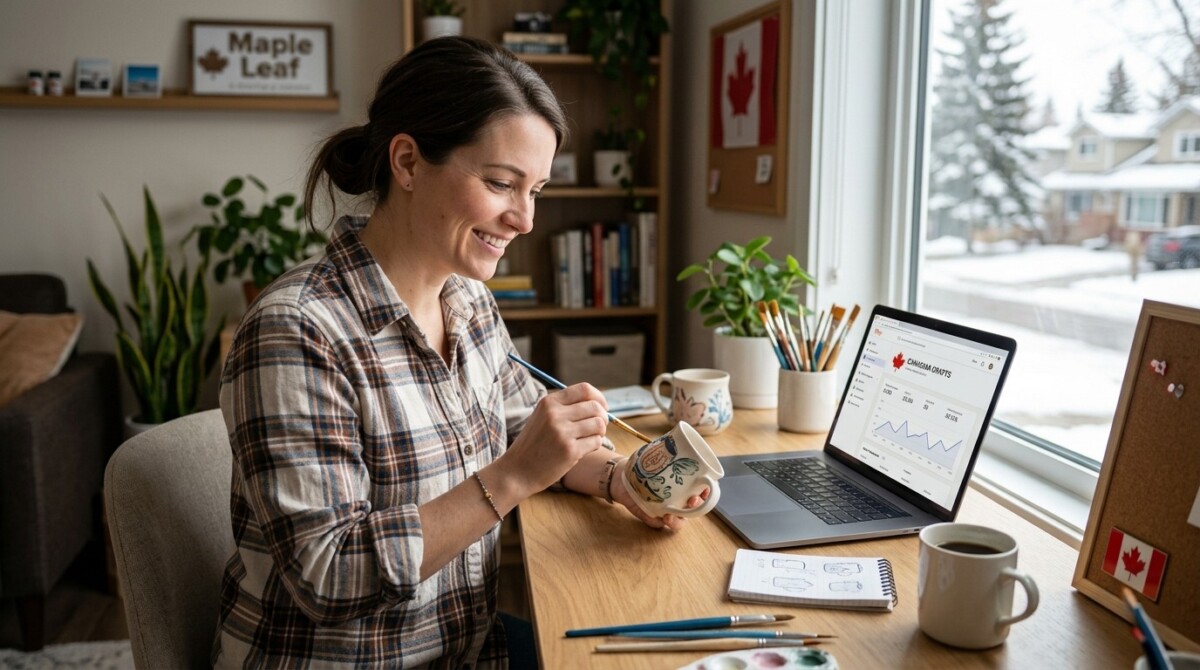
31% of Canadians now have a side hustle in 2026, and 85% started for financial reasons rather than passion. Ecommerce and online resale is the most popular category by a wide margin, with 48% of side hustlers selling products online, making it the most accessible on-ramp to building a real business this year.
The side hustle is no longer a passion project. For most Canadians in 2026, it is a financial necessity, and the ones who treat it like a business from day one are the ones who end up with something worth keeping.
Side hustles in Canada have gone from a fringe behavior to a mainstream financial strategy in roughly two years. An April 2026 survey of 1,029 Canadian respondents, conducted by Cint on behalf of Omnisend, puts 31% of the adult population in the side hustle category right now. That is up from 25% in mid-2025, and the trajectory tells you everything you need to know about where the Canadian economy actually stands for everyday people.
Collectively, those side hustlers are estimated to generate $9.9 billion in extra income every single month across Canada. To put that in perspective: this is not a niche economic phenomenon. It is a parallel economy operating alongside the formal one, built on spare hours, resale platforms, and the very practical need to make rent.
The headline numbers from the 2026 survey: 31% of Canadians currently have a side hustle. 85% started for financial reasons rather than personal fulfillment. 57% started specifically to cover bills or essentials. Only 8% started to pursue a passion or hobby, down from 17% in October 2025. And 81% plan to continue over the next 12 months. That last number matters most. An 81% continuation rate is not what you see from people doing something out of boredom or novelty. It signals that side hustles have become a structural part of how Canadians manage their finances, not a temporary experiment.
The real catalyst for the Canadian side hustle surge in 2026 is financial pressure, not creative ambition, and the data makes that distinction sharper than any prior survey wave has. The popular narrative around side hustles has always leaned aspirational: the side hustle as creative expression, the side hustle as the first chapter of a founder story. The 2026 data is telling a different story, and it is more grounded and, honestly, more interesting.
57% of Canadian side hustlers started because they needed extra money for bills or essentials. Not savings goals. Not travel funds. Bills and essentials. This tracks with what Statistics Canada’s economic data on household financial pressure shows about the broader picture: grocery price inflation averaged 4.0% across the second half of 2025, meat prices were up 8.5% year-over-year, and shelter costs, while easing, remain elevated. Headline CPI may be near the 2% target, but the categories that hit household budgets hardest have stayed stubbornly above it.
For a lot of Canadians, $200 to $500 a month is not “nice to have.” It is the difference between a month that works and one that does not. The survey confirms this: 53% of side hustlers earn $500 or less per month, yet 73% report being satisfied with that income. The satisfaction is not about the amount. It is about the buffer.
The drop from 17% to 8% of hobby-motivated starters in a single survey wave is not noise. It is a directional signal. The “passion economy,” the idea that everyone could monetize what they love and build a personal brand around it, was a story that made sense during low-inflation, low-unemployment years. That environment has changed.
When the Bank of Canada’s January 2026 Monetary Policy Report shows unemployment sitting at 6.8%, with youth unemployment particularly elevated, the calculation shifts. People are not asking “what do I love doing?” They are asking “what can I sell?” That is not cynical. It is practical. And it is actually a better foundation for building something real than passion alone ever was.
Most Canadian side hustlers earn $500 or less per month after taxes, yet 73% report being satisfied with their side hustle income, which tells you the value of having a controllable income stream matters as much as its size. The earnings picture is modest but meaningful. $9.9 billion per month is the survey’s estimate for total side hustle income generated across Canada. The methodology extrapolates from the survey data to the broader adult population, applying midpoint values to reported income ranges. It is a directional figure, not a precise audit, but the scale is real: this is not a hobby economy. It is a structural income layer that millions of Canadians are quietly building.
The majority earn $500 or less per month. A meaningful minority earns $500 to $1,000. A smaller group breaks above $1,000 per month. For most people, this is supplemental income that covers a specific gap: groceries, a car payment, a credit card balance.
What I find genuinely interesting here is the satisfaction gap. If you asked most people whether earning $300 to $500 a month from a side project would feel worthwhile, they might hesitate. But 73% of people actually doing it say they are satisfied. The act of having control over an income stream, even a small one, appears to matter as much as the amount itself. Whether you are doing $10K months or working toward them, that sense of ownership over an income source compounds in ways the dollar figure alone does not capture.
48% of Canadian side hustlers are selling products online, making ecommerce and resale the single most popular side hustle category in the country, ahead of freelance work (17%), food delivery (15%), and content creation (15%). Three reasons explain why ecommerce consistently wins at this stage.
First, the barrier to entry is genuinely low. You do not need a business license to list something on Facebook Marketplace. You do not need a warehouse to sell vintage clothing on eBay. You do not need a graphic design degree to put a design on a shirt through a print-on-demand service. The path from “I want to try this” to “I have my first sale” can be a matter of hours. Second, the hours are flexible. The survey data shows 91% of side hustlers spend fewer than 20 hours per week on their hustle, with 5 to 9 hours being the most common range. Ecommerce fits that pattern better than almost any other category. Third, there is a natural growth path. A food delivery gig is a food delivery gig. An ecommerce side hustle can become something more.
The product category breakdown shows a clear preference for accessible, low-overhead inventory. Vintage or secondhand items lead at 27% of online side hustlers, because the inventory is essentially free or close to it: you are monetizing things you already own, or sourcing cheaply from thrift stores and garage sales. Handmade or custom goods come in at 23% and require more time but command better margins. Print-on-demand sits at 11% and is the most scalable of the three: no inventory, no upfront cost, and designs that can sell while you sleep.
The platform breakdown shows a strong preference for marketplaces over standalone stores, which is exactly what you would expect from people testing the waters rather than committing to a full business build. Facebook Marketplace leads at 53% because it is frictionless: no fees to list, no account setup required beyond a Facebook profile, and a built-in local buyer base. Amazon follows at 34% and eBay at 28%, both offering broader reach with more complexity. Etsy sits at 18%, which makes sense given that 23% are selling handmade or custom goods, its natural home.
The marketplace-first pattern is smart strategy for a side hustle. You are not investing in a domain, a theme, or a marketing budget before you know whether your product sells. You are using existing traffic to validate demand. The question of when to move to a standalone store is a separate conversation, but starting on marketplaces is the right call for most people at this stage.
91% of Canadian side hustlers spend fewer than 20 hours per week on their hustle, and the most common range is just 5 to 9 hours per week, which makes ecommerce one of the most schedule-compatible options available. The number one objection I hear from people thinking about starting an online side hustle is time. “I already work full-time. I have a family. I don’t have 20 hours a week to dedicate to something new.” The survey data addresses this directly.
That is one focused evening and a couple of hours on a weekend. It is manageable for most people, and ecommerce fits that schedule better than almost any other category. You list products when you have time. You ship when orders come in. You are not locked into a delivery shift or a client call schedule. The flexibility is part of why 48% of side hustlers chose ecommerce over every other option available to them.
Yes, the data makes a strong case for starting a side hustle in 2026, especially an ecommerce one. 81% of current side hustlers plan to continue over the next 12 months. That is not a number that comes from people who feel like they are spinning their wheels. It comes from people who have found something that works, even if it is modest.
I have watched this pattern play out across hundreds of conversations with early-stage operators over the years. The side hustlers who turn their ecommerce projects into actual businesses are not usually the ones who started with a grand vision. They are the ones who started small, validated that people would pay for something, and then made one deliberate upgrade at a time.
The typical progression: start on Facebook Marketplace or eBay to test demand, move to Etsy or Amazon for broader reach, and then, when you have consistent sales and a product people are returning for, build a standalone store where you own the customer relationship. That last step is where the economics change. On a marketplace, you are renting access to someone else’s audience. On your own store, you are building an asset. The difference between $400 a month on Facebook Marketplace and $4,000 a month on a Shopify store is usually not the product. It is the infrastructure around it: email capture, repeat purchase flows, and the ability to run your own promotions without paying a platform’s cut on every sale.
If you are currently in the side hustle phase and wondering whether to take it further, the eCommerce Fastlane guide to AI side hustles for entrepreneurs is a good place to think about where leverage actually comes from in 2026. The tools available now, particularly for product creation, customer service, and marketing automation, have fundamentally lowered the effort required to run a real store. 31% of Canadians are already in the game. The ones who treat it as a business from day one, even a small one, are the ones who end up with something worth keeping.
Source: Survey of 1,029 Canadian respondents conducted by Cint on behalf of Omnisend, April 2026. Margin of error ±3%. The $9.9 billion monthly estimate is extrapolated from survey data to the Canadian adult population and should be treated as a directional figure.
31% of Canadians currently have a side hustle, according to an April 2026 survey of 1,029 Canadian respondents conducted by Cint on behalf of Omnisend. That is up from 25% in mid-2025, representing a significant increase in roughly one year. The 81% continuation rate among current side hustlers suggests the number is unlikely to fall in the near term.
85% of Canadian side hustlers started for financial reasons rather than personal fulfillment. 57% started specifically to cover bills or essentials. Only 8% started to pursue a passion or hobby, down from 17% in October 2025. The shift reflects broader economic pressures including persistent food price inflation and elevated shelter costs documented in Statistics Canada and Bank of Canada data from 2025 and early 2_





