


Your most loyal customers like you. So why not give them a chance to get your products on the regular without having to regularly visit your store — and give them a little bit of VIP treatment while you’re at it.
That’s what monthly clubs are great for. But it doesn’t just give you the opportunity to serve your customers better, it also creates an additional revenue stream for your business.
As you’ll see from the examples below, monthly clubs can be a great opportunity for stores in almost any industry. Plus, it’s relatively easy to add elements of convertible, curated, build-a-box, or exclusive subscription models to your monthly club, which can help you build a stronger relationship with customers that keeps them subscribed.

Monthly clubs work very much like curation boxes, such as Birchbox, except they’re usually offered by a specific brand as opposed to curating a multi-brand collection of items. Much like a curation club however, the goal is the same: encouraging discovery. Apart from the recurring revenue, there are two primary reasons why you might want to offer a monthly club:
While monthly clubs are often associated with a single brand, multi-brand retailers can easily jump on the bandwagon. For example, a snack food store specializing in international snacks from around the world could send out a monthly ‘discovery’ box.
Here are a few stores serving customers and creating recurring revenue with monthly clubs.
Land of a Thousand Hills’ onboarding flow offers a monthly club-style subscription, or a regular delivery of their standard blends. Naming their club program ‘Adventure Subscription’ helps spark curiosity. Read more about coffee subscriptions here.  Key takeaway: Use a simple onboarding flow to engage your customers and help them feel like they’re getting a personalized experience and product.
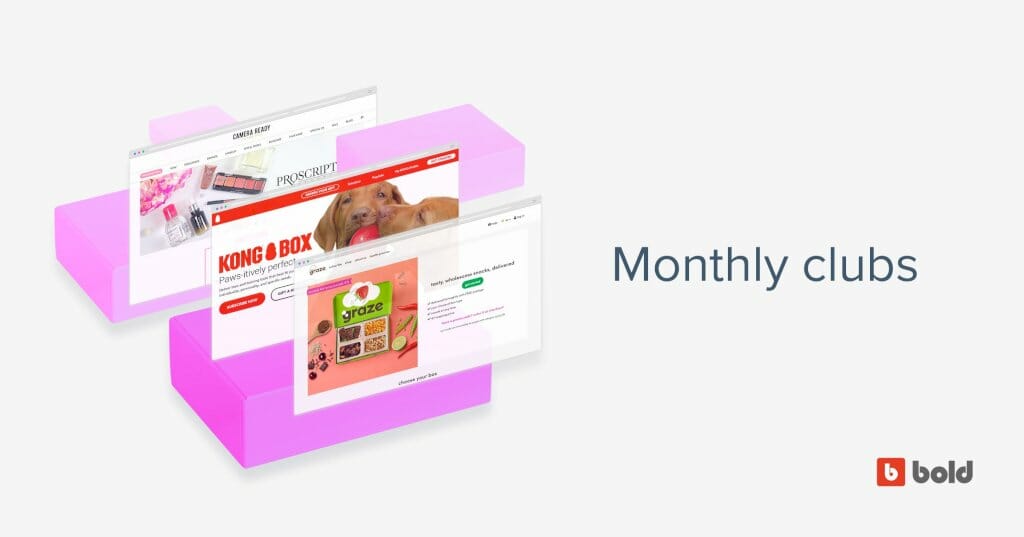
Graze makes it hard to say ‘no’ to their introductory offer. They clearly state their delivery frequency, free postage, box customization capabilities, the ability to cancel at any time, and a low recurring price.
They also deliver their snacks in delightful, branded packaging with the snack divided into little sections, giving subscribers a good unboxing experience. Key takeaway: Offer flexibility and promote it to attract subscribers. The customization, free delivery, and cancelling options Graze offers probably helps people feel a lot more comfortable signing up.
It’s hard to miss Oddballs’ subscription offering, given it’s highlighted in hot pink. Click on the link and you’re instantly prompted to start a subscription, gift one, or redeem a complimentary gift. Key takeaway: Don’t be afraid to call attention to your monthly box by giving it a dedicated place of honor in your top navigation, home page, or main menu. If your monthly box is a side product to your core business, it can get lost in the shuffle of your regular inventory.
Who doesn’t want to save up to 70%? Mirenesse uses their subscription kits to test out new products (or to potentially sell off items they have excess inventory of), all at an extreme discount. As a beauty brand, they’re uniquely positioned to serve up sample sizes to maximize their ROI while producing large quantities of samples for a range of purposes.
Learn about more beauty subscriptions here. Key takeaway: Use monthly clubs to test new products. It’s likely that your subscribers are some of your most loyal customers. That means they’ll not only be excited to get a sneak peak of new products, they’ll probably also be excited to give you feedback and tell their friends about the experience.
Hopefully this got you excited about starting a monthly club for your store. If you want to learn more, check out our free ebook, 7 Subscription Models to Master. It packed full of tips and real-life examples to inspire you and help you plan your own subscription.
Let us know in the comments below what kind of monthly club you want to start.
This article originally appeared in the Bold Commerce blog and has been published here with permission.





