

The funnel you spent ten years optimizing is quietly being rebuilt for an audience that does not read landing pages. One platform is already converting AI-referred shoppers at 14.2 percent versus 2.8 percent from traditional search. The merchants who notice first will spend the next 18 months compounding visibility while the rest debate whether any of this is real.
Stripe announced 288 product updates at Sessions 2026 last week. Most of the coverage went straight to the agent buying coffee demo, which is exactly the right thing to make a video about and exactly the wrong thing to plan a quarter around. Then I went back and dug into the Walmart number that surfaced a few weeks earlier, the one where their ChatGPT checkout converted three times worse than Walmart.com, and the picture got a lot more interesting for Shopify operators.
Three storylines collided over the last 60 days. Stripe shipped the economic infrastructure for an agent-driven internet. Walmart proved that the most hyped version of agentic commerce does not yet work. And Shopify quietly turned every eligible merchant into a sales channel inside ChatGPT, Microsoft Copilot, and Google’s AI Mode by default, with most operators still unaware their store is already shopping in the new internet.
This piece pulls the signal out of the noise. We will look at what Stripe actually announced and which pieces matter for a Shopify merchant in 2026, what Walmart’s 1.18 percent conversion rate teaches us about where agentic commerce really stands, what Shopify shipped that you should activate this week, and how to think about the work depending on whether you do $10K a month or $10M a month. The 288 announcements are interesting. The two or three things you should do tomorrow morning are more useful.

Stripe Sessions 2026 produced 288 announcements, but the meaningful story is contained in maybe a dozen of them, all aimed at one thesis: AI agents are becoming economic actors and they need rails. Patrick Collison framed the keynote as “the biggest platform shift for the economy since the internet.” Will Gaybrick said the quiet part out loud: “If AI can solve Nobel-level physics problems but cannot buy a domain, something has gone wrong.”
The pieces that matter most for Shopify operators sit in three buckets. The first is buyer-side payment authority. Stripe opened up Link, its consumer wallet with over 250 million users globally, to agents. People can now grant their agents permission to make payments on their behalf, with spending approvals and full purchase visibility. The agent never touches the raw credentials. This is the bridge that lets agents transact against the existing internet without requiring every merchant to adopt a new protocol.
The second bucket is the seller-side discovery and checkout suite. Stripe expanded its Agentic Commerce Suite (originally launched in December 2025) with a Google partnership that brings the Universal Commerce Protocol into AI Mode and Gemini, joining existing relationships with OpenAI, Microsoft, and Meta. Stripe also brought the suite to Wix, BigCommerce, WooCommerce, and Squarespace, which is the news for non-Shopify merchants.
The third bucket is the machine economy plumbing. The Machine Payments Protocol (co-authored with Tempo) and Shared Payment Tokens through the Payment Intents API let agents transact programmatically, including microtransactions and recurring patterns that humans rarely created because we were too slow or impatient to coordinate them. Streaming payments combine Metronome’s metering with Tempo stablecoin micropayments, which solves the timing mismatch when an AI product burns tokens in real time but waits a month to settle.
The Radar updates round it out: bot abuse prevention to distinguish legitimate agents from fraudulent actors, free trial abuse prevention, and Stripe Signals extending fraud detection across the entire Stripe network including transactions Stripe does not process directly. That is the actually important shortlist. Most of the other 270-something announcements are normal product progress that did not need an AI framing.

Walmart’s data from inside ChatGPT tells you exactly where agentic commerce stands today: the discovery is real, the in-chat checkout is not ready.
Here is what happened. Starting in November 2025, Walmart put about 200,000 products into OpenAI’s Instant Checkout. Shoppers could complete purchases inside ChatGPT without ever visiting Walmart.com. The conversion rate landed at 1.18 percent with 77.45 percent cart abandonment, three times worse than the same products bought via click-out to Walmart’s website. Daniel Danker, Walmart’s EVP of product and design, called the experience “unsatisfying” to Wired. OpenAI killed Instant Checkout entirely on March 4, 2026.
What is interesting is what Danker said about why it failed. Shoppers feared receiving five separate boxes when they actually wanted one shipment. They could not see member pricing, saved addresses, reorder history, or personalized recommendations. The chat interface stripped away the context, trust signals, and decision space that retail websites have spent 30 years building. Strip the scaffolding and the decision collapses, even when the catalog is identical.
Walmart’s response is the lesson. They built Sparky, their own AI shopping assistant, and embedded it inside ChatGPT. The Walmart store meets you where you are, rather than a third party trying to mediate the transaction. Sparky inside ChatGPT is now converting at roughly 70 percent of Walmart.com’s rate, more than double what Instant Checkout managed. On Walmart’s own properties, Sparky users spend approximately 35 percent more per order, and roughly 50 percent of Walmart app users have engaged with it, per Q4 earnings comments from Walmart U.S. CEO David Guggina.
The pattern is worth tattooing on a whiteboard somewhere: AI commerce works when the AI lives inside the merchant’s ecosystem. It collapses when a third party attempts to take ownership of the transaction. Discovery moves into AI surfaces. Conversion stays where the merchant controls the experience. For Shopify operators, that is not a depressing finding. It is a defining one.
Shopify turned every eligible merchant into an AI sales channel by default, and most operators have not checked the toggle yet.
Tobi Lutke summarized the play in one sentence at the Winter ’26 Edition launch on January 11: “We are making every Shopify store agent ready by default.” That is the entire move. Shopify Agentic Storefronts now syndicate eligible products to ChatGPT (live), Microsoft Copilot, Google AI Mode, and Gemini (in early access for most stores), with Perplexity expected to follow. The Universal Commerce Protocol that powers it was co-developed with Google and is already endorsed by 20-plus retailers and platforms.
Here is the part most operators missed: this is active by default. If your store is US-based, sells to US customers, has products eligible for Shopify Catalog, has store policies in place, and does not require account login at checkout, your products are probably already discoverable in ChatGPT today. The only setting you need to know about lives at Settings, then Sales channels, then Agentic storefronts. From there you can toggle individual AI channels on or off, decide whether customers complete purchases in chat or get redirected to your storefront, and pull up your AI-attributed orders by referrer.
Brands selling through Agentic Storefronts already include Glossier, Spanx, Vuori, Stanley 1913, Steve Madden, Monos, Gymshark, Everlane, Keen, and Pura Vida. Per Shopify, AI-attributed purchases have climbed 11x, and AI traffic continues to accelerate across the merchant base. Vanessa Lee, Shopify’s VP of Product, has been clear that Shopify’s bet is to handle the technical complexity so merchants can focus on growth.
There is also an Agentic Plan for brands that are not on Shopify. They can list products in Shopify Catalog and become shoppable across AI channels and the Shop App, even without a Shopify online store. That is a meaningful competitive lever for Shopify and a reasonable threat to merchants on platforms with weaker AI distribution.
The action this week: open your admin and check the Agentic Storefronts tab. If you do not see it, sign up at shopify.com/chatgpt to be notified when it activates for your store.
There are at least four agentic commerce protocols competing for the standard, and for most Shopify merchants the right answer is to ignore them and let your platform handle the abstraction.
The shortlist: ACP (the Agentic Commerce Protocol, co-developed by Stripe and OpenAI and now open sourced); UCP (the Universal Commerce Protocol, co-developed by Shopify and Google, with Stripe partnered for distribution); MPP (the Machine Payments Protocol, Stripe and Tempo, focused on machine-to-machine and microtransaction patterns); and a growing supporting cast that includes Mastercard and Google’s Verifiable Intent cryptographic standard launched March 5, 2026, Visa’s agent transaction rails, Coinbase’s x402, and Ant International’s mobile commerce protocol. Each handles a different slice of discovery, payment authority, fraud, or settlement.
Here is the part that matters. If you are on Shopify, you do not pick. The Agentic Storefronts feature abstracts the protocol layer entirely. Shopify is endorsing UCP at the platform level while Stripe’s Agentic Commerce Suite is positioned to support all major protocols through a single integration. From the merchant’s seat, this looks like one toggle in admin and your products show up across ChatGPT, Copilot, Gemini, AI Mode, and whatever else launches next year.
For operators on Wix, BigCommerce, WooCommerce, Squarespace, or commercetools, the equivalent path runs through Stripe’s Agentic Commerce Suite. You connect a product catalog, select the AI agents you want to sell through in the Stripe Dashboard, and Stripe handles discovery, checkout, payments, and fraud detection. The lift is heavier than Shopify’s default-on flow but workable.
The merchants who actually need to think about protocols are the ones building custom commerce stacks, B2B platforms with non-standard catalogs, or anyone trying to be the agent themselves. For everyone else, the protocol war is a story you can read about on Hacker News while letting the platforms do the work. The one underlying point worth absorbing: this is the platform consolidation play in real time. Shopify and Stripe are competing for the abstraction layer that sits between the merchant and the AI surfaces. That competition is good for merchants right now. It might not stay that way.
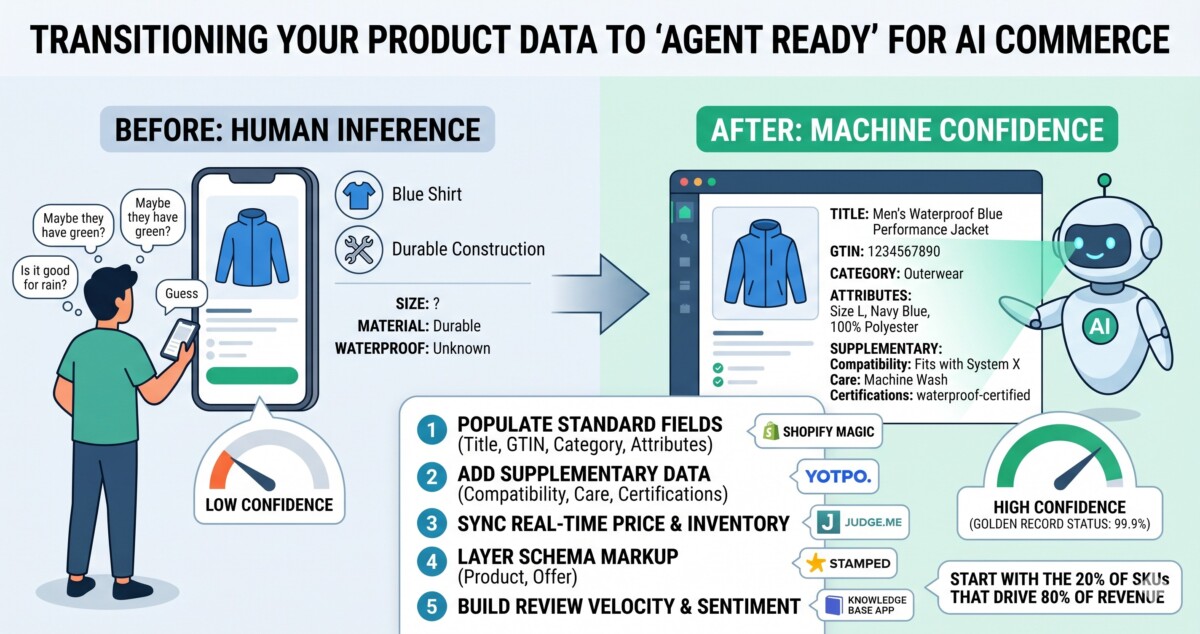
Agent ready means your product data answers questions a buyer would ask without you being there to elaborate.
A human shopper lands on your product page and fills in the gaps. They see a blue shirt and assume it comes in other colors. They read “durable construction” and infer outdoor use. They tolerate vagueness because they can ask, browse, or guess. AI agents do none of that. If your size attribute is empty, the agent marks it unknown and moves on. If a customer asks “is this waterproof,” and your data does not explicitly say so, the agent recommends a competitor whose data does.
The structural shift is the move from human inference to machine confidence scoring. Every product gets ranked against the buyer’s request based on how well the structured data matches. Stores hitting what the industry calls Golden Record status, where roughly 99.9 percent of expected attributes are populated and consistent, are seeing 3 to 4 times higher visibility in AI recommendations than stores with sparse data, per recent reporting from feed management providers.
For a Shopify operator, the practical work is in five layers. First, fully populate the standard product fields: title, description, brand, GTIN, category, and the explicit attributes (size, color, material, weight, dimensions, fit). Second, add supplementary fields that answer the questions agents face: compatibility, care instructions, certifications, what is in the box, who it is for. Third, keep pricing and inventory synced in real time, because stale data is treated as low confidence. Fourth, layer in schema markup (Product, Offer, aggregateRating) so the data is machine readable on your storefront pages too. Fifth, build review velocity, because ChatGPT and Perplexity perform sentiment synthesis on actual review text, not just star averages.
The Shopify ecosystem has the tools you need. Shopify Magic can enrich titles and descriptions at scale. Yotpo, Judge.me, and Stamped handle reviews with proper schema. The new Shopify Knowledge Base app is built specifically to feed AI agents your brand and policy information without changing the front end of your store. Use the existing FAQ content as the seed. Do not try to optimize 5,000 SKUs at once. Start with the 20 percent that drive 80 percent of revenue.
The right amount of work this week depends entirely on your revenue stage, and getting the calibration wrong in either direction costs you.
If you are doing $0 to $50K a month, your job this week is short. Open your Shopify admin, navigate to Settings, then Sales channels, and confirm Agentic Storefronts is enabled (or sign up at shopify.com/chatgpt to be notified when it is available). Then audit your top 10 products against three questions: does the title clearly state what it is, are the explicit attributes populated, and would an AI know who this product is for. Spend an hour and move on. The infrastructure does most of the work at this stage.
If you are doing $50K to $500K a month, the math changes. Push your top 50 SKUs to Golden Record status (90 to 99 percent attribute completion). Install the Shopify Knowledge Base app and seed it with your existing FAQ, brand, and policy content. Build review velocity using a structured data-aware app like Yotpo, Judge.me, or Stamped because review text now feeds AI sentiment synthesis. Set up referrer reporting so you can actually measure ChatGPT and Copilot orders separately from organic. The whole effort runs maybe 8 to 12 hours over a week.
If you are doing $500K to $5M a month, you are at the stage where AI channel performance becomes a measurable line item. Audit your full feed across all channels including Google Merchant Center because ChatGPT pulls roughly 75 percent of its product results from Google Shopping data. Test the direct purchase versus redirect to storefront toggle in Shopify Agentic Storefronts to see what actually converts for your category. Start measuring AI traffic conversion separately from traditional. If you are not on Shopify, this is the stage where you would evaluate Stripe’s Agentic Commerce Suite seriously.
I watched this stage-specific calibration play out repeatedly during my six years as a Senior Merchant Success Manager at Shopify, working with brands at $1M, $5M, $10M, and $20M in revenue. The failure mode was almost never a lack of ambition. It was operators at the $500K to $2M stage investing engineering and operational resources in infrastructure that the platform was already abstracting for them, while the actual leverage, product data quality, review velocity, feed accuracy, sat untouched. The merchants who compounded fastest were the ones who let Shopify carry the protocol complexity and put their energy into the catalog work that no platform can do for you.
If you are doing $5M or more a month, this is your competitive window. Build a dedicated AI commerce operating motion: someone whose job is product data quality, agent visibility, and AI channel performance reporting. Test Shopify’s Agentic Plan as a catalog expansion play, especially for SKUs you do not surface on your main storefront. Talk to your CFO and CMO about how attribution and incentives change when 20 to 40 percent of discovery moves into AI surfaces over the next 18 months.
Apply the 18-month sustainability filter to all of this and the picture clears up fast: discovery shifts faster than transaction, and the merchant who keeps the buying surface keeps the customer.
The work that probably compounds over the next 18 months is unsexy and operational. Structured product data quality. Review depth, because the agents are reading actual review text and synthesizing sentiment. Real-time inventory and pricing accuracy, because stale data lowers your confidence score and pushes you down the recommendation list. Brand memorability for the agent, which is a real concept (your agent can carry preference for a coffee roaster or apparel brand the same way you can, and that preference becomes a constraint on every future recommendation). Page speed and product page completeness for the redirect flows, because most of the actual buying still happens on the merchant’s storefront.
The work that probably does not matter yet for most Shopify operators: machine-to-machine streaming payments (unless you sell something billed by token or by API call), stablecoin acceptance for retail (the rails exist, the consumer demand does not), building your own dedicated shopping agent, and most of the protocol-level architectural decisions. The platforms will abstract those for you. Ignore the calls to action that suggest otherwise.
The work that might or might not matter, depending on how the next year plays out: in-chat purchase coming back in some form for genuinely impulse categories, agent-driven subscription management, B2B agent-to-agent commerce, and trust standards like Verifiable Intent becoming required versus optional. None of these are bad bets to track. None require action this quarter for most operators.
If the Walmart data tells us anything, it is that the agentic transition will be uneven. Discovery is moving fast. Conversion is moving slowly. Plumbing is being rebuilt for use cases that do not fully exist yet. That gap between announced and useful is exactly where premature complexity gets merchants killed. Pick the work that compounds. Skip the work that requires the world to look different than it does today.
A handful of things on my radar that should be on yours.
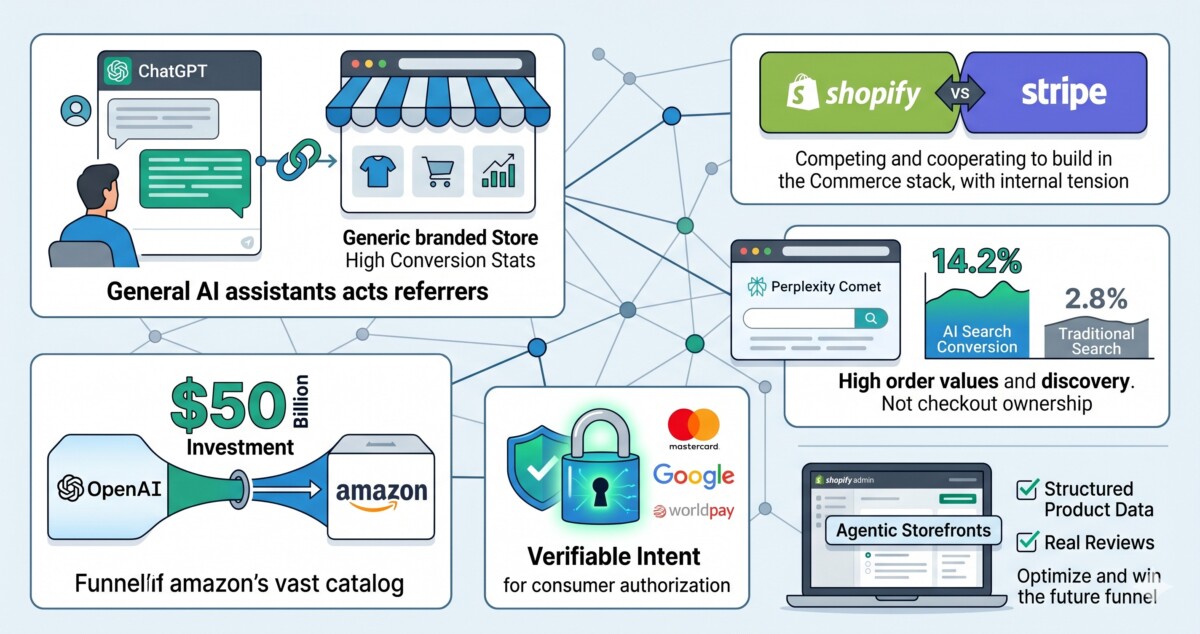
The first is whether Sparky-style merchant AI inside ChatGPT becomes the dominant pattern, with general AI assistants increasingly acting as referrers to brand-owned shopping experiences rather than third-party intermediaries. Walmart’s early Sparky numbers (roughly 70 percent of Walmart.com’s conversion rate from inside ChatGPT) suggest yes, but it is still early.
The second is how Shopify and Stripe split influence over the agentic commerce stack. They are competing for the abstraction layer right now while also remaining each other’s largest distribution partners. That tension is good for merchants today and may not stay that way.
The third is Perplexity. Their Comet browser has been live since July 2025, their AI search converts at roughly 14.2 percent versus 2.8 percent from traditional search, and Perplexity shoppers reportedly spend 57 percent more per order. They never tried to own the checkout, which seems to be exactly the right call. Watch whether their agentic discovery model takes share from ChatGPT and Google.
The fourth is the Amazon and OpenAI partnership math after Amazon’s $50 billion investment in OpenAI in February 2026. That money has to direct ChatGPT’s commerce partnerships somewhere, and the obvious somewhere is Amazon’s catalog. How that affects Shopify and the broader merchant ecosystem is a real open question.
The fifth is the Mastercard and Google Verifiable Intent rollout, the cryptographic trust standard launched March 5 with IBM, Worldpay, Fiserv, and Adyen. It is designed to create proof of consumer authorization at the moment an AI agent initiates a transaction. If it becomes a payment network requirement (versus a nice to have), the integration work shifts from interesting to mandatory.
What I would do this week: open your Shopify admin and check the Agentic Storefronts tab. If you sell on Shopify and the toggle is there, you are already in. The hard part is not the technology. It is making sure your product data is good enough that the agent picks you instead of the next store down the list. The funnel you spent ten years optimizing is being rebuilt. The work to win the next version starts with structured fields and real reviews. It is not glamorous. It compounds.
Shopify Agentic Storefronts is active by default for eligible US-based stores. Open your Shopify admin and go to Settings, then Sales channels, then Agentic storefronts. From there you can manage individual AI channels (ChatGPT, Microsoft Copilot, Google AI Mode and Gemini), toggle direct purchase versus redirect to your storefront, hide specific products, and review your AI-attributed orders by referrer. To be eligible your store must be US-based selling to US customers, have products eligible for Shopify Catalog, have store policies in place, and not require customer login at checkout. If you do not see the Agentic Storefronts section yet, sign up at shopify.com/chatgpt to be notified when it activates for your store.
AI shopping agents need structured, machine-readable product data with explicit attributes rather than the inferential context human shoppers tolerate. The critical fields include title, description, brand, GTIN, category, and explicit attributes like size, color, material, weight, dimensions, and fit. Supplementary fields matter too: compatibility, care instructions, certifications, and who the product is for. Real-time pricing and inventory accuracy is essential because stale data reduces the confidence score agents use to rank recommendations. Schema markup (Product, Offer, aggregateRating) makes your storefront pages readable on the redirect path. Reviews feed sentiment synthesis, so velocity and depth matter. Stores reaching roughly 99.9 percent attribute completion, often called Golden Record status, report 3 to 4 times higher visibility in AI recommendations than stores with sparse data.
Walmart’s ChatGPT Instant Checkout converted at 1.18 percent with 77.45 percent cart abandonment, three times worse than Walmart.com, because the chat interface stripped away the context, trust signals, and decision space that retail websites have built over 30 years. Daniel Danker, Walmart’s EVP of product and design, told Wired the experience was “unsatisfying.” Specifically, shoppers could not see member pricing, saved addresses, reorder history, or personalized recommendations, and they feared receiving five separate boxes when they actually wanted one consolidated shipment. OpenAI killed Instant Checkout entirely on March 4, 2026. Walmart’s pivot was to embed their own Sparky AI inside ChatGPT, which is now converting at roughly 70 percent of Walmart.com’s rate, more than double what Instant Checkout managed.
Most of Stripe’s 288 Sessions 2026 announcements are not directly actionable for typical Shopify merchants because Shopify abstracts the protocol and payment infrastructure layers. The pieces that matter most fall into three groups. First, the buyer-side payment authority work, especially Link wallet for agents, which lets consumers grant their AI agents permission to make payments on their behalf with spending controls. Second, the Agentic Commerce Suite expansion to Google AI Mode and Gemini, which extends merchant reach across more AI surfaces. Third, the upgraded Radar fraud system including bot abuse prevention, which matters for any merchant accepting agent-initiated transactions. The streaming payments and Machine Payments Protocol announcements are forward-looking infrastructure for AI-native businesses billed by token or by API call, not most retail merchants.
Small Shopify stores under $50K a month should not worry about agentic commerce, but they should spend roughly an hour this week on three things. First, confirm Agentic Storefronts is active in your admin at Settings, then Sales channels, or sign up at shopify.com/chatgpt to be notified when eligible. Second, audit your top 10 products against three questions: does the title clearly state what the product is, are the explicit attributes (size, color, material) populated, and would an AI know who this product is for. Third, fix the worst offenders. The infrastructure does most of the work at this stage. Premature investment in custom AI agent integrations, stablecoin acceptance, or protocol-level decisions is the kind of premature complexity that kills early-stage stores.




