

Here’s a thing that almost every Shopify brand does, and almost no one talks about.
You set up your post-purchase flow. You spend real time on it — maybe three, four, five emails. A thank-you, a product education piece, a cross-sell, a review ask. You’re proud of it. You set it live.
When a single post-purchase flow serves your entire customer base, your most engaged segment — loyal repeat buyers — masks the poor performance of everyone else. First-timers, lapsed customers, and high-value prospects all get the same message, which means you’re leaving significant revenue on the table every single week.
At Tresl, we’ve analyzed customer data for hundreds of Shopify merchants — and this pattern shows up constantly.
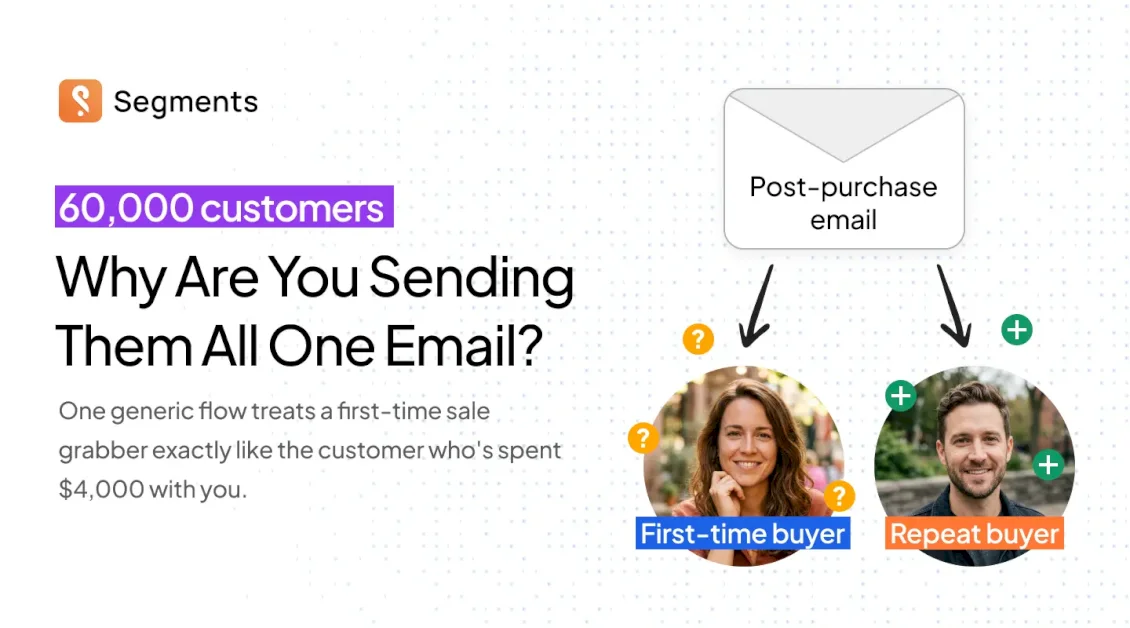
Then a year goes by. Your list grows to 60,000 people. And every single one of them — the first-time buyer who grabbed a sale item, the customer who’s bought eleven times and spent $4,000 with you — walks through the same sequence.
That’s not segmentation. That’s just email.
The thing about a generic post-purchase flow is that it doesn’t look broken. Open rates are fine. Click rates are okay. Revenue attribution is there.
But underneath those averages is a story the data isn’t telling you.
Brandon Erickson runs Contra Visual, a fashion agency managing campaigns across six brands simultaneously. Every week, his team was manually figuring out which segments to email — pulling reports, exporting lists, cross-referencing by hand. Six brands, six spreadsheets, six separate guesses about who to reach and with what message.
It wasn’t that the data didn’t exist. It was that nobody had time to actually use it.
Over at a hijab brand, the email click-through rates looked healthy. But when someone finally dug into the breakdown, almost all of that engagement was coming from a single segment: the most loyal repeat buyers. Everyone else — first-timers, lapsed customers, second-purchase window prospects — was basically non-responsive. The aggregate metric was lying. One highly engaged segment was covering for total inactivity everywhere else.

That’s the cannibal problem. When you don’t segment by lifecycle, your best customers make your worst performance look acceptable. You never see the gap.
The version of this story that stuck with me most came from a jewelry brand.
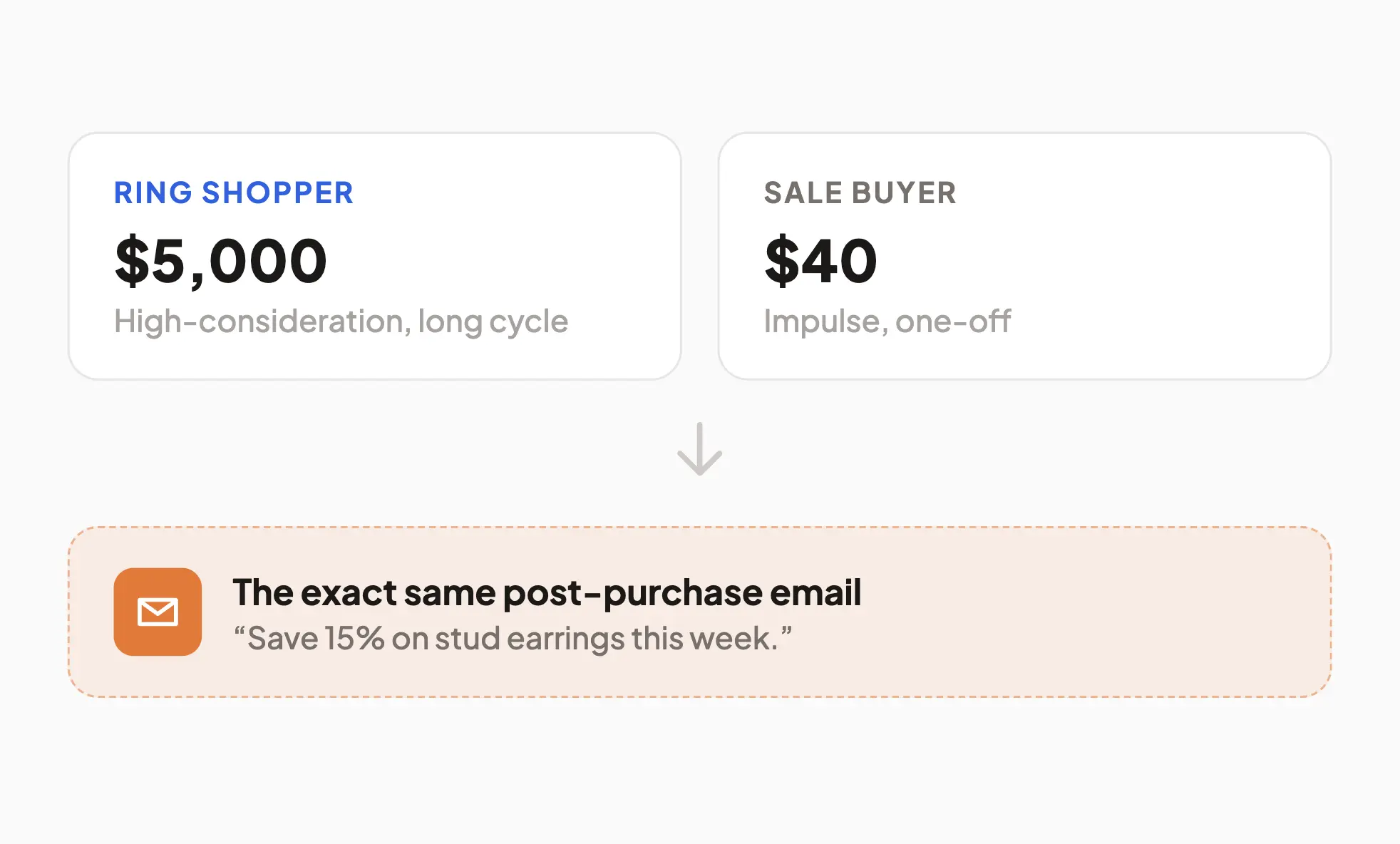
Renaissance Global sells engagement rings. High consideration product, long purchase cycle, emotional stakes. They had a post-purchase flow like everyone else. And somewhere in that flow, they had an email promoting a discount on stud earrings.
The founder’s reaction when he realized what was happening: “Why would someone looking to buy an engagement ring want to see a discount on studs?”
He was right to be annoyed. The customer who’s browsing for the most important jewelry purchase of their life is not the same customer who impulse-buys earrings in a sale. Sending them a stud discount doesn’t just fail to convert — it signals that you don’t know who they are. It cheapens the brand relationship at exactly the moment you need to be building trust.
One flow, two completely different buyers, one message. Someone in the consideration window for a $3,000 ring getting the same email as a $40 sale buyer. That’s the reality for most brands operating on a single post-purchase sequence.
This is where Segments AI changes things.
Instead of pulling reports or waiting on an analyst, you open a chat and ask: “Which lifecycle segments have the most at-risk buyers right now?”
In seconds, you get a breakdown. Not a generic one — your actual customer base, split by lifecycle stage, with at-risk buyers surfaced by segment. You can see which segment is drifting toward lapsed. Which groups have high predicted CLV but haven’t bought in 90 days. Which first-timers are in the window where a well-timed email could push them to a second purchase.
Then you ask a follow-up: “What products are most common in the first purchase of customers who went on to buy 3+ times?” That answer tells you which new customers are worth a different kind of onboarding — more investment, a separate flow, a higher-touch sequence.
Brandon’s team doesn’t spend their Monday mornings manually building segment lists anymore. They ask the questions, get the answers, and build the campaigns.
Renaissance Global can now route engagement ring browsers into a separate sequence — one that treats the purchase the way it deserves to be treated. No stud discounts.
If you’re running a single post-purchase sequence for your entire customer base, you’re not doing email wrong — you’re just not finished yet.
The goal isn’t complexity for its own sake. It’s giving your $5,000 buyer a different experience than your $40 one. It’s knowing which segment is covering for poor performance everywhere else, so you can fix it. It’s asking the questions that turn a generic flow into something that actually matches how customers behave.
The data is already there. You just need to ask it.
If you want to ask your own customer data questions like this, try Segments AI free — no SQL, no dashboards, just ask.





