
Picture a potential buyer browsing your site—just a few clicks from checkout—when something distracts them and they abandon their cart. E-commerce brands know this all too well.
Right now, the worldwide average abandoned cart rate sits at over 73%. If you want to turn these near-misses into lasting relationships, you’ll need the right strategy.
By unifying data sources (e.g., website behavior, email engagement, loyalty programs) and applying dynamic, personalized messaging, you can gently address customer concerns and nudge them toward completing their purchases.
In this guide, we’ll discuss nine best practices for leveraging data, personalization, and timing to attract lost shoppers and the benefits of unifying data with platforms like SAP Emarsys Customer Engagement.

Goal: Consolidate customer data into a single, unified view to create highly personalized and effective abandoned cart emails.
Customers expect brands to recognize their preferences and anticipate their needs. However, scattered data often prevents businesses from delivering the right message at the right time.
By integrating data sources such as:
✔ Web analytics (browsing behavior, time spent on pages, exit intent)
✔ Past purchases (order history, frequency, preferences)
✔ Loyalty program engagement (points earned, redeemed offers, VIP status)
Businesses can create a comprehensive customer profile that powers dynamic and relevant abandoned cart emails.
Using a customer engagement platform like SAP Emarsys, brands can:
This enables marketing teams to send hyper-personalized abandoned cart emails that go beyond generic reminders. Instead of a simple “You left something behind” message, customers receive tailored content that:
📌 Personalization leads to results – Research shows that 80% of consumers are more likely to make a purchase from brands that offer personalized experiences.
📌 Customers feel understood – Rather than feeling like just another transaction, they see that the brand recognizes their preferences and shopping behaviors.
📌 Higher conversion rates – By sending relevant, data-driven messages, businesses increase the likelihood of customers finalizing their purchases.
With unified data and automation, abandoned cart emails become smarter, more engaging, and more effective—turning near-misses into successful sales.
Goal: Send timely nudges that reignite a shopper’s interest without overwhelming them. The timing and frequency of abandoned cart emails are crucial to their effectiveness.
An email sent within an hour of cart abandonment often reaches buyers while they are still considering the product. This prompt response captures their attention when interest is fresh, increasing the likelihood of conversion.
However, timing must be strategic. Sending emails too soon may feel intrusive, while waiting too long may result in lost momentum. Customer behavior patterns and preferences should guide send times to maximize engagement.
A well-structured abandoned cart email sequence typically includes 2-3 emails sent at carefully timed intervals:
Pro tip: Using a discount in your abandoned cart automation? To avoid customers gaming the system, add a check in your email flow to ensure customers haven’t received a code in the last few days.
Rather than relying on generic timing rules, brands should analyze open and click rates to determine the best-performing timeframes for different customer segments.
By tracking customer response patterns, businesses can:
With a unified customer view, brands can refine email timing to better align with each shopper’s unique preferences and behaviors, further increasing conversion rates.
Learn more about timing with our guide: Is There A Best Time To Send Marketing Emails?

Goal: Provide extra motivation to encourage shoppers to return to their carts and complete their purchases.
Different incentives appeal to different audiences. The key is to select offers that resonate with your customers and align with your overall business strategy. Effective incentives include:
Rather than applying a one-size-fits-all approach, brands should segment customers based on purchase history and engagement levels to tailor incentives effectively. As with abandoned cart emails, be sure to put checks in place to avoid lost margins from savvy customers.
A clear and compelling call-to-action (CTA) should seamlessly guide customers back to their carts with minimal friction.
Well-designed CTAs can significantly improve click-through rates and conversions by focusing customer attention on the next step.
While discounts can drive short-term conversions, relying on them too often may train customers to abandon carts intentionally, expecting a deal later.
A data-driven approach is more sustainable, segmenting customers based on:
By tailoring incentives based on customer value and behavior, businesses can maximize both conversions and profitability without eroding their margins.
Learn more about AI-powered marketing segmentation strategies.

Goal: Leverage advanced e-commerce platforms to unify data, automate email workflows, and optimize abandoned cart recovery.
Many businesses struggle with fragmented customer data, making it difficult to deliver relevant and timely abandoned cart emails. By integrating data sources—including website behavior, purchase history, and email engagement—brands can establish a single source of truth for each customer.
This unified view enables more precise targeting and personalized messaging, helping businesses recover more lost sales.
Beyond personalization, integrating the right technology stack brings efficiency and scalability to abandoned cart email strategies:
By leveraging these capabilities, marketers can scale their recovery efforts and ensure every email reaches the right customer with the most relevant message.
For CMOs evaluating technology investments, selecting the right platform is critical. Key features to look for include:
✔ Seamless integration with existing e-commerce, CRM, and email marketing systems.
✔ Advanced analytics to measure performance and optimize recovery campaigns.
✔ AI-powered automation for predictive personalization and segmentation.
Platforms like SAP Emarsys provide these capabilities, allowing brands to streamline abandoned cart recovery while maximizing efficiency and revenue potential.
Goal: Go beyond basic name personalization by tailoring abandoned cart emails to each shopper’s unique preferences, behaviors, and concerns.
Static emails no longer cut it—customers expect highly relevant messaging that adapts to their shopping behavior. Using dynamic content, businesses can:
This data-driven approach ensures that every email feels tailored and engaging, rather than generic and impersonal.
A one-size-fits-all abandoned cart email won’t work for every shopper. Segmenting customers based on their behavior allows for more effective recovery strategies.
For example:
By segmenting audiences and customizing messaging, businesses can increase conversions and build stronger customer relationships.

Goal: Treat cart abandonment as an opportunity to support customers, not just recover lost sales. By addressing concerns and adding value, businesses can build trust and long-term loyalty.
Many shoppers abandon their carts because they are undecided or have unanswered questions. Offering helpful content can ease uncertainty and increase confidence in the purchase. Consider including:
Rather than a simple “You forgot something” message, these emails offer value, encouraging the shopper to revisit their cart.
Cart abandonment is often driven by hesitations—concerns about pricing, returns, or convenience. Instead of focusing solely on the sale, address potential barriers by:
By proactively solving pain points, brands enhance the shopping experience and increase conversions without resorting to aggressive sales tactics.
A customer-centric approach goes beyond the transaction. Even if a shopper doesn’t complete their purchase immediately, positive interactions increase the likelihood of future conversions.
Ways to build brand loyalty through abandoned cart emails include:
When customers feel supported rather than pressured, they trust the brand more and are more likely to return—turning one-time shoppers into repeat buyers.
Goal: Leverage artificial intelligence (AI) to anticipate shopper actions, personalize messaging, and optimize send times for abandoned cart emails.
Not all shoppers abandon their carts for the same reason—some need a small nudge, while others require a stronger incentive. Predictive analytics helps identify which customers are most likely to convert and what type of messaging will be most effective.
By analyzing historical data and behavioral patterns, AI can:
This allows businesses to focus efforts on high-value customers, reduce unnecessary discounts, and increase overall recovery rates.
AI-powered platforms analyze engagement trends to determine the best time to send each abandoned cart email. Instead of relying on generic timing rules, AI can:
With AI-driven send-time optimization, abandoned cart emails are delivered when they are most likely to convert, improving open rates and click-through rates.
AI-powered platforms like SAP Emarsys enable ongoing performance optimization by:
By constantly learning and adapting, AI ensures that abandoned cart recovery campaigns become more effective over time, increasing conversions without increasing manual effort.
Goal: Collaborate with technology providers that align with your brand’s needs and enhance abandoned cart recovery efforts.
Not all marketing automation platforms are created equal. When selecting a technology partner, businesses should assess:
A strong technology partner should simplify data unification, enhance personalization, and automate email sequences, ensuring a seamless and effective abandoned cart strategy.
Beyond software capabilities, the right partner should provide:
With a trusted technology partner, businesses can refine their abandoned cart email strategies over time, adapting to new insights and improving recovery rates.
The ideal partner isn’t just a service provider—they should be an extension of your team, helping to:
By forming strategic partnerships with technology providers like SAP Emarsys, businesses can recover more revenue, reduce manual effort, and create data-driven abandoned cart campaigns that continually improve over time.
Let’s take a look at some brands who’ve mastered the art and science of abandoned cart marketing:
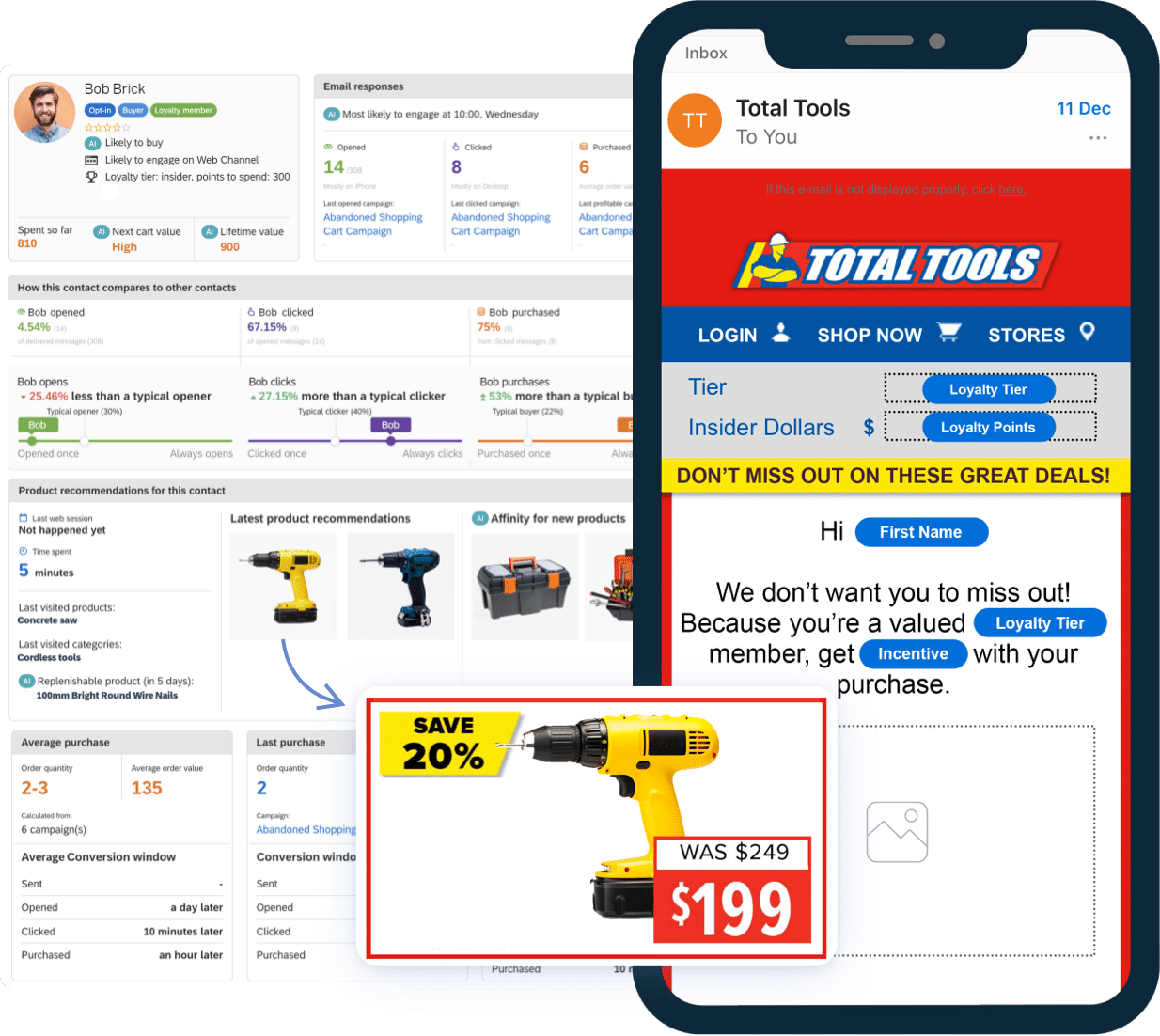
Total Tools faced several roadblocks in delivering a seamless, personalized experience:
To overcome these challenges, Total Tools partnered with SAP Emarsys to unify their data and streamline their marketing efforts:
The integration with SAP Emarsys led to immediate and measurable improvements:
✔ 20+ automated data-driven workflows launched, significantly improving efficiency.
✔ 2x increase in click-through rates, demonstrating stronger customer engagement.
✔ Reduced reliance on email by adopting a channel-agnostic strategy, ensuring customers received relevant messages via their preferred touchpoints.
✔ Relaunched the Insider Rewards loyalty program, fully integrating it across channels for a more engaging, personalized experience.
With these new capabilities, Total Tools transformed their marketing approach, ensuring that customers receive the right message at the right time, on the right channel.
Discover the complete success story of how Total Tools unifies data to drive omnichannel experiences that boost loyalty.
Ryderwear is a global fitness apparel brand catering to athletes, bodybuilders, and gym enthusiasts. With a strong e-commerce presence, the brand needed a more effective and scalable approach to abandoned cart recovery to maximize revenue from online shoppers.
Despite having a loyal customer base, Ryderwear’s manual approach to cart recovery was inefficient and inconsistent, leading to lost sales. The key challenges included:
To optimize its abandoned cart strategy, Ryderwear integrated SAP Emarsys’ automated email workflows with:
By automating the cart recovery process, Ryderwear could scale its email marketing efforts while delivering more relevant messaging to each shopper.
The results were transformational:
✔ Email marketing revenue surged from 4-5% to nearly 20% of total revenue.
✔ Abandoned cart emails became a major revenue driver, improving recovery rates significantly.
✔ 80% of email revenue now comes from automated workflows rather than manual campaigns.
✔ Overall email revenue increased by 300%, showcasing the power of AI-driven automation.
By implementing SAP Emarsys, Ryderwear turned abandoned carts into high-converting sales opportunities, proving that automation and personalization are key to scaling e-commerce success.
Discover how Ryderwear generated 80% of revenue from automations versus campaigns, resulting in a complete reversal in just two years and boosted email revenue by 300%. Learn more.
Booktopia is Australia’s leading online bookstore, offering a vast selection of books across multiple genres. With a strong focus on customer satisfaction, the brand needed to refine its abandoned cart recovery strategy to drive conversions without compromising long-term loyalty.
While Booktopia aimed to increase abandoned cart conversions, the team faced key concerns:
To address these challenges, Booktopia shifted to a customer-first strategy by:
By prioritizing helpfulness over hard selling, Booktopia turned abandoned cart emails into a trusted customer touchpoint rather than a transactional nudge.
This strategic shift led to:
✔ Stronger customer loyalty, as shoppers felt supported rather than pressured.
✔ Improved brand reputation, reinforcing Booktopia’s position as a customer-centric retailer.
✔ Sustainable revenue growth, proving that cart recovery doesn’t need to rely on discounts to be effective.
By focusing on value, trust, and long-term relationships, Booktopia enhanced customer retention while still recovering lost sales, making its abandoned cart strategy both effective and sustainable.
Ellie Quacquarelli is a Strategic Consultant & Team Lead at SAP Emarsys in London. With 10+ years of experience, she helps businesses develop customer-centric CRM strategies and measure ROI in an era of evolving email privacy. Passionate about enhancing customer experiences, Ellie specializes in driving meaningful audience connections across marketing channels, working closely with brands to optimize engagement and long-term retention.