





Key Takeaways
- Treat your Shopify launch as a 90-day sprint split into clear 30-day phases, not a single “go live” date, so you avoid stalling with a half-finished store.
- Use the first 30 days to validate your offer with real people, build a minimum viable store, and start an email list instead of over-perfecting themes or hiding in apps.
- Use days 31–60 to tighten product pages, lock in three core email flows, design a time-bound launch, and test one primary traffic channel so you get clean first-customer data.
- Use days 61–90 to track a simple KPI set, fix obvious funnel leaks, raise AOV and early retention, and decide your next sprint based on what your numbers actually show.
If you treat launch day like a finish line, your store will feel dead on arrival. The brands that win treat it as the starting gun for a 90-day sprint.
In hundreds of conversations with founders on Ecommerce Fastlane, the same pattern keeps showing up. The ones who map a clear shopify store launch plan for their first 90 days get traction faster, waste less cash, and avoid the classic “half-built store that never goes live” problem.
This is the 90-day blueprint I wish every first-time Shopify founder had on their desk from day one.
Why You Need a 90-Day Shopify Store Launch Plan
A strong launch plan turns chaos into a simple question: “What matters this week?” Instead of bouncing between apps, themes, and random YouTube advice, you work a tight sequence, one phase at a time.
New founders usually get stuck in two places. They either spend weeks perfecting their theme before adding a single product, or they rush live without clear offers, email flows, or tracking in place. Both hurt you. A structured plan avoids that by setting clear goals for each 30-day block.
If you want a detailed pre-launch checklist, Omnisend’s Shopify checklist for 2025 is a solid companion to what you are about to build here.
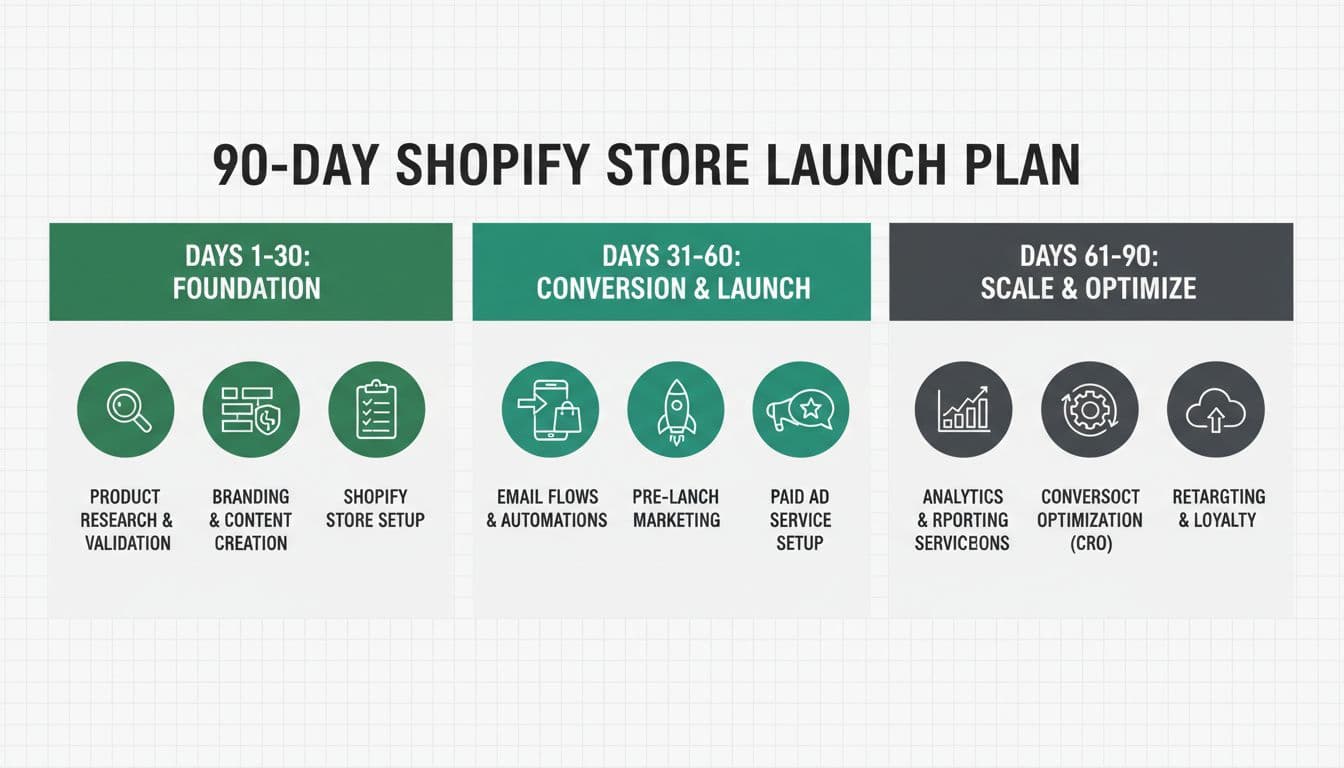
Caption: 90-day Shopify store launch timeline overview. Image generated by AI.
Across hundreds of brands, the pattern is simple: treat launch as a 90-day process, not a single day, and your odds of real momentum go way up.
Days 1–30: Foundation That Actually Sets You Up To Sell
Your first 30 days are about clarity and structure, not perfection. By day 30 you want a valid product, a basic but clean store, and your first group of people waiting to hear from you.
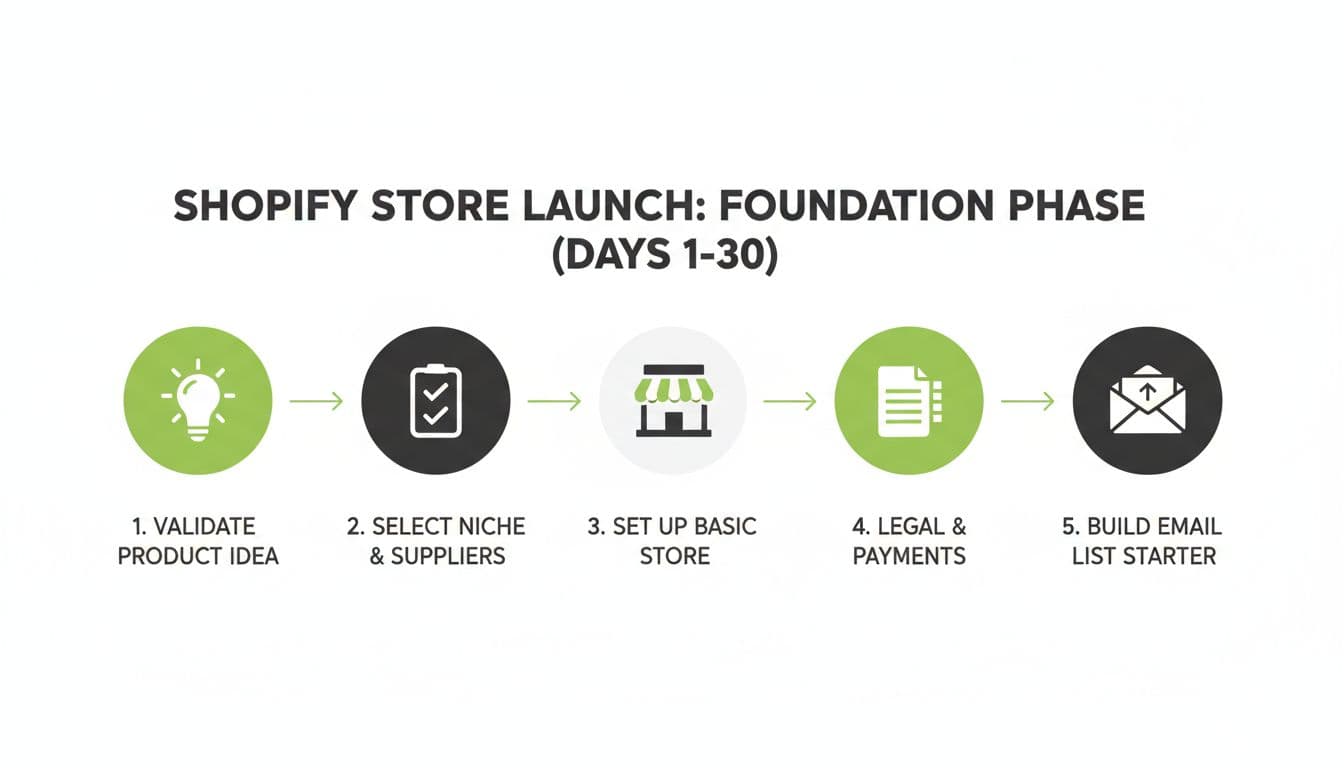
Caption: Key steps for the foundation phase of your Shopify launch. Image created with AI.
Here is where to focus.
1. Validate the product and audience
Do not hide in the Shopify admin yet. Talk to ten to twenty real people who match your target buyer. Ask what they use today, what annoys them, what they wish existed. If you already have a product, get samples in hands and collect blunt feedback.
2. Define one clear offer
Pick a hero product or a very tight bundle. New founders who launch with twenty unfocused SKUs usually confuse buyers. Launch with a sharp, simple offer and add depth later.
3. Build a minimum viable store, not a perfect one
You need:
- A clean theme with your logo and brand colors
- Product pages that answer real questions, not fluffy copy
- Essential pages: About, Contact, Shipping, Returns
If you want a detailed walkthrough of these setup steps, use the guide to building a Shopify store as your side-by-side build companion.
4. Set up payments, taxes, and basic analytics
Turn on Shopify Payments or your chosen gateway, configure tax and shipping, and connect Google Analytics and Meta pixels. You cannot improve what you cannot see.
5. Start a simple email list
Even if you are not sending campaigns yet, add a site-wide signup form and a basic welcome email. Your day-60 and day-90 results depend on the list you start building now. Kajabi has a helpful Shopify website launch checklist that also covers pre-launch list building.
Days 31–60: Conversion, Launch, And First Sales
Days 31–60 are where you shift from “store setup” to “sell something now.” The goal is to warm up your audience, lock in core automations, and run a focused launch that brings in your first clean wave of customers.
1. Tighten your product pages and conversion basics
Look at your product page like a skeptical buyer.
- Do images clearly show size, use, and detail?
- Is pricing clear, with no surprises at checkout?
- Are shipping and returns easy to find?
Add social proof as soon as you can, even if it is early customer quotes instead of full reviews.
2. Build three essential email flows
Do not try to build every automation under the sun. Start with:
- Welcome flow (2–3 emails) that tells your story and pushes toward first purchase
- Abandoned checkout flow that reminds visitors what they left behind
- Post-purchase flow that thanks, educates, and nudges a second order
These three flows are often responsible for a large share of early revenue for stores featured on our podcast.
3. Design a simple, time-bound launch
Pick your launch week and work backward.
- Tease the offer to your email list and social audience
- Offer an incentive for first buyers (small discount, free shipping, or a bonus item)
- Create a clear “launch ends on X date” message
For a more product-focused angle, pair this with the planning steps from Gembah’s 90-day Shopify go-to-market strategy, which breaks launch into workable weekly actions.
4. Test one primary traffic channel
Do not try to master five channels at once.
Pick one:
- Meta ads for broad consumer products
- TikTok or UGC for visually strong products
- Google Shopping if people already search for what you sell
Run small, structured tests. You are buying data, not chasing overnight profit in this window.
Days 61–90: Scale, Optimize, And Act Like An Operator
The last 30 days are about turning your early wins into a repeatable machine. This is where you start thinking less like a tinkerer and more like a real operator.
1. Get honest with your numbers
At a minimum, track:
- Traffic and conversion rate
- Average order value
- First 30-day repeat purchase rate
- Revenue from email vs paid vs organic
Across 400+ Ecommerce Fastlane conversations, the brands that scale keep these numbers in front of the team every week. They do not hide from them.
2. Patch obvious conversion leaks
Look at your funnel:
- High add-to-cart but low checkout start usually means friction in the cart
- Strong checkout start but low completion often points to shipping or payment issues
Fix one leak at a time and re-check the data after a week or two.
3. Improve AOV and early retention
You worked hard for every visitor. Make each one count.
- Add simple in-cart or post-purchase upsells that are true add-ons, not random products
- Test bundles that solve a larger problem in one click
- Use your post-purchase email flow to get customers back for a second purchase within 30–45 days
If you want ideas for pushing growth after launch, this breakdown of Shopify launch and growth strategies collects patterns that have worked across a wide range of DTC brands.
For more ideas on lifting revenue quickly, Skailama shares five simple tactics to increase Shopify sales in 90 days that line up nicely with this phase.
4. Decide what the next 90 days look like
By now you should have:
- A working offer
- A basic acquisition channel that shows promise
- Email flows that bring in repeat revenue
Now decide: double down on what is working, or test a second channel. The worst move here is drifting without a clear next sprint.
Simple 90-Day Shopify Launch Roadmap (Quick Reference)
Use this table as your at-a-glance checklist.
| Phase | Core goal | Key outputs by day 90 |
|---|---|---|
| Days 1–30: Foundation | Prove the idea and get “launch ready” | Validated offer, MVP store, payments, basic email list |
| Days 31–60: Launch | Convert attention into first buyers | Core email flows, focused launch, first paid traffic test |
| Days 61–90: Scale | Turn wins into a repeatable system | Clear KPIs, higher AOV, early retention, next 90-day plan |
Bookmark this and check against it weekly. If something does not fit your current phase, park it for later.
Summary
A successful Shopify launch is less about a single day and more about how you use the first 90 days to build, test, and refine a real business engine. Brands that win treat launch as a structured sprint with three phases: foundation, launch, and scale, each with a focused set of actions instead of a random checklist pulled from YouTube or the app store. This approach consistently shows up in founder stories and practical checklists from tools like Omnisend and Kajabi, which stress pre‑launch validation, clean setup, and early list building over theme perfectionism.
In the first 30 days, your job is to validate your product and audience, define one sharp hero offer, ship a minimum viable store with clear product pages and essential policies, set up payments and analytics, and start collecting emails. Days 31–60 shift into conversion and launch: tighten PDPs, build three high-leverage flows (welcome, abandoned checkout, post-purchase), design a simple time-bound launch, and test one main traffic channel like Meta, TikTok, or Google Shopping so you can buy data without burning cash. The last 30 days are about acting like an operator: track traffic, conversion, AOV, early repeat rate, and revenue by channel; fix obvious funnel leaks; add thoughtful upsells and bundles; and decide whether to double down on what’s working or add a second channel. When you follow this kind of 90-day roadmap—backed by proven growth patterns and launch frameworks—you turn a fragile “store launch” into a repeatable system that you can scale with confidence.
Frequently Asked Questions
Why do I need a 90-day launch plan instead of just turning my Shopify store on?
Because most stores fail not on launch day, but in the weeks before and after, when there is no clear focus. A 90-day plan gives you phased goals and keeps you from either overbuilding before launch or rushing live without offers, email flows, or tracking in place.
What should I focus on during the first 30 days before launch?
Focus on validating your product and audience with real conversations, defining one hero offer or tight bundle, building a clean but simple store, setting up payments, taxes, and analytics, and starting an email list with at least a basic welcome message. This foundation phase is about being “good enough to sell,” not perfect.
How many products should I launch with?
Most first-time founders do better launching with one hero product or a very tight set of SKUs instead of a big, unfocused catalog. A clear offer makes it easier for visitors to understand what you sell, and you can always add more products once the core offer is working.
Which email flows are essential in the first 60 days?
Start with three: a welcome flow that tells your story and nudges first purchase, an abandoned checkout flow that recovers lost carts, and a post-purchase flow that thanks customers, educates them, and encourages a second order. These automations often drive a large share of early revenue for new stores.
How should I plan my actual launch week?
Pick a specific launch week, warm your email and social audiences with teasers, set a clear incentive for first buyers, and make sure the offer has an end date. Treat it like a small campaign with a start and finish, not a vague “we’re live now” announcement.
How many marketing channels should I test at first?
Start with one primary traffic channel—such as Meta ads, TikTok/UGC, or Google Shopping—so you can learn faster and avoid spreading budget too thin. In the first 60 days, you’re buying information more than profit, so keep testing structured and focused.
What numbers should I track in days 61–90?
Track traffic, conversion rate, average order value, first 30-day repeat purchase rate, and revenue split by email, paid, and organic. Reviewing these weekly helps you see where to fix leaks and where to invest more, instead of guessing based on ad dashboards alone.
How can I quickly improve AOV and early retention?
Add simple, relevant upsells in cart or post-purchase, test bundles that solve a bigger problem in one click, and use your post-purchase flow to bring customers back within 30–45 days. Even small gains in AOV and repeat rate can make your paid traffic efforts work much better.
What if my store is half-built already and I feel stuck?
Identify which 30-day phase you’re really in—Foundation, Launch, or Scale—and rebuild your plan around that stage instead of trying to finish everything at once. For example, if you have a theme but no offer, flows, or traffic plan, you’re still in Foundation and should go back to validation and basics.
How do I decide what to do after the first 90 days?
By day 90, you should know your working offer, your most promising acquisition channel, and how well your email flows are performing. Use those insights to decide whether to double down on your current playbook, add a second channel, or refine your positioning before pushing harder.
