


Artificial Intelligence (AI) has transcended the domain of sci-fi to become an integral part of our daily lives, particularly in eCommerce.
Far from the human-like robots depicted in movies, AI in the eCommerce sector is about sophisticated algorithms and learning technologies that enhance customer experiences and streamline business processes.
In 2022, the worldwide market for artificial intelligence in eCommerce stood at USD 5.81 billion. It is anticipated to grow to approximately USD 22.60 billion by 2032, with a Compound Annual Growth Rate (CAGR) of 14.60% over the forecast period from 2023 to 2032.
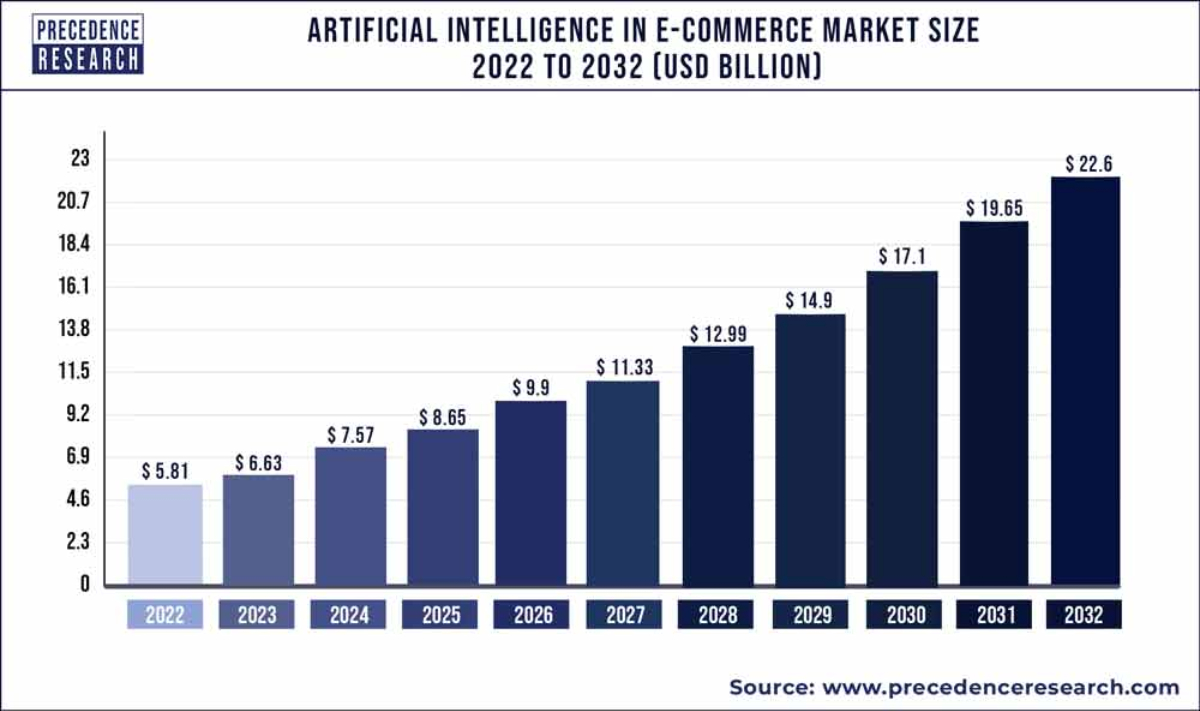
The data suggests that AI can empower modern online retailers to enhance the customer experience, both on their eCommerce platforms and beyond. By leveraging business intelligence and customer data, AI enables more informed decision-making and precise forecasting for the future.
There is more…
That’s why this article dives deep into the world of AI in eCommerce, exploring its impact, applications, and prospects.
Technological advancements, ranging from digital transformation, private AI chat, Software-as-a-Service to virtual reality and artificial intelligence, continually expand the boundaries of eCommerce capabilities.
With the rapid evolution of technology, online retailers are constantly presented with innovative options. The real challenge lies not in finding new technologies to explore, but in discerning which opportunities are most beneficial for your eCommerce business.
In the case with eCommerce AI, everyone knows it at the surface and wants to make use of it before their competitors.
Artificial intelligence is more than just a trendy tech feature; it’s a game-changer for many aspects of a business.
To get how AI can make a difference, it’s good to know its main parts:
Recently, AI has become a go-to tool to help sell more and make business operations smoother. Nowadays, even smaller online shops are starting to use AI in some form.
AI technology revolutionizes various facets of eCommerce, enhancing both the customer experience and business operations:
AI algorithms analyze customer data, like browsing history and purchase patterns. This analysis enables online stores to offer highly personalized shopping experiences and tailored marketing messages.
For instance, if a customer frequently looks at sports shoes, AI can suggest similar products or sports-related items, making their shopping experience more relevant and engaging.
By delivering targeted marketing messages and personalized experiences, eCommerce businesses can significantly increase customer loyalty.
AI helps in understanding customer preferences and behavior, enabling businesses to offer deals and products that are more likely to be of interest, thereby encouraging repeat purchases.
AI automates routine tasks such as inventory management, customer queries through chatbots, and even email marketing campaigns. This automation reduces the workload on human staff, allowing them to focus on more strategic tasks.
For example, AI systems can automatically reorder stock when levels are low, ensuring that the business never runs out of popular products.
AI can optimize the entire sales funnel, from lead generation to closing sales. By analyzing customer interactions and feedback, AI can identify the most effective sales tactics and even predict future buying trends. This allows businesses to tailor their sales strategies in real time, increasing conversion rates and overall sales.
AI applications are transforming the eCommerce landscape in several key areas:
By analyzing past purchase history and browsing behavior, AI can suggest products that customers are more likely to buy. This personalization enhances the shopping experience and increases the chances of additional sales.
AI tools can adjust product prices in real time based on various factors like demand, competitor pricing, and market trends. This helps in maintaining competitive pricing and can maximize profits by capitalizing on periods of high demand.
Custom chatbot solutions, especially virtual assistants, can handle customer inquiries instantly, providing information, resolving complaints, and even assisting in the purchasing process. This improves customer satisfaction and frees up human customer service representatives to deal with more complex issues.
AI can segment customers more accurately based on their behavior, demographics, and purchase history. This segmentation allows for more targeted and effective marketing campaigns, improving the return on investment for marketing expenditures.
AI enhances logistics by predicting the best routes for delivery, optimizing warehouse operations, and forecasting demand to ensure that products are stocked appropriately. This leads to faster delivery times, reduced costs, and improved customer satisfaction.
AI analyzes market trends, customer behavior, and external factors to predict future product demand. This helps businesses in planning their inventory, marketing strategies, and even in developing new products that are likely to be in demand.
There is one more use case of AI in eCommerce. It’s very new, and it needs more profound understanding. So, let’s get to that.
The advent of AI-generated Content (AIGC) marks a significant paradigm shift in eCommerce, heralding a new era of digital content creation and customer interaction. Being an AI development company, we’ve been experimenting with generative AI technologies to find the best solution.
AIGC, following the footsteps of Professional Generated Content (PGC) and User-Generated Content (UGC), encompasses a diverse array of applications including AI-driven painting, writing, music composition, video generation, voice search for eCommerce, and even AI programming.
This innovative approach to content creation is poised to revolutionize the eCommerce industry by offering personalized, engaging, and scalable content solutions.
Gartner, a leading research and advisory company, has identified generative AI as one of the most commercially promising AI technologies in its 2022 AI Technology Maturity Curve. The projection indicates that generative AI will reach production maturity within 2-5 years, suggesting significant development potential and application scope in various sectors, particularly in eCommerce.
The AI-enabled eCommerce market size is expected to reach a staggering $16.8 billion by 2030, growing at 15.7% CAGR over the next eight years. This growth is underpinned by the widespread adoption of AI in marketing and sales, with customer service analytics emerging as the most common application.
AIGC is creating a new landscape for digital content generation, offering immense potential for businesses to craft unique and personalized content at scale. This technology not only streamlines content creation processes but also improves the quality and relevance of the content, thereby enhancing customer engagement and experience.
In the context of eCommerce, AIGC can be leveraged in several ways:
AI can generate personalized product images and videos, showcasing items in various styles and settings, tailored to individual customer preferences.
AI-generated marketing material can resonate more effectively with targeted customer segments, improving the impact of advertising campaigns.
AIGC facilitates interactive and engaging product descriptions and narratives, making the online shopping experience more immersive.
AI-generated content can adapt to real-time customer feedback, offering dynamic and responsive communication.
AIGC reduces the dependency on traditional content production methods, such as photoshoots, leading to significant cost savings.
The ability to rapidly produce diverse content allows for more experimentation and innovation in marketing strategies.
As eCommerce businesses navigate the AI-driven landscape, the integration of AI and generative content represents both an opportunity and a challenge. The potential benefits are vast – from refined customer experiences and optimized operations to innovative resource utilization. However, this journey requires continual adaptation and innovation.
Businesses that embrace AI and generative content technologies are poised to lead the eCommerce industry into a future characterized by growth, personalization, and dynamic customer engagement. The digital marketplace of the future is not just transactional; it’s intelligent, personalized, and interactive, driven by technologies that anticipate customer needs and revolutionize the shopping experience. Enterprises should consider AI consulting services to find the best use cases to get started.
Developing an AI strategy involves understanding your eCommerce business’s unique needs and how AI can address them. It’s not just about adopting technology for its sake; it’s about integrating AI to solve real business challenges. Consider the following steps:
The effectiveness of AI in eCommerce heavily depends on identifying the right use cases. Previously, we’ve discussed the use cases of AI in eCommerce. Retailers should analyze use cases like a customer service AI chatbot, an AI product recommendation engine, and more, and find the appropriate fit.
Given the complexity of AI technologies, partnering with AI experts can significantly enhance implementation:
Once you have a clear strategy and have tested AI in smaller projects, it’s time to scale:
Adopting AI in eCommerce is not without its challenges. Addressing these effectively is key to successful implementation.
One of the greatest challenges in implementing AI is managing data privacy and security:
The cost of AI implementation can be substantial, and measuring ROI is crucial:
While AI can enhance customer service, it cannot fully replace the human touch:
It’s evident that the integration of AI is not just a technological upgrade but a strategic necessity. However, the complexity of AI development, coupled with the challenges of data management, privacy concerns, and the need for continuous optimization, makes it a daunting task for many eCommerce businesses, especially those with limited in-house technical expertise.
This is where the strategic decision to outsource AI development comes into play.
Outsourcing AI development connects eCommerce companies with specialized talent and expertise. AI development agencies and consultants bring a wealth of experience across various industries, offering insights and solutions that might not be available in-house.
Developing AI solutions internally can be resource-intensive, requiring significant investment in hiring skilled professionals, training existing staff, and procuring necessary technologies. Outsourcing can be a more cost-effective solution, allowing businesses to leverage existing infrastructures and the expertise of service providers.
By outsourcing AI development, eCommerce companies can focus on their core business areas like product development, marketing, and customer relationship management. This ensures that the primary business goals are not sidelined by the complexities of AI implementation.
Outsourced AI solutions provide scalability and flexibility. As the business grows or the market evolves, AI solutions can be quickly adjusted or scaled up to meet the changing needs without the need for significant capital investment or restructuring of the in-house team.
AI development involves risks, including technological, compliance, and operational risks. Outsourcing partners often have established risk management protocols and can handle these challenges more efficiently, reducing the burden on the eCommerce company.
When choosing an outsourcing partner, consider their expertise in eCommerce, track record, understanding of compliance and data security, and ability to provide scalable and flexible AI solutions.
In conclusion, the integration of AI is critical for staying competitive in the ever-evolving eCommerce landscape. Outsourcing AI development offers a practical, cost-effective, and strategically sound approach, enabling businesses to harness the full potential of AI without diverting focus from their core operations.
As we embrace this AI-driven future, partnerships with specialized AI developers will become a cornerstone for success in the digital commerce arena.





