


Imagine this: You’ve crafted the perfect email with a compelling subject line, engaging content, and a clear call-to-action. You hit send, but your open rates and click-through rates fall short of expectations. What went wrong? The answer might lie in your email timing.
Marketers have long debated the “best time” to send emails, but the truth is there’s no universal answer. In fact, 50% of marketers agree that there’s no single perfect time for email campaigns because every business and every individual is different.
This is why personalization is essential. While 58% of email users check their inbox first thing in the morning, every customer has their own unique rhythm. By understanding these unique behaviors, marketers can deliver messages at the moment they’re most likely to resonate.
Email send times remain highly relevant but work schedules, time zones, and personal habits all influence when someone is most likely to engage.
The key is delivering emails to each of your customers at their own “best time”. However, personalizing send times for every recipient does not scale.
Marketers face the daunting task of catering to a vast spectrum of customer behaviors and preferences; from early morning commuters checking their inbox on the go to the night owls browsing at home in the late hours. This makes it nearly impossible to manually determine the best send time for each person.
These complexities multiply when you factor in:
This is where innovations like Send Time Optimization (STO) come into play.
Send Time Optimization (STO) is an email marketing tactic that leverages AI and machine learning to determine the best times to send emails to individual subscribers. For marketers, STO is transformative as it takes the guesswork out of email timing.
By leveraging Send Time Optimization and focusing on personalized delivery times, marketers can significantly improve the effectiveness of their email campaigns, ensuring that each recipient receives messages when they’re most likely to engage.
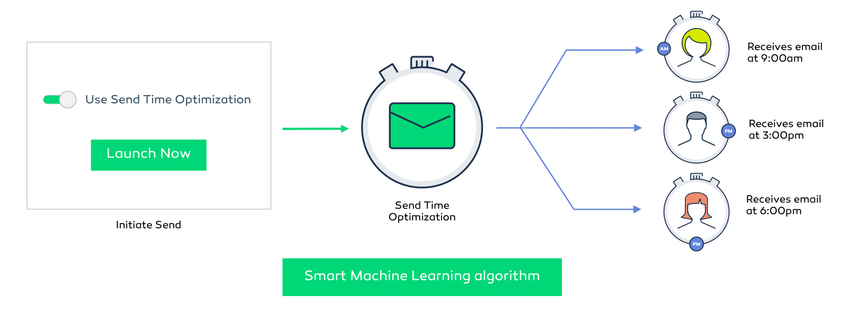
Send Time Optimization (STO) can also help marketers gain a more comprehensive and nuanced understanding of their audience, leading to more effective and personalized email marketing strategies.
STO analyzes individual recipient behavior which can offer insights into their daily routines and habits. This goes beyond basic “best time” assumptions, exposing how your audience allocates attention throughout their day.
These behavioral fingerprints show:
By determining individual preferences for email engagement, STO provides a foundation for deeper omnichannel personalization strategies e.g. refine SMS and app notification strategies to match optimal engagement windows.
By tracking engagement across different segments, STO helps identify how factors like age, location, and job title influence engagement. These insights enable hyper-targeted segmentation strategies that respect audience diversity.
For example:
STO systems continuously update their models based on ongoing engagement data. This constant refinement ensures strategies stay relevant even as customer habits evolve.
STO’s machine learning models can detect subtle shifts in behavior, alerting marketers to:
Leveraging send time optimization as a diagnostic tool rather than just a delivery tactic, gives marketers a multidimensional view of their audience. These insights create a blueprint for customer-centric engagement across every channel.
Puma Europe, a prominent sports and lifestyle brand, faced a common challenge in global retail: effectively engaging a diverse audience base.
Their solution? A strategic shift from batch-and-blast emails to intelligent email and send time personalization powered by Emarsys STO.
Puma’s success demonstrates three critical implementation principles (who, what and when):
We’ve seen some great results using the Send Time Optimization feature within Emarsys… We can speak to everybody from the people buying on their commute to work through to the late-night shoppers who are shopping in the middle of the night.
Results:
Puma saw a 5-10% improvement in their email open rates, demonstrating the effectiveness of personalized timing in driving engagement.
As Puma’s results show, when you respect customers’ time, they reward you with their attention.
Today’s email marketing success hinges on understanding that timing, like your customers, is unique. As the industry evolves, there is an ever-growing emphasis on personalization, automation, and real-time optimization.
Brands embracing hyper-personalization powered by real-time data and machine learning will forge deeper connections with their audience, turning each send into an opportunity for meaningful engagement.
Remember, your customers don’t operate on a fixed schedule—and neither should your email strategy. The question isn’t whether there’s a universal best time to send emails. It’s how well you can tailor your timing to each unique customer journey. Are you ready to transform your email strategy from guesswork to precision?
Find out more about send time optimization
Kirk Donlan is a content marketing manager at SAP Emarsys where he uses his marketing, customer success, and copywriting experience to develop engaging, industry-specific content for marketers and marketing leadership.
Connect with Kirk: LinkedIn

Kirk Donlan
Product Marketing Manager





