



In today’s fast-paced digital retail environment, ecommerce companies need every strategic advantage they can get. Accounting automation empowers brands to streamline financial operations, reduce manual errors, and gain real-time insights that drive smarter, faster decisions.
In the fiercely competitive e-commerce landscape, brands are constantly seeking an edge. The surge in online shopping has opened unprecedented opportunities but also introduced significant operational challenges. Factors like social commerce, the proliferation of marketplace platforms, and expanding cross-border transactions create a complex web that traditional accounting methods struggle to manage effectively.
The nature of seasonality in sales, combined with varying lead times for purchasing products, means cash flow and the ability to adapt quickly are critical levers for successful ecommerce brands. So how do you optimize your cash flow management? And how do you better reach and serve your customers and improve margins? Can you trust your data or even access it in real time to make a strategic business decision?
Forward-thinking brands are addressing these complexities through accounting automation. By automating manual expense, payment, and accounting workflows, these companies are gaining a competitive advantage in 2025.
Financial operations have become exponentially more complex than just managing a simple shopping cart. Modern ecommerce businesses must navigate multiple payment processors, various marketplace fee structures, international currencies, real-time inventory costs, and a maze of sales tax requirements across jurisdictions. Maintaining competitive pricing while preserving margins adds to this complexity.
Enter accounting automation — a transformative approach that’s becoming less of a luxury and more of a necessity for growing ecommerce operations. Accounting automation leverages technology to streamline financial processes, from transaction categorization and reconciliation to expense management and financial reporting. By automating these traditionally manual tasks, ecommerce companies can reduce accounting errors, save time, and gain real-time visibility into their cash position. But the real benefits are all the value this automation unlocks for the business.
In an environment where cash flow management can make or break an ecommerce business, and customers expect seamless transactions and rapid service, automating financial operations offers a critical competitive advantage. Implementing accounting automation can be the difference between thriving and merely surviving in today’s digital marketplaces.

So why should you set out to improve accounting workflows? Because automating accounting processes can unlock valuable business advantages for all types of organizations. Here are the top five benefits of automated accounting for ecommerce companies.
How many vendors do you pay? How many different channels and marketplaces are you advertising on? Instead of juggling spreadsheets and logging into multiple platforms, what if you could see all your payments, expenses, and available cash in one place? A smart business credit card integrated into a modern spend management software solution can help you track and manage those transactions, and automate the expense reconciliation for an always-up-to-date cash position.
“Without quality cash management, ecommerce businesses can miss out on bulk inventory deals, marketing can’t make that strategic ad buy, or procurement loses early payment discounts from suppliers,” says Ben Gammell, CFO at Brex. “When your corporate card gives you up to 20x higher card limits, payment terms that match your cash cycle, and real-time expense automation, that’s how you seize opportunities the moment they appear — while your competitors are still waiting for traditional credit approvals.”
Look for AI-powered solutions that automatically categorize your transactions and match receipts, so you’re not wasting time on manual reconciliation. Plus, smart automation can help you spot opportunities to optimize your working capital and catch early payment discounts. The result? You can make faster, smarter decisions about inventory purchases and growth investments and stay competitive.
“As our spending needs increased, it became difficult to stay organized and access the higher credit limits we needed to drive further expansion,” said Lindsay Bodeman, VP of Finance and Accounting at Dude Wipes. “We wanted a future-proof solution that could scale with us and help us meet our goals at every stage of growth.”
Accounting automation transforms cost and margin protection by:
“With [order] automation in place, we’re freeing up significant hours every day. And there are fewer human touchpoints and fewer loopholes that typically allow fraud to trickle in,” said Ahad Azalman, Director of Finance for online gifting platform Goody.
Additionally, features like early payment discount capture and reduced payment processing fees further enhance profitability for any business — and especially ecommerce companies.
The customer experience is pivotal in ecommerce. How quickly can you process refunds when customers ask? How long does your support team spend hunting down transaction details? Accounting automation transforms these customer touchpoints by giving your team instant access to accurate financial data.
With real-time visibility into transactions and AI-powered tools managing your billing and shipping costs, you can resolve customer issues in minutes, not days. Your support team gets immediate access to transaction histories and payment statuses, while automated processes ensure consistent pricing and billing across all your sales channels. The result? Faster refunds, fewer billing disputes, and happier customers who keep coming back to shop with you.
“Our mandate is to maximize the enterprise value of the company,” says Teddy Collins, VP of Corporate Finance for online ticketing platform SeatGeek. “That means leveraging systems and automation and being thoughtful about designing scalable processes to enable greater transparency for employees into their spend, and also reduce the overhead on accounting. We’ve developed our finance stack and processes to support a deep understanding of our customers and enterprise clients.”
Operational efficiency is critical for keeping up with fast-paced sales cycles, complex supply chains, and evolving market demands. Tight ERP integration ensures accuracy as spend data syncs in real time. Without seamless integration, companies face manual reconciliations, vendor payment tracking, and multi-entity management, leading to bottlenecks. Automating these processes accelerates month-end close and financial reporting.
“We knew that a complete NetSuite integration would help us automate much of our closing process while also ensuring accuracy,” said Lindsay Bodeman, VP of Finance and Accounting at Dude Wipes. “We’re saving 40 hours a week thanks to Brex’s robust integration with NetSuite.”
In a competitive industry with tight margins, informed, timely decisions are vital. Automated accounting provides real-time visibility into financial performance across all entities, enabling smarter, faster decisions. Without accurate, up-to-date spend data, businesses risk missing key opportunities. Imagine delaying the decision to pick up excess inventory from a competitor liquidating resources because your financials weren’t consolidated in time. Or overspending on ad campaigns in certain markets without a clear picture of their ROI. Automation enables finance teams to identify growth opportunities, optimize spend, and allocate resources more effectively. It also simplifies due diligence for M&A opportunities with comprehensive audit trails and delivers the accurate reporting investors and stakeholders demand.
“Custom [mapping] rules and a direct NetSuite integration give us real-time clarity across all our brands and markets, helping us act quickly when opportunities arise,” said Amber Papp, VP of Finance at Scentbird, a monthly fragrance subscription service. “We are completing expenses and accounting twice as fast with Brex than before.”
Accounting automation can enhance ecommerce operations by helping improve cash flow management, protecting margins through fraud prevention, enhancing customer experiences, boosting operational efficiency, and accelerating decision-making with real-time insights. Here are some examples to better illustrate how brands are leveraging accounting automation to get ahead.
When ecommerce companies centralize their spending and expense management and automate their accounting, they spend smarter and move faster, making every dollar count for their businesses.
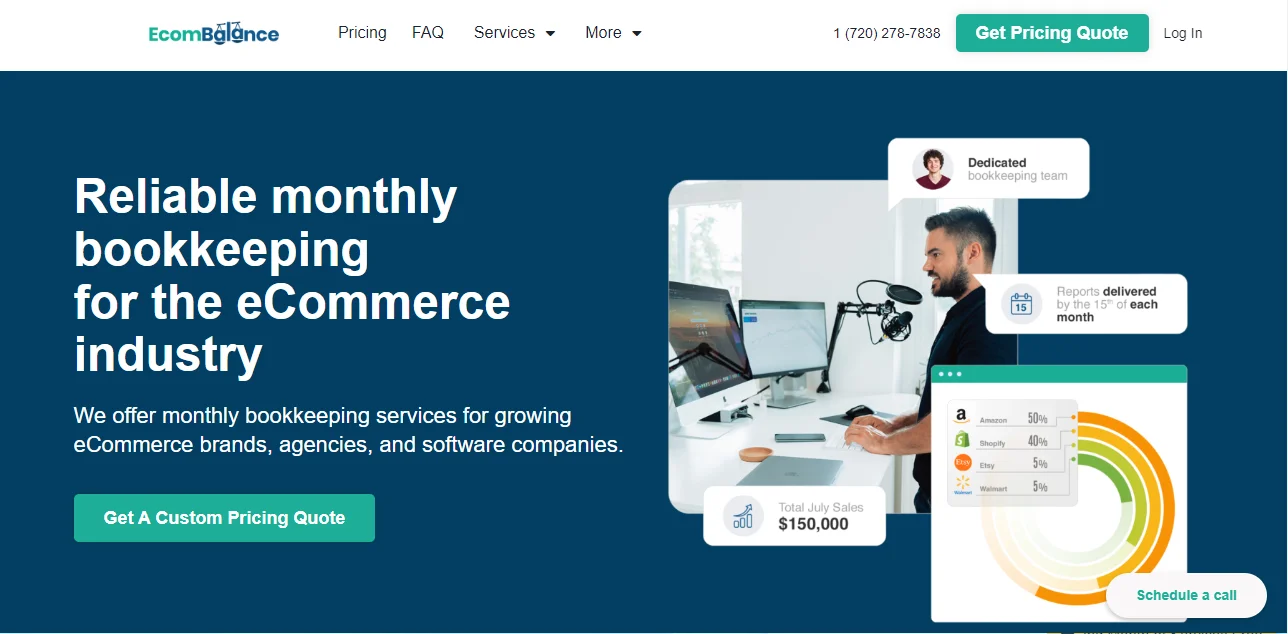
EcomBalance is a monthly bookkeeping service specialized for eCommerce companies selling on Amazon, Shopify, eBay, Etsy, WooCommerce, & other eCommerce channels.
We take monthly bookkeeping off your plate and deliver you your financial statements by the 15th or 20th of each month.
You’ll have your Profit and Loss Statement, Balance Sheet, and Cash Flow Statement ready for analysis each month so you and your business partners can make better business decisions.
Interested in learning more? Schedule a call with our CEO, Nathan Hirsch.
And here’s some free resources:





