


If you’ve ever tried to decode Google’s algorithm, you know it feels like a black box. For years, most so-called “best practices” came from guesswork, not proof, leaving even experienced ecommerce teams frustrated when rankings stalled despite their efforts.
Cracking Google’s algorithm isn’t about finding some hidden trick or riding the latest SEO trend. It’s about understanding and aligning your site with the nine factors Google’s actually measuring—proven through more than 400 scientific tests and a patented methodology. These are not hunches or recycled myths; they’re actionable ranking signals, tested in fiercely competitive markets.
If you’re chasing scalable growth and want to avoid the common traps that stall most brands, these insights will give you the framework you need to stop guessing and start driving results. The breakdown ahead will show you exactly how each factor works and why shifting your focus to these fundamentals pays off with both rankings and revenue. For those wanting a deeper dive into how these principles outperform SEO “theories,” see my breakdown on the True Google Ranking Factors Explained.
SEO is filled with half-truths and recycled advice. Everyone has heard wild claims about what truly moves the needle in Google rankings. When those tactics don’t work, the frustration is real. But Here’s the truth that most miss: SEO Services is the key to understanding Google’s algorithm is not a roulette wheel or a mysterious gatekeeper — it’s a complex, but logical, mathematical system. Success isn’t reserved for gurus; it’s driven by aligning your site with what the algorithm actually measures, not just rumors passed around in Facebook groups.
Let’s break down why the narrative of “SEO magic” is holding brands back, and lay bare the hard math—and real ranking factors—that set leaders apart.
For years, much of SEO has operated on myth and assumption because Google doesn’t spell out its ranking recipe. But behind the secrecy, the core of the algorithm is mathematical. Google uses sophisticated formulas to evaluate patterns within hundreds of billions of web pages, analyzing how closely pages match search intent and which sites users trust. It doesn’t make subjective or emotional decisions.
Consider this: in real-world experiments, SEO pros who isolated specific ranking factors—like optimized page titles, stronger internal linking, and content refreshes—consistently saw ranking improvements that could be tracked and measured. In one striking example, a website written almost entirely in placeholder Latin (except for a few keyword-optimized areas) managed to reach page one. Why? Because it hit the mathematical signals Google was looking for—not because of “great” content, but because it matched the blueprint the algorithm was built to detect.
If you’re still treating SEO like fishing in the dark, you’re missing the patterns that can be tested, engineered, and repeated for real growth.
It’s easy for advice to get warped over time, especially when Google’s updates spark panic. Below are the most common SEO myths still floating around—plus, the data-driven reality:
If you want extra detail on E-E-A-T and how Google weighs these signals, check this helpful piece on common Google E-E-A-T misconceptions.
Once you realize that Google’s rankings are the result of pattern recognition, not gut-feel, the process gets less mysterious—and a lot more actionable. Every tweak can be measured against engagement metrics, crawl frequency, and ranking shifts. Take the guesswork out of SEO by focusing on changes you can actually track and improve.
If you’re ready to anchor your efforts in what works, start with the basics set out in resources like Google’s own SEO Starter Guide, and then test what’s relevant for your specific category and customer.
By treating SEO as a math problem, not a magic show, ambitious brands give themselves a repeatable way to scale. Interested in practical strategies to ramp up your ranking factors? Check out the framework for proven ranking signals that actually move the needle in ecommerce.
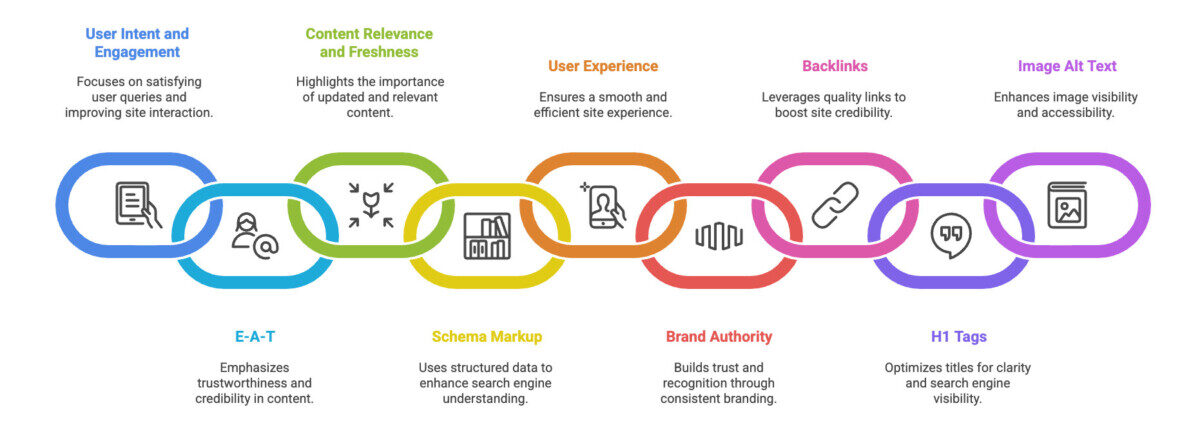
Want your Shopify store to land where it counts—at the top of Google, not buried in the traffic desert? Here’s the straight answer from hundreds of experiments: ranking is a math problem, not black magic. The nine signals below are what actually move the needle, no matter how often the algorithm updates. Here’s a breakdown you can act on right now.
Google’s top priority is matching search intent—not trickery or clever tricks. The system measures how well your content answers a user’s question by tracking engagement: do people stick around, scroll, click, or do they bounce?
Let’s illustrate this. A supplement brand came to us with plenty of traffic, but nearly zero revenue from organic search. Instead of rewriting all the content, we focused on three key elements:
Within 90 days, their engagement rate jumped 50% and rankings followed. Want a shortcut? Check your average bounce rate in GA4. If visitors leave quickly, Google takes note, and no amount of keywords will fix it. For a complete breakdown of how user engagement influences rankings, see our Google Ranking Factors Overview.
How to optimize engagement fast:
Google raises the bar for any site giving financial, health, or shopping advice. If you’re in a “your money, your life” category, trust signals aren’t optional. E-A-T means Google wants to see real expertise and credibility.
What works? For a money-saving blog that lost nearly all traffic after a Google update, we rebuilt their E-A-T from scratch:
Within four months, they hit 3,500 organic visits per month and boosted domain authority dramatically. Authenticated, transparent brands win. Faking it doesn’t cut it, especially with AI pulling direct answers from verified sources for shoppers and researchers. If you want more ways to signal expertise and trust, learn from recent content marketing strategy examples.
E-A-T checklist for busy teams:
Google values relevance, but gives extra credit for content that’s up to date. Leave a blog post to gather dust, and you risk losing both rankings and indexed visibility. We refreshed and restructured 12 science education posts for a client, and organic traffic surged 52% in just 45 days.
The secret? Not just updating facts, but connecting pages tightly with internal links—this built trust for both visitors and Google’s crawlers. Internal links pass contextual signals, showing your site is a growing authority, not a dated archive. Want tactical tips on keeping your Shopify store fresh? See the latest Shopify SEO guide.
Quick wins on relevance and freshness:
For more focused advice, don’t miss our deep-dive on website SEO ranking factors.
Schema markup turns your content from shapeless data into something Google can actually “see.” This is how you win rich results—stars, FAQs, product badges—and a shot at being pulled into AI-generated summaries. Too many brands skip this, assuming Google knows what their content is about.
First steps for Shopify and DTC teams:
If you want a hands-on guide to get started, dive into our e-commerce schema guide.
Schema checklist:
UX is no longer a bonus; it’s table stakes for ranking. Google cares about speed, mobile design, and layout stability. Measuring Core Web Vitals is the starting point—Largest Contentful Paint (LCP) should be under 2.5 seconds, and Total Blocking Time (TBT) under 200 ms. Page experience isn’t just technical, it bleeds into engagement and conversion rates.
Even simple fixes deliver big ROI:
These small wins drive organic growth and conversions. Check our playbook of top website optimization techniques for more actionable metrics.
Google wants proof you’re a real business, not a faceless affiliate. Branded search traffic—people looking up your brand name—signals trust and authority. This is only getting more important as AI search and summaries surface recognized brands first.
Boosting branded demand isn’t about buying followers. It’s about:
We’ve seen brands triple organic growth in months just by running coordinated PR and content sprints. For more, dig into future-proof link building strategies for DTC brands.
Links remain Google’s most powerful signal—when done right. Earning links from trusted, relevant sites can move you up 14 positions in as little as two weeks. But low-quality, irrelevant links can actively harm you.
It’s not just about outside signals. Strong internal linking lets you shape how Google sees your site, passes “link equity” to high-value pages, and improves crawl efficiency. If you’re not actively managing internal links, you’re leaving money on the table.
For a technical breakdown, check our guide to understanding link equity in SEO. For extra depth on Google’s overall philosophy of links, see Importance of Links in Google Rankings.
Backlink and internal link tips:
If your top headline is vague or missing, you’re giving up easy wins. Google uses your H1 to understand the main topic. Case studies show that specific, keyword-relevant H1 tags lift rankings by 3-6 spots compared to generic or poorly formatted headers.
What works for Shopify teams:
Audit your pages using these basics from our SEO-friendly e-commerce site architecture.
Fast audit checklist:
Image alt text is more than just an accessibility checkbox. Google now uses advanced image recognition and OCR, but it still relies on your alt tags to “read” what images mean. In tests, optimizing both the alt text and file names led to higher rankings and more visibility in image-focused searches.
Dual benefits of alt text:
Want tactical details on visual SEO? Check out our image optimization guide for ecommerce.
How to write great alt text:
Every one of these nine factors gives you an edge if you act on them—not just in Google, but across the AI-powered search world now shaping ecommerce.
Algorthims never sleep—and in ecommerce, being caught off guard by the next big Google update or AI search feature can cost you more than just rankings. If you want to protect hard-won growth and keep your brand ahead, you need a living SEO strategy that adapts as fast as the algorithms do. Here’s a playbook you can rely on when the rulebook is always changing.
Treat SEO like a continuous science lab, not a one-time project. Test, measure, and adjust—then repeat. Every month brings new SERP features and AI-powered summaries that shift how users find and interact with your content. Waiting until after an update to react puts you behind. Build a habit of running small experiments on link structure, schema, or page speed. Track what drives real improvements and use those wins to steer your playbook.
Relying only on keywords and backlinks isn’t enough—especially as AI starts to drive how people search and how answers are pulled directly into overviews. If Google launches a feature that grabs your page zero traffic, you need backup channels.
For more on adapting to shifts like AI summaries and search overviews, see our action plan for future-proofing during the Website Traffic Crisis 2025.
Google, Bing, and new AI search tools favor content that’s structured, transparent, and easy to parse. This means going beyond good titles and meta descriptions.
Our experience has shown that even updating alt text and file names on images can help win you featured spots in both traditional SERPs and AI-powered results. For a deeper perspective on integrating AI into your eCommerce SEO, check out Boosting eCommerce SEO with AI.
What works today might drop overnight with one core update. Smart teams don’t rely on luck—they set up real-time monitoring and alerts. Use automated tools or custom scripts to flag when rankings for strategic pages move sharply up or down.
Building awareness into your workflow puts you in pole position to adapt, not just react.
Your tools and processes only go so far without an agile team. Give your writers, developers, and marketers the resources and playbooks they need to spot ranking signals that are gaining or losing weight in real time.
If you want extra insights on what’s working now, including how AI and machine learning are reshaping ranking factors, see our guide on AI and Machine Learning in SEO.
AI-powered systems and constantly-updated algorithms emphasize trust. Make sure you’re building, not eroding, your authority online.
By focusing on this set of actions, you help your ecommerce site thrive no matter how Google’s rules shift. Brands that adopt this rolling, proactive approach are not just reacting to algorithms. They are commanding their own growth, with SEO as a true business asset.
If you need more hands-on tactics, frameworks, and real-world examples, our podcast archives and resource guides dig even deeper into what’s working right now for ambitious brand leaders and consultants.
Aligning with Google’s algorithm isn’t about chasing hacks—it’s about engineering an organic growth machine that stands up to updates and feeds on compounding returns. With hundreds of interviews, tests, and war stories behind us, one truth is clear: systems, not stunts, fuel true scale. Here’s how to assemble a growth engine that’s insulated from volatility and set up to outperform.
Start by thinking in systems, not silos. Ranking factors like user engagement, E-A-T, content quality, and link structure don’t work in isolation. They interact, and strengthening one can amplify the others. Treat each move as a gear in your machine—optimize collectively, not piecemeal.
Bulletproof growth plans often look like this:
You can see this holistic thinking in play in brands who’ve implemented the 350k Growth Engine Strategy, proving that sustainable gains are built on strong, integrated foundations—not luck.
Compounding growth is about momentum. Top stores don’t just earn a win and move on; they set up processes so each improvement creates new opportunities. Think of it like this: every positive signal from engagement, speed, or trust earns you a stronger baseline for future efforts.
Make compounding simple by:
Like any well-oiled machine, small improvements—when repeated and reinforced—drive results most brands miss because they never set this compounding cycle in motion.
The brands that win don’t live in fear of updates. They know Google will change the specifics, but the fundamentals stay the same: satisfy the user better than anyone else, and prove you’re for real. Future shocks—such as shifts to AI overviews or new SERP features—are speed bumps, not brick walls, if your growth machine is built right.
Here’s what resilience looks like:
This approach boosts confidence, improves long-term ROI, and means you can plan investments with more certainty.
The goal isn’t to chase a few keywords or seasonal spikes—it’s to build a machine that prints new opportunities as you grow. Scale comes from repeatable processes and strategic assets, not “overnight wins.”
What does this look like in practice?
Remember, the real growth machines create momentum that stacks—each turn of the flywheel making the next one easier and more profitable.
Lastly, break down the walls between SEO and the rest of your growth engine. Brands hitting consistent 7- or 8-figure runs know organic, paid, retention, and brand all cross-pollinate.
When you do this, organic becomes both a lever and a shield—fueling growth when other channels falter, and reinforcing every other part of your ecommerce engine.
Build for scale, not the next best trick. Trust the flywheel, back it with systems, and stack improvements until updates are just another day at the office.
Cracking Google’s algorithm isn’t magic—it’s measurable, and it’s within reach for any team committed to real action. The brands that win understand this simple truth: Google rewards clear signals and consistent execution, not lucky guesses or hacks that fade after the next update. If you focus on the proven nine factors, ignore the noise, and treat SEO as a process you can control, your Shopify store will see compounding results in rankings and revenue.
Resist distractions from endless SEO “secrets” that rarely hold up. The edge comes from rigorous, ongoing improvement, not chasing every rumor. Roll these principles into your operating playbook and you’ll build a growth engine strong enough to weather algorithm shifts—and ready to claim new ground each year.
For those who want to go deeper, subscribe to Ecommerce Fastlane’s Newsletter (Fastlane Insider) and tune into the podcast for the latest tactical breakdowns, guest interviews, and frameworks tested in the field. As you engineer your own path forward, ask yourself: Are you acting on scalable, proven tactics—or just hoping for magic? If the answer is the former, you’re building the foundation that lasts.
One last ask. Share your biggest algorithm challenge below or how you’re prioritizing your next SEO experiment. Your insights help shape the next set of AI search visibility tips and keep this community miles ahead.
Google considers nine key ranking factors, such as user engagement, content quality, trust signals, schema markup, site speed, brand authority, backlinks, clear headlines, and image alt text. Focusing on these signals helps stores improve search rankings and drive sales.
Google tracks how people interact with your site, including how long they stay and if they continue exploring. Higher engagement signals that your content matches user needs, which can boost your rankings.
E-E-A-T stands for Experience, Expertise, Authority, and Trust. Google favors sites that show real expertise and clear information about who creates the content, making your store more trustworthy to shoppers and search engines.
Yes, refreshing and improving older pages can lead to fast ranking gains since Google rewards fresh, relevant content. Regular updates show Google your site is active and provides value to visitors.
One common myth is that backlinks no longer matter, but in reality, quality links from trusted sites are still a powerful ranking signal. Earning the right links helps Google recognize your site’s authority and relevance.
Add structured data to key pages like products, articles, and FAQs using schema markup. This helps Google understand your content and can win your brand rich search results, boosting click-through rates in the process.
Start by fixing page titles, adding clear H1 tags, improving internal links, compressing images for speed, and providing strong author bios on key pages. These steps can quickly enhance both site trust and search visibility.
Stronger brand authority attracts branded search traffic and more organic clicks, signaling to Google that your business is real and trusted. This trust can protect your rankings across updates and help your store stand out in AI-generated search summaries.
Image alt text improves accessibility for all visitors and helps Google “see” and index your images for search. Well-written alt tags also increase your visibility in visual search results, driving more organic traffic to your store.
Building SEO success is about creating ongoing feedback loops—regularly updating, testing, and improving your site based on data. Relying on a proven system, not trends or myths, will help your store adapt and grow as algorithms change.





