

This guide explains how TikTok Shop in 2026 creates a real DTC growth lane for Shopify brands that feel squeezed by rising customer acquisition costs on Meta and Google.
TikTok Shop hit $15.82B in US sales in 2025, up 108% year over year, after 407% growth in 2024, and it already represents 18.2% of US social commerce.
That kind of curve changes behavior. When a channel grows this fast, buyers build new habits, creators follow the money, and brands that wait end up paying more later. TikTok isn’t “another social platform.” It’s a discovery engine with checkout built in, so attention and transactions live in the same place.
EcommerceFastlane has a front-row seat here. Across 450+ founder and operator interviews in the Shopify ecosystem, one pattern shows up again and again: brands win when they pair a strong offer with a channel that can create demand, not just harvest it.
Mini-summary takeaway: TikTok Shop works because the For You Page finds buyers who never searched for you, then removes friction with in-app checkout, creating a loop where content, sales, and creators fuel each other.
TikTok Shop is not Amazon, not Instagram Shopping, and not your Shopify storefront. It behaves differently because discovery happens before intent, and checkout happens before doubt.
On Amazon, shoppers arrive with a mission. They type keywords, compare reviews, and you pay for placement. On Instagram, reach often depends on followers or paid ads, so you fight the same auction everyone else is fighting. On a Shopify site, you own the experience, but you still have to buy or earn the traffic first.
TikTok flips the order. People show up to be entertained, then the algorithm matches them with products that fit their behavior. Add product tags and native checkout, and you get “watch, trust, buy” in a single session.
Here’s the compounding loop EcommerceFastlane keeps seeing across brands of all sizes:
This is why TikTok Shop can feel like a “second store” that actually brings its own foot traffic, not just a catalog page inside an app.
If you’re just starting, the upside is speed: you can validate an offer without months of ad optimization. If you’re scaling, the upside is efficiency: creators can produce more winning angles than an in-house team can film in a week. If you’re established, the upside is diversification: a channel that doesn’t depend on third-party cookies or crowded search auctions.
To ground your expectations, start at the source: TikTok’s merchant tooling lives in the TikTok Seller Center, and creative trends are easiest to track inside the TikTok Creative Center.
TikTok is discovery-first. That’s not a slogan, it’s the core mechanic. The For You Page is built around an “interest graph,” meaning it predicts what a person will watch next based on behavior, not who they follow.
Compare that to:
On TikTok, products find people. That’s why “discovery commerce” is a useful mental model: your job is to create a video that makes a stranger feel like they just found a solution. The algorithm handles distribution.
Two practical implications that matter for DTC operators:
First, your first videos can sell even if your account is brand-new. You don’t have to “build an audience” before you earn revenue, as long as the content is clear and the offer is simple.
Second, creative testing beats perfect branding. A polished brand kit won’t save a weak hook. A scrappy but clear demo can outperform a studio shoot because it feels like a friend showing you something that worked.
If you’ve been trained by Meta to think in audiences and funnels, TikTok asks a different question: “Can you tell the story of the product in 15 seconds so someone stops scrolling?”
TikTok’s real advantage is that it turns product demos into entertainment. People aren’t “shopping,” they’re watching, laughing, learning, and then buying because it feels easy.
The psychology is simple:
The data supports the behavior. TikTok Shop reached $15.82B in US sales in 2025, and TikTok users converted at 8% to 12% in some estimates, compared to 2% to 4% for traditional ecommerce. That’s a massive gap, and it’s why brands feel the “it’s working faster than it should” effect.
Even older spend estimates point the same way: one dataset pegged average annual spend at about $708 per buyer in 2024, or roughly $59 per purchase. You don’t need a $200 AOV product to win here. You need an offer that people can understand instantly.
A quick checklist for impulse-friendly products on TikTok Shop:
If your product needs a 10-minute explanation, consider using TikTok for awareness, then close the sale elsewhere. TikTok Shop rewards clarity.
TikTok Shop is large enough in 2026 to be taken seriously by any DTC brand, but it’s not evenly “easy.” Some categories fit TikTok perfectly, and some don’t.
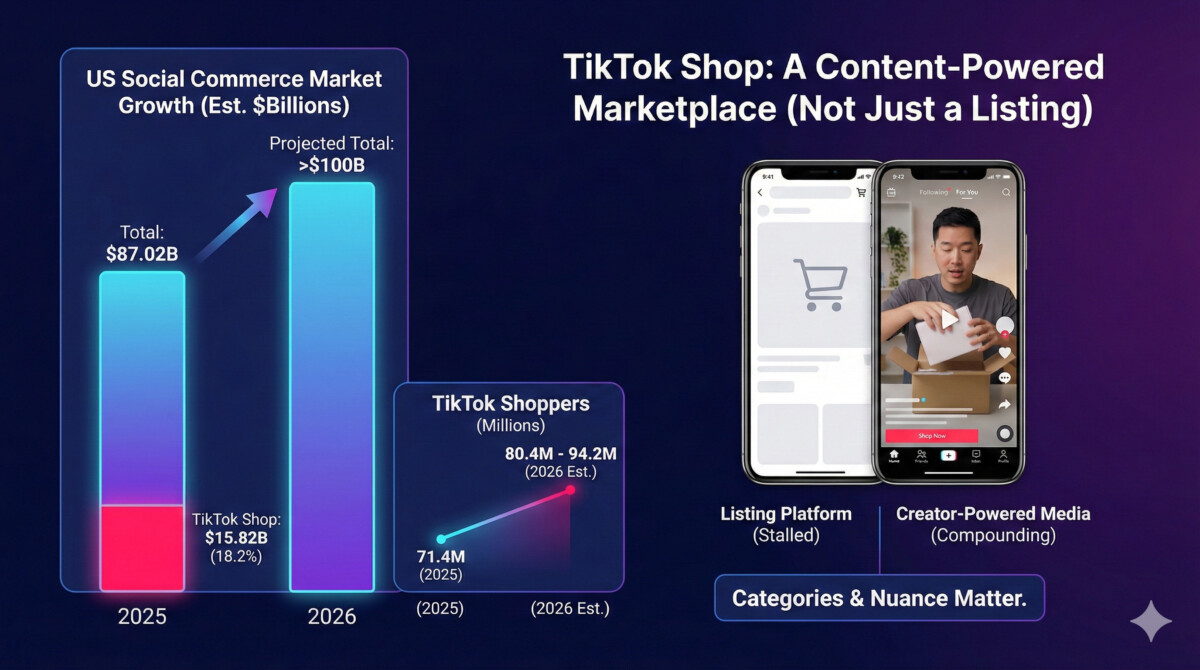
Start with the market math: TikTok Shop generated $15.82B in US sales in 2025, and the broader US social commerce market was about $87.02B in 2025, projected to pass $100B in 2026. TikTok already owns 18.2% of the category, which is a stunning share for a product that only launched in the US in September 2023.
But here’s the nuance: TikTok Shop is not a “set it and forget it” marketplace. It’s a content business attached to ecommerce. Brands that treat it like a listing platform stall out. Brands that treat it like a creator-powered media channel tend to compound.
In 2025, estimates suggest about 71.4M Americans shopped on TikTok Shop, up 24.5% from 2024. Projections for 2026 vary by source and measurement method, ranging from roughly 80.4M to 94.2M shoppers. (You’ll see “buyers” and “shoppers” reported differently depending on methodology.)
The cleanest way to frame the opportunity is the growth curve, not a single-year number.
That’s why founders are paying attention. Even if your brand never becomes “TikTok famous,” the buyer behavior is scaling fast.
Simple chart suggestion for your post: a two-line chart with (1) TikTok Shop US sales by year (2024, 2025, 2026 projected) and (2) TikTok Shop share of US social commerce (2025 actual, 2027 projected). This makes the story obvious at a glance.
If you want quick signal, follow the categories that are easiest to show on camera.
Health and beauty dominates. One report puts health and beauty at 79.3% of TikTok Shop sales, with other meaningful volume in apparel and accessories, food, and household care. Category leaderboards also consistently show:
The common winner pattern is simple: low friction, quick payoff, creator-friendly, and easy to demonstrate in a bedroom, bathroom, kitchen, or car.
A quick warning that saves money: not every brand fits TikTok Shop, and that’s fine. If your item is high-consideration, regulated, fragile, or return-heavy, you may still use TikTok for top-of-funnel content, but keep checkout on Shopify. The goal is to test fit fast, not force fit.
A profitable TikTok Shop plan in 2026 comes down to three things: pick the right SKUs, ship a lot of content, and protect contribution margin like it’s oxygen.
Here’s the most useful insight I keep hearing from operators who are winning: TikTok Shop isn’t a “traffic channel,” it’s a merchandising channel where creative is the targeting. If you treat creative like an ad asset you refresh once a month, you’ll lose. If you treat creative like product R&D you run weekly, you’ll build a system.
TikTok Shop scaled to $15.82B in US sales in 2025 because it merges discovery and checkout in one loop, content drives reach, reach drives sales, and sales attract creators who produce more content.
Start narrow. TikTok’s algorithm (and your operations team) does better with focus.
Pick 5 to 10 hero SKUs with these traits: clear demo, consistent inventory, low defect rates, and clean margins. Your job in month one is to teach the algorithm what you sell and collect signal on which products earn repeatable sales.
Listing basics matter more than most founders want to admit:
Then build bundles. Bundles help you raise effective order value without forcing a higher-priced hero product. They also give creators more angles (starter kit, travel pack, “before bed” set). If you already have Shopify bundles that work, you can mirror the logic inside TikTok Shop.
If you’re new, keep the first offer simple: one hero SKU and one bundle, both easy to understand. Complexity kills momentum.
Creators are the fastest way to scale output without hiring a full studio team. TikTok Shop’s affiliate model makes it measurable: creators earn a commission when they drive a sale.
Public guidance on “typical” commission ranges is wide, but many physical products land in the 5% to 15% band, with higher rates sometimes used for aggressive growth or high-margin categories. The smart play is to start conservative, then pay up only where profit supports it.
A practical approach that works whether you’re doing $10K months or $10M months:
A short creator outreach script idea:
“Hey [Name], I loved your video on [topic]. We sell [product] that solves [problem]. Want a sample and a custom offer for your audience? If it sells, we’ll increase your commission after your first 20 orders.”
Track what matters. Views aren’t sales. Focus on:
If you want a starting point for finding partners, TikTok’s Creator Marketplace is the most direct place to browse and contact creators.
This is where most brands get hurt. TikTok Shop can grow fast, and fast growth hides bad math until it’s too late.
Based on publicly shared fee examples, plan for:
Some fee items, like withdrawal fees and shipping incentives, aren’t consistently published in one universal schedule and can change by region or promotion. Confirm your exact rates inside Seller Center before you scale spend.
Use a simple margin equation your team can agree on:
Retail price
minus COGS
minus TikTok fees (referral + transaction)
minus creator commission
minus fulfillment and shipping
equals contribution margin
If contribution margin is thin, fix the offer before you add more creators. Raise price, adjust bundles, improve COGS, or tighten commission. Don’t “hope” volume saves you. It rarely does.
If you need Shopify-side integration support, Shopify’s help docs are a solid starting point for channel setup and catalog basics: Shopify TikTok channel documentation.
TikTok Shop is no longer “early.” It is a real commerce channel that is already changing how people discover and buy products. In the US, TikTok Shop reached $15.82B in sales in 2025, growing 108% year over year, after 407% growth in 2024. It now holds about 18.2% of US social commerce. That kind of growth matters because it creates new buying habits. Buyers get used to shopping inside the app, creators follow the sales, and brands that wait often end up paying more later in higher commissions, higher content costs, or tougher competition.
The core reason TikTok Shop works is simple: it is discovery plus checkout in one place. People do not open TikTok to search like Amazon or browse a feed like Instagram. They open TikTok to watch. The For You Page then matches them with content based on what they engage with. If your video clearly shows the problem and the fix, TikTok can send you buyers even if they have never heard of your brand. Add product tags and in-app checkout, and you get “watch, trust, buy” without extra steps.
If you are an ecommerce founder or marketer, the main practical lesson is this: treat TikTok Shop like a content-driven storefront, not a listing channel. Brands that win build a flywheel:
Here is a simple way to apply it in the real world:
If you want a clean next step, follow a 30-day sprint:
To keep your execution grounded, use TikTok’s own tools like Seller Center for shop operations and Creative Center for trends and examples. And if you want to go deeper, you can review EcommerceFastlane’s related guides on TikTok Shop strategies, setup, and influencer marketing to build a repeatable system.
Optional next reads:
Curated and synthesized by Steve Hutt | Updated January 2026
📋 Found these stats useful? Share this article or cite these stats in your work – we’d really appreciate it!





