

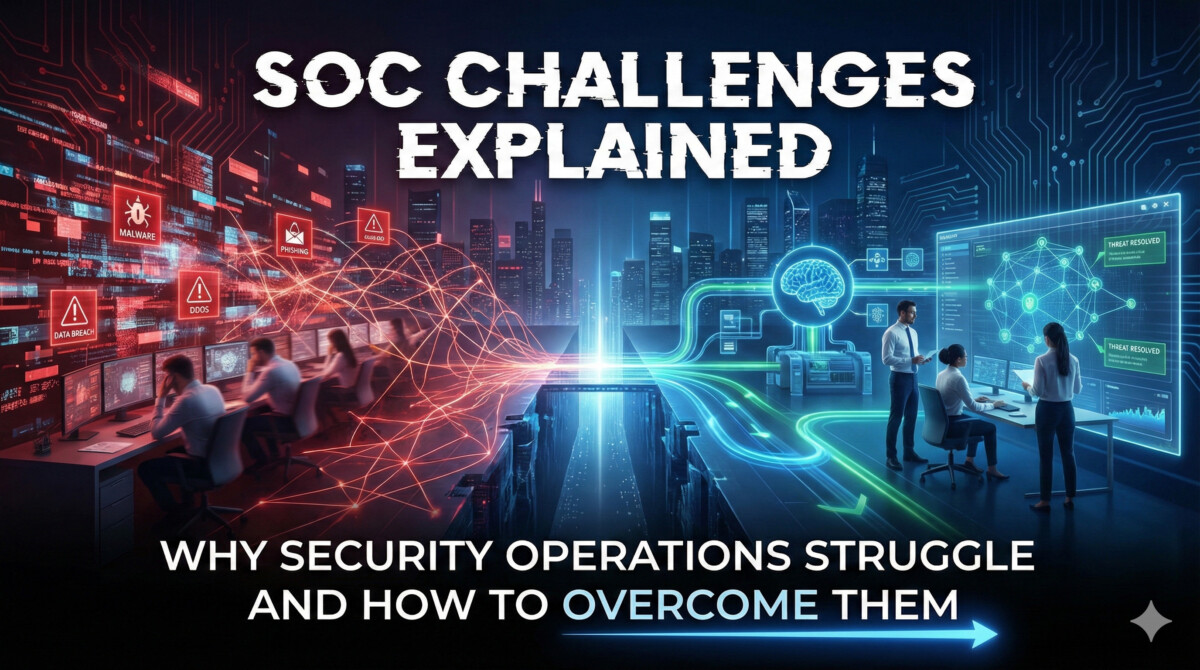
In the fight against cybercrime, Security Operations Centres (SOCs) are at the forefront.
They are responsible for finding threats, investigating suspicious activity, and responding to incidents before damage escalates. Still, many businesses face the same operational problems year after year, even though they spend more on tools, automation, and staff.
Alert backlogs grow. Analysts burn out. Incidents slip through unnoticed. Leadership questions the return on investment. These outcomes are not caused by a lack of effort or intent. They result from structural, operational SOC challenges that are often underestimated.
Understanding why SOCs struggle requires looking beyond technology. This blog discusses the most common problems SOCs face today, why they persist, and what practical steps can help overcome them.
One of the most visible SOC challenges is the sheer volume of alerts.
Modern security stacks get alerts from applications, identity systems, networks, cloud platforms , and endpoints. Even though visibility has improved, the signal quality often hasn’t.
Some common issues are:
SOC challenges caused by alert fatigue make analysts less effective and more likely to miss threats.
SOC visibility is often fragmented.
As companies adopt cloud, SaaS, and remote work models, security telemetry is distributed over multiple platforms. SOC teams frequently lack a unified view of activity.
Visibility-related SOC challenges include:
Detection becomes reactive instead of proactive when there isn’t full visibility.
Many SOCs accumulate tools over time without a clear integration strategy.
This means:
One of the most common problems in SOC is tool sprawl, which makes things more complicated without necessarily improving outcomes.
People remain the most critical component of a SOC.
However, many organisations struggle to recruit, train, and retain experienced analysts. The skills gap contributes directly to SOC challenges like slow investigation and irregular response.
Common workforce issues include:
Even strong processes start failing when people are stretched too thin.
Response is what stops attacks, not just detection.
During incident response, a lot of problems emerge with SOC, such as confusion and delays.
Typical response issues include:
Without well-defined workflows, response speed and consistency suffer.
Threat intelligence is often underutilised.
Many SOCs get threat feeds, but integrating intelligence into everyday work is still challenging.
Intelligence-related SOC problems include:
SOCs that work well focus on actionable intelligence instead of raw data.
People often ask SOC leaders to demonstrate value, but it’s hard to come up with useful metrics.
Some common measurement-related SOC problems are:
Without the right metrics, it is difficult to justify investment or guide improvement.
People often think that automation can help with SOC challenges, but the results vary.
Poorly implemented automation can:
Automation works best when paired with strong processes and human oversight.
SOC teams often operate disconnected from business context.
This means:
To address long-term SOC problems, it’s important to ensure security operations align with business risk.
Many businesses spend a lot of money on tools and services, but the results don’t change.
This happens because:
SOC problems recur when fundamental issues are not fully addressed.
Organisations that successfully reduce SOC challenges take a disciplined approach.
They usually do this:
These steps change SOCs from reactive monitoring centres to proactive defence teams.
It is time to rethink your SOC strategy when:
These signals indicate systemic issues with the SOC that need to be addressed.
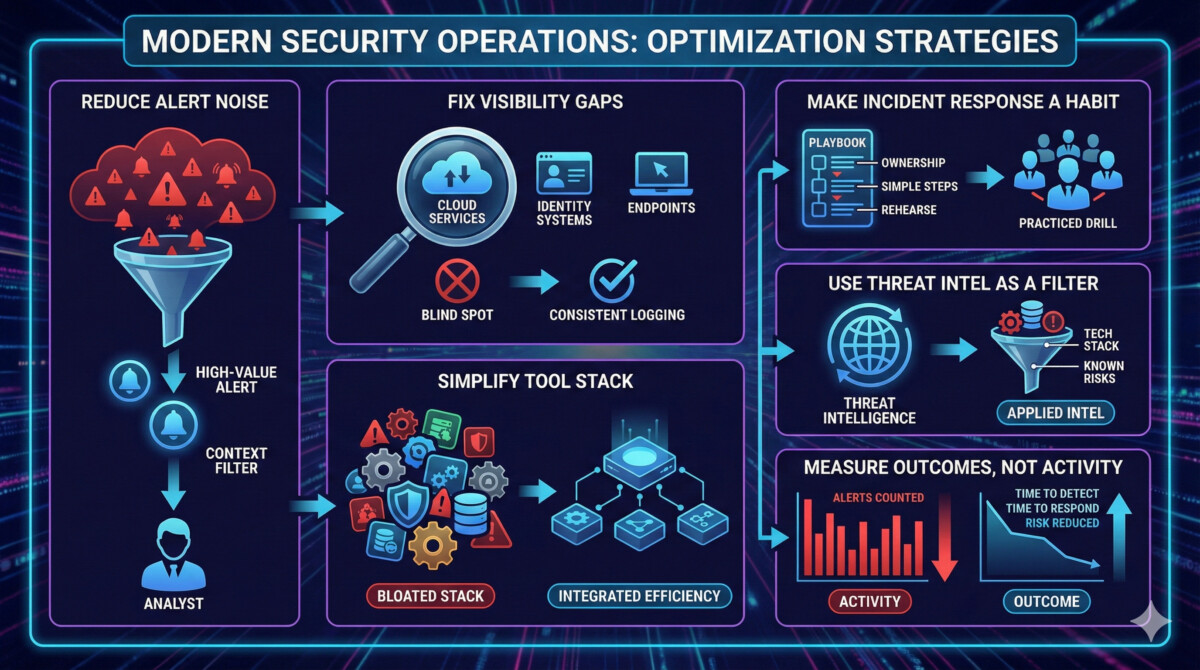
Running a Security Operations Center (SOC) is not failing because teams do not care or tools are missing. It fails because the work becomes unmanageable. The article breaks this down clearly: alert overload creates signal fatigue, visibility gets fragmented across cloud, SaaS, and remote devices, and tool sprawl forces analysts to jump between dashboards while real threats keep moving. Add a skills shortage and unclear incident response ownership, and you get the pattern most leaders recognize: growing backlogs, burnout, missed incidents, and tough questions about ROI.
For ecommerce founders and marketers, this matters because security issues quickly become business issues. A single incident can shut down storefronts, break customer trust, and pull teams off growth work for weeks. The fastest path to a stronger SOC is not “buy another tool.” It is tightening fundamentals:
If you operate in ecommerce, also remember that compliance pressure often increases the workload. Common audit and assurance pain points, like access control gaps, incomplete asset inventories, and vendor risk management, can create extra noise and urgency if they are not handled early. Treat those as SOC inputs, not last-minute paperwork.
A SOC gets stronger when you reduce noise, improve visibility, simplify tools, and run clear response playbooks that real people can follow under stress. If you implement only one change this week, start by cutting alert volume and adding better context, because that single move lowers burnout and improves detection at the same time. Next, pick one gap to close (cloud logs, identity visibility, or response ownership), set a 30-day target, and track improvement with simple outcome metrics. If you want to go further, audit your access controls, asset inventory, and key vendor risks, then align your SOC workflows to those realities so security supports growth instead of interrupting it.
Before trying to fix ongoing SOC problems, organisations should begin with an honest assessment of alert quality, visibility gaps and response workflows. In a lot of cases, simplifying instead of adding more tools is what leads to improvements.
CyberNX is a cybersecurity firm that provides AI-powered SOC services that are designed for modern security threats. They have a centralized, shared model that helps with 24/7 threat hunting. They make detection more accurate, response workflows more efficient, and align security operations with real-world threat behaviour.





